After a bit of a sleepless night, I awake to find my former university in the news and not in a good way. There are various comments on the nature of the working environment there.
Here is last night’s dreaming segment.
I am in a room with others, we are being threatened by a group of people with dogs on leashes. The dogs are straining to attack. They are like pit bulls. The owners are having trouble holding them back. I am quite relaxed. One of the pit bulls has inordinately long fangs and is angrily taking an interest in me. I offer it my right arm. It bites down hard and strong and will not let go. I am not worried about this. The owner of the dog tries to get it to let go. It will not. I place my left hand around the side of its jaws and squeeze. The dog opens its jaws and backs off happy.
I look down and it has left a mark reminiscent of a double vajra in oranges and red. There is no blood simply what looks like a tattoo on the inside of my forearm. I show everyone in the room my new tattoo.
Later I am working at the checkout in a supermarket and I show each of the customers my new tattoo about which I am slightly excited.
Dream ends
–
–
Excerpted from Rigpa Wiki
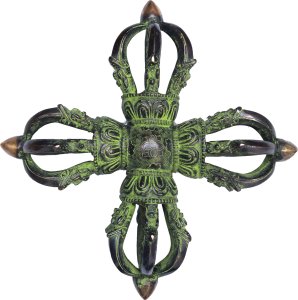
The double vajra (Skt. vishva-vajra; Tib. རྡོ་རྗེ་རྒྱ་གྲམ་, dorje gyadram, Wyl. rdo rje rgya gram) or crossed vajra is formed from four lotus-mounted vajra-heads that emanate from a central hub towards the four cardinal directions and symbolizes the principle of absolute stability.
In the cosmographic description of Mount Meru, a vast crossed vajra supports and underlies the entire physical universe. Similarly in the representation of the mandala, a vast crossed vajra serves as the immoveable support or foundation of the mandala palace and here the central hub of the vajra is considered to be dark blue in colour with the four heads coloured to represent the four directions-white (East), yellow (South), red (West) and green (North). These also correspond to the five elements and the buddhas of the five families with blue Akshobhya in the centre.
It’s also an emblem of the green buddha of the north, Amoghasiddhi, and represents his all-accomplishing wisdom as lord of the karma family of activity.
The raised throne upon which masters are seated when teaching is traditionally decorated on the front by a hanging square of brocade displaying the image of a crossed vajra in the centre, often with four small swastikas in the corners. This emblem represents the unshakeable ground or reality of the Buddha’s enlightenment.

 Dreamyoga