
———
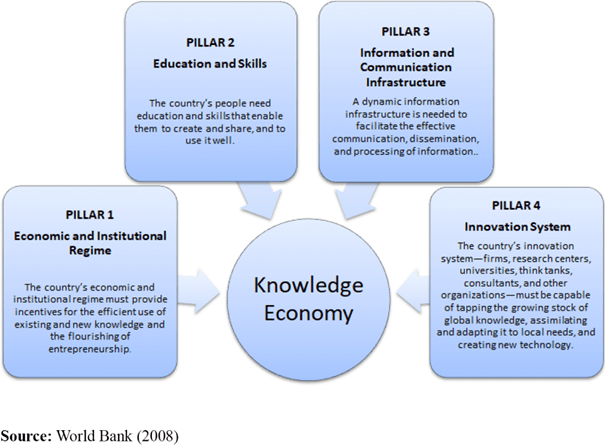
“ The knowledge economy, or knowledge-based economy, is an economic system in which the production of goods and services is primarily driven by knowledge-intensive activities that contribute to the advancement of technical and scientific innovation. The key element of value in this paradigm lies in the increased reliance on human capital and intellectual property as primary sources of innovative ideas, information, and practices. Organizations are called upon to leverage this “knowledge” in their production processes to stimulate and consolidate their business development. This approach is characterized by reduced dependence on physical inputs and natural resources. A knowledge-based economy is founded on the crucial role of intangible assets within organisations as an enabler of modern economic growth.”
Excerpted from Wikipedia
————-
—–
There are various schools of thought which suggest that in modern times knowledge is a key factor in economic success. That knowledge must be commercially exploitable and can include skills and artisanal know-how. As recent world events suggest, access to natural resources remains of high geo-political importance. Venezuelan oil being an obvious marker.
In my view this schematic is a tad idealistic, it does not mention socio-political barriers and vested interests. One might say that recent changes in US policy have moved away from the notion of a knowledge economy back towards gun boat aircraft carrier diplomacy.
Just like AI has been shown to hallucinate it is a moot point as to whether the so-called AI investment boom is also a group or herd like hallucination among humans. FOMO investments can have bubble-bursts.
The knowledge which has pecuniary value relates only to profit. There is little attention paid to altruistic knowledge. To live only for profit and gain is unbalanced. In the eyes of some there may be more to life and living than that. Not everyone agrees.
One could argue that I am an example of how the so-called knowledge economy failed to make use of a resource. It failed. I failed. Either way I am now retired and doing gardening and DIY.
“You lose what you do not use.”
Is an axiom which has perhaps wide applicability. Knowledge which is not applied and practised can no longer be recalled. The edge of its blade becomes blunted by rust. Slowly like an untended path in the woods it becomes overgrown, deserted and before long nobody remembers that it is there or ever was there. As an older person I have seen how scientific knowledge from many decades ago has to be reinvented because people cannot find it so easily in online search engines. Because search engines are now biased to the fee paying advertiser, much knowledge is now lost in far flung unvisited corners of the internet, there to gather spiders and webs.
It is reasonable to assume that whatever knowledge I may have will die with me. That may not be a great loss but it is an example, of how people may talk a good game. But when push comes to shove knowledge is rarely as important as self-promotion. There is nobody queuing up to learn from me. And by now I am too hermit-like to converse.
There is a danger that human evolution, despite all the advances in technology, is taking a backward step towards a new dark age. An age where image and sound-byte becomes a new Goebbels-reality. An age where short snappy mind numbing mantra replace thought and consideration. An age in which metrics and graphs bury substance and worth in cold clammy tombs. Bullet point thinking is not knowledge and not wisdom.
I think popularity and fame have removed knowledge and wisdom from the mantelpiece above our hearths. Shiny, flashy and chav dominate; viral despite COVID remains a term indicative of success.
It may seem strange but I think that the pool of available knowledge is actually shrinking, it is becoming more standardised and subject to peer approval. Loss of diversity is generally bad for ecosystem; it is an indicator of environmental decline.
I think that genuine knowledge is becoming much less important than claimed or asserted knowledge. The tendency is away from the unfathomable and profound towards the safety of the shallows and the common. I suspect that reputation has become more important than knowledge.
Once diversity has been lost it is very hard to replace. Same is not often best. Clone-think tends to be counter-evolutionary.
Once knowledge has been lost it is not easily restored. Value for money seems to be the main arbiter of which knowledge survives and is nurtured. There is a very short term outlook.
Sometimes we are so stubborn, adamant and omniscient that we can only learn through loss.
—–
—
“Only when the last tree has been cut down, the last fish been caught, and the last stream poisoned, will we realize we cannot eat money.”
Native American Proverb
—

 Dreamyoga