
Following on from the link to Horse Guards Parade and my uncle Ken in my dream of yesterday…
Mostly excerpted from { https://www.royalsignalsmuseum.co.uk/cap-badge-history/}.
–
–
Mercury as a cap badge
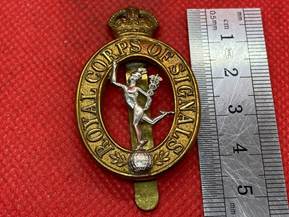
It was not until the ‘Corps of Signals’ was formed that the question of a cap badge came into being. Following the decision of King George V to grant the ‘Royal’ title the first cap badge of Mercury was approved on 24 March 1921. This was of the initial pattern with the oval band surrounding it.
The Royal Signals cap badge is heraldically described as:
“The figure of Mercury holding a Caduceus in the left hand, the right hand aloft poised with the left foot on a globe all silver above the globe a scroll inscribed ‘Certa Cito’ and below on each side six laurel leaves all gold, the whole ensigned with the Crown in gold.
–
–
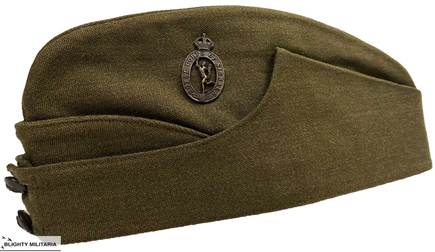
Above is a WWII officer field cap, the like of which my uncle might have worn in the desert with Monty…
Origins of The Royal Signals Cap Badge
To members of the Corps the Royal Signals Cap Badge is affectionately known as ‘Jimmy’ – but what are the origins of the badge and its name? A boxing hero, a band-stick or something else? We examine the evidence behind the theories.
Nobody is 100 per cent sure, but to believe the most widely accepted theories it is necessary to trace the history of communications units in the Army back to the formation in 1870 of ‘C’ Telegraph Troop, Royal Engineers. The Troop served with distinction in the Ashanti and Zulu Wars and by 1884, because of the growth in communications requirements, it was decided to form 1st and 2nd Divisions of the 1st Telegraph Battalion, Royal Engineers.
Major CFC Beresford was the initial Commander of the 2nd Division and he was determined that it should have its own emblem (or ‘device’ as he called it). Having asked the Battalion for suggestions he decided none were better than his own – the figure of Mercury.
—
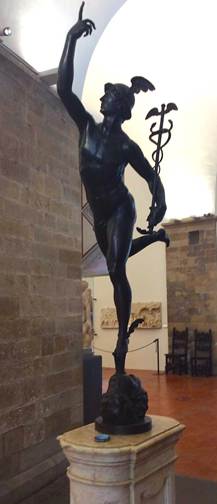
It is thought the inspiration for Mercury came to Major Beresford from the statue of Mercury that his father had probably purchased at the Great Exhibition at Hyde Park in 1851, a copy from an original sculpture in the Pitti Palace, Florence designed by Giambologna. This statue was subsequently positioned in his garden in Camberley.
Mercury is the Roman God of messages/communication (including divination) as well as the God of financial gain, commerce, eloquence (including poetry), travellers, luck, trickery and thieves (yes really!). Additionally Mercury is also the keeper of boundaries between the upper and lower worlds – something not lost in today’s world of virtual reality!
Mercury was duly adopted, first appearing in the Battalion magazine Military Telegraph Bulletin, on 15 September 1884, and on its headed notepaper.
–
–
This is the original “Jimmy” on display in the Bargello Museum in Florence. It was made between 1578 and 1580 by Giambologna (Jean do Boulogne) and it is possible that “ Jimmy” was derived from his name.
–
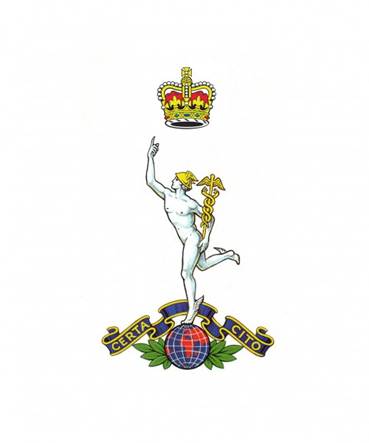
The 1946 Royal Signals Cap Badge With Tudor Crown
The Corps changed its style of badge in 1946 to that currently used. ‘Certa Cito’, meaning ‘Swift and Sure’, was included for the first time. Pictured below: Cap Badge 1946 – 1953.
–
–

 Dreamyoga