Things That Come Back to Bite You on the Bum

The devil is often in the detail.

There are several permanent records held on the internet: Patents, Companies House, and things like Scholar GPS. There are many more.

This is my GPS graph referenced today.

It is weird to see that from time to time someone might still cite one of my cobweb papers. I don’t know if an h-index of ~15 is any good or not.

Truth is we all leave paper trails, data trails which might come back to bite us on the bum. These days the world is very interconnected, what once might have lain hidden in a paper archive can be cross-linked and cross-referenced electronically. AI might be good at that. Data may be traded between organisations.

Scholar GPS says that I have 43 papers but there are more than that. Back a layer behind a Google search I am linked, in perpetuity, in the literature, to various individuals if only for a fleeting moment. My erstwhile affiliation is evidenced by the claimed institutional address.

Our answers on official documents are no longer in musty filing cabinets, they are electronic. Even paper here in France is converted into machine readable PDF. There are some things upon which I am very mindful for the need for accuracy, particularly in detail. These are tax and medical related. I would never make even a semi-manufactured insurance claim.

You never know when something might turn out to be important. A forgery in the heat of the moment could resurface, a lie in an official document could result in prosecution. False claims made to secure funding can be seen as fraud.

It was just a detail… ask party-Boris how details can impinge.

Family law in France differs significantly from UK, here the children can be liable for the care home fees of their parents, seems only fair if they get a slice of the property on death.

It is usually the things which we do not face or try to avoid which keep on coming back. Pretending that we don’t need to do anything is rarely a wise strategy. The universe has a habit of re-presenting the things which we sought to avoid or escape from.

Things that come back to bite us on the bum can be very, very persistent.

Survived Another Winter – Spring Cleaning

It is the middle of February and the long range weather forecast suggests that the month may end with a warmer Southerly wind. This means that we have probably survived another winter. How many more we have left, is moot.

I have organised my dreams in this blog and am happy that there is not much more to be done with them. The web stats suggest that this is my least read blog ever. I have made no effort to promote it or optimise SEO because dreams are not about force and anyone floating by like a cloud, is welcome.

There are around 200,000 words here with ~ 250 posts and a total of 600 registered views {non France}.

It is possible that people read content without the stats monitoring it. There is no way to quantify this. Based on evidence very few are interested. I am not surprised; people have way more important things.

The plan for the site renews in May and I have a mind to do some spring cleaning, to wipe the slate perhaps. The reads for my Substack are also very low. Maybe a fresh start?

I am perhaps due a big operation sometime in 2025, perhaps not.

I have been getting some big dreams of late which bear no commonality with my day to day life. The wife even had one thematically linked too.

If we were to sell the house to down size to a nanna-flat or bungalow, spring summer looks to be the time to start. We have had all the diagnostics done.

I am far from the normal mundane currents of life, a little eddy in a backwater. It is very unlikely that this will change. Although the universe has curve balls, I am not even at the batting home plate, should it seek to pitch. Any incoming is probably going to be health related.

In a sense these dreams are an insubstantial pageant which bears little tangibility to the life quotidian. They prove nothing though hint at more. Maybe they are tendrils from a far off land, a far off place, a time that never was, ghost echoes in the web of life, an unmanifest potential not even nearing a threshold. Perhaps a faintly traced charcoal sketch of karmic comedy and tragedy writ filagree on rice paper.

Impermanence is not attained by many, they take so very much for granted.

Maybe that time is again at hand.

—————————————————————————-

PROSPERO, to Ferdinand 

You do look, my son, in a moved sort,
As if you were dismayed. Be cheerful, sir.


Our revels now are ended. These our actors,
As I foretold you, were all spirits and
Are melted into air, into thin air;
And like the baseless fabric of this vision,
The cloud-capped towers, the gorgeous palaces,
The solemn temples, the great globe itself,
Yea, all which it inherit, shall dissolve,
And, like this insubstantial pageant faded,
Leave not a rack behind. We are such stuff
As dreams are made on, and our little life
Is rounded with a sleep. 

Sir, I am vexed.


Bear with my weakness. My old brain is troubled.
Be not disturbed with my infirmity.
If you be pleased, retire into my cell
And there repose. 

A turn or two I’ll walk
To still my beating mind.

The Tempest – Act 4, scene 1 William Shakespeare

The Problem of Both And

This “problem” can be found on all sides. It stems from the desire to have both one thing and another. It has a root in idealism but also in an unwillingness to choose or decide.

At the moment relatively wealthy humanity is accustomed to having multiple up to date electronic devices, frequent new cars, foreign holidays involving air travel and conspicuous consumption which is sometimes diarised for show in social media. Yet in the back of the mind there is the spectre of anthropogenic climate change. There is a weak desire to slow this down. People want both their current way of life and to limit the ravages of global warming. Most approaches to planetary heating back “solutions” which do not significantly impinge on current lifestyle.

This is an obvious fallacy.

But it is one that is not addressed because in affect it is taboo and politically very unpopular. In wanting both and decisive action is delayed and put off. The advocates of striving to limit climate change themselves travel by air. People cross their fingers and hope we can limit climate change without changing our behaviours. The fairy godmother of technology will wave its magical AI wand and ta-da we have a solution for global warming. In the meantime, business green washes to keep the greenbacks rolling.

There is an awful lot of kidding and people are willing to be kidded because their conscience is assuaged by flashy on tone public relations. Look the oil manufacturers and producers are transitioning to green alternatives…😉

“Phew, I can have my holiday in the Maldives after all…”

Elsewhere I have predicted that the impact of climate change needs to get catastrophic before humanity wakes up. By which time it will be very late, perhaps too late.

We saw it coming, we did fuck all.

“Complacency is a state of mind that exists only in retrospect; it has to be shattered before ascertained.”

Vladimir Nabokov

Humanity has a monkey with its hand in the cookie jar mentality. Inside the cookie jar are lovely cookies. We put our hand in it to extract the cookie but we cannot pull it out with the whole cookie in hand. The villagers are coming with sticks. We are so tempted by the cookies; we do not want a beating by the villagers. What to do?

This is a catch 22 which stems from greed and desire. In the absence of desire, there is no dilemma. Drop the cookie and get the hell out of Dodge. But it is a lovely cookie with banana and chocolate chips….

I cannot have both the cookie and avoid a beating.

No desire, no greed, no problem. Let go. Do a runner.

Most catch 22s stem from wanting something, some desire or some ambition. They are based on preferred outcome. In the absence of these the dilemma dissolves; it is a figment of mind and emotion.

Humans have a face in a jar problem. Inside the jar is their face, their social self-image, which they are clinging on to. They may want to resolve a relationship or ameliorate it but they are burdened by their face which they hold clenched in their fist. They are unable to shake hands whilst their fist is clenched tight around the mask of face. So, for most of their lives they walk around with their face clenched bare knuckled in fist and never know the freedom of an open palm free of social encumbrance. They may want to save both their face and a relationship. However, this is impossible, humans are stubborn and before long, it is too late.

You can see this human folly all around you.

Life is not a quantum superstition state. Sooner or later the both-and must be measured and collapse into either-or. The coherence of the both-and is finite. Decision is not something people are fond of.

Sometimes nature, the universe, or a planet will make the decision for us…

Wanting both-and is greedy.

LIFE is way bigger than petty human want and desire…

The Price of Face

22 is the dark jewel egotism and it can create many catch 22 situations. People do not as a rule, in the common socio-political construct, like to lose face. This notion of “face” can be very expensive indeed.

One can cut off one’s nose to spite one’s face.

Face is the dreaming symbol for social self-image which belongs to the class of mayas and illusions. Despite what your social media tries to push, you are not the image imagined and advertised thereupon. That is just some stuff you made up.

People like to “win” arguments or battles in order to save “face”.

I have been in numerous situations where people have expected me to act in accordance with what they imagine face saving behaviour might be. They were fighting a “battle” on the assumption that the normal rules of society and “face” applied.

“He will come round, he will break. He will say sorry because of the guilt trip I laid upon him.”

When this does not happen a kind of catch 22 situation results. The protagonist does not want to lose face but starts to understand that holding breath and crossing fingers is not the answer. What to do? If one gives in, one loses faces. So, one cuts off one’s nose to spite one’s face and leaves a totally unnecessary bloody mess. Because the “he” here did not succumb to the manipulation a loss, perhaps profound has resulted. It was about something not real – face.

Face can be very expensive indeed.

Tens of thousands have people have died because people do not want to lose face.

Deterrence as it is often used / bandied about relies on this notion of face. 

“They killed a few thousand in October. How dare they!!”

“We will destroy their country, kill fifty thousand, maim a hundred thousand more so as to save face because we were caught napping! Are we not heroes? That’ll show them!”

People can try to justify so many things with this emotive notion of face. It is cyclical and silly.

He offended me, I must offend him back or get him cancelled as punishment. My face got upset that he called me fat even though my BMI is 40. I must make him pay for offending my face. I’ll send the message on my way going to the pharmacy for my Ozempic.

Face it seems requires punishment as deterrence for questions or contradictory versions of reality. Face does not like to be challenged because it is the outer expression of egotism, self-importance and victim martyr tendency…

——————————

Has face and the attempt at preserving thereof ever worked out very expensive for you?

Was it worth it in the final analysis?

——————————–

Catch 22

A catch-22 is a paradoxical situation from which an individual cannot escape because of contradictory rules or limitations. The term was coined by Joseph Heller, who used it in his 1961 novel Catch-22.

Catch-22s often result from rules, regulations, or procedures that an individual is subject to, but has no control over, because to fight the rule is to accept it. Another example is a situation in which someone is in need of something that can only be had by not being in need of it (e.g. the only way to qualify for a loan is to prove to the bank that you do not need a loan). One connotation of the term is that the creators of the “catch-22” situation have created arbitrary rules in order to justify and conceal their own abuse of power.

Wikipedia

———————————————————————

catch-22

an impossible situation where you are prevented from doing one thing until you have done another thing that you cannot do until you have done the first thing:

a situation in which there are only two possibilities, and you cannot do either because each depends on having done the other first

a difficult situation in which the solution to a problem is impossible because it is also the cause of the problem:

Cambridge Dictionary

——————————————————————

catch-22

noun

1. a situation in which a person is frustrated by a paradoxical rule or set of circumstances that preclude any attempt to escape from them

2. a situation in which any move that a person can make will lead to trouble

Collins English Dictionary.

A Month on the Opium

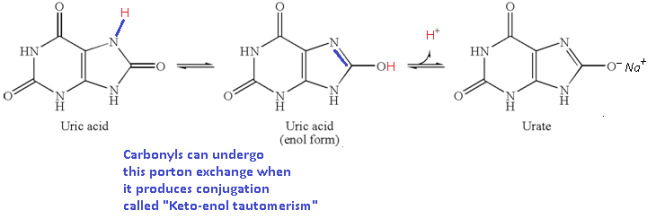
I am in the middle of an attack of gout. It seems to me that this is in some way governed by the simplified reversible reaction:

C5H3O3N4(aq) + Na+(aq) ⇌ C5H3O3N4Na(s)

In which sodium urate crystals are deposited in the tissues of my foot. There will be a multitude of other equilibria and pH dependent equations. It is obvious to me that increasing [C5H3O3N4] and [Na+] will drive the reaction to the right, simplistically. Higher concentration means more pain.

Gout is not fun!!

Yet the concentration of sodium ions is not mentioned in the swathe of articles I have read this morning. Am I missing something? Why is this not factored in? Am I being picky?

Medical research always seems a tad vague to my sensibilities. Yet the conclusions are acted upon.

There is a lot of anecdotal stuff about gout, cut and pasted, all over the internet. Victorian stereotypes persist. People read things and don’t question provenance. Maybe I should get a tin foil hat just in case. Where can I buy a reputable bottle of snake oil? Which has the best Trustpilot rating? If 87% of 75 people said it works, it must be true, after all we are worth it.

My urate ion concentrations are less than 10% above the norms yet my C reactive protein is moderately elevated consistent with significant inflammation. It could be gout but I also wonder if something more exotic is being missed.

The GP has prescribed for me a poison, which has no antidote, to combat the symptoms. The margin between effective dosage and toxicity is small. In the tablets are an anti-convulsive and opium powder to offset the possible side effects of the toxin.

If I stick to the prescription, I will be on low dose opium for a month. I am also prescribed allopurinol with the aim of reducing my serum urate levels to the bottom end of the “normal” amounts.

Tomorrow, I see a podiatrist to discuss an orthopaedic sole to compensate for the fact that my left, titanium pinned leg, is shorter than my right. I will also discuss bilateral hip replacement in March. I have a COPD linked follow up with a lung doctor and a colorectal cancer endoscopy pencilled in for late spring. I have a working hypothesis that all these medical issues are a reminder to never incarnate again.

I have what are called co-morbidities and this reduces the available medical play book.

I am not entirely happy with the notion of a very mild opium fog.

Hmnn…

Gout and Sodium Ions

Much of the literature on gout focusses on reducing the concentration of uric acid and hence urate ions in the blood. Gout arrives, apparently, when sodium urate crytals preciptate out at joints, often in the foot. The solubility of sodium urate is lowest at pH of 7.7. The literature ascribes {anecdotally} gout to uric acid crystals, which is a bit loose.

In the past they have treated gout with lithium {ions} becuase the solubility of lithium urate is higher than sodium and (?) potassium. Having severe depression treated with lithium may reduce gout. (?)

It seems to me that an obvious thing is being missed. An enhanced concentration of sodium ions is likely to precipitate more sodium urate crystals. This is a simple thing to adjust by diet, no medication needed.

What are the roles of electrolytes in gout?

My experiment begins…no salty crips today and for a while…

True Intuition and the Soul or Dreamer

There are various types of intuition, one of these is intellectual pattern forming in which the mind maps things and comes up with some arrangement. An example of this is when I prepare a shopping list, I put items in rough order for where they are in the store. The last item is usually butter or fresh bread because these are closest to the checkouts. When I used to play the card game “pairs”. Instead of row and column, I would remember where, pictorially.  Listening to questions on “university challenge” I occasionally intuit an answer with little or no laboured thinking. Of course this is far from 100% accurate.

There is another kind of intuition, which is less rational, we might call it a direct knowing. This maybe when a friend or family is about to ‘phone and we go towards the ‘phone as it rings. It is kind of spooky for some but completely normal for others.

True intuition is when the dreamer or Soul speaks directly to the incarnate being through the veil of personality and ambition.

Pictorially here is a schematic of levels of awareness as per Théun Mares.

In the schematic the dreamer corresponds to the Soul and true inner-tuition arises when the dreamer tries to advise and direct the dreamed. I can say that I have had numerous occasions when I have been busy doing something and all of a sudden, I get an imperative out of nowhere, to cease and desist. Alternatively, if I lack courage, I can get a sudden swelling of bravado and encouragement to go ahead.

Until rapport has been established with the dreamer or soul, until one is technically speaking soul-infused, intuition is largely mental or emotional and hence a property of the dreamed or incarnate personality.

Lifetime after lifetime the dreamer dreams in a dreamed, a vehicle in which it learns and evolves. The dreamer is often frustrated by the wayward dreamed, but that is the challenge of the dreamer to fully manifest its awareness on the physical and meaty plane.

By setting one’s intent to intelligently cooperate with the dreamer one “lifts” awareness onto what is called in some circles the intuitional or buddhic “plane”. I prefer state to plane. Thus, the goal is to expand awareness towards a buddhic or true intuitional level, state or scope. True intuition is never separative rather holistic and inclusive. I use holistic in a much more elevated and expansive sense than it is commonly bandied about, here.

According to the blue books opus, human evolution is headed in the direction of lifting awareness out of the meaty carnal, emotional and mental polarisation towards a true intuitional beingness. That looks nothing like modern soap-opera living, whether Trumpian or otherwise.

The theory goes that humanity is in general not in touch with nor en rapport with its Soul or dreamer. One of the ways contact can be established with the Soul is by dreaming. BUT, in order to do this one has to let go and NOT try to direct the dreams. Otherwise dreaming becomes a mental/emotional/carnal practice. Which does not liberate.

An imperative true intuition is very difficult to ignore, and the consequences of such ignoring can be wide reaching and impactful. The dreamer is persistent and will kneel the dreamed if so required.

True intuition can be very imperative. It can also be light and gentle. The dreamer is the “real” you, so it makes no sense in negating your “self”.

It is said that the greatest act of a warrior is to shift from control to abandon. In that one hands the steering wheel of the mundane vehicle over to the dreamer, the Soul. Life then is Soul influenced, Soul infused and tends to be way less petty and full of gripes and groans and moans.

One learns to dream true…

More Tibetan Phrase Dream Follow Up

“I start out on my route and part the way along in or near Mongolia I am given two white plaques of an irregular shape. Phonetically these plates speak in the dream. They say, “Mon yet {yat} Dzong” and “Sprul yet Tsaay” I can see the associated Tibetan script but cannot associate it directly with the phonetics.”

—————————————————————————-

The name “Khyentse,” often equated with the Rimé movement, is the union of two Tibetan words, khyen (མཁྱེན་པ་,“ken,” or sometimes “chen”) and tsé (བརྩེ་བ་, “tsay”), meaning “wisdom” and “compassion.”

From web site of Dzongsar Jamyang Khyentse Rinpoche

————————————————————————————–

“Sprul yet Tsaay”

ཡེ – primordial – ye or je

བརྩེ་བ – compassion – tsay

—————

ཡེ

waldo1) first, primordial, beginning, original, eternal[ly] fundamental; 2) always, constant
valbyfrom the beginning, from eternity, utterly, perfectly, highly, quite, from the very beginning, principle of light & being, basic
barrontimeless; atemporal

བརྩེ་བ

rangjungbenevolent, affection, compassion, love, merciful, care for. love; to love (v); loving kindness; to love/ feel affection; to love, love, kindness, to count up, mercy, affection, playing with; {brtse ba, brtse ba, brtse ba} intr. v.; ft. of {rtse ba}
waldo1) will play [f rtse ba]; 2) (Tha mi dad pa,, 1 be unbearable; 2) affection, compassionate, pity, [p brtses],, love, have concern/ compassion, merci[ful], kind[ness], benevolent affection, compassion, love, care for, count up, play w
valbyresponsive, kindness, tenderness, benevolent, affection, compassion, love, merciful, mercy, fervent love

སྤྲུལ་

Sprul

Hopkins 2015send forth an emanation; emanate; emanation
Rangjung Yeshecreated, ཡིད་ mentally. emanated, “incarnated”, apparitional, magical, emanating, emanation, nirmanakaya, miraculous, transformed [into], manifested. vi. to change / transform [miraculously]; imp. of སྤྲུལ་བ་
Hackett Defi­nitions 2015(PH) snake
James Valbyjuggle, make phantoms appear, transform creation, emanating, recasting oneself, snake, 1 of ‘jigs pa rnam par brgyad, abbr for sprul sku
Ives Waldo1) mentally created/ emanated [as]; 2) incarnated; 3) apparitional, magical, miraculous, transformed [~into] emanated[ing][tion]; 4) nirmanakaya; 5) manifest, change/ transform [miraculously]

སྤྲུལ་ ཡེ བརྩེ་བ

Sprul ye tsay

Emanation of primordial compassion

————————————————

Avalokiteshvara or  Avalokiteśvara

In Buddhism, Avalokiteśvara (meaning “the lord who looks down”, also known as Lokeśvara (“Lord of the World”) and Chenrezig (in Tibetan), is a tenth-level bodhisattva associated with great compassion (mahakaruṇā). He is often associated with Amitabha Buddha.

Wikipedia

Avalokiteshvara (Skt. Avalokiteśvara; Tib. སྤྱན་རས་གཟིགས་ or སྤྱན་རས་གཟིགས་དབང་ཕྱུག, Chenrezik or chenrezig wangchuk, Wyl. spyan ras gzigs or spyan ras gzigs dbang phyug) is said to be the essence of the speech of all the buddhas and the incarnation of their compassion.

As one of the Eight Great Close Sons, he is usually depicted as white in colour and holding a lotus.

He is of special importance to Tibetans, so much so that he is sometimes described as the patron deity of Tibet. Among his emanations are King Songtsen Gampo—who is credited with authoring the Mani Kabum, a cycle of teachings and practices dedicated to the deity—as well as the lineages of Dalai Lamas and Karmapas.

Rigpa Wiki

Tibetan Phrase Dream Follow up

“I start out on my route and part the way along in or near Mongolia I am given two white plaques of an irregular shape. Phonetically these plates speak in the dream. They say, “Mon yet {yat} Dzong” and “Sprul yet Tsaay” I can see the associated Tibetan script but cannot associate it directly with the phonetics.”

ཡེ (ye, “primordial”)

Ye{t} could have been je or jay

DEFINING THE TERM MON

According  to  Neeru  Nanda  in  her  article,  “Monpas  in  their  borderland-A  historical  review”  she  stated  that  the  Monpas have a local saying that; “We are neither of Gyasar(Tibet) nor of Gyagar(India),we are the Mon”. The Monpa tribe of Arunachal Pradesh represents the dominant ethnic group of the region. The term Monpa meaning someone from Mon, is used either for people living in the region of Mon or for someone who is of Mon, irrespective of region. The term Monpa or Mon are hence used as a blanket terms by Tibetan to designate certain neighbouring region or people situated to the south. In many Tibetan writings, Mon, Monyul, Lho Mon or Shar Mon refers to a region, specifying a location mostly to the south of Central Tibet. According to early Tibetan sources, Monyul is situated in South Tibet, it was also known as Lho Mon, the southern belt of Tibet before the emergence of Kingdom in Bhutan and Sikkim Lho Mon was reffered to the people who lived in south Tibet. According to the historical sources of Bhutan, Sikkim and Tibet Lho-Mon is referred to as the inhabitant of south Tibet  which  includes  Bhutanese  and  Monpa.  Lho means south in Tibetan and Mon means people inhabiting in the region. Old Mon is largely connected to an area, which includes the whole of Sikkim state, Bhutan and the Mon region i.e. the Tawang and West kameng district in the westernmost tribe of Arunachal Pradesh.

Old Mon even included the southernmost counties of Lhoka and Shigatse Prefectures, such as Mon Tsho sna and Mon Gro mo in the TAR, which are adjoining border areas to Sikkim, Bhutan and Tawang district . Besides the description of the Monpa people of the Mon region as a “Scheduled tribes” in the state of Arunachal Pradesh, the term Mon is also widely used in other parts of the Himalayan region. Presently from the eastern Himalaya to the western Himalayas, Mon or Monpa is used as an unspecific meaning of an ethnic group. In the case of the eastern Himalayas, it is used in Bhutan, Sikkim and adjoining district of the west Bengal state. The trend of differentiating these regions as being not referred to Mon prior to the eighteenth century is strong in contemporary writings from the region.

Presently in Bhutan, Mon refers to an ethnic group living in the south-central districts and to a cluster of villages in Monmola  Trashithangyed,  Chiwog  of  Serthi  Gewog  region  in  the  Samdrup  Jongkhar  district.  In Sikkim and  n  the  adjoining district, Mon is referred to the region as well as to the Lepcha tribe and other ethnic group in the region.In the western Himalayas, the region of Ladakh and Kargil of Jammu and Kashmir as well as Lahaul, spiti and Kinnaur areas of Himachal  Pradesh,  Mon  and  sometimes  Mon pa  represent  group  of  sedentary  musicians  who  are  situated  low  in  the  social hierarchy. This lower social status of Mon is further recorded in Baltistan of Pakistan. The usage of term mon is also found in Central Himalayas region, where the upland hill people called or named their southern valley neighbours Mon.

The historical understanding of the different key term Mon, in its ancient and orginal term Man, is applied by the Chinese to several ‘barbarian’  groups  related  to  the  ch’iang  including  the  people  of  rGyal  rong.  The term is found in Tibetan text of the eighth and ninth centuries in the forms of Mon and Mong, and thereafter it is applied to all kinds of groups throughout the Himalaya with whom the Tibetan come in contact. The term lost any specificity it might once have had and came to mean little more than ‘southern or western mountain-dwelling non-Indian non-Tibetan barbarian’. The present range of term must have had its first impetus in a movement from the east to the south-east, and the affinities noted above incline one to look for the main point of secondary diffusion in the centre and east of ‘proto-bhutan’; not only the language but also some of social institution peculiar to the area may have served to link it in Tibetan eyes to the true Mon of rGyal rong.  The old towers  and  fortresses  in  the  Sino-Tibetan  marches,  the  mong-dzong  of  the  Nam  text,  are  parralled by many such building which have disappeared or lie in ruins in central and eastern Bhutan and in Kameng .

Sangey Phurpa, Rajiv Gandhi University

Journal of Visual and Performing Arts June 2024 5(6), 1889–1893

————————

“Sprul yet Tsaay”

At a push yet {yat} tsay could be yantse

—— Sprul {emanation} from (g)yantse

About Gyantse Dzong

Gyantse Dzong is a historic fortress perched majestically on a hill overlooking the charming town of Gyantse in Tibet. Gyantse Dzong, also known as Gyantse Fortress, is a symbol of Tibet’s rich cultural heritage and a testament to its strategic importance in the region’s history. You can trek to the top of Gyantse Dzong and overlook Pelkor Chode Monastery.

Dating back to the 14th century, Gyantse Dzong served as a military stronghold, administrative center, and royal palace, playing a crucial role in the defense of the town and surrounding areas. The fortress’s imposing walls, watchtowers, and strategic location offer a glimpse into Tibet’s past as a land of ancient kingdoms, epic battles, and enduring traditions.

Gyantse is often called the “Hero City” by local people, because of the determined resistance of the Tibetans against far superior forces during the British invasion of Tibet in 1903 and 1904. It was a slow and bloody massacre of hundreds of Tibetan people, who were only equipped with antiquated matchlock guns, swords spears, and slingshots at that time. What they faced were Maxim machine guns and 10-pound cannons.

As you wander through the corridors and chambers of Gyantse Dzong, you will encounter relics of the past, including ancient murals, prayer halls, and artifacts that speak to the fortress’s role as a center of governance and spirituality. The peaceful ambiance of the fortress, coupled with its commanding presence against the backdrop of the Himalayas, creates a sense of awe and reverence for the history and heritage it embodies.

Whether you are a history enthusiast, a cultural explorer, or simply a traveler seeking to immerse yourself in the beauty and legacy of Tibet, a visit to Gyantse Dzong promises a memorable experience filled with insights into the region’s past and the enduring spirit of its people. Join us on a journey to Gyantse Dzong and discover the stories, legends, and architectural marvels that make this fortress a cherished landmark in the heart of Tibet.

—————————–

Gyantse, officially Gyangzê Town (also spelled Gyangtse; Tibetan: རྒྱལ་རྩེ, Wylie: rgyal rtse, ZYPY: Gyangzê; simplified Chinese: 江孜镇; traditional Chinese: 江孜鎮; pinyin: Jiāngzī Zhèn), is a town located in Gyantse County, Shigatse Prefecture, Tibet Autonomous Region, China. It was historically considered the third largest and most prominent town in Tibet (after Lhasa and Shigatse), but there are now at least ten larger Tibetan cities.

Wikipedia

—————-

“Sprul yet Tsaay”

Ye-tsaay

Wisdom of the emanation?

Or emanation of wisdom?

—————–

ɕ is a sshh sound

ཡེ་ཤེས

Tibetan Etymology

From ཡེ (ye, “primordial”) +‎ ཤེས (shes, “to know, understand, realise, cognise”).

Pronunciation

    Old Tibetan: /*je.ɕes/

    Lhasa: /ji˩˨.ɕi˥˨/

Noun

ཡེ་ཤེས • (ye shes)

  • wisdom, awareness, knowledge
  •   (Buddhism) jnana

Proper noun

ཡེ་ཤེས • (ye shes)

    a unisex given name, Yeshe

From Wiktionary