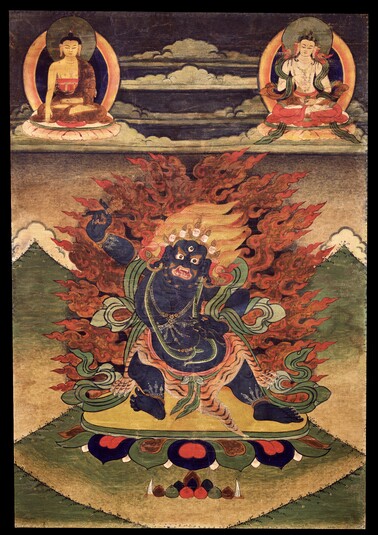
The Tantra of the Blue-Clad Blessed Vajrapāṇi

Bhagavannīlāmbara­dhara­vajra­pāṇi­tantra

Toh 498

Degé Kangyur, vol. 87 (rgyud ’bum, da), folios 158.a–167.a

ᴛʀᴀɴsʟᴀᴛᴇᴅ ɪɴᴛᴏ ᴛɪʙᴇᴛᴀɴ ʙʏ

  • Celu
  • Phakpa Sherab

Translated by the Dharmachakra Translation Group
under the patronage and supervision of 84000: Translating the Words of the Buddha

——————————————————-

——————————————————

“The text begins with the bodhisattva Vajrapāṇi requesting the Buddha Akṣobhya to teach a tantra that can tame all evil spirits that live beneath the ground. The notion that an underworld exists in which various forms of evil spirits flourish was well developed in Indian Buddhism since the very early days. Both of the two other Caryātantra tantras on Blue-Clad Vajrapāṇi (Toh 499 in seven chapters and Toh 501 in five chapters) share the same theme, unfolding as Vajrapāṇi requests the Buddha to teach the rituals that can tame the nāgas and yakṣas below the ground and, in the process, accomplish the wealth that they guard and repel the disease that they inflict on humans. These two other tantras thus appear to be slightly condensed (or perhaps earlier) versions of The Tantra of the Blue-Clad Blessed Vajrapāṇi.

The Buddha Akṣobhya agrees to Vajrapāṇi’s request, and then prepares to teach the tantra known as The Vajra That Subjugates the Evil Forces Below the Vajra Earth, which throughout this text is synonymous with the main title of the tantra. Before he begins, however, he first blesses Vajrapāṇi with the ability to tame the various serpent beings living in the environment below, headed by the nāga king Anantaka (another name for Śesa, the serpent associated with Viṣṇu). Once tamed in this way, the serpent beings join in the request being put to the Buddha that he teach the tantra. With the stage thus set, the Buddha Akṣobhya proceeds to teach.”


Excerpted from. https://84000.co/translation/toh498#UT22084-087-003-introduction

The Nidānakathā – it is not the fault…

The Nidānakathā

or

The Three Epochs

—-


Inasmuch as this comment on the Jātaka, if it be expounded after setting forth the three Epochs, the distant, the middle, and proximate, will be clearly understood by those who hear it by being understood from the beginning, therefore I will expound it after setting forth the three Epochs. Accordingly from the very outset it will be well to determine the limits of these Epochs. Now the narrative of the Bodhisatta’s existence, from the time that, at the feet of Dīpaṅkara, he formed a resolution to become a Buddha to his rebirth in the Tusita heaven after leaving the Vessantara existence, is called the Distant Epoch. From his leaving the Tusita heaven to his attainment of omniscience on the throne of Knowledge, the narrative is called the Intermediate Epoch. And the Proximate Epoch is to be found in the various places in which he sojourned {during his ministry on earth}.

The Distant Epoch

Tradition tells us that four asankheyyas and a hundred thousand cycles ago there was a city called Amaravatī. In this city there dwelt a brahmin named Sumedha, of good family on both sides, on the father’s and the mother’s side, of pure conception for seven generations back, by birth unreproached and respected, a man comely, well-favoured and amiable, and endowed with remarkable beauty. He followed his brahminical studies without engaging in any other pursuit. His parents died while he was still young. A minister of state, who acted as steward of his property, bringing forth the roll-book of his estate, threw open the stores filled with gold and silver, gems and pearls, and other valuables, and said, “So much, young man, belonged to your mother, so much to your father, so much to your grandparents and great-grandparents,” and pointing out to him the property inherited through seven generations, he bade him guard it carefully. The wise Sumedha thought to himself, “After amassing all this wealth my parents and ancestors when they went to another world took not a farthing with them, can it be right that I should make it an object to take my wealth with me when I go?” And informing the king of his intention, he caused proclamation to be made in the city, gave largess to the people, and embraced the ascetic life of a hermit.

The Distant Epoch

Now one day the wise Sumedha, having retired to the splendid upper apartmentof his house, seated himself cross-legged, and fell a thinking. “Oh! wise man, grievous is rebirth in a new existence, and the dissolution of the body in each successive place where we are reborn. I am subject to birth, to decay, to disease, to death, – it is right, being such, that I should strive to attain the great deathless Nirvāṇa, which is tranquil, and free from birth, and decay, and sickness, and grief and joy; surely there must be a road that leads to Nirvāṇa and releases man from existence.

Accordingly it is said,

17. Seated in seclusion, I then thought as follows:

Grievous is rebirth and the breaking up of the body.

18. I am subject to birth, to decay, to disease,

Therefore will I seek Nirvāṇa, free from decay and death, and secure.

19. Let me leave this perishable body, this pestilent congregation of vapours,

And depart without desires and without wants.

20. There is, there must be a road, it cannot but be:

I will seek this road, that I may obtain release from existence.

—-

Further he reasoned thus, “For as in this world there is pleasure as the correlative of pain, so where there is existence there must be its opposite the cessation of existence; and as where there is heat there is also cold which neutralizes it, so there must be a Nirvāṇa that extinguishes (the fires of) lust and the other passions; and as in opposition to a bad and evil condition there is a good and blameless one, so where there is evil Birth there must also be Nirvāṇa, called the Birthless, because it puts an end to all rebirth.”

Therefore it is said,

—-

21. As where there is suffering there is also bliss,

So where there is existence we must look for non-existence.

22. And as where there is heat there is also cold,

So where there is the threefold fire of passion extinction must be sought.

23. And as coexistent with evil there is also good,

Even so where there is birth the cessation of birth should be sought.

Again he reasoned thus, “Just as a man who has fallen into a heap of filth, if he beholds afar off a great pond covered with lotuses of five colours, ought to seek that pond, saying, ‘By what way shall I arrive there?’ but if he does not seek it the fault is not that of the pond; even so where there is the lake of the great deathless Nirvāṇa for the washing of the defilement of sin, if it is not sought it is not the fault of the lake. And just as a man who is surrounded by robbers, if when there is a way of escape he does not fly it is not the fault of the way but of the man; even so when there is a blessed road loading to Nirvāṇa for the man who is encompassed and held fast by sin, its not being sought is not the fault of the road but of the person. And as a man who is oppressed with sickness, there being a physician who can heal his disease, if he does not get cured by going to the physician that is no fault of the physician; even so if a man who is oppressed by the disease of sin seeks not a spiritual guide who is at hand and knows the road which puts an end to sin, the fault lies with him and not with the sin-destroying teacher.”

Therefore it is said,

—-

24. As a man fallen among filth, beholding a brimming lake,

If he seek not that lake, the fault is not in the lake;

25. So when there exists a lake of Nirvāṇa that washes the stains of sin,

If a man seek not that lake, the fault is not in the lake of Nirvāṇa.

26. As a man beset with foes, there being a way of escape,

If he flee not away, the fault is not with the road;

27. So when there is a way of bliss, if a man beset with sin

Seek not that road, the fault is not in the way of bliss.

28. And as one who is diseased, there being a physician at hand,

If he bid him not heal the disease, the fault is not in the healer:

29. So if a man who is sick and oppressed with the disease of sin

Seek not the spiritual teacher, the fault is not in the teacher.

—-

How Things Pan Out…

I think it fair to say we never really know how things are going to pan out. Sometimes hindsight and retrospect enable us to re-frame our narratives concerning how we got here, wherever here might be.

I can say that my “future” at the turn of the century looked markedly different to how it turned out and actually is now. I doubt even the greatest “seer” could have pictured what happened and how we live our lives now. The divergence of imagined future and subsequent actuality was large.

Aside from what goes on in the dreams, it is more straightforward to suggest an on-going likely trajectory now than it was back then. For a start the number of variables in life are reduced as is the dramatis personae.

Of course there could be an influx of new and new people but given the circles we move in, the likelihood is low.

We will have provisional answers on the major events of 2026 in a few months. One of these question marks we have a good indication on already.

I have been toying with an idea and that is about leaving the wheel of rebirth. In the hagiographies this is often represented as quasi-miraculous perhaps to generate aspiration. Maybe it is a whole lot simpler than that. Perhaps all one needs is to have seen a lot, experienced a lot and to be essentially {in its core meaning} used up. If one is used up and has zero residual ambition there is no driver to take on another body, another slab of meat. One becomes quiescent and has not the impulse to energise another biological form. This idea is perhaps more logical that others. The urge to be reborn ceases and it is no more complicated than that. No desire – no rebirth. No want – no rebirth. No greed – no rebirth.  The list goes on.

Maybe it is a kind of boredom that allows one to escape the wheel. I have been there, seen that, done that and now at last, I have the t-shirt. I have learned along the way.

What hindsight may also suggest is the role others have had in our lives. How we perceive that role may differ from how they do. We may learn a little about for what purpose we called them forth into our lives. We may have missed the point entirely. Too often we berate and blame instead of considering. The way modern life is lived, lacks patience. In our haste we miss so very much.

Maybe that is it, no more drama…

Siddartha said, “stop being such a drama queen and like a cart follows an ox you will find satisfaction, serenity and peace. In time, after you have discarded your pink feather boa and ludicrous overreactions, you will be free.”

I have an inkling that many obsessed with complexity and intellectual masturbation fail to see the buddha-field of simplicity…

You never know what life has in store for you, nor how things will pan out.

All you every really have is now…

—————————————

Chapter VII: The Venerable (Arhat)

90 There is no suffering for him who has finished his journey, and abandoned grief, who has freed himself on all sides, and thrown off all fetters.

91 They depart with their thoughts well-collected, they are not happy in their abode; like swans who have left their lake, they leave their house and home.

92 Men who have no riches, who live on recognised food, who have perceived void and unconditioned freedom (Nirvana), their path is difficult to understand, like that of birds in the air.

93 He whose appetites are stilled, who is not absorbed in enjoyment, who has perceived void and unconditioned freedom (Nirvana), his path is difficult to understand, like that of birds in the air.

94 The gods even envy him whose senses, like horses well broken in by the driver, have been subdued, who is free from pride, and free from appetites.

95 Such a one who does his duty is tolerant like the earth, like Indra’s bolt; he is like a lake without mud; no new births are in store for him.

96 His thought is quiet, quiet are his word and deed, when he has obtained freedom by true knowledge, when he has thus become a quiet man.

97 The man who is free from credulity, but knows the uncreated, who has cut all ties, removed all temptations, renounced all desires, he is the greatest of men.

98 In a hamlet or in a forest, in the deep water or on the dry land, wherever venerable persons (Arhanta) dwell, that place is delightful.

99 Forests are delightful; where the world finds no delight, there the passionless will find delight, for they look not for pleasures.

Dhammapada (Max Muller)

O still small voice of calm

—————

Drop Thy still dews of quietness,
till all our strivings cease;
take from our souls the strain and stress,
and let our ordered lives confess
the beauty of Thy peace.

Breathe through the heats of our desire
Thy coolness and Thy balm;
let sense be dumb, let flesh retire;
speak through the earthquake, wind and fire,
O still small voice of calm!

John Greenleaf Whittier

——————–

Over the last few days I have been on an off back with Narziß und Goldmund. A duality of aspects of me. I have according to my dreams been more often Narziß.

The journey into searching for me really began with St Francis and his famous prayer.

Là où sont les ténèbres, que je mette la lumière.

Là où est la tristesse, que je mette la joie.

Ô Seigneur, que je ne cherche pas tant à être consolé qu’à consoler, à être compris qu’à comprendre, à être aimé qu’à aimer.

In which he expresses his heartfelt bodhisattva vows.

I have yet to find a more erudite expression for contact with one’s soul than “o still small voice of calm.”

Which reminds us that no matter what is transpiring there is something which persists and remains unsullied by all that drama. It is an injunction to detach and not to be such a drama queen caught and enthralled in the maelstrom of emotions. The words exhort one to achieve balance and perspective. It suggests being the calm in the storm. It hints that ambitious striving is not the be all and end all.

We could all of us do with a little more near silent reconnection with our essence. For so often the quiet whispering wisdom of our soul, our inner being, is drowned out in the hectic cacophony of modern existence. Our list of seemingly oh so important devoirs inundates us and our FOMO steers us like a tiny boat in a raging tempest.

We have often lost touch with our soul, our anchor.

Our inner candle which burns softly and which silently radiates can be missed in the loud relentless fake CGI of modern ways. It is not flashy and relentless. It not unnerving and unsettling. It is always there should we seek it.

We should all endeavour to be more attentive to the vital utterances of our still small voices of calm.

Inspecting Budda Relics Dream – 22-01-2026

Here is last night’s dream which finished around 3 AM but which was subsequently revisited on going back to sleep.

The dream starts in a brightly lit room. There is a sense of subterranean of basement and of vault. The overhead light is bright like a fluorescent light but there is no hum. I am sat at a very large  lab-bench like table but which is large boardroom size. I am on the only chair in the room. The table is a work table for inspection of artefacts. It feels forensic and museum like. The air is treated for humidity and is slightly warm but dry.

The door opens and in walks a man and woman. They are younger than me and wearing a dark olive green curators uniform with trousers and short sleeve shirts. The uniforms have been immaculately pressed. They are both wearing white jeweller’s gloves. The woman has curly blonde hair held back in a clip and the man is dark haired. The man places an object in front of me. I know this to be a reliquary containing pieces of Buddha’s body or so the narrative goes. The box is the size of a tissue box. It is on four curved ornate legs which have an animal {query lion} foot finish. The whole thing is made out of an exquisite light yellow gold carved in a motif of India query Sri Lanka. The pattern is exquisite, fine. The box is surprisingly light. I know that it has a mechanism whereby the lid can be rotated to reveal two compartments. One of these is smaller than the other. Without opening the box I know that the compartments have a red “felt” lining. I inspect the box from the outside. The workmanship is impressive. The woman looks at me for permission and then picks the box up and together they leave the room.

They return. This time the woman is carrying a small cloth bundle. It is square shaped with a depth of a couple of inches. The cloth is folded over and over to make a parcel. She handles it with reverence. The cloths are heavy and exquisitely woven with a fine shiny silken thread running through it. There are layers of a purple-ish base fabric cloth and a rich red-magenta cloth. The cloth is luxury.  She places the bundle in font of me on the table. I know that it is Tibetan-Himalayan in origin and that it too contains a relic of the Buddha. I pick the bundle up and inspect it from all sides, paying particular attention to the bottom. I am holding it in both hands just above my head inspecting.

{This relic is “privately” owned and on loan.}

As I do this I see a “wall” to a room or cave. The wall is made of a grey sandy granular sedimentary rock. In my mind’s eye I touch the rock and it starts to crumble and flow away leaving a couple of small pillars about 20 cm tall. There is an opening in the wall about 40 cm wide and 20 cm tall with pillars of a few centimetres thickness and a void or opening behind. There is a sense of a store or a cache behind the wall. In the dream I know that in this space are other relics pertaining to Buddha and his corporeal. I can see that the cache extends to both the left and the right of the opening in the wall.

I return from the vision and place the unwrapped bundle back on the table. The man signals to me and I nod. He picks the bundle up and they leave the room.

They return and this time the man is carrying a clear plastic sample storage drawer. It is around 10 by 10 cm on the front face and has a depth of about 30 cm. There is a catalogue card with number and content written in German. There is an acquisition date and I understand it to be a museum piece kept under preserving conditions and attributed as a Buddha relic considered by some a part of Buddha. They place it on the table in front of me and nestled on a bed of tissue paper and with a moisture absorbing paper silica sack is a small bundle of jet black felt cloth held together with a thin golden drawstring. It is a small bundle.  

The man and the woman, the curators, stand back behind me one on either side of me and against the wall.

The dream ends.

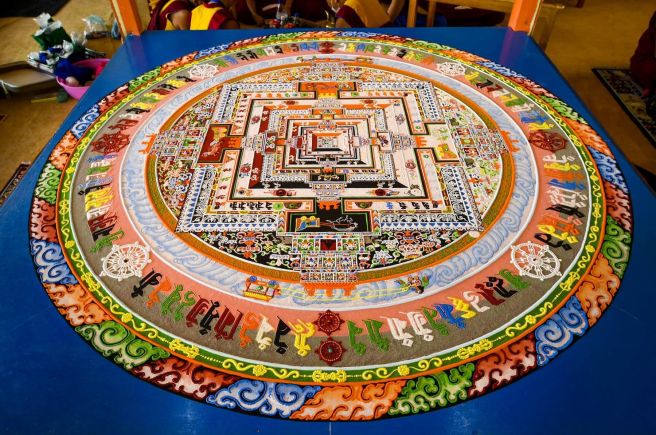
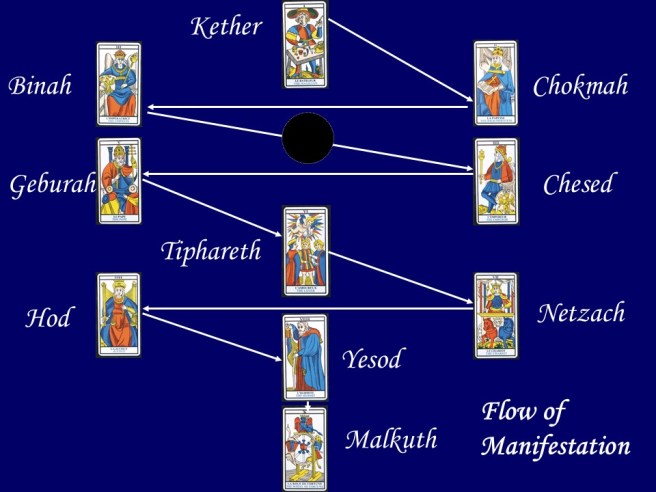
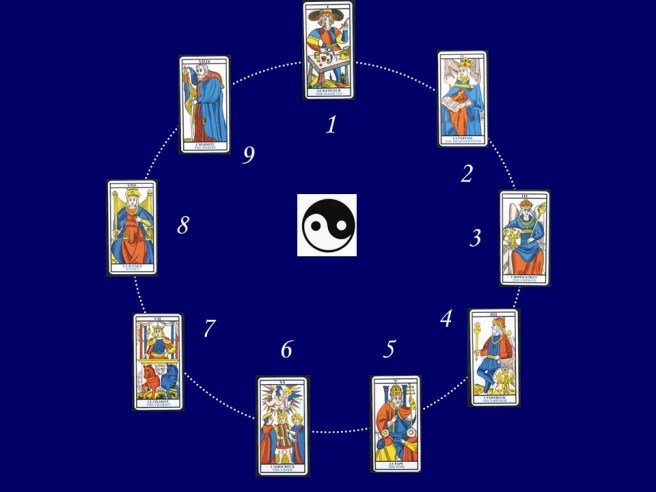
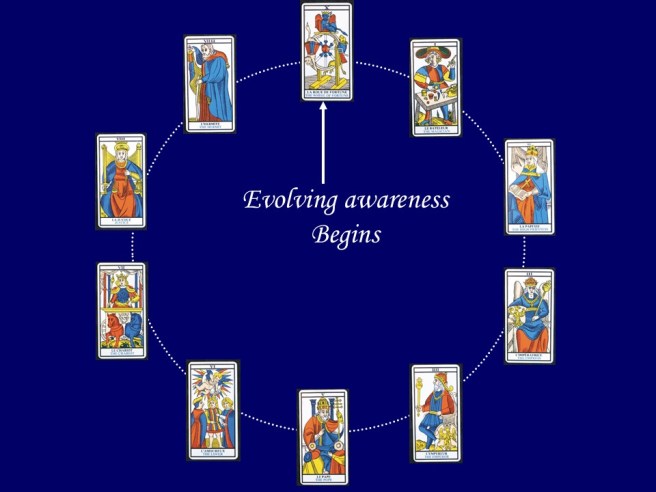
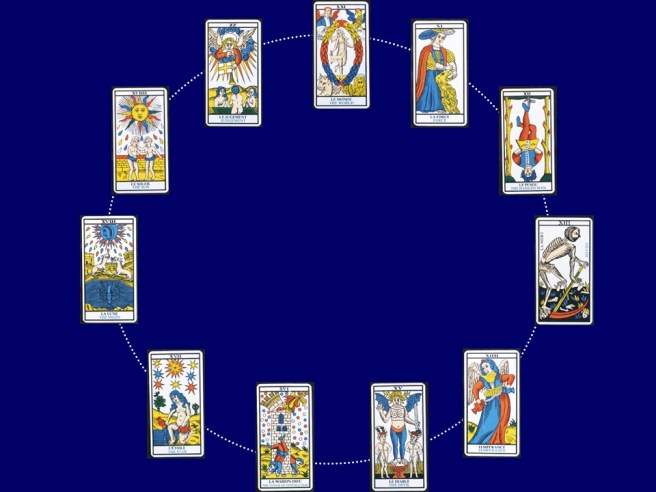
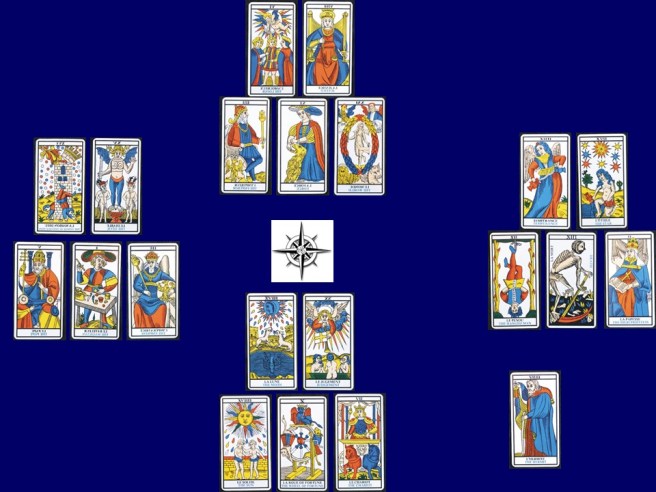
Mandala – Kālacakra and Tarot

Mandala can be thought of as models or re-presentations of a reality. They are a way of arranging and making partial sense of observed phenomenon. They can be a short-form to a much wider corpus of thought forms and images. Having been a scientist I have used models to convey scientific knowledge to students. I have often wondered if the traditional setting of image collections of mandala is culture specific.

If one was bilingual one might see more commonality than difference.

The Kālacakra mandala is famous in Tibetan buddhism.

The kabbalists have the tree of life-

And the Jewels of Awareness or Tarot can be arranged according to a compass of N E S W.

These have a very mandala-like flavour.

The Not Invented Here Syndrome

I’ll kick this off with a statement

People are evangelical about the comprehensive nature of their self-diagnosed omniscience.

They are convinced that they know best and seek to promote and otherwise sell their approach(es). After all education is a business and bums on seats keep the pennies flowing into coffers. Religion too is a business and the treasuries must be kept full. Politics too is a business. In all of these cash flow is important. Self-marketing is important for livelihood. One must strive for supremacy and market domination.

I have encountered and been repulsed by the not invented here syndrome many times which can be paraphrased,

“We know best, fuck off with your strange and foreign ideas!! We love Status Quo.”

I once met a young man who tried to persuade me that Vajrayana practice was very difficult, like scaling a cliff. It was very hard but promised high gain yet the risks of falling and getting very badly hurt were high. He was showing off a little. I thought to myself, “try the warrior’s path sunshine and that might change your attitude…”

It is all a bit cock wavy. “My path is harder and more macho than yours!”

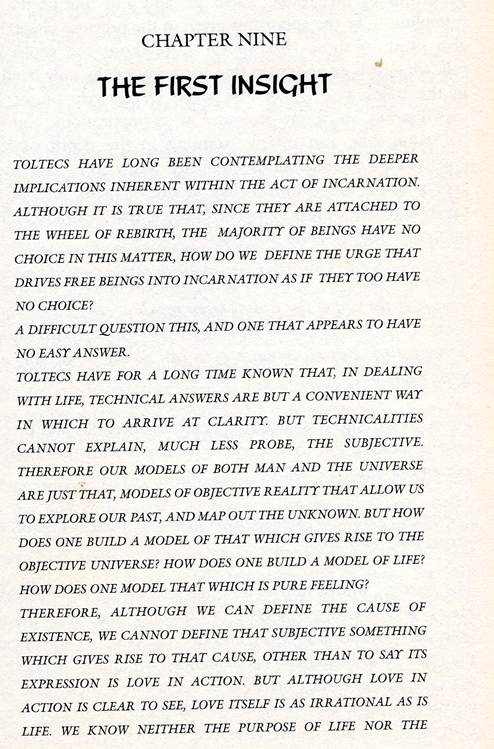
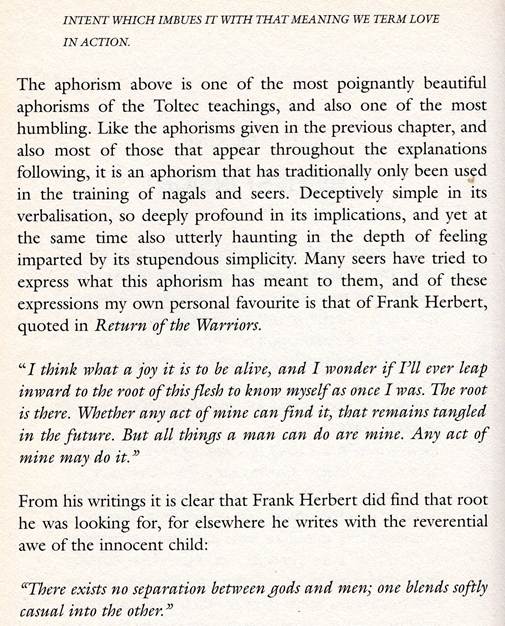
If you read and consider deeply the aphorism from the rule of the three pronged nagal above you can see that it is not facile or shallow. This insight comes from direct experiential contact with The VOID. It is a part of the inner subjective teachings of the Toltec schema. Perhaps akin by extrapolation to inner Kalachakra.

I have joked that I am a quantum yogi, in a geek-yogi superposition state. As such I am suspected by scientists and suspected by yogis because I not one thing or the other. I am not pure. Like the driven snow I am tainted by other thought forms. Yuk!!

I probably am quite well placed to do a balanced compare and contrast for many different ways of thinking.

Sometimes one needs more than verbatim translation to carry across meaning. People can argue when in fact they are in agreement.

They are just not willing to listen with an open mind and a willingness to find common ground…

The call of the soap box can be irresistible…

Cockney have name like Treey, Arthur and Del-boy
We have name like Winston, Lloyd and Leroy
We bawl out YOW! While cockneys say OI!
What cockney call a Jack’s we call a Blue Bwoy
Say cockney have mates while we have spar
Cockney live in a drum while we live in a yard
Say we nyam while cockney get capture
Cockney say guv’nor. We say Big Bout ya
In a de Cockney Translation!

Smiley Culture

—-