The Not Invented Here Syndrome

I’ll kick this off with a statement

People are evangelical about the comprehensive nature of their self-diagnosed omniscience.

They are convinced that they know best and seek to promote and otherwise sell their approach(es). After all education is a business and bums on seats keep the pennies flowing into coffers. Religion too is a business and the treasuries must be kept full. Politics too is a business. In all of these cash flow is important. Self-marketing is important for livelihood. One must strive for supremacy and market domination.

I have encountered and been repulsed by the not invented here syndrome many times which can be paraphrased,

“We know best, fuck off with your strange and foreign ideas!! We love Status Quo.”

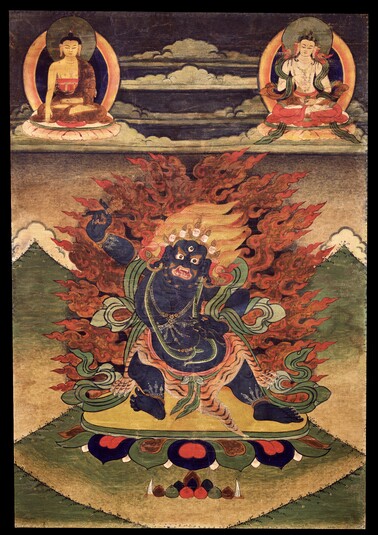
I once met a young man who tried to persuade me that Vajrayana practice was very difficult, like scaling a cliff. It was very hard but promised high gain yet the risks of falling and getting very badly hurt were high. He was showing off a little. I thought to myself, “try the warrior’s path sunshine and that might change your attitude…”

It is all a bit cock wavy. “My path is harder and more macho than yours!”

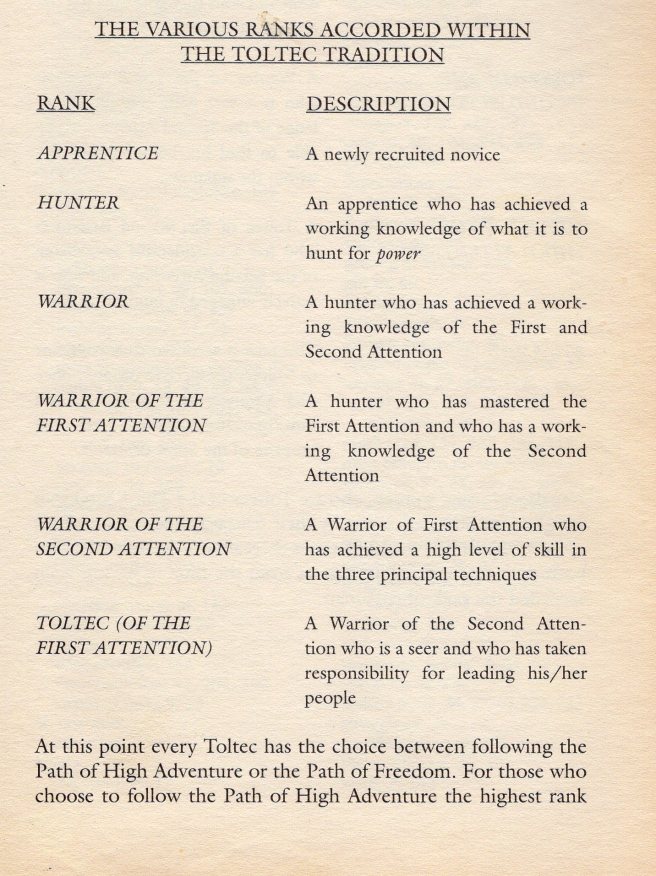
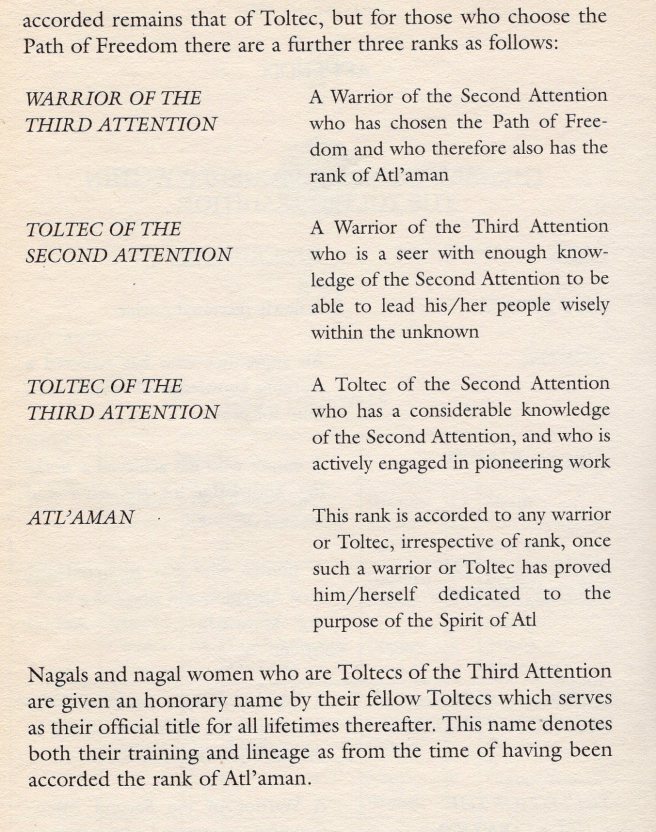
If you read and consider deeply the aphorism from the rule of the three pronged nagal above you can see that it is not facile or shallow. This insight comes from direct experiential contact with The VOID. It is a part of the inner subjective teachings of the Toltec schema. Perhaps akin by extrapolation to inner Kalachakra.

I have joked that I am a quantum yogi, in a geek-yogi superposition state. As such I am suspected by scientists and suspected by yogis because I not one thing or the other. I am not pure. Like the driven snow I am tainted by other thought forms. Yuk!!

I probably am quite well placed to do a balanced compare and contrast for many different ways of thinking.

Sometimes one needs more than verbatim translation to carry across meaning. People can argue when in fact they are in agreement.

They are just not willing to listen with an open mind and a willingness to find common ground…

The call of the soap box can be irresistible…

Cockney have name like Treey, Arthur and Del-boy
We have name like Winston, Lloyd and Leroy
We bawl out YOW! While cockneys say OI!
What cockney call a Jack’s we call a Blue Bwoy
Say cockney have mates while we have spar
Cockney live in a drum while we live in a yard
Say we nyam while cockney get capture
Cockney say guv’nor. We say Big Bout ya
In a de Cockney Translation!

Smiley Culture

—-

Gateway to the Nagual’s World – South the place of Dreaming

In my case, don Juan wanted an omen before he taught me the ritual. That omen came when don Juan and I were driving through a border town in Arizona and a policeman stopped me. The policeman thought I was an illegal alien. Only after I had shown him my passport, which he suspected of being a forgery, and other documents, did he let me go. Don Juan had been in the front seat next to me all the time, and the policeman had not given him a second glance. He had focused solely on me. Don Juan thought the incident was the omen he was waiting for.

His interpretation of it was that it would be very dangerous for me to call attention to myself, and he concluded that my world had to be one of utter simplicity and candor – elaborate ritual and pomp were out of character for me. He conceded, however, that a minimal observance of ritualistic patterns was in order when I made my acquaintance with his warriors. I had to begin by approaching them from the south, because that is the direction that power follows in its ceaseless flux. Life force flows to us from the south, and leaves us flowing toward the north. He said that the only opening to a Nagual’s world was through the south, and that the gate was made by two female warriors, who would have to greet me and would let me go through if they so decided.

He took me to a town in central Mexico, to a house in the countryside. As we approached it on foot from a southerly direction, I saw two massive Indian women standing four feet apart, facing each other. They were about thirty or forty feet away from the main door of the house, in an area where the dirt was hard-packed. The two women were extraordinarily muscular and stern. Both had long, jet-black hair held together in a single thick braid. They looked like sisters. They were about the same height and weight – I figured that they must have been around five feet four, and weighed 150 pounds. One of them was extremely dark, almost black, the other much lighter. They were dressed like typical Indian women from central Mexico – long, full dresses and shawls, homemade sandals.

Don Juan made me stop three feet from them. He turned to the woman on our left and made me face her. He said that her name was Cecilia and that she was a dreamer. He then turned abruptly, without giving me time to say anything, and made me face the darker woman, to our right. He said that her name was Delia and that she was a stalker. The women nodded at me. They did not smile or move to shake hands with me, or make any gesture of welcome. Don Juan walked between them as if they were two columns marking a gate. He took a couple of steps and turned as if waiting for the women to invite me to go through. The women stared at me calmly for a moment. Then Cecilia asked me to come in, as if I were at the threshold of an actual door.

Don Juan led the way to the house. At the front door we found a man. He was very slender. At first sight he looked extremely young, but on closer examination he appeared to be in his late fifties. He gave me the impression of being an old child: small, wiry, with penetrating dark eyes. He was like an elfish apparition, a shadow. Don Juan introduced him to me as Emilito, and said that he was his courier and all-around helper, who would welcome me on his behalf.

It seemed to me that Emilito was indeed the most appropriate being to welcome anyone. His smile was radiant; his small teeth were perfectly even. He shook hands with me, or rather he crossed his forearms and clasped both my hands. He seemed to be exuding enjoyment; anyone would have sworn that he was ecstatic in meeting me. His voice was very soft and his eyes sparkled.

We walked into a large room. There was another woman there. Don Juan said that her name was Teresa and that she was Cecilia’s and Delia’s courier. She was perhaps in her early thirties, and she definitely looked like Cecilia’s daughter. She was very quiet but very friendly. We followed don Juan to the back of the house, where there was a roofed porch.

It was a warm day. We sat there around a table, and after a frugal dinner we talked until after midnight. Emilito was the host. He charmed and delighted everyone with his exotic stories. The women opened up. They were a great audience for him. To hear the women’s laughter was an exquisite pleasure. They were tremendously muscular, bold, and physical. At one point, when Emilito said that Cecilia and Delia were like two mothers to him, and Teresa like a daughter, they picked him up and tossed him in the air like a child.

Of the two women, Delia seemed the more rational, down- to-earth. Cecilia was perhaps more aloof, but appeared to have greater inner strength. She gave me the impression of being more intolerant, or more impatient; she seemed to get annoyed with some of Emilito’s stories. Nonetheless, she was definitely on the edge of her chair when he would tell what he called his “tales of eternity.” He would preface every story with the phrase, ‘Do you, dear friends, know that. . . ?’

The story that impressed me most was about some creatures that he said existed in the universe, who were the closest thing to human beings without being human; creatures who were obsessed with movement and capable of detecting the slightest fluctuation inside themselves or around them. These creatures were so sensitive to motion that it was a curse to them. It gave them such pain that their ultimate ambition was to find quietude. Emilito would intersperse his tales of eternity with the most outrageous dirty jokes. Because of his incredible gifts as a raconteur, I understood every one of his stories as a metaphor, a parable, with which he was teaching us something.

 Don Juan said that Emilito was merely reporting about things he had witnessed in his journeys through eternity. The role of a courier was to travel ahead of the Nagual, like a scout in a military operation. Emilito went to the limits of the second attention, and whatever he witnessed he passed on to the others.

—————–

From “The Eagle’s Gift” by Carlos Castaneda, Part Three.

  • The gate to our property is in the South. Currently there is a beat up Citroen there…

Karma Quotes

Like gravity, karma is so basic we often don’t even notice it.

Sakyong Mipham

I want revenge, but I don’t want to screw up my karma.

Susane Colasanti

You cannot control the results, only your actions.

Allan Lokos

How people treat you is their karma; how you react is yours.

Wayne W. Dyer

Life will give you whatever experience is most helpful for the evolution of your consciousness. How do you know this is the experience you need? Because this is the experience you are having at the moment.

Eckhart Tolle

If you’re really a mean person you’re going to come back as a fly and eat poop.

Kurt Cobain

Even chance meetings are the result of karma… Things in life are fated by our previous lives. That even in the smallest events there’s no such thing as coincidence.

Haruki Murakami

Is Fate getting what you deserve, or deserving what you get?

Jodi Picoult                                

Dear Karma, I really hate you right now, you made your point.

Ottilie Weber

Strange things conspire when one tries to cheat fate.

Rick Riordan

I guess one of the ways that karma works is that it finds out what you are most afraid of and then makes that happen eventually.

Cheech Marin

Karma, when properly understood, is just the mechanics through which consciousness manifests.

Deepak Chopra

There’s a natural law of karma that vindictive people, who go out of their way to hurt others, will end up broke and alone.

Sylvester Stallone

To go from mortal to Buddha, you have to put an end to karma, nurture your awareness, and accept what life brings.

Bodhidharma

I am what we call a ‘karma yogi’ in Sanskrit. A karma yogi is somebody who believes in data. I collect a lot of data.

N. R. Narayana Murthy

Whether or not we believe in survival of consciousness after death, reincarnation, and karma, it has very serious implications for our behavior.

Stanislav Grof

With some things, karma is good enough. Lessons come back in different ways, you know what I mean?

Big Narstie

Being vegan just gives you such great karma.

Alicia Silverstone

As long as karma exists, the world changes. There will always be karma to be taken care of.

Nina Hagen

Cagliostro – History and Agenda

It is raining today. I’ll make some comments.

There is a lot of cut and past without attribution “stuff” on the internet. There is a lot of re-hashing

I’ll speculate that laziness has prevented good research.

I’ll comment that the level of scholarship may not  be high.

In this document seemingly in his own words.

The man who takes on the name Comte de Cagliostro describes the fact that his place of birth was unknown and that he was initially raised in a Muslim household and that he visited Mecca. He was allegedly an orphan.  It is possible that amongst his  studies of the sciences he did optics and astronomy. He says that he learned many languages.

There is perhaps a Christian bias against Islamic science and scholarship which is promulgated in the easily available material. The fascination with politics and courtly goings on is emphasized in the available material, soap opera stories entertain. Elsewhere he describes a kind of power struggle with the Christian theocracy and power brokers.

1766 has him travelling to Rhodes and Malta where he takes on the name Cagliostro and adopts Christian dress. He is well received by the Knights of Malta. Later in the text he suggests that his date of birth was 1750 {by subtraction} and that he arrived in Strasbourg in 1780. From his narrative he had access to some high ranking and important geezers. Pretty soon he ends up in the Bastille. The memoire is dated March 1783.

“The Storming of the Bastille occurred in Paris, France, on 14 July 1789.”

This text already differs from the Wiki page. He does say that he travelled to Sicily.

In the text he glosses over travels in Egypt and Asia.  Which would have had him exposed to  Vedic and Buddhist thought . Other texts on the various masonic rites points at a Zoroastrian Ahura Mazda influence in Egyptian masonic traditions.

{I have only scan read}

He goes to Rome incognito and is invited to see Cardinal Orsini…

“The Orsini are one of most important families in Italian history. At the height of their influence, in the late Middle Ages and into the Renaissance, the Orsini were crucial players in Italian politics; they were closely allied to the Medici, with whom they were tied by several high-level marriages. The family produced three popes, about thirty cardinals and 62 senators of Rome, as well as several electors of Saxony and Brandenburg, and grand masters of the Knights of Malta.”

Of a Sunday morning one can see that quite a lot of stuff on the internet may have an agenda and a bias.

It is a bit strange reading 18th century French…