
–

–
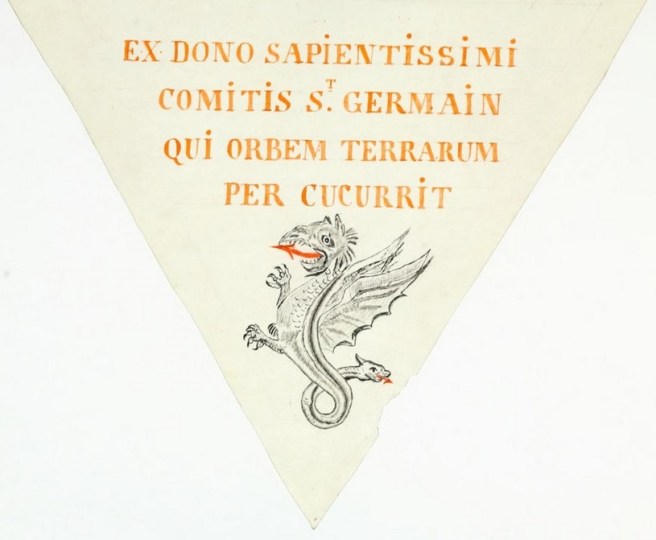
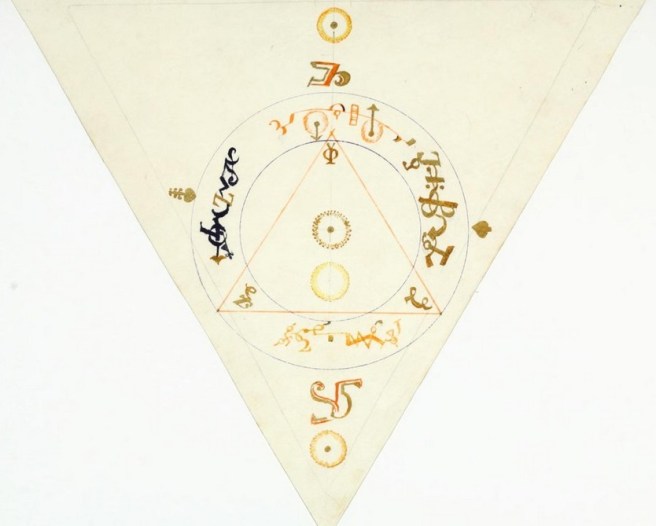
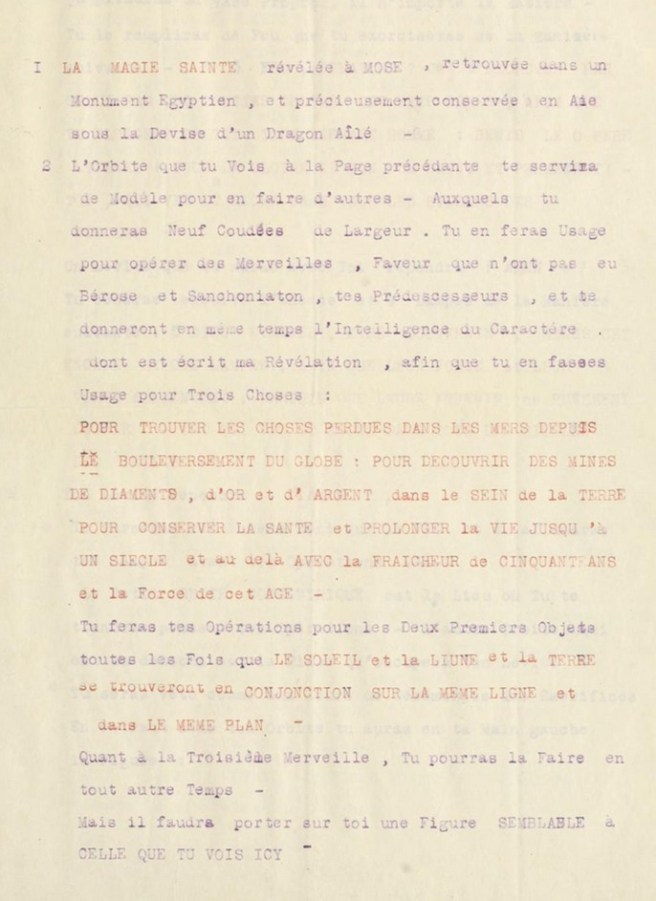
The Triangular Book of St. Germain or The Triangular Manuscript is an untitled 18th-century French text written in code, and attributed to the famous Count of St. Germain. It takes its name from its physical shape: the binding and sheets of vellum that comprise the manuscript are in the shape of an equilateral triangle. The text, once deciphered, details a magical operation through which a person can perform feats of magic, notably the discovery of treasure and extension of life.
History
The two known copies of the Triangular Manuscript exist as Hogart Manuscript 209 and 210 (MS 209 and MS 210). Both currently reside in the Getty Research Institute’s collections, each with its own history.
MS 209, dated 1775, was made for Antoine Louis Moret, a French freemason who immigrated to the United States in 18th century. At one point it resided in the library of Jules C. G. Favre (1809-1880), a French politician. Pliny E. Chase (1820-1886), an American mathematician with an interest in cryptography, makes mention of it in a lecture to the American Philosophical Society on October 3, 1873, stating that the manuscript was “purchased in Amsterdam, about seventy years ago,” i.e. around 1803. It is unclear if he owned the manuscript, examined it, or had simply heard of its existence. French bibliographer, poet, and Rosicrucian Stanislaus de Guaita (1860-1898) had it in his library for some time. From there it passed on to a certain Madame Barbe of Paris, and then to Frank Hollings, a 20th century London writer and antiquary. After 1934, Hollings sold it to Manly P. Hall.
Much less is known about the other manuscript, MS 210. Dated 1750, older of the two copies, it was once in the library of Lionel Hauser, a member of the Theosophical Society in Paris. In 1934, Manly P. Hall purchased it for 40 guineas at an auction of Hauser’s library at Sotheby’s.
————
The Count of St. Germain (French: Comte de Saint Germain; 1691 or 1712 – 27 February 1784) whose real name and origins remain unknown, was a European adventurer who had interests and achievements in science, alchemy, philosophy, and the arts. He rose to prominence in the European high society of the mid-18th century due to his works and interests. He associated himself with some of the top contemporary figures, including Casanova, Voltaire and Mozart.
The count used a variety of names and titles, including the Marquess of Montferrat (Fr. Marquis de Montferrat), Count Bellamarre (Fr. Comte Bellamarre), Knight Schoening (Fr. Chevalier Schoening), Count Weldon, Count Soltikoff (Fr. Comte Soltikoff), Manuel Doria, Graf Tzarogy, and Prince Ragoczy (De. Prinz Ragoczy). He appears to have begun to be known under the title of the Count of St Germain during the early 1740s.
He is said to have made far-fetched claims (such as being 500 years old), leading Voltaire to dub him “the Wonderman”, and that “he is a man who does not die, and who knows everything”. Prince Charles of Hesse-Kassel, called him “one of the greatest philosophers who ever lived”.
—————
In 1892, Helena Blavatsky characterized the Count of St. Germain as “the greatest Oriental Adept Europe has seen during the last centuries.” She said that he was one of her Masters of Wisdom and hinted that he had given her secret documents. The Theosophical Society after Blavatsky’s death considered him to be a Mahatma, Master of the Ancient Wisdom, or Adept.
According to the Theosophical Society, the Seven Rays are seven metaphysical principles that govern both individual souls and the unfolding of each 2,158-year-long Astrological Age. Since, according to Theosophy, the upcoming Age of Aquarius will be governed by the Seventh (Violet) Ray (the Ray of Ceremonial Order), Saint Germain is sometimes called “The Hierarch of the Age of Aquarius”.
Annie Besant said that she met the Count in 1896. C. W. Leadbeater claimed to have met him in Rome. According to Leadbeater, the count had brown eyes, olive colored skin, and a pointed beard, adding “the splendour of his Presence impels men to make obeisance”. Elsewhere, he described the count as wearing “a suit of golden chain-mail which once belonged to a Roman Emperor; over it is thrown a magnificent cloak of crimson, with on its clasp a seven-pointed star in diamond and amethyst, and sometimes he wears a glorious robe of violet.”
Excerpted from Wikipedia
—————————-
The extracts below are from the internet archive of the manuscript from the Manly Palmer Hall collection held at Getty Research Institute
–



–
—

—
 Dreamyoga