Cagliostro – Erasing Personal History

In a world obsessed with the curriculum vitae it makes “sense” to be able to account for our life, our training and our affiliations. We might even get a job on the basis of our CV. Historians may want to pin down where we were born, to whom and with whom we associated. That makes a story, a narrative of our lives, a his-story or a her-story. Human folly suggests that these stories are important when they are in fact impermanent and mutable. If someone knows our story we can be held to it.

“You said you are vegan and that meat is murder. How come you are eating a steak you lying bastard?”

Our stories make an expectation which people expect us to life up or down to. If we don’t behave as a good priest we could be chucked out of church for shagging a prostitute.

There is a Toltec technique called “Erasing Personal History”. In which one is encouraged to unpick, change and ultimately remove any legend or story we might have about ourselves. We become free of the bullshit we tell ourselves about who and what we are. We are liberated by rubbing out the story, erasing it. As an interim measure we might make a working story to use until such time as we have no story at all.

The CIA and MI6 allegedly prepare extensive cover stories for agents complete with passports and driver licences. The back story might be fleshed out in, inter alia, social media.

So why not invent a cover as Comte de Cagliostro?

It might infuriate those who want to try to pin you down to some identity or other. You are not playing fair if you do not stick to “normal” societal rules. Who is this charlatan?

Well maybe he was someone who was erasing his personal history forever reinventing how he behaved and how he presented himself. As he evolved as a spiritual being his story, his legend evolved with him. He was not a fixed and rigid being. He was not constrained by the stories others sought to tell and be adamant about.

Right now there is nobody who can give a good account of me. I have claimed that I used to teach chemistry to the nurses. Nobody has tested my knowledge. I could be a lying charlatan. Weirdly I might be able to talk about high resolution laser spectroscopy and how to use a two-stroke strimmer.

If your bloodline was dangerous to you. It might be wise to hide your pedigree. Having noble parents could mean your end. There are many motivations why someone might be vague about their birth.

They did not have DNA screening and biometrics back then!!

It is funny to watch people getting into a tizzy about who Comte de Cagliostro might have been. Then watch them present their theories, which have made it onto Wikipedia.

So obvs they must be gospel true.

The whole notion of wanting and trying to erase any and all personal history goes against what makes “sense” in the normal socio-political view of the world. A personal history can shackle.

Peoples lives are ruined now because once they made an ill conceived remark. Their careers can be trashed, cancelled, because of the recorded history of what they are alleged to have said.

Now like so many others I am writing off any trip to the USA because what I have written on blogs may be held against me and prohibit my entrance. There is no point doing the paperwork.

Having your history held against you is not very liberating…

I have not been to Malta for quite a number of years 😉
Cagliostro – History and Agenda

It is raining today. I’ll make some comments.

There is a lot of cut and past without attribution “stuff” on the internet. There is a lot of re-hashing

I’ll speculate that laziness has prevented good research.

I’ll comment that the level of scholarship may not  be high.

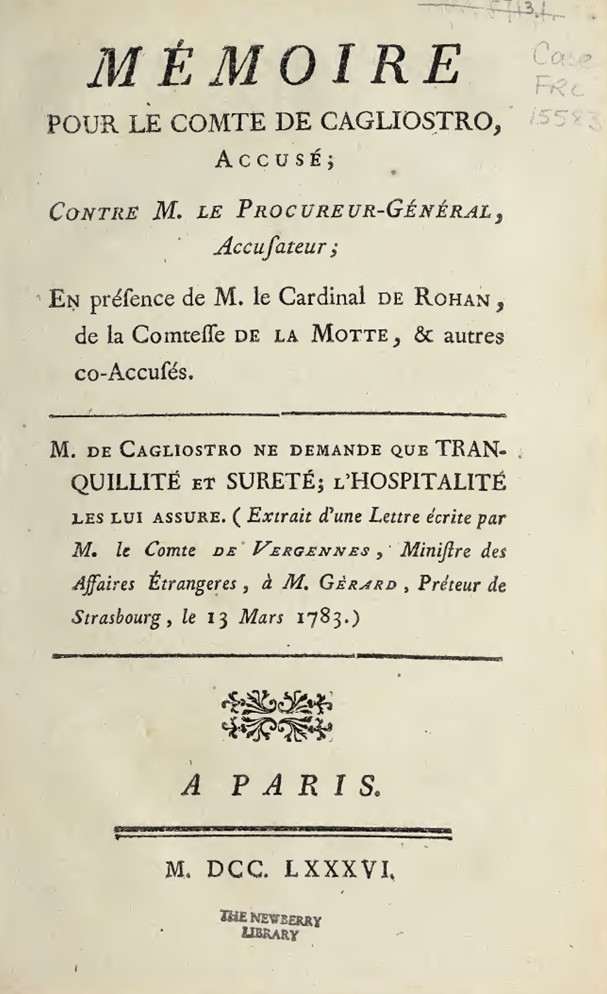
In this document seemingly in his own words.

The man who takes on the name Comte de Cagliostro describes the fact that his place of birth was unknown and that he was initially raised in a Muslim household and that he visited Mecca. He was allegedly an orphan.  It is possible that amongst his  studies of the sciences he did optics and astronomy. He says that he learned many languages.

There is perhaps a Christian bias against Islamic science and scholarship which is promulgated in the easily available material. The fascination with politics and courtly goings on is emphasized in the available material, soap opera stories entertain. Elsewhere he describes a kind of power struggle with the Christian theocracy and power brokers.

1766 has him travelling to Rhodes and Malta where he takes on the name Cagliostro and adopts Christian dress. He is well received by the Knights of Malta. Later in the text he suggests that his date of birth was 1750 {by subtraction} and that he arrived in Strasbourg in 1780. From his narrative he had access to some high ranking and important geezers. Pretty soon he ends up in the Bastille. The memoire is dated March 1783.

“The Storming of the Bastille occurred in Paris, France, on 14 July 1789.”

This text already differs from the Wiki page. He does say that he travelled to Sicily.

In the text he glosses over travels in Egypt and Asia.  Which would have had him exposed to  Vedic and Buddhist thought . Other texts on the various masonic rites points at a Zoroastrian Ahura Mazda influence in Egyptian masonic traditions.

{I have only scan read}

He goes to Rome incognito and is invited to see Cardinal Orsini…

“The Orsini are one of most important families in Italian history. At the height of their influence, in the late Middle Ages and into the Renaissance, the Orsini were crucial players in Italian politics; they were closely allied to the Medici, with whom they were tied by several high-level marriages. The family produced three popes, about thirty cardinals and 62 senators of Rome, as well as several electors of Saxony and Brandenburg, and grand masters of the Knights of Malta.”

Of a Sunday morning one can see that quite a lot of stuff on the internet may have an agenda and a bias.

It is a bit strange reading 18th century French…

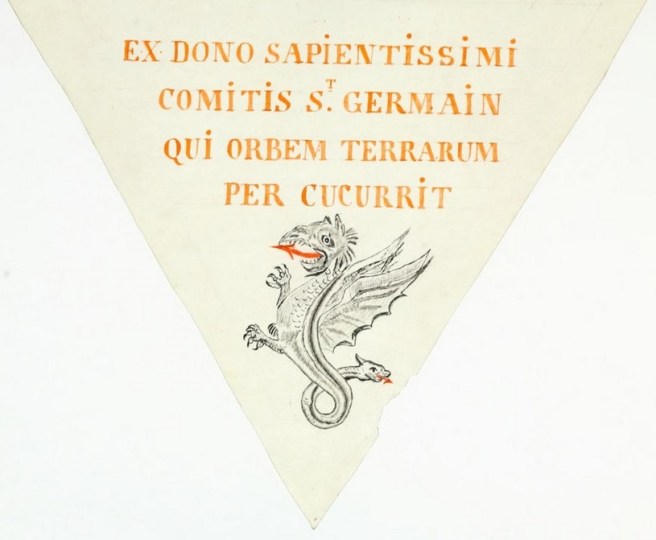
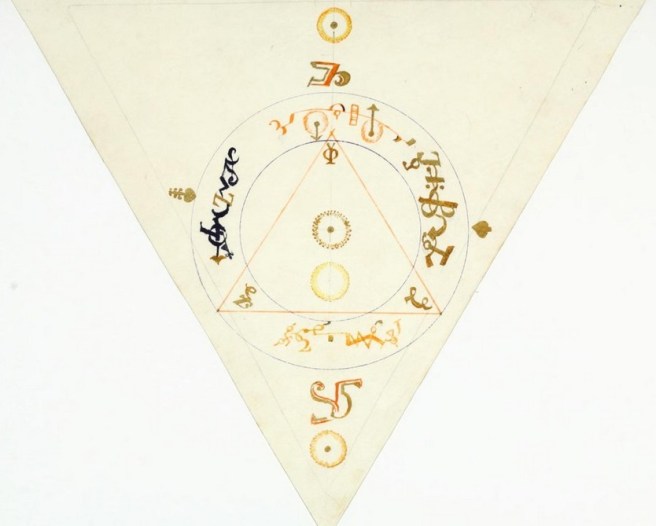
The Triangular Book of St. Germain

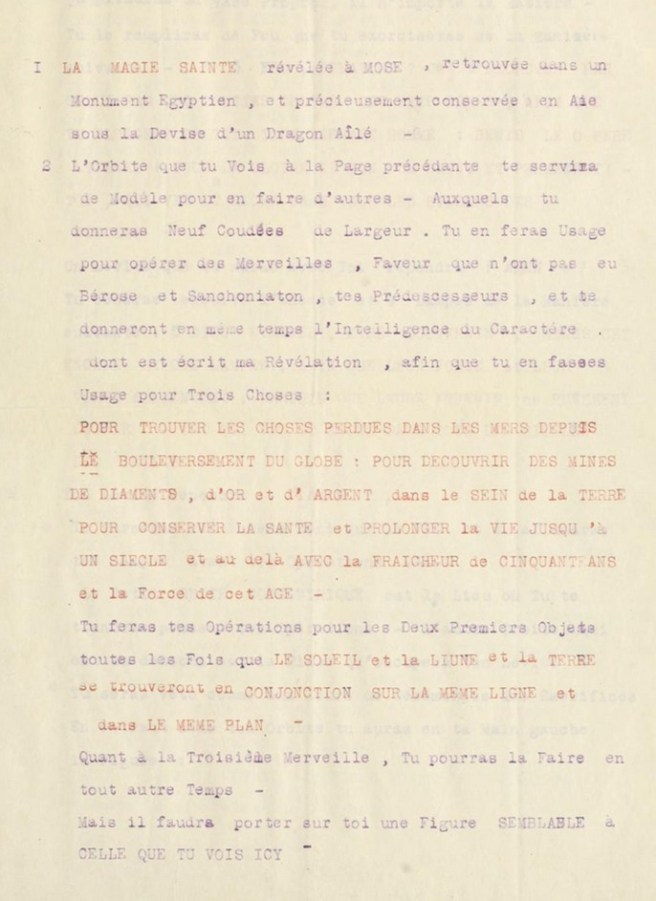
The Triangular Book of St. Germain or The Triangular Manuscript is an untitled 18th-century French text written in code, and attributed to the famous Count of St. Germain. It takes its name from its physical shape: the binding and sheets of vellum that comprise the manuscript are in the shape of an equilateral triangle. The text, once deciphered, details a magical operation through which a person can perform feats of magic, notably the discovery of treasure and extension of life.

History

The two known copies of the Triangular Manuscript exist as Hogart Manuscript 209 and 210 (MS 209 and MS 210). Both currently reside in the Getty Research Institute’s collections, each with its own history.

MS 209, dated 1775, was made for Antoine Louis Moret, a French freemason who immigrated to the United States in 18th century. At one point it resided in the library of Jules C. G. Favre (1809-1880), a French politician. Pliny E. Chase (1820-1886), an American mathematician with an interest in cryptography, makes mention of it in a lecture to the American Philosophical Society on October 3, 1873, stating that the manuscript was “purchased in Amsterdam, about seventy years ago,” i.e. around 1803. It is unclear if he owned the manuscript, examined it, or had simply heard of its existence. French bibliographer, poet, and Rosicrucian Stanislaus de Guaita (1860-1898) had it in his library for some time. From there it passed on to a certain Madame Barbe of Paris, and then to Frank Hollings, a 20th century London writer and antiquary. After 1934, Hollings sold it to Manly P. Hall.

Much less is known about the other manuscript, MS 210. Dated 1750, older of the two copies, it was once in the library of Lionel Hauser, a member of the Theosophical Society in Paris. In 1934, Manly P. Hall purchased it for 40 guineas at an auction of Hauser’s library at Sotheby’s.

————

The Count of St. Germain (French: Comte de Saint Germain; 1691 or 1712 – 27 February 1784) whose real name and origins remain unknown, was a European adventurer who had interests and achievements in science, alchemy, philosophy, and the arts. He rose to prominence in the European high society of the mid-18th century due to his works and interests. He associated himself with some of the top contemporary figures, including Casanova, Voltaire and Mozart.

The count used a variety of names and titles, including the Marquess of Montferrat (Fr. Marquis de Montferrat), Count Bellamarre (Fr. Comte Bellamarre), Knight Schoening (Fr. Chevalier Schoening), Count Weldon, Count Soltikoff (Fr. Comte Soltikoff), Manuel Doria, Graf Tzarogy, and Prince Ragoczy (De. Prinz Ragoczy). He appears to have begun to be known under the title of the Count of St Germain during the early 1740s.

He is said to have made far-fetched claims (such as being 500 years old), leading Voltaire to dub him “the Wonderman”, and that “he is a man who does not die, and who knows everything”. Prince Charles of Hesse-Kassel, called him “one of the greatest philosophers who ever lived”.

—————

In 1892, Helena Blavatsky characterized the Count of St. Germain as “the greatest Oriental Adept Europe has seen during the last centuries.” She said that he was one of her Masters of Wisdom and hinted that he had given her secret documents. The Theosophical Society after Blavatsky’s death considered him to be a Mahatma, Master of the Ancient Wisdom, or Adept.

According to the Theosophical Society, the Seven Rays are seven metaphysical principles that govern both individual souls and the unfolding of each 2,158-year-long Astrological Age. Since, according to Theosophy, the upcoming Age of Aquarius will be governed by the Seventh (Violet) Ray (the Ray of Ceremonial Order), Saint Germain is sometimes called “The Hierarch of the Age of Aquarius”.

Annie Besant said that she met the Count in 1896.   C. W. Leadbeater claimed to have met him in Rome. According to Leadbeater, the count had brown eyes, olive colored skin, and a pointed beard, adding “the splendour of his Presence impels men to make obeisance”. Elsewhere, he described the count as wearing “a suit of golden chain-mail which once belonged to a Roman Emperor; over it is thrown a magnificent cloak of crimson, with on its clasp a seven-pointed star in diamond and amethyst, and sometimes he wears a glorious robe of violet.”

Excerpted from Wikipedia

—————————-

The extracts below are from the internet archive of the manuscript from the Manly Palmer Hall collection held at Getty Research Institute


Vampire DNA at Imperial College and Hip Replacement Update

I started watching “A Discovery of Witches” whilst in hospital after my total hip replacement. The other night we started series three. The main protagonists “academics” from Oxford University, also a vampire and a witch, had just gotten back from time walking to Elizabethan London in search of an alchemical text. They want to understand the vampire “blood rage” so obviously they go to Imperial College London to do some research. The TV programme had footage of the main entrance on Exhibition Road and drone views of the South Kensington Campus. The wife and I looked at each other.

There is no getting away from the place. It is everywhere like a rash. Like an antibiotic resistant STI it keeps popping up. Since the COVID days it is often in the news.

The story looks at the so-called vampire DNA of the de Clermont blood line and has quite a lot of London footage so-far including mews shots etc.. I do not look back at my interaction with that institution with fond memories. I am sometimes embarrassed to have been associated. And now it is in a bloody TV programme too!! FFS.

I am now four weeks into the time after hip replacement. I can walk around the house unaided, no crutches. Yesterday we walked the hills of Lannion centre and today my muscles ache. The actual joint pain in the hip is markedly reduced from before. There is enhanced flexibility and it seems that the functionality will continue to improve. There remains some problems with early morning-late nocturnal pain in the sacroiliac joints and where the sacral spine joins the lumbar spine. This kicks in around 5 AM. I am down to only one co-codamol a night taken around 2 AM. If I get up and move around, do some back stretches, I can sleep on a bit. I am sleeping through the night. We go to bed about midnight and I am up 6 – 6:30 AM at the moment.

It is not ideal though is tolerable. I could easily take some more dope – some more codeine. But I don’t think that is a good idea. When I am able to lie on my right hip, the operated one, I may be able to sleep better. The pain goes away within minutes of getting up and moving around. The incentive is not to lounge around like a hippie in bed.

The problem is I am not looking forward to going to bed. I am not looking forward to waking up in the morning. A non-ideal situation. Not sure what to do. I may try some back stretches later today. The pain may not go and I might have to resort to my previous medication which worked before the operation. Too early to tell.

There could be an enhanced vigilance at play. The last time I went to sleep, I woke up with an eight inch scar and a lump of Titanium…that is what happens if you doze off..

Luckily I know that many things do indeed pass. The hip progress seems OK. The sleeping and pre-dawn pains could be better.

On the whole the now is a whole lot better than the before….

Following the footsteps of a rag doll dance…

Not all cultural references are directly transferable some are “time of life” and others are “time of man” related.  I personally view myself as being on the conservative side in that outwardly I am not outlandish. It always used to amuse me how the “goths” had less of an idea of the shadows than I did.

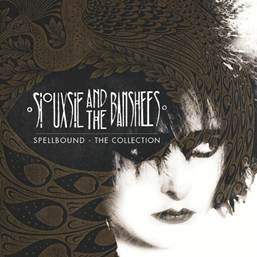
But Siouxsie et al. were definitely a part to the soundtrack of my life.

In the “A Discovery of Witches” TV series the notion of the main protagonist being spellbound has come to the fore. In which her parents cast a spell which both hid and prevented the usage of her powers. She was literally bound by spell or spell bound. The narrative suggests that this practice was usually reserved for insane witches and that it was a harsh thing to do, to prevent the person from living to their full potential, to inhibit and otherwise hinder them. The back story is that the “creatures” are forced to hide from the discriminatory humans and their notions of normality. Humans are depicted as prejudiced. The story also has “time-walker” as a top echelon witchcraft skill. A lot of the plot revolves around “powers” of a magical and special kind. Power ever being the motivator for political intrigue, shenanigan and skullduggery. Somehow Diana is able to summon an old text which may or may not hold the secret(s).

In physics a lot of stock is made upon observables and making an observation. If one in any way makes an observation one changes the system. For example if one “observes” a photon using a detector that photon changes the energy state of an electron. The photon ceases to be. The energy has been transformed from one thing to another. At a very local and very tiny level every act of observation changes the system.  Science rhetoric is less explicit as to the nature of interpretation and subsequent assimilation caused by the observation, the act of observation. One could say that the observation of a “handful” of particles in a science experiment can have a truly dramatic and wide ranging impact because of interpretation and assimilation to or with a previously held thought form or model. I might infer that a photon is the witness to an act of proton transfer. My observation hints at a physical process. Any observation changes the system and it cannot be undone. If I talk about it down the pub that handful of photons triggers synapses and a train of thought heads off on whichever trajectories.

I have always had a few problems with the notion of time travel because of observation. It is impossible to travel back in time without altering its forward propagation. Although pleasant as an artistic and entertaining notion it is philosophically tricky. {Ok there may be some time reversal events at sub atomic levels that I am unaware of but these may be mathematical legerdemain}. In terms of karma time travel is also problematic.

In my mind it raises an interesting thought line. “Does reminiscence alter the past or merely our recollection and narrative assimilation thereof?” We do not travel back in time to the acts of perception but how we retell what we “remember” does change our futures because our basis for world interpretation has altered if only slightly.

If for example you held a view that I was a complete bastard and you hated my guts, then any future interaction would be coloured by this framing. If on reminiscing you decided I was only a partial bastard then you have already changed the future. Your change of mind changes the future(s).

Time-walking may be seen as a reinterpretation of events previously observed. Bearing in mind that the apparatus of observation must of course be error prone and never 100% accurate. Not all instruments are sensitive nor well calibrated. We do not actually go back in “physical” time rather review our mental registers of how we have constructed the time evolving narratives. We could re-consider, re-view and possibly re-perceive. Much like an astronomer may apply correction factors to space telescope raw data. There is some “algorithm” which enables (perhaps) a more reliable assimilation. We may refuse to apply said algorithm because we are stuck in our ways and like to cling to old perceptions, prejudices and world views.

The quantum mechanics of a 75kg lump of wet proteins and fats going backwards {or forwards} in time do not seem plausible. Perception and “mind” however are clearly much less physically tangible. In a sense these may be able to travel along what might be called time-registers. In the absence of matter time has no meaning. In a sense time as it is measured is a property of matter (vibration or time to travel between spatial coordinates). How we currently measure time is by the observation of photons in a fancy physics rig.

To extrapolate wildly by measuring time we are changing our futures.