The Triangular Book of St. Germain

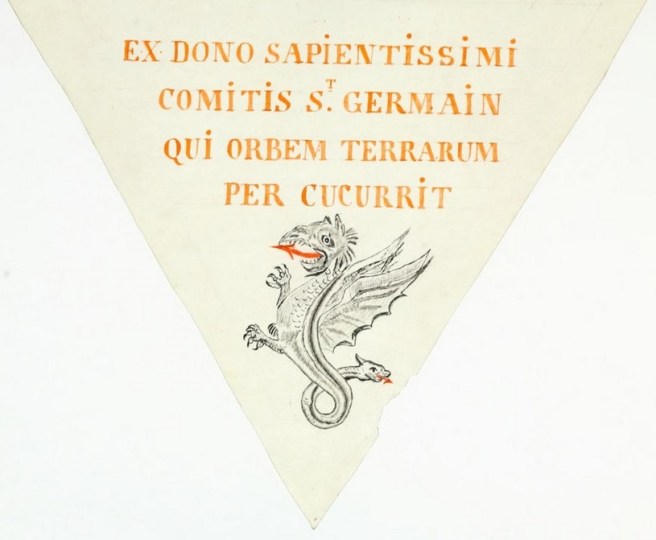
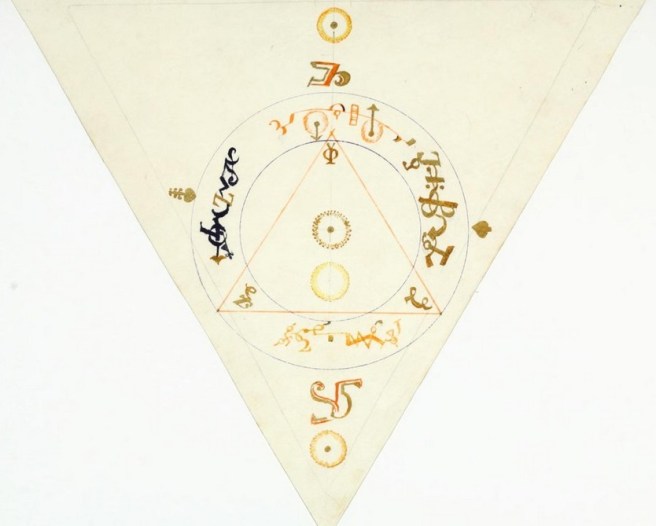
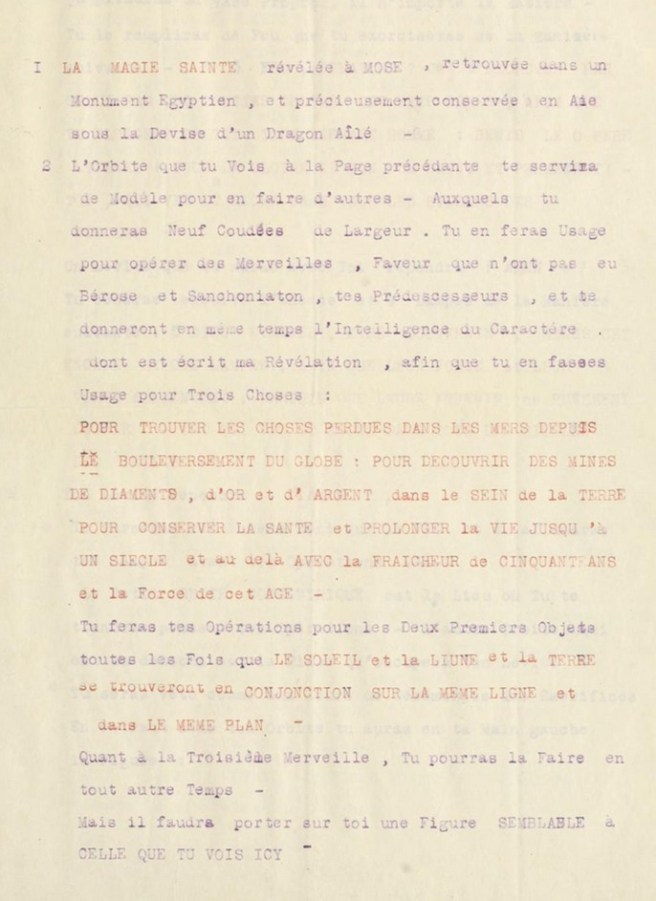
The Triangular Book of St. Germain or The Triangular Manuscript is an untitled 18th-century French text written in code, and attributed to the famous Count of St. Germain. It takes its name from its physical shape: the binding and sheets of vellum that comprise the manuscript are in the shape of an equilateral triangle. The text, once deciphered, details a magical operation through which a person can perform feats of magic, notably the discovery of treasure and extension of life.

History

The two known copies of the Triangular Manuscript exist as Hogart Manuscript 209 and 210 (MS 209 and MS 210). Both currently reside in the Getty Research Institute’s collections, each with its own history.

MS 209, dated 1775, was made for Antoine Louis Moret, a French freemason who immigrated to the United States in 18th century. At one point it resided in the library of Jules C. G. Favre (1809-1880), a French politician. Pliny E. Chase (1820-1886), an American mathematician with an interest in cryptography, makes mention of it in a lecture to the American Philosophical Society on October 3, 1873, stating that the manuscript was “purchased in Amsterdam, about seventy years ago,” i.e. around 1803. It is unclear if he owned the manuscript, examined it, or had simply heard of its existence. French bibliographer, poet, and Rosicrucian Stanislaus de Guaita (1860-1898) had it in his library for some time. From there it passed on to a certain Madame Barbe of Paris, and then to Frank Hollings, a 20th century London writer and antiquary. After 1934, Hollings sold it to Manly P. Hall.

Much less is known about the other manuscript, MS 210. Dated 1750, older of the two copies, it was once in the library of Lionel Hauser, a member of the Theosophical Society in Paris. In 1934, Manly P. Hall purchased it for 40 guineas at an auction of Hauser’s library at Sotheby’s.

————

The Count of St. Germain (French: Comte de Saint Germain; 1691 or 1712 – 27 February 1784) whose real name and origins remain unknown, was a European adventurer who had interests and achievements in science, alchemy, philosophy, and the arts. He rose to prominence in the European high society of the mid-18th century due to his works and interests. He associated himself with some of the top contemporary figures, including Casanova, Voltaire and Mozart.

The count used a variety of names and titles, including the Marquess of Montferrat (Fr. Marquis de Montferrat), Count Bellamarre (Fr. Comte Bellamarre), Knight Schoening (Fr. Chevalier Schoening), Count Weldon, Count Soltikoff (Fr. Comte Soltikoff), Manuel Doria, Graf Tzarogy, and Prince Ragoczy (De. Prinz Ragoczy). He appears to have begun to be known under the title of the Count of St Germain during the early 1740s.

He is said to have made far-fetched claims (such as being 500 years old), leading Voltaire to dub him “the Wonderman”, and that “he is a man who does not die, and who knows everything”. Prince Charles of Hesse-Kassel, called him “one of the greatest philosophers who ever lived”.

—————

In 1892, Helena Blavatsky characterized the Count of St. Germain as “the greatest Oriental Adept Europe has seen during the last centuries.” She said that he was one of her Masters of Wisdom and hinted that he had given her secret documents. The Theosophical Society after Blavatsky’s death considered him to be a Mahatma, Master of the Ancient Wisdom, or Adept.

According to the Theosophical Society, the Seven Rays are seven metaphysical principles that govern both individual souls and the unfolding of each 2,158-year-long Astrological Age. Since, according to Theosophy, the upcoming Age of Aquarius will be governed by the Seventh (Violet) Ray (the Ray of Ceremonial Order), Saint Germain is sometimes called “The Hierarch of the Age of Aquarius”.

Annie Besant said that she met the Count in 1896.   C. W. Leadbeater claimed to have met him in Rome. According to Leadbeater, the count had brown eyes, olive colored skin, and a pointed beard, adding “the splendour of his Presence impels men to make obeisance”. Elsewhere, he described the count as wearing “a suit of golden chain-mail which once belonged to a Roman Emperor; over it is thrown a magnificent cloak of crimson, with on its clasp a seven-pointed star in diamond and amethyst, and sometimes he wears a glorious robe of violet.”

Excerpted from Wikipedia

—————————-

The extracts below are from the internet archive of the manuscript from the Manly Palmer Hall collection held at Getty Research Institute


Vampire DNA at Imperial College and Hip Replacement Update

I started watching “A Discovery of Witches” whilst in hospital after my total hip replacement. The other night we started series three. The main protagonists “academics” from Oxford University, also a vampire and a witch, had just gotten back from time walking to Elizabethan London in search of an alchemical text. They want to understand the vampire “blood rage” so obviously they go to Imperial College London to do some research. The TV programme had footage of the main entrance on Exhibition Road and drone views of the South Kensington Campus. The wife and I looked at each other.

There is no getting away from the place. It is everywhere like a rash. Like an antibiotic resistant STI it keeps popping up. Since the COVID days it is often in the news.

The story looks at the so-called vampire DNA of the de Clermont blood line and has quite a lot of London footage so-far including mews shots etc.. I do not look back at my interaction with that institution with fond memories. I am sometimes embarrassed to have been associated. And now it is in a bloody TV programme too!! FFS.

I am now four weeks into the time after hip replacement. I can walk around the house unaided, no crutches. Yesterday we walked the hills of Lannion centre and today my muscles ache. The actual joint pain in the hip is markedly reduced from before. There is enhanced flexibility and it seems that the functionality will continue to improve. There remains some problems with early morning-late nocturnal pain in the sacroiliac joints and where the sacral spine joins the lumbar spine. This kicks in around 5 AM. I am down to only one co-codamol a night taken around 2 AM. If I get up and move around, do some back stretches, I can sleep on a bit. I am sleeping through the night. We go to bed about midnight and I am up 6 – 6:30 AM at the moment.

It is not ideal though is tolerable. I could easily take some more dope – some more codeine. But I don’t think that is a good idea. When I am able to lie on my right hip, the operated one, I may be able to sleep better. The pain goes away within minutes of getting up and moving around. The incentive is not to lounge around like a hippie in bed.

The problem is I am not looking forward to going to bed. I am not looking forward to waking up in the morning. A non-ideal situation. Not sure what to do. I may try some back stretches later today. The pain may not go and I might have to resort to my previous medication which worked before the operation. Too early to tell.

There could be an enhanced vigilance at play. The last time I went to sleep, I woke up with an eight inch scar and a lump of Titanium…that is what happens if you doze off..

Luckily I know that many things do indeed pass. The hip progress seems OK. The sleeping and pre-dawn pains could be better.

On the whole the now is a whole lot better than the before….

A Discovery of Witches – Thread

Whilst I was in hospital I came upon this UK TV series on Netflix. It seemed that I had already started watching it according to Netflix. I did not recall this.  So I started to watch again. So far it is enjoyable.

———————————————–

A Discovery of Witches is a British fantasy television series based on the All Souls Trilogy by Deborah Harkness, named after the first book in the trilogy.

Diana Bishop, a historian and reluctant witch, unexpectedly discovers a bewitched manuscript in Oxford’s Bodleian Library. This discovery forces her back into the world of magic in order to unravel the secrets it holds about magical beings. She is offered help by a mysterious biochemist and vampire Matthew Clairmont. Despite a long-held mistrust between witches and vampires, they form an alliance and set out to protect the book and solve the mysteries hidden within while dodging threats from the creature world.

—-

Discovery of Witches is a 2011 historical-fantasy novel and the debut novel by American scholar Deborah Harkness. It follows Diana Bishop, a history of science professor at Yale University, as she embraces her magical blood after finding a long-thought-lost manuscript and engages in a forbidden romance with a charming vampire, Matthew Clairmont.

When Diana Bishop returns to Oxford University, her life is flipped upside down. While researching in the library, Diana requests a book called Ashmole 782. This manuscript, also known as the Book of Life, has been missing for over 150 years. As soon as Diana touches the ancient manuscript, her powers are activated. Frightened by her clear cosmic connection to Ashmole 782, Diana returns the book. It appears, however, that her discovery had already caught the attention of other creatures, which results in a series of events that slowly brings her witch heritage and family back into her life.

—————————————————–

Diana is  cast as a young academic investigating Alchemy partly autobiographically inspired on behalf of the author. The first few episodes are very good for Oxford university tourism. The photography is top notch.

Ashmole was a founder member of The Royal Society and this is his coat of arms.

Note Hermes bearing the golden Caduceus top right. Note also the Breton symbol around the lower central panel.

Aside from founding the Ashmolean museum he is famous for collecting things like this:

Theatrvm chemicvm britannicum : containing severall poeticall pieces of our famous English philosophers, who have written the hermetique mysteries in their owne ancient language

by Ashmole, Elias, 1617-1692; Cross, Thomas, fl. 1632-1682; Vaughan, Robert, 17th cent; Goddard, John, fl. 1645-1671

Given where I did my Ph.D. and my interest in things witchy and Alchemy related I have found something to look into a bit while I recuperate.

A new thread to explore?

Aux vrays difciples de Hermes – Immortalité

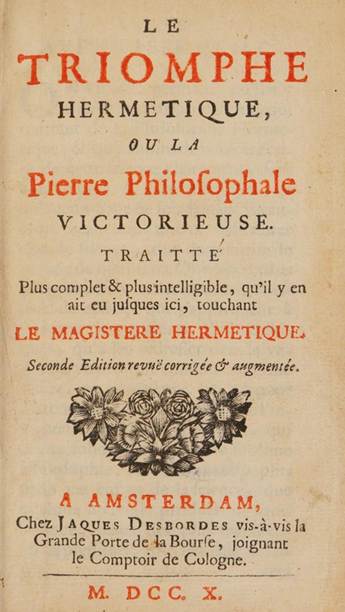
There is a very real likelihood of ancient non mainstream, dare I say it, non-peer reviewed knowledge, being undervalued and forgotten. Some manuscripts have been kept. This one has a publication date of 1710 by Limojon de Saint-Didier, Alexandre-Toussaint {approximately 1630-1689}. These are {inter alia} in the internet archive and at Wellcome Collection library, there are other Alchemical texts.

I have seen a 1699 frontispiece for this.

Peter the Philosopher was made famous by J. K. Rowling. In the Hermetic mercurial tradition, there are references on turning quicksilver into gold. Here silver {quick} is matter and gold is spirit. Transmutation of consciousness is out of gross form to achieve liberation {nirvana} and cease the endless cycle of rebirth and hence death. One never dies again; one ceases to be mortal and hence achieves im-mortality. It does not mean living in meat, incarnate, for ever and ever {or a very long time}. It means not being reborn. No more dying.

Just as in esoteric Vajrayana Buddhism there are Hermetic mandalas:

The symbolism in sketches like this is extensive and cannot be understood entirely rationally. That approach gets nowhere other than intellectual masturbation. The thought form has to be built with care and the consequences of making it, managed in “real” meaty life. It is the battle royal of soul in matter. The Caduceus in not solely two dimensional. People imagine, incorrectly, that the stone, the rock, Pierre is a thing, a talisman, a magic artefact. They may fuck around in a chemistry lab trying to synthesise it.

One can only grasp and attain these mandalas fully when one is ready. Whoever drew this one was no novice….

It is a shame that required orthodoxy often squanders knowledge and burns books. Socio-political position and self-advancement so often overshadows. The powerful often destroy knowledge, wisdom and science if it threatens their power base. Because knowledge is power, in a sense, those in search of mundane power seek to handicap and destroy it. Anything not catholic enough in terms of the papal edicts, whatever shape or form they may be, is ostracised and attacked.

Soon New-speak and The Ministry of Truth rule the roost and all dissidents are punished.

In the kingdom of the blind the one eyed man is king.

This pattern is a historically repeating one.

Sometimes the esoteric can survive in the shadows. Sometimes things are lost for ever. We will never know, by definition, what is lost already.

The orthodoxy always ridicules and talks down, bad mouths, that which does not conform or obey. It has always been thus and it will probably continue to be…