
Arhats Pratyekabuddhas and Bodhisattvas – Hagiography

I have a pet theory that the hagiography of all religions exaggerates and glosses. From knowledge of human behaviour and Chinese whispers, things passed down get embellished so as to confer kudos on the teller, the raconteur. Rarely are things made greyer and more boring. This means that taking things with a pinch of salt might offer some balance.

To the faithful there is nothing quite like a miracle to prove truth and religious figures are given, in narrative, super-human abilities and qualities. These days they would be told with enhanced computer CGI and special effects on a big budget. Bigging up martyrs and buddhas is good PR for the various churches. Who in the past had control of the proles as a raison d’être. The Sacerdotes have always had ritual magic and theatre in their playbook. Simplifying the message to an all fire-consuming hell and blissful pearly-gated paradise could be writ large on the side of big red double decker “Brexit” bus. Nobody could come back to provide a TripAdvisor rating for either holiday destination.

What if all that exaggeration has gotten completely out of hand?

Christianity, depending on flavour has a host of saints. Jesus’ crew, his disciples, are sanctified and portrayed. That depiction has taken place over two millennia. They are represented as holy. When if you think about it, they were learners, disciples, in the act of being taught and trained. Similarly, Buddha’s sixteen {18} arhats are seen as holy, saintly. When they were hanging out listening to Buddha and learning his ideas. It is said they achieved enlightenment. Lessening of burden is enlightenment, full liberation may not be the same as the partial enlightenment.

People pray to the saints and the arhats.

The canon’s of both Buddhism and Christianity were/are written by human beings and therefore by logic are coloured with bias and wishful thinking. There may well be some idealising.

Mahayana promotes the bodhisattva ideal where enlightened or near enlightened beings come back to teach out of the kindness of their hearts for the benefit of all sentient beings. This is seen by some as more worthy. Whereas the haughty arhats are too arrogant to teach, the pratyekabuddhas who do it all by themselves are not sufficiently omniscient to teach. They leave no legacy. They shun the sangha; they are not one of the gang. They are too arrogant, snobby, aloof, to be with normal people. The arhats, perhaps at one with the awesome and austere nature of reality and universe, lack the cosy human compassion are biased against and not as “nice” and the smiling friendly bodhisattva. They cannot be arsed to come back time and time again, the bastards.

People who do not know what these states of consciousness are like, make judgments thereupon. This {scholarly?} interpretation gets incorporated into the ongoing cannon, the creed, the gospel. People like definitions and will roll out comparison between, all knowing, earning bragging rights about something which they do not know. One could look it up in “Buddhism for Dummies”.

Religious thinking likes its “signs”. A rainbow appearing when someone achieves Parinirvana.

What if all these processes are entirely natural, relatively low key and nothing to shout about?

The hagiography diverges from reality…what is natural becomes miraculous. Which may inhibit application. The idea of a miracle is out of reach; the idea of continuous improvement and stepwise attainment is less daunting. Toning it down might increase genuine uptake of practice.,

Status pissing contests are a common human practice and are to be found in religion and science. People like to bullshit each other and pretend to know shed loads.

I have a pet theory that the hagiography of all religions exaggerates and glosses.
How Many Fully Enlightened People Are There?

If you type various versions of this question into Google you see that there are people discussing it on line. I have even seen articles on Buddhism which states that the goal is to achieve nirvāṇa. Buddhism does not have KPIs and personal development planning, nor does your line manager tear you off a strip if you don’t achieve your goals.

I’ll speculate whoever considers nirvāṇa a goal is a long way indeed from said goal. He is in a gaol of Western thinking.

In various school of thought nirvāṇa is when the causal vehicle {Soul or reincarnating Jiva} has been blown off. This means there is no requirement to reincarnate, a strictly human thing. Humans are “bound” to the wheel of rebirth. Someone, some being, who has done that, nirvāṇa, is strictly speaking no longer human. In the context at death the being who has attained nirvāṇa achieves the state of parinirvāṇa at the dissolution of the meaty incarnate form. Thereafter “they” remain formless.

We could get into the gender debate about pronouns. What pronouns do you use for some entity which has no body, no observable physical plane presence? What is the correct pronoun for a fully enlightened Buddha? It?

The problem I have with enlightenment as a concept is that is enlightenment an absolute or a relative term? It might be said that someone got enlightenment, does that mean that they are a fully enlightened Buddha or does it mean that they are little less heavy than before. They have attained a quantum of enlightenment, a bit, one step further up the ladder. They are lighter, less dark and thereby enlightened. To progress one gains enlightenment in a stepwise fashion, realisation by realisation. At nirvāṇa the being is lighter because it no longer has a causal vehicle or personality, notions of self have dissolved. It is enlightened, unburdened.

There is the concept of returning high attainment Bodhisattvas, who on death put off the attainment of parinirvāṇa and come back of their own free will to teach. Because they have no causal vehicle, they create a nirmāṇakāya emanation for such a purpose. If I understand it correctly there may be many of these in the Tulku tradition. Arhats can be seen as selfish because they do not come back. But that is a transference of human personality onto someone who has no self. I have seen it prejudiced that Bodhisattvas are good, and Arhats not so. Human folly, methinks.

In esoteric thinking the end of the causal vehicle comes at the fourth initiation. If one cross references, this is nirvāṇa or blowing off. If I understand it correctly this phenomenon is associated often with physical plane death {but not always}. One gets nirvāṇa and sharpish thereafter parinirvāṇa. In that school of thinking there are a few more stages of development, the other initiations, after doing what Siddartha did in getting planetary nirvāṇa.

One might rephrase the question, “how many fully enlightened beings are there?”

In the esoteric school of thought the fourth degree initiate goes on to take the fifth and become what some call masters. This happens, according to my reading, relatively soon.

I think most people would struggle to envision or envisage a “living” awareness or consciousness in the absence of a physical plane body. So, people invent worlds and dimensions or abodes where they might picture some enveloping form even if that be nebulous. The inventions are inspired by life on earth. Being superstitious people like signs and miracles as circumstantial evidence or proof of nirvāṇa or parinirvāṇa. There must be a rainbow or a comet. If it is a wholly natural part of evolution why would this happen? It is kind of no big deal. There is a desire for sanctity and holiness where they may just be a natural evolutionary process.

The question itself seeks to quantify and scale because people like to compare, to play top trumps.

“My God is better and more real than yours”, being a root of many wars.

Going a step further “are” implies existence or being. Can something exist if there is no form, no measurable lump of meat. If something is formless, is it?

Instead of quantifying we may now rephrase.  “Are there enlightened beings?” “Do they exist?”

“It’s life Jim, but not as we know it!”

Astrobiology and astrochemistry are looking for life in a chemical-biological entity with a physical existence measurable by modern instrumentation. The assumption being that life can only exist in some kind of form, or particularly a corporeal form no matter how small. Science requires a form {and perhaps reproductive urge} as a basic component of life and its definition.

A formless Buddha after paranirvāṇa would not technically be alive according to human definition.

So maybe according to science enlightened beings do not exist.

The answer is therefore zero and not 42….

Which poses the ancillary question does, zero exist or not?

Bakula – Buddhist Arhat – Dream 12-08-2011

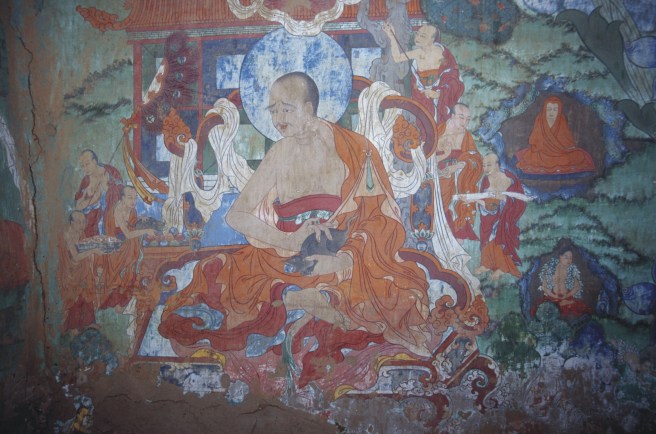
A thangka depicting Bakula, one of Buddha’s sixteen arhats, with his mongoose.

I am in a roof top garden, there is some sort of party going on with loads of people sat around and at tables. There are people of many ethnicities from all over the world. They are dressed in brightly coloured “hippie” style clothes. As the party carries on, they draw a curtain around one part of the garden and gather around some Buddhist icons. A south American man there starts to do some chanting. I butt in with Tibetan deep voice chanting. They do not recognise me and are annoyed at my interruption. I point out to them that it is my garden which they are in. I strike up again and do White Tara. I need a drink of water before I can find my voice. After several cups I strike the right note and do some White Tara. Everyone joins in and after a while the party resumes happily.

The wife and I are in one segment of the garden when Anna L and a friend turn up. They have been travelling in India. She has remained pale but her friend has gone brown. She talks of her travels and I say that we will in time need to have a proper talk. She has something for me. At which point she shoots straight up into the air and then lands. She has brought many “ethnic”, clothes and trinkets.


Next I am on a mountain train. I arrive at a terminus in a hillside town way up in the mountains. It is very much like Nepal / Tibet / Bhutan. I get out of the train and wander along the high street. Turning instinctively to the right I go up a hill to “my” palace. Again, there is a vibrant garden with peacocks. It is “my” garden.


Later I make another journey on the mountain train and end up at another terminus. Here the streets are filled with market traders selling saffron and magenta clothes, together with gold trinkets and jewellery. I have time to explore. Everyone is trying to barter with the merchants trying to buy goods in various currencies. The merchants will not trade unless the currency matches the passport of the person trying to buy.


I am not interested in bartering and look on watching. Somehow, I am “in tune” with the locals. I wander back to the main street and notice various pins sticking in my back. Somehow, I am now in an off the shoulder monk’s robe. One by one I pull the pins out of my back. They are made of a very fine gold pin topped with a tiny ivory chess figure. There is a castle, a knight, a king and a queen. I have also been adorned with much golden jewellery.


I go into an emporium as I am pulling out these pins and sit down. I ask the shopkeeper about what has been happening. She says that they have done this to me so as to make me unattractive to the locals so that they won’t fall for me and want to have sex with me.


Anna L comes into the shop and sits next to me. We start talking about my palace. An old Indian man with very short hair suddenly starts to talk in a very proper English accent. He says that she holds for me a key and that we must find it. It relates back to 1773. He says that I must get back to Bakula.


We leave the shops and seek out the train station. “All trains go through Bakula”, says the station announcer. We look at the map and it is configured like this.

  • Before this dream I had never heard of Bakula nor the sixteen arhats.
  • It is possible that Anna L is dakini.