Here is this morning’s dream / vision.
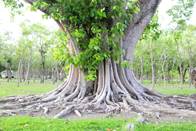
The dream starts with a view of a large, gnarled tree with many visible roots. The tree is effectively dead with no foliage or growth. I know it to be a bodhi tree which has been struck by lightning.
—
—
The tree is in the middle of a temple / monastery courtyard. It is in a square shaped flowerbed sectioned off with stones. The courtyard is very foot worn. Around the edge is a quasi-covered walk way on all four sides. There is one entrance and one exit corridor. The feel is very Tibetan / Himalayan. This tree has lain dormant ever since it was struck by lightning, by a thunderbolt, dorje. There is sun on the tree and despite its state it is tended and looked after.
This morning a young novice monk to whom the job has fallen is weeding and watering the tree. He notices significant new growth which has appeared overnight. There is growth on some of the roots and higher up in the tree. That growth has been caused by me and my arrival on the planet. The young monk is very excited and runs to find someone to tell. Soon there are a few monks there looking and chattering excitedly. They look up to the sky and to the South they can see a rainbow just below the clouds. The rainbow is feint but persistent. There is much excitement, which increases.
I wake up for a loo break it is 4:30 AM.
In between sleep and wake, I become very aware of the 17th Gyalwa Karmapa in my full visual and mental field. It is as if we are some how joined twinned or connected. The feeling is guttural. They have started some kind of pre-dawn / dawn ritual in honour of the Parinirvana of Siddhartha. They are in a planetary sense to the East of me. There is chanting and those awful horns. I can hear and feel the ritual as if I am there in the hall with them. The visual image of the 17th persists and it is even here slightly as I type. It is clear that something is up / happening. I wonder if the Dalai Lama is dying but search for him and can still find the feeling of him, so am reassured. The ritual goes on and I know in one sense it is connected with me.
I drift off.
I am shown D whom I knew ~ 20 years ago. He is bloated and unwell. He is filled with anger and even hatred towards me. I can see his bloated bare stomach upon which are written the positions by number of each of the 64 I Ching hexagram numbers. They are medical points. I know that he has misused Dao and that he has been taught dark Dao and it has taken seed in him and others. The only chance that they have is to use the I Ching medically to reverse and impede the spread of bad-Dao. I am the key.
The scene changes and I am in the garden outside my office here. I can hear some noises up by the purple rhododendron. Out of sight I can hear munching. I catch sight of a grey spotted foal and her mother a dark brown horse. So as not to scare them I move very quietly. I know they are windhorses or lungta. They jump up and run along the top of our hedges down towards the river. The foal stops and takes a snack on the maple. As they approach the river they are joined by two more white adult horses. Together all four of them ride off along the tops of the French oaks by the river. They are not touching the oaks but flying and galloping in the air.
I am now in communication with some being which says that I am of Nāgārjuna with the j being specific. That I am of the nāgas and nāgarājas. That is my source and my belonging. I am of Nāgārjuna. The role of the nāgas is not yet understood.
The dream ends.
——————————–
Notes:
Nāgārjuna (Sanskrit: नागार्जुन, Nāgārjuna; c. 150 – c. 250 CE) was an Indian monk and Mahāyāna Buddhist philosopher of the Madhyamaka (Centrism, Middle Way) school. He is widely considered one of the most important Buddhist philosophers.
Nāgārjuna is widely considered to be the founder of the Madhyamaka school of Buddhist philosophy and a defender of the Mahāyāna movement. His Mūlamadhyamakakārikā (Root Verses on Madhyamaka, MMK) is the most important text on the Madhyamaka philosophy of emptiness. The MMK inspired a large number of commentaries in Sanskrit, Chinese, Tibetan, Korean and Japanese and continues to be studied today.
From Wikipedia
 Dreamyoga