Bodhisattva

This from Britannica on line.

Click here

bodhisattva, in Buddhism, one who seeks awakening (bodhi)—hence, an individual on the path to becoming a buddha.

Pali: bodhisatta (“one whose goal is awakening”)

In early Indian Buddhism and in some later traditions—including Theravada, at present the major form of Buddhism in Sri Lanka and other parts of Southeast Asia—the term bodhisattva was used primarily to refer to the Buddha Shakyamuni (as Gautama Siddhartha is known) in his former lives. The stories of his lives, the Jatakas, portray the efforts of the bodhisattva to cultivate the qualities, including morality, self-sacrifice, and wisdom, which will define him as a buddha. Later, and especially in the Mahayana tradition—the major form of Buddhism in Tibet, China, Korea, and Japan—it was thought that anyone who made the aspiration to awakening (bodhicittotpada)—vowing, often in a communal ritual context, to become a buddha—is therefore a bodhisattva. According to Mahayana teachings, throughout the history of the universe, which had no beginning, many have committed themselves to becoming buddhas. As a result, the universe is filled with a broad range of potential buddhas, from those just setting out on the path of buddhahood to those who have spent lifetimes in training and have thereby acquired supernatural powers. These “celestial” bodhisattvas are functionally equivalent to buddhas in their wisdom, compassion, and powers: their compassion motivates them to assist ordinary beings, their wisdom informs them how best to do so, and their accumulated powers enable them to act in miraculous ways.

Avalokiteshvara

Bodhisattvas are common figures in Buddhist literature and art. A striking theme in popular literature is that of the concealed greatness of the bodhisattvas. In numerous stories ordinary or even distinctly humble individuals are revealed to be great bodhisattvas who have assumed common forms to save others. The lesson of these tales is that, because one can never distinguish between paupers and divinities, one must treat all others as the latter. In popular folklore bodhisattvas appear as something like saviour deities, a role they acquired both through the evolution of earlier ideas and through fusion with already existing local gods.

Buddhism: Celestial buddhas and bodhisattvas

A particularly important mythology in East Asia is that of Dharmakara. According to the Pure Land Sutra, Dharmakara was a bodhisattva whose vows were realized when he became the Buddha Amitabha. Pan-Buddhist bodhisattvas include Maitreya, who will succeed Shakyamuni as the next buddha in this world, and Avalokiteshvara, known in Tibet as Spyan ras gzigs (Chenrezi), in China as Guanyin (Kuan-yin), and in Japan as Kannon. Although all bodhisattvas act compassionately, Avalokiteshvara is considered the embodiment of the abstract principle of compassion. Bodhisattvas of more localized importance include Tārā in Tibet and Jizō in Japan.

Revisiting the “Thai” Incarnation – Ong Bak

I mentioned earlier in the blog that around 2003 I started having visions of myself as Buddhist priest / monk with om mane padme hum tattooed on my forearms in Sanskrit. This tattooing suggested the Sak Yant of Thai, Laos, Vietnam, Cambodia / Burma, I could not see the colour of the robes in those visions but was certain that the calligraphy was not Tibetan.

More recently I had an “Indochina” dream, a link is below.

One could say that the Buddhist Muay Thai dream resulted from me watching Tony Jaa in the early Ong Bak films. But I don’t think so.

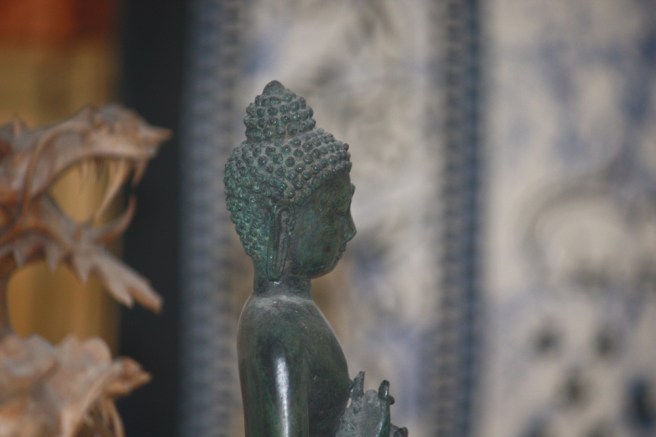
As a regular user of Watkins books where one can find much on “spirituality” I frequented Cecil Court near Trafalgar Square, London. There was an artefact shop opposite. There I purchased this Buddha / Avalokiteśvara. He is sitting in our hallway to this day.

At the time I was talking with a chemistry student during her final year research project on statute patinas joint with The Royal College of Art. The shop has moved probably to Camden. I had a long conversation with proprietor about how the village from which he sourced the statuettes used special techniques to create ancient looking patinas.

Many years later following on from a dream I visited a Thai Forest Buddhist centre, Cittaviveka, also known as Chithurst Buddhist Monastery. This was not far from where we lived in the UK.

When I had the “Thai” dream in 2023 I was genuinely quite surprised because I had mentally ruled out Indochina. But today that notion has again resurfaced. The hair-do on the statute is very Indochina – style. I have said “Thai” but it could be elsewhere on the peninsula.

The Buddhist thread is linked to the pen-pal of the wife’s mother who was the daughter of a Sri Lankan ambassador and a Pali Scholar, the author of a Pali dictionary and important to the spread of Buddhism to London. This is the Theravada link.

The monk I spoke with at Cittaviveka had looked after Christmas Humphreys. A key figure in bringing Buddhism and meditation to London.

In that dream for the first time, “I am wearing only some saffron-yellow trousers.” I am clearly Asian.

Hmnn…

More Tibetan Phrase Dream Follow Up

“I start out on my route and part the way along in or near Mongolia I am given two white plaques of an irregular shape. Phonetically these plates speak in the dream. They say, “Mon yet {yat} Dzong” and “Sprul yet Tsaay” I can see the associated Tibetan script but cannot associate it directly with the phonetics.”

—————————————————————————-

The name “Khyentse,” often equated with the Rimé movement, is the union of two Tibetan words, khyen (མཁྱེན་པ་,“ken,” or sometimes “chen”) and tsé (བརྩེ་བ་, “tsay”), meaning “wisdom” and “compassion.”

From web site of Dzongsar Jamyang Khyentse Rinpoche

————————————————————————————–

“Sprul yet Tsaay”

ཡེ – primordial – ye or je

བརྩེ་བ – compassion – tsay

—————

ཡེ

waldo1) first, primordial, beginning, original, eternal[ly] fundamental; 2) always, constant
valbyfrom the beginning, from eternity, utterly, perfectly, highly, quite, from the very beginning, principle of light & being, basic
barrontimeless; atemporal

བརྩེ་བ

rangjungbenevolent, affection, compassion, love, merciful, care for. love; to love (v); loving kindness; to love/ feel affection; to love, love, kindness, to count up, mercy, affection, playing with; {brtse ba, brtse ba, brtse ba} intr. v.; ft. of {rtse ba}
waldo1) will play [f rtse ba]; 2) (Tha mi dad pa,, 1 be unbearable; 2) affection, compassionate, pity, [p brtses],, love, have concern/ compassion, merci[ful], kind[ness], benevolent affection, compassion, love, care for, count up, play w
valbyresponsive, kindness, tenderness, benevolent, affection, compassion, love, merciful, mercy, fervent love

སྤྲུལ་

Sprul

Hopkins 2015send forth an emanation; emanate; emanation
Rangjung Yeshecreated, ཡིད་ mentally. emanated, “incarnated”, apparitional, magical, emanating, emanation, nirmanakaya, miraculous, transformed [into], manifested. vi. to change / transform [miraculously]; imp. of སྤྲུལ་བ་
Hackett Defi­nitions 2015(PH) snake
James Valbyjuggle, make phantoms appear, transform creation, emanating, recasting oneself, snake, 1 of ‘jigs pa rnam par brgyad, abbr for sprul sku
Ives Waldo1) mentally created/ emanated [as]; 2) incarnated; 3) apparitional, magical, miraculous, transformed [~into] emanated[ing][tion]; 4) nirmanakaya; 5) manifest, change/ transform [miraculously]

སྤྲུལ་ ཡེ བརྩེ་བ

Sprul ye tsay

Emanation of primordial compassion

————————————————

Avalokiteshvara or  Avalokiteśvara

In Buddhism, Avalokiteśvara (meaning “the lord who looks down”, also known as Lokeśvara (“Lord of the World”) and Chenrezig (in Tibetan), is a tenth-level bodhisattva associated with great compassion (mahakaruṇā). He is often associated with Amitabha Buddha.

Wikipedia

Avalokiteshvara (Skt. Avalokiteśvara; Tib. སྤྱན་རས་གཟིགས་ or སྤྱན་རས་གཟིགས་དབང་ཕྱུག, Chenrezik or chenrezig wangchuk, Wyl. spyan ras gzigs or spyan ras gzigs dbang phyug) is said to be the essence of the speech of all the buddhas and the incarnation of their compassion.

As one of the Eight Great Close Sons, he is usually depicted as white in colour and holding a lotus.

He is of special importance to Tibetans, so much so that he is sometimes described as the patron deity of Tibet. Among his emanations are King Songtsen Gampo—who is credited with authoring the Mani Kabum, a cycle of teachings and practices dedicated to the deity—as well as the lineages of Dalai Lamas and Karmapas.

Rigpa Wiki