
A Discovery of Witches – Thread

Whilst I was in hospital I came upon this UK TV series on Netflix. It seemed that I had already started watching it according to Netflix. I did not recall this.  So I started to watch again. So far it is enjoyable.

———————————————–

A Discovery of Witches is a British fantasy television series based on the All Souls Trilogy by Deborah Harkness, named after the first book in the trilogy.

Diana Bishop, a historian and reluctant witch, unexpectedly discovers a bewitched manuscript in Oxford’s Bodleian Library. This discovery forces her back into the world of magic in order to unravel the secrets it holds about magical beings. She is offered help by a mysterious biochemist and vampire Matthew Clairmont. Despite a long-held mistrust between witches and vampires, they form an alliance and set out to protect the book and solve the mysteries hidden within while dodging threats from the creature world.

—-

Discovery of Witches is a 2011 historical-fantasy novel and the debut novel by American scholar Deborah Harkness. It follows Diana Bishop, a history of science professor at Yale University, as she embraces her magical blood after finding a long-thought-lost manuscript and engages in a forbidden romance with a charming vampire, Matthew Clairmont.

When Diana Bishop returns to Oxford University, her life is flipped upside down. While researching in the library, Diana requests a book called Ashmole 782. This manuscript, also known as the Book of Life, has been missing for over 150 years. As soon as Diana touches the ancient manuscript, her powers are activated. Frightened by her clear cosmic connection to Ashmole 782, Diana returns the book. It appears, however, that her discovery had already caught the attention of other creatures, which results in a series of events that slowly brings her witch heritage and family back into her life.

—————————————————–

Diana is  cast as a young academic investigating Alchemy partly autobiographically inspired on behalf of the author. The first few episodes are very good for Oxford university tourism. The photography is top notch.

Ashmole was a founder member of The Royal Society and this is his coat of arms.

Note Hermes bearing the golden Caduceus top right. Note also the Breton symbol around the lower central panel.

Aside from founding the Ashmolean museum he is famous for collecting things like this:

Theatrvm chemicvm britannicum : containing severall poeticall pieces of our famous English philosophers, who have written the hermetique mysteries in their owne ancient language

by Ashmole, Elias, 1617-1692; Cross, Thomas, fl. 1632-1682; Vaughan, Robert, 17th cent; Goddard, John, fl. 1645-1671

Given where I did my Ph.D. and my interest in things witchy and Alchemy related I have found something to look into a bit while I recuperate.

A new thread to explore?
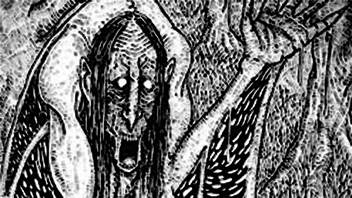
Granny Was a Gwrach…

————————————-

Gwrach y Rhibyn

The legend of the cyhyraeth is sometimes conflated with tales of the Gwrach-y-Rhibyn or Hag of the Mist, a monstrous Welsh spirit in the shape of a hideously ugly woman – a Welsh saying, to describe a woman without good looks, goes, “Y mae mor salw â Gwrach y Rhibyn” (she is as ugly as the Gwrach y Rhibyn) – with a harpy-like appearance: unkempt hair and wizened, withered arms with leathery wings, long black teeth and pale corpse-like features. She approaches the window of the person about to die by night and calls their name, or travels invisibly beside them and utters her cry when they approach a stream or crossroads, and is sometimes depicted as washing her hands there. Most often the Gwrach y Rhibyn will wail and shriek “Fy ngŵr, fy ngŵr!” (My husband! My husband!) or “Fy mhlentyn, fy mhlentyn bach!” (My child! My little child!), though sometimes she will assume a male’s voice and cry “Fy ngwraig! Fy ngwraig!” (My wife! My wife!).

If it is death that is coming, the name of the one doomed to die is supposed to be heard in her “shrill tenor”. Often invisible, she can sometimes be seen at a crossroad or a stream when the mist rises.

Some speculation has been asserted that this apparition may have once been a water deity, or an aspect of the Welsh goddess Dôn. She is the wife of Afagddu, the despised son of Ceridwen and Tegid Foel, in some retellings of the Taliesin myth.

From Wikipedia

—————————————-

If I were to show you the autocorrelation traces of two femtosecond laser pulses on an expensive oscilloscope in a dark laser lab it us unlikely that you would be thinking of the witch, the hag of the mist, Gwrach-y-Rhibyn. The two things do not correlate for most.

A part of my maternal family hails from Snowdonia, the foot of Snowdon,  in North Wales and the family legend has it that at least one of my maternal relatives, a granny of sorts, was a Gwrach, a witch, perhaps a seeress. In that context then there is a chance that I inherited the bloodline and hence the “gift” so to speak. As such it was entirely natural {and perhaps inevitable} that I would be interested in shamanism and shamanic ritual.

Of course in terms of someone able to write Fortan programs to calculate Franck Condon factors for anharmonic oscillator molecular vibronic photon excitations that seems far-fetched.

Contextually the vice versa might apply. Why would a shaman piss about with fancy lasers and science?

In Brittany there remains an interest in {and perhaps practice of} witchcraft. This is no way freaks me out. It is possible the practises here were sourced in the Welsh diaspora arriving. They are of similar roots.

I’ll speculate that a blog post like this would not enhance my promotion prospects were I still institutionalised in science academia.

I have always loved the mist and the fog. I nearly died on The Old Man of Coniston once. I was alone and following crows up a trail in the snow deep into the fog, alone on the mountain. It was exciting. Luckily before I got completely lost in the otherworld, I turned back. I have had much similar fun on Kinder Scout in dense fog. There is something womb-like and enveloping.

Of a still and misty night, when the full moon is partially veiled and you heard a voice at your window calling your name, what would you do.

Could you take secure refuge in the omniscience of your infallible reason?

Or would your blood run cold?