Bodhisattva

This from Britannica on line.

Click here

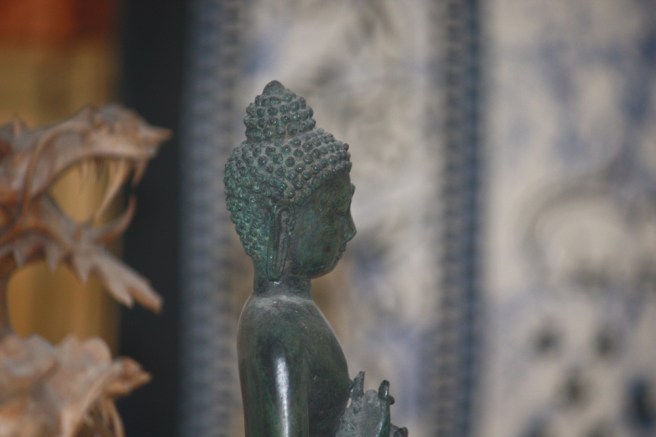
bodhisattva, in Buddhism, one who seeks awakening (bodhi)—hence, an individual on the path to becoming a buddha.

Pali: bodhisatta (“one whose goal is awakening”)

In early Indian Buddhism and in some later traditions—including Theravada, at present the major form of Buddhism in Sri Lanka and other parts of Southeast Asia—the term bodhisattva was used primarily to refer to the Buddha Shakyamuni (as Gautama Siddhartha is known) in his former lives. The stories of his lives, the Jatakas, portray the efforts of the bodhisattva to cultivate the qualities, including morality, self-sacrifice, and wisdom, which will define him as a buddha. Later, and especially in the Mahayana tradition—the major form of Buddhism in Tibet, China, Korea, and Japan—it was thought that anyone who made the aspiration to awakening (bodhicittotpada)—vowing, often in a communal ritual context, to become a buddha—is therefore a bodhisattva. According to Mahayana teachings, throughout the history of the universe, which had no beginning, many have committed themselves to becoming buddhas. As a result, the universe is filled with a broad range of potential buddhas, from those just setting out on the path of buddhahood to those who have spent lifetimes in training and have thereby acquired supernatural powers. These “celestial” bodhisattvas are functionally equivalent to buddhas in their wisdom, compassion, and powers: their compassion motivates them to assist ordinary beings, their wisdom informs them how best to do so, and their accumulated powers enable them to act in miraculous ways.

Avalokiteshvara

Bodhisattvas are common figures in Buddhist literature and art. A striking theme in popular literature is that of the concealed greatness of the bodhisattvas. In numerous stories ordinary or even distinctly humble individuals are revealed to be great bodhisattvas who have assumed common forms to save others. The lesson of these tales is that, because one can never distinguish between paupers and divinities, one must treat all others as the latter. In popular folklore bodhisattvas appear as something like saviour deities, a role they acquired both through the evolution of earlier ideas and through fusion with already existing local gods.

Buddhism: Celestial buddhas and bodhisattvas

A particularly important mythology in East Asia is that of Dharmakara. According to the Pure Land Sutra, Dharmakara was a bodhisattva whose vows were realized when he became the Buddha Amitabha. Pan-Buddhist bodhisattvas include Maitreya, who will succeed Shakyamuni as the next buddha in this world, and Avalokiteshvara, known in Tibet as Spyan ras gzigs (Chenrezi), in China as Guanyin (Kuan-yin), and in Japan as Kannon. Although all bodhisattvas act compassionately, Avalokiteshvara is considered the embodiment of the abstract principle of compassion. Bodhisattvas of more localized importance include Tārā in Tibet and Jizō in Japan.

Arhats Pratyekabuddhas and Bodhisattvas – Hagiography

I have a pet theory that the hagiography of all religions exaggerates and glosses. From knowledge of human behaviour and Chinese whispers, things passed down get embellished so as to confer kudos on the teller, the raconteur. Rarely are things made greyer and more boring. This means that taking things with a pinch of salt might offer some balance.

To the faithful there is nothing quite like a miracle to prove truth and religious figures are given, in narrative, super-human abilities and qualities. These days they would be told with enhanced computer CGI and special effects on a big budget. Bigging up martyrs and buddhas is good PR for the various churches. Who in the past had control of the proles as a raison d’être. The Sacerdotes have always had ritual magic and theatre in their playbook. Simplifying the message to an all fire-consuming hell and blissful pearly-gated paradise could be writ large on the side of big red double decker “Brexit” bus. Nobody could come back to provide a TripAdvisor rating for either holiday destination.

What if all that exaggeration has gotten completely out of hand?

Christianity, depending on flavour has a host of saints. Jesus’ crew, his disciples, are sanctified and portrayed. That depiction has taken place over two millennia. They are represented as holy. When if you think about it, they were learners, disciples, in the act of being taught and trained. Similarly, Buddha’s sixteen {18} arhats are seen as holy, saintly. When they were hanging out listening to Buddha and learning his ideas. It is said they achieved enlightenment. Lessening of burden is enlightenment, full liberation may not be the same as the partial enlightenment.

People pray to the saints and the arhats.

The canon’s of both Buddhism and Christianity were/are written by human beings and therefore by logic are coloured with bias and wishful thinking. There may well be some idealising.

Mahayana promotes the bodhisattva ideal where enlightened or near enlightened beings come back to teach out of the kindness of their hearts for the benefit of all sentient beings. This is seen by some as more worthy. Whereas the haughty arhats are too arrogant to teach, the pratyekabuddhas who do it all by themselves are not sufficiently omniscient to teach. They leave no legacy. They shun the sangha; they are not one of the gang. They are too arrogant, snobby, aloof, to be with normal people. The arhats, perhaps at one with the awesome and austere nature of reality and universe, lack the cosy human compassion are biased against and not as “nice” and the smiling friendly bodhisattva. They cannot be arsed to come back time and time again, the bastards.

People who do not know what these states of consciousness are like, make judgments thereupon. This {scholarly?} interpretation gets incorporated into the ongoing cannon, the creed, the gospel. People like definitions and will roll out comparison between, all knowing, earning bragging rights about something which they do not know. One could look it up in “Buddhism for Dummies”.

Religious thinking likes its “signs”. A rainbow appearing when someone achieves Parinirvana.

What if all these processes are entirely natural, relatively low key and nothing to shout about?

The hagiography diverges from reality…what is natural becomes miraculous. Which may inhibit application. The idea of a miracle is out of reach; the idea of continuous improvement and stepwise attainment is less daunting. Toning it down might increase genuine uptake of practice.,

Status pissing contests are a common human practice and are to be found in religion and science. People like to bullshit each other and pretend to know shed loads.

I have a pet theory that the hagiography of all religions exaggerates and glosses.

Gelugpa Wrasse – Dreams and Snippets 21-02-2025

The first thing to say here is that what follows is inordinately difficult to verbalize.

Leading up to the last few days and despite numerous appearances of Tibetan based themes in dreaming I have been fairly certain that I have never had a Tibetan-Bhutanese-Nepalese incarnation. In whatever visions or dreams I have had with a Buddhist flavour I have never been wearing the maroon robes of that locality and certainly never any groovy hats.

Nevertheless, the tulku {or nirmāṇakāya} phenomenon has been resident at the periphery. I have never had the Mahayana urge or thought form pertaining to a bodhisattva training journey of coming back for the benefit of all sentient beings, to teach and to aid. This idealised wish form projected onto would be bodhisattvas seems a human thing and potentially prevents beings from leaving when they ought to be exiting the wheel of rebirth. “Please don’t leave us”, is not an empowering or enabling sentiment.

A few days ago, in the twilight between sleep and wakefulness I had a few images of me dressed in maroon monks robes with a yellow hat characteristic of the Gelug lineage of Tibetan Buddhism. I was surprised. It was a “turn up for the books” and does not fit with my hypothetical chronology. The only Tibetan stuff I have felt akin with are the tales of Chögyam Trungpa though I met at a distance Akong Rinpoche. Their relationship was complex if I understand it correctly. I have a hypothesis as to why Trungpa resonated.

What is safe to say is that the thought-forms associated with and to centuries old Buddhist traditions, studied and recited by thousands are firm, almost solid. The lineage has a “mind” all of its own, nurtured by devotees of and with a ruthless and tireless devotion. It exists in the mental and emotional space of humanity. People reciting and chanting for centuries make something almost tangible in a physical sense. The traditions and practice are kept vital and alive by regular enactment, quasi-archaic though they may be. They are alive.

Newtonian mechanics dominated the human psyche to be improved upon around a century ago for microscopic systems. Yet Newton is useful to this day in our everyday reality. These mechanics are a part of the mental space of humanity. They have merit. They work. There is a loose analogy.

This morning, I had a brief dreaming sequence in which I encountered a fish in a tank. The tank was large, beautiful and with coral. The fish was an ocean going wrasse. It introduced it self as a Gelugpa Wrasse. It told me that even if I had been previously associated with the Gelug, there was no place for me therein in this life. Such a thing would be way too disruptive. The wrasse was calm and relaxed. It was just conveying without colouration.

It said that way back in the 1990s in Switzerland there had been a possibility but life circumstances had scuppered that. “Not to worry”, it said. It showed me some images of Bern.

I struggled to hold more of the dream but the wrasse part remained clear. Fish is the dreaming symbol for awareness or the need to be wide awake. The wrasse was pretty enough though contained in a tank. It was not free.

I am not sure what to make of it.

Last night we watched the Netflix programme “Adolescence” in which life for a family changes dramatically overnight. It was very good and left one with a breathless reminder of how normality can be completely flipped in a matter of hours.

We have had a few flips over the years.

Freaky Friday, an equinox talking with fish again…

Buddha Pronounces the Sūtra of the Total Annihilation of the Dharma

This prompted by my dream see previous post.


Translated from Sanskrit into Chinese

by

An Unknown Person

Thus I have heard:

    At one time the Buddha, together with bhikṣus and Bodhisattvas, was staying in the city kingdom of Kuśinagara, where He would enter parinirvāṇa in three months. Countless multitudes came to the Buddha and bowed their heads down to the ground. Surrounded by His devotees longing to hear the Dharma, the World-Honored One remained silent, and His radiance did not manifest.

    The venerable Ānanda made obeisance to the Buddha and asked Him, “When the World-Honored One pronounces the Dharma, His awesome radiance is always displayed before and after. Now in this huge assembly, His radiance does not appear. Why is this so? There must be a reason. I pray to hear its implication.”

    The Buddha remained silent, not responding. After Ānanda asked this question for the third time, the Buddha told Ānanda, “After my parinirvāṇa, as the Dharma comes to an end, the way of the māras will thrive in this world of the five turbidities. Māras will appear as śramaṇas so as to undermine and destroy my Way. They will wear lay clothes and delight in the monk’s robe dyed with a mixture of five colors. To gratify ravenous appetites, they will drink alcohol, eat flesh, and kill sentient beings. Devoid of lovingkindness, they will hate and envy others.

    “At that time, there will be Bodhisattvas, Pratyekabuddhas, and Arhats, who energetically cultivate virtue and treat all with respect. Esteemed by all, they will teach and transform others impartially. They will pity the poor and old, and help the needy and unfortunate. They will teach others to revere and uphold the sūtras and the holy images. Kind and benevolent in nature, they will do meritorious karmas. Never harming others, they will disregard any harm to themselves in order to help others. Kind and friendly, they will endure abuse, not protecting themselves.

    “Although there will be such good people, all māra bhikṣus will be jealous of them. They will slander, malign, and banish them. Afterward, individually and as a group, the māra bhikṣus will not cultivate virtue. Temples will be deserted, falling into disrepair then into ruins. Greedy for material wealth, they will accumulate things, not using them to acquire merit. They will sell slaves to work in the fields. Devoid of lovingkindness, they will burn mountain forests, harming sentient beings. Male slaves will become bhikṣus, and female slaves will become bhikṣuṇīs. Devoid of morality, they will engage in sexual debauchery and perversion, whether with men or women. Such people will cause my Way to fade away.

    “Some of them will seek sanctuary in my Order to escape prosecution by the law. They will become śramaṇas but will not observe the precepts or regulations. Although they will, in appearance, recite the precepts on new-moon and full-moon days, they will be reluctant and indolent, not wanting to hear the recitation. They will omit some precepts, not wanting to recite all of them. They will not recite or study the sūtras. If there are readers who do not know the words [in the sūtras], they will claim that they know them. They will not consult the learned ones, but will instead seek fame for self-elevation. They will glorify themselves with fake elegant ways, expecting offerings from others. For committing any of the five rebellious sins, after death, these māra bhikṣus will fall into the hell of uninterrupted suffering. They will then be reborn as animals or hungry ghosts for as many kalpas as the sands of the Ganges. After their sins have been purged, they will be reborn [as humans] in a fringe country where the Three Jewels will not be accessible.

    “When the Dharma is ending, women will diligently do meritorious karmas while men will be indolent and arrogant. Men, having no faith, will not use the words in the Dharma, but will regard śramaṇas as feces and dirt. When the Dharma is ending, gods will shed tears. Flood and drought will ravage, and five kinds of grain will not ripen. Epidemics will be prevalent and many will die. People will endure a hard life, and government officials will exploit them. People will not follow good principles, thinking only of pleasure and strife. The evil ones will become as numerous as the sands in the sea. The good ones will decrease to one or two. As a kalpa is ending, the sun and the moon will be unstable and human lifespan will shorten. At the age of 40, one’s hair will turn white. Men indulging in sexual acts may die prematurely from depletion of their semen, or may live to only 60. While men will live short lives, women will live long to 70, 80, 90, or even 100 years. Faithless people will say that the situation can be permanent.

    “A massive flood will suddenly rise, lasting endlessly. Various species of sentient beings, lofty or lowly, will drown or drift in the waters, and they will be eaten by fish and other sea creatures. Bodhisattvas, Pratyekabuddhas, and Arhats, driven away by the māras, will not convene. [These holy beings of] the Three Vehicles will enter the meritorious grounds in the mountains. There they will live a long life, tranquilly biding their time. They will meet with one another when the god-kings escort Moonlight Bodhisattva to appear in the world. Together they will revitalize my Dharma for fifty-two years.

    “Then the Śūraṅgama Sūtra and the Pratyutpanna Buddha Sammukhāvasthita Samādhi Sūtra will be destroyed, to be followed by all other sūtras in the twelve categories. Their words will not be seen again. The monk’s robe will naturally turn white. When my Dharma perishes, it will be like [the flame of] an oil lamp. When it is dying, its light becomes brighter for a while then dies out. When my Dharma perishes, it will be like the extinction of a lamp. What will happen afterward is hard to describe. Eventually, after tens of millions of years, Maitreya Bodhisattva will descend to this world to become a Buddha. All toxic gases will then be eliminated, and the world will be safe and peaceful. The rains will be harmonious and the five grains will thrive. The trees will be tall, and humans will each be eighty feet tall, with a lifespan of 84,000 years. Innumerable sentient beings will be delivered.”

    The venerable Ānanda made obeisance to the Buddha and asked Him, “What should we call this sūtra? How should we uphold it?”

    The Buddha replied, “Ānanda, this sūtra is called Total Annihilation of the Dharma. Pronounce it to all and let them know its significance. Your merit will be immeasurable, beyond reckoning.”

    The four groups of disciples, having heard this sūtra, were distressed and downcast, but they all activated their resolve to attain the unsurpassed bodhi. Then they made obeisance to the Buddha and departed.