
140 keV Gamma “Ray” Bone Scans…

My rate of emission of 140 keV photons is now down to lower levels, five radioactive half lives after injection. The concentration has been reduced by biological elution and the radioactivity by decay. It was interesting to read how few suppliers there were for 99mTc. Yesterday, she only injected a few millilitres of tracer.

I have been reading up and watching videos on the interpretation of bone scans, I can probably note metastatic lesions, depletion in tracer localisation due to prothesis, fractures (old and new), areas of bone formation and depletion. It might be interesting to see what my damaged cervical spine looks like and if my “broken” ribs from rugby can be seen.  Osteophytes are evident on my thoracic spine and near my Titanium pin. The Diffuse Idiopathic Skeletal hyperostosis (DISH) is probably still growing and could localise tracer. {I had a full body scan.} This, if seen, can be cross referenced with an upcoming CT scan.

There could be plenty in my scans for a nuclear medicine professional to discuss with her younger colleagues.

I meet some of the diagnostic criteria for polycythaemia (probably secondary). If it is the malignant form this may interfere with bone cycling in the marrow and could appear in the scintigraphy. There are a few suggestions in the literature to use nuclear medicine to detect this. But it is not common practice.

I guess the single-photon emission computed tomographic (SPECT) images might show something like this below. My hip arthritis is much worse than in the X-ray or CT images below. It does not look like a whole lot of extra knowledge comes from the SPECT data for the hip.

——————————————————
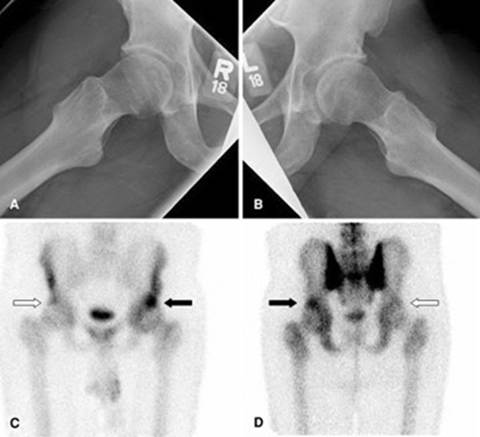
Dunn’s view of (A) right and (B) left hips of a 48-year-old male patient presenting with left hip pain only. Single-photon emission computed tomographic images shown in (C) anterior and (D) posterior coronal views display more uptake (black arrow) along the superolateral aspect of the acetabular roof on the symptomatic left hip compared with the asymptomatic right hip (white arrow).

Clin Orthop Relat Res. 2008 Dec 17;467(3):676–681

—————————————————————————–

What might however be interesting is what tips up in the rest of the body scan. The pain in my lower and mid lumbar spine has been explained in different ways by different doctors.  There might be clues as to what is going on.

I guess what I do not want to see is evidence for primary bone cancer or metastatic disease. The main diagnostic differentiation of the latter is a disordered or “random” appearance of tracer localisation. Metastatic disease is incurable and often terminal.

I have joked that I could re-train as a radiographer or a nuclear medicine operator. But you know what they say about old dogs.

It is weird, I feel very up in the air, with little or no idea if/when I will get to see the data. Something which could change the direction of life is hanging ill-defined in the aether. I am in a kind of limbo.

I wonder if people who prescribe scans have ever had to wait and hang like this…

Maybe it should be a compulsory part of training…

Pandora, what does two plus two equal?

————————————–

“A bone scan or bone scintigraphy is a nuclear medicine imaging technique used to help diagnose and assess different bone diseases. These include cancer of the bone or metastasis, location of bone inflammation and fractures (that may not be visible in traditional X-ray images), and bone infection (osteomyelitis).

————————————-

The most common radiopharmaceutical for bone scintigraphy is 99mTc with methylene diphosphonate (MDP). Other bone radiopharmaceuticals include 99mTc with HDP, HMDP and DPD. MDP adsorbs onto the crystalline hydroxyapatite mineral of bone. Mineralisation occurs at osteoblasts, representing sites of bone growth, where MDP (and other diphosphates) “bind to the hydroxyapatite crystals in proportion to local blood flow and osteoblastic activity and are therefore markers of bone turnover and bone perfusion”.”

From Wikipedia

——————————————

I have not long returned from the Nuclear Medicine suite at Yves Le Foll hospital Saint Brieuc. The pretext from my bone scan was to look at where there might be inflammation in my right femoral head / neck and hip prior to an operation. The first orthopaedic surgeon, who prescribed the scan, suggested that it might be done with an Iodine radio-tracer. That is not for bones. He became a little flustered when questioned and pressed on the subject. The second orthopaedic surgeon questioned why he might even order such a test. It seemed incongruous to him.

Nobody in France has yet mentioned the C word! Looking in Pandora’s box can have unexpected results. They could be doing a “Basil Fawlty”.

At the end of my scan today the operatives in the control room were all looking intently at my images, pointing and talking animatedly. Before the scan they did not help me onto the scanner table, after it they were very helpful with the dismount. The images changed behaviour. I was not privy to my gamma ray “only fans” content which had them talking. The secretary suggested that I will get the results in a letter at some unspecified time in the future. The results will go to the first orthopaedic surgeon and my GP.

The following outcomes are possible:

1)  The results simply show osteo-arthritic frictional inflammation in the bony tissues. What I call the pepper mill effect. In which case I will get the results through the post and I can take a good scooby at them myself.

2) There is a long delay during which a conflab occurs. I do not get the results in a timely fashion, some other follow up plan is hatched. Something needing to be followed up has been found.

3) I get a telephone call to tell me bad news. I am being followed for elevated prostate specific antigen and have had colon cancer. There are anomalies in my blood work.

4) The results arrive in a tardy fashion with bad news therein, before anyone contacts me.

This is what the Canadian Cancer Society says:

————————————-

Société canadienne du cancer

La scintigraphie osseuse aide les médecins à diagnostiquer et à évaluer différentes maladies et affections osseuses. On peut y avoir recours pour:

  • trouver un cancer des os ou déterminer si un cancer présent dans une autre région s’est propagé aux os;
  • aider à diagnostiquer la cause ou à déterminer l’emplacement d’une douleur osseuse inexpliquée;
  • aider à diagnostiquer des fractures osseuses qui ne sont pas évidentes à la radiographie;
  • voir jusqu’où le cancer s’est propagé;
  • trouver des lésions osseuses causées par une infection ou d’autres affections osseuses;
  • savoir si le traitement du cancer est efficace ou pour faire un suivi.

————————————————-

Obviously, they are going to have a cancer bias. My gut feeling is that people are not being 100% straightforward with me. My gut feelings are often with substance. The French can beat around the bush so to speak.

Waffle, moi?

Whatever the outcome, knowing what the data says does not change the actual physical plane reality. It does / might affect how things move on from here…

It is out of my hands; I can do nothing…

We shall see…