Archaic Deity – Archaic Iconography…

Many depictions of deity are a tad dated. They arose in times when the power of kings and emperors was quasi absolute. The iconography has “radioactive” halos around sainted beings, chariots, swords and thrones. There are arguments about who stands or sits around the throne and on which side various beings are to be found. There are crowns and often a patrilineal succession of power. Humanity obsesses about organisational flow charts of the heavens and in the past who had career advancement amongst the Gods depended upon level of obedience and sycophancy. The celestial “human” resources department had severance packages to negotiate.

Fear of God put bums on seats and pennies on the collection plate.

These days the power of kings is much diminished. We don’t drive roman chariots all that much. The machete has replaced the short sword. The Heckler and Koch automatic has replaced the spear. The ultimate symbol of mundane power is a ginormous nuclear powered aircraft carrier equipped with stealth bombers. Thrones are old hat.

In constructing a deity and a pecking order of them, whether that be of Gods and angels or Buddhas and bodhisattvas, the notions are related to the mundane order of things. The iconography perhaps an aid for the illiterate. In many cases the “clergy” asserted power over flock and encouraged supplication therefrom. The “clergy” encouraged a notion that they were higher, perhaps better and more revered than the lay. The churches and temples extracted wealth and called it meritorious. It might help your journey in the afterlife to fund the claret of a bishop. It was a good pitch. People can read and think now.

I am not sure older notions of Gods and Buddhas wash as well these days. Despite what fragrances Unilever might add. Subscription to religious providers it probably falling all over the world.

There is a glaring difference in iconography between the seated tranquil garden statue Buddha and the tortured crucified Christ bleeding from his crown of thorns. This despite much similarity in their teachings. Man has emphasised the suffering of Jesus over his peaceful message. It prefers to show images of internecine cruelty and suffering rather than brotherly love. In our time there is much need both for tranquillity and for love.

Religious iconography is very often chavvy and overly ornate. It is showy and “look at me”.

“We have shit loads of gold! We the clergy must be powerful! Kneel pleb!”

Modern military power does not lend itself to very personal, even familial iconography. There is no big hearted daddy on the throne. Rather a couple of old men, fingers above a red button, ready to embody Shiva the destroyer aspect of deity. It is not an image of fatherly love. It is one of pendant wrath and nuclear winter.

Notions of deity need updating in a manner more suitable for modern mind, modern living. And no I do not mean a Marvel escapist universe. The sublime needs divorced from the family drama and the incestuous and the Machiavellian.

Spirit and consciousness needs to evolve away from the zoomorphic whilst retaining the feelings and value. A new form of understanding might spring from where we find ourselves now, so very obsessed with corporeal image and public relations spin-bullshit. Petabytes of images are quite a quagmire for the minds of mankind.

Yup…I think the old forms of iconography and depictions of deity are looking rather dated and may no longer be fit for purpose.

We may even need a thorough review of what we imagine deity and/or a God to be.

I wonder how might we imagine and create a God 2.0 ?

The Bodhisattva’s Renunciation

IT was night. The prince found no rest on his soft pillow; he arose and went out into the garden. “Alas!” he cried “all the world is full of darkness and ignorance; there is no one who knows how to cure the ills of existence.” And he groaned with pain.

Siddhattha sat down beneath the great jambu-tree and gave himself to thought, pondering on life and death and the evils of decay. Concentrating his mind he became free from confusion. All low desires vanished from his heart and perfect tranquility came over him.

In this state of ecstasy he saw with his mental eye all the misery and sorrow of the world; he saw the pains of pleasure and the inevitable certainty of death that hovers over every being; yet men are not awakened to the truth. And a deep compassion seized his heart.

While the prince was pondering on the problem of evil, he beheld with his mind’s eye under the jambu tree a lofty figure endowed with majesty, calm and dignified. “Whence comest thou, and who mayst thou be asked the prince.

In reply the vision said: “I am a samana. Troubled at the thought of old age, disease, and death I have left my home to seek the path of salvation. All things hasten to decay; only the truth abideth forever. Everything changes, and there is no permanency; yet the words of the Buddhas are immutable. I long for the happiness that does not decay; the treasure that will never perish; the life that knows of no beginning and no end. Therefore, I have destroyed all worldly thought. I have retired into an unfrequented dell to live in solitude; and, begging for food, I devote myself to the one thing needful.

Siddhattha asked: “Can peace be gained in this world of unrest? I am struck with the emptiness of pleasure and have become disgusted with lust. All oppresses me, and existence itself seems intolerable.”

The samana replied: “Where heat is, there is also a possibility of cold; creatures subject to pain possess the faculty of pleasure; the origin of evil indicates that good can be developed. For these things are correlatives. Thus where there is much suffering, there will be much bliss, if thou but open thine eyes to behold it. Just as a man who has fallen into a heap of filth ought to seek the great pond of water covered with lotuses, which is near by: even so seek thou for the great deathless lake of Nirvana to wash off the defilement of wrong. If the lake is not sought, it is not the fault of the lake. Even so when there is a blessed road leading the man held fast by wrong to the salvation of Nirvana, if the road is not walked upon, it is not the fault of the road, but of the person. And when a man who is oppressed with sickness, there being a physician who can heal him, does not avail himself of the physician’s help, that is not the fault of the physician. Even so when a man oppressed by the malady of wrong-doing does not seek the spiritual guide of enlightenment, that is no fault of the evil-destroying guide.”

The prince listened to the noble words of his visitor and said: “Thou bringest good tidings, for now I know that my purpose will be accomplished. My father advises me to enjoy life and to undertake worldly duties, such as will bring honor to me and to our house. He tells me that I am too young still, that my pulse beats too full to lead a religious life.”

The venerable figure shook his head and replied: “Thou shouldst know that for seeking a religious life no time can be inopportune.”

A thrill of joy passed through Siddhattha’s heart. “Now is the time to seek religion,” he said; “now is the time to sever all ties that would prevent me from attaining perfect enlightenment; now is the time to wander into homelessness and, leading a mendicant’s life, to find the path of deliverance.”

The celestial messenger heard the resolution of Siddhattha with approval. “Now, indeed he added, is the time to seek religion. Go, Siddhattha, and accomplish thy purpose. For thou art Bodhisatta, the Buddha-elect; thou art destined to enlighten the world. Thou art the Tathagata, the great master, for thou wilt fulfill all righteousness and be Dharmaraja, the king of truth. Thou art Bhagavat, the Blessed One, for thou art called upon to become the savior and redeemer of the world. Fulfill thou the perfection of truth. Though the thunderbolt descend upon thy head, yield thou never to the allurements that beguile men from the path of truth. As the sun at all seasons pursues his own course, nor ever goes on another, even so if thou forsake not the straight path of righteousness, thou shalt become a Buddha. Persevere in thy quest and thou shalt find what thou seekest. Pursue thy aim unswervingly and thou shalt gain the prize. Struggle earnestly and thou shalt conquer. The benediction of all deities, of all saints of all that seek light is upon thee, and heavenly wisdom guides thy steps. Thou shalt be the Buddha, our Master, and our Lord; thou shalt enlighten the world and save mankind from perdition.

Having thus spoken, the vision vanished, and Siddhattha’s heart was filled with peace. He said to himself: “I have awakened to the truth and I am resolved to accomplish my purpose. I will sever all the ties that bind me to the world, and I will go out from my home to seek the way of salvation. The Buddhas are beings whose words cannot fail: there is no departure from truth in their speech. For as the fall of a stone thrown into the air, as the death of a mortal, as the sunrise at dawn, as the lion’s roar when he leaves his lair, as the delivery of a woman with child, as all these things are sure and certain-even so the word of the Buddhas is sure and cannot fail. Verily I shall become a Buddha.”

The prince returned to the bedroom of his wife to take a last farewell glance at those whom he dearly loved above all the treasures of the earth. He longed to take the infant once more into his arms and kiss him with a parting kiss. But the child lay in the arms of his mother, and the prince could not lift him without awakening both. There Siddhattha stood gazing at his beautiful wife and his beloved son, and his heart grieved. The pain of parting overcame him powerfully. Although his mind was determined, so that nothing, be it good or evil, could shake his resolution, the tears flowed freely from his eyes, and it was beyond his power to check their stream. But the prince tore himself away with a manly heart, suppressing his feelings but not extinguishing his memory.

The Bodhisattva mounted his noble steed Kanthaka, and when he left the palace, Mara stood in the gate and stopped him: “Depart not, O my Lord,” exclaimed Mara. “In seven days from now the wheel of empire will appear, and will make thee sovereign over the four continents and the two thousand adjacent islands. Therefore, stay, my Lord.”

The Bodhisattva replied: “Well do I know that the wheel of empire will appear to me; but it is not sovereignty that I desire. I will become a Buddha and make all the world shout for joy.”

Thus Siddhattha, the prince, renounced power and worldly pleasures, gave up his kingdom, severed all ties, and went into homelessness. He rode out into the silent night, accompanied only by his faithful charioteer Channa. Darkness lay upon the earth, but the stars shone brightly in the heavens.


Excerpted from:

BUDDHA, THE GOSPEL

By Paul Carus

Chicago, The Open Court Publishing Company,

[1894]

At Sacred Texts

Click here

Bodhisattva

This from Britannica on line.

Click here

bodhisattva, in Buddhism, one who seeks awakening (bodhi)—hence, an individual on the path to becoming a buddha.

Pali: bodhisatta (“one whose goal is awakening”)

In early Indian Buddhism and in some later traditions—including Theravada, at present the major form of Buddhism in Sri Lanka and other parts of Southeast Asia—the term bodhisattva was used primarily to refer to the Buddha Shakyamuni (as Gautama Siddhartha is known) in his former lives. The stories of his lives, the Jatakas, portray the efforts of the bodhisattva to cultivate the qualities, including morality, self-sacrifice, and wisdom, which will define him as a buddha. Later, and especially in the Mahayana tradition—the major form of Buddhism in Tibet, China, Korea, and Japan—it was thought that anyone who made the aspiration to awakening (bodhicittotpada)—vowing, often in a communal ritual context, to become a buddha—is therefore a bodhisattva. According to Mahayana teachings, throughout the history of the universe, which had no beginning, many have committed themselves to becoming buddhas. As a result, the universe is filled with a broad range of potential buddhas, from those just setting out on the path of buddhahood to those who have spent lifetimes in training and have thereby acquired supernatural powers. These “celestial” bodhisattvas are functionally equivalent to buddhas in their wisdom, compassion, and powers: their compassion motivates them to assist ordinary beings, their wisdom informs them how best to do so, and their accumulated powers enable them to act in miraculous ways.

Avalokiteshvara

Bodhisattvas are common figures in Buddhist literature and art. A striking theme in popular literature is that of the concealed greatness of the bodhisattvas. In numerous stories ordinary or even distinctly humble individuals are revealed to be great bodhisattvas who have assumed common forms to save others. The lesson of these tales is that, because one can never distinguish between paupers and divinities, one must treat all others as the latter. In popular folklore bodhisattvas appear as something like saviour deities, a role they acquired both through the evolution of earlier ideas and through fusion with already existing local gods.

Buddhism: Celestial buddhas and bodhisattvas

A particularly important mythology in East Asia is that of Dharmakara. According to the Pure Land Sutra, Dharmakara was a bodhisattva whose vows were realized when he became the Buddha Amitabha. Pan-Buddhist bodhisattvas include Maitreya, who will succeed Shakyamuni as the next buddha in this world, and Avalokiteshvara, known in Tibet as Spyan ras gzigs (Chenrezi), in China as Guanyin (Kuan-yin), and in Japan as Kannon. Although all bodhisattvas act compassionately, Avalokiteshvara is considered the embodiment of the abstract principle of compassion. Bodhisattvas of more localized importance include Tārā in Tibet and Jizō in Japan.

Arhats Pratyekabuddhas and Bodhisattvas – Hagiography

I have a pet theory that the hagiography of all religions exaggerates and glosses. From knowledge of human behaviour and Chinese whispers, things passed down get embellished so as to confer kudos on the teller, the raconteur. Rarely are things made greyer and more boring. This means that taking things with a pinch of salt might offer some balance.

To the faithful there is nothing quite like a miracle to prove truth and religious figures are given, in narrative, super-human abilities and qualities. These days they would be told with enhanced computer CGI and special effects on a big budget. Bigging up martyrs and buddhas is good PR for the various churches. Who in the past had control of the proles as a raison d’être. The Sacerdotes have always had ritual magic and theatre in their playbook. Simplifying the message to an all fire-consuming hell and blissful pearly-gated paradise could be writ large on the side of big red double decker “Brexit” bus. Nobody could come back to provide a TripAdvisor rating for either holiday destination.

What if all that exaggeration has gotten completely out of hand?

Christianity, depending on flavour has a host of saints. Jesus’ crew, his disciples, are sanctified and portrayed. That depiction has taken place over two millennia. They are represented as holy. When if you think about it, they were learners, disciples, in the act of being taught and trained. Similarly, Buddha’s sixteen {18} arhats are seen as holy, saintly. When they were hanging out listening to Buddha and learning his ideas. It is said they achieved enlightenment. Lessening of burden is enlightenment, full liberation may not be the same as the partial enlightenment.

People pray to the saints and the arhats.

The canon’s of both Buddhism and Christianity were/are written by human beings and therefore by logic are coloured with bias and wishful thinking. There may well be some idealising.

Mahayana promotes the bodhisattva ideal where enlightened or near enlightened beings come back to teach out of the kindness of their hearts for the benefit of all sentient beings. This is seen by some as more worthy. Whereas the haughty arhats are too arrogant to teach, the pratyekabuddhas who do it all by themselves are not sufficiently omniscient to teach. They leave no legacy. They shun the sangha; they are not one of the gang. They are too arrogant, snobby, aloof, to be with normal people. The arhats, perhaps at one with the awesome and austere nature of reality and universe, lack the cosy human compassion are biased against and not as “nice” and the smiling friendly bodhisattva. They cannot be arsed to come back time and time again, the bastards.

People who do not know what these states of consciousness are like, make judgments thereupon. This {scholarly?} interpretation gets incorporated into the ongoing cannon, the creed, the gospel. People like definitions and will roll out comparison between, all knowing, earning bragging rights about something which they do not know. One could look it up in “Buddhism for Dummies”.

Religious thinking likes its “signs”. A rainbow appearing when someone achieves Parinirvana.

What if all these processes are entirely natural, relatively low key and nothing to shout about?

The hagiography diverges from reality…what is natural becomes miraculous. Which may inhibit application. The idea of a miracle is out of reach; the idea of continuous improvement and stepwise attainment is less daunting. Toning it down might increase genuine uptake of practice.,

Status pissing contests are a common human practice and are to be found in religion and science. People like to bullshit each other and pretend to know shed loads.

I have a pet theory that the hagiography of all religions exaggerates and glosses.

Revisiting the “Thai” Incarnation – Ong Bak

I mentioned earlier in the blog that around 2003 I started having visions of myself as Buddhist priest / monk with om mane padme hum tattooed on my forearms in Sanskrit. This tattooing suggested the Sak Yant of Thai, Laos, Vietnam, Cambodia / Burma, I could not see the colour of the robes in those visions but was certain that the calligraphy was not Tibetan.

More recently I had an “Indochina” dream, a link is below.

One could say that the Buddhist Muay Thai dream resulted from me watching Tony Jaa in the early Ong Bak films. But I don’t think so.

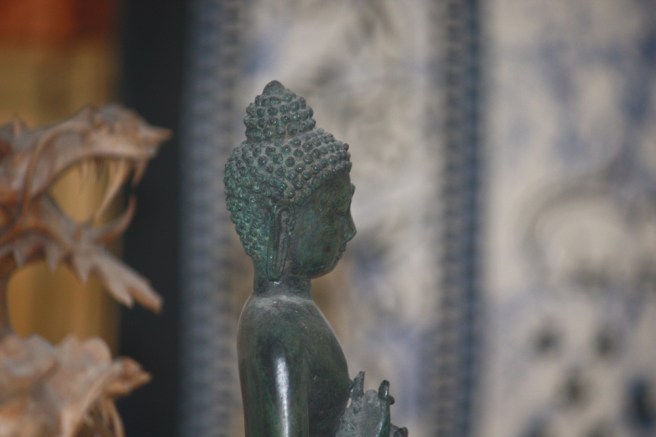
As a regular user of Watkins books where one can find much on “spirituality” I frequented Cecil Court near Trafalgar Square, London. There was an artefact shop opposite. There I purchased this Buddha / Avalokiteśvara. He is sitting in our hallway to this day.

At the time I was talking with a chemistry student during her final year research project on statute patinas joint with The Royal College of Art. The shop has moved probably to Camden. I had a long conversation with proprietor about how the village from which he sourced the statuettes used special techniques to create ancient looking patinas.

Many years later following on from a dream I visited a Thai Forest Buddhist centre, Cittaviveka, also known as Chithurst Buddhist Monastery. This was not far from where we lived in the UK.

When I had the “Thai” dream in 2023 I was genuinely quite surprised because I had mentally ruled out Indochina. But today that notion has again resurfaced. The hair-do on the statute is very Indochina – style. I have said “Thai” but it could be elsewhere on the peninsula.

The Buddhist thread is linked to the pen-pal of the wife’s mother who was the daughter of a Sri Lankan ambassador and a Pali Scholar, the author of a Pali dictionary and important to the spread of Buddhism to London. This is the Theravada link.

The monk I spoke with at Cittaviveka had looked after Christmas Humphreys. A key figure in bringing Buddhism and meditation to London.

In that dream for the first time, “I am wearing only some saffron-yellow trousers.” I am clearly Asian.

Hmnn…

The Power of a Buddha or Evolved Bodhisattva

The image of Buddha is very widespread and one can get a statue down the garden centre or a poster to put up on the walls of your home. The vibe associated is often calm tranquillity. Never is it in battle with Mara, Māra. In the west Buddha is often seen as wholly benign and passive. Those fond of smoking joints may have a Buddha statuette or have paraphernalia which is Buddha themed. One can get a vegetarian meal called a Buddha Bowl. Back when I was a vegan and visiting Japan I used to eat “Monk’s Meals” there.

Most of the statues have a Buddha who is not emaciated and with Thai style hair, a bit fat. Rarely is he seen as skinny. He is often depicted with a halo as might be perceived by a quasi-clairvoyant. 

It is not as weird as the blonde, blue eyed Aryan representations of Jesus who was probably semitic, Jewish, in appearance. But Buddha is often not quite as brown as he might have been in real life. He lived alfresco and would have tanned up well.

In the West people do not imagine the power, sometimes magical of a Buddha or evolved Bodhisattva. The imaginations do not extend beyond some dude sitting on a mat cross legged meditating.

“Hey man, that is Zen…”

Tibetan Buddhism is perhaps unique in representing wrathful forms of various Bodhisattvas. They do battle with evil. In Vajrayana there is black and white magic. Force sometimes needs met. There is significant power in a Buddha or evolved Bodhisattva. Power beyond normal ken.

The various canons have a list of special powers attained as a Bodhisattva proceeds along their journey to enlightenment. These supra-mundane powers are not to be found in garden centres. Scientists may quibble as to whether they are real manifestations or not.

As a teenager I was fascinated by the TV series Monkey.

“Monkey eats many of the peaches, which have taken millennia to ripen, becomes immortal and runs amok. Having earned the ire of Heaven and being beaten in a challenge by an omniscient, mighty, but benevolent, cloud-dwelling Buddha (釈迦如来, Shakanyorai), Monkey is imprisoned for 500 years under a mountain in order to learn patience.

Eventually, Monkey is released by the monk Tripitaka (三蔵法師, Sanzōhōshi), who has been tasked by the Boddhisatva Guanyin (観世音菩薩, Kanzeon Bosatsu) to undertake a pilgrimage from China to India to fetch holy scriptures (implied to be the region of Gandhāra in the song over the closing credits).”

Which is about the spread of the threefold Tripitaka to China and hence Japan. Evil tries to stop the dharma from being propagated and many adventures ensue. Here Buddhism is proactive and not passive. There is struggle.

The Buddhist canons have many stories of remarkable miracles carried out both by Siddartha and other Bodhisattvas. Padmasambhava considered a Nirmāṇakāya of Shakyamuni Buddha is attributed with magical powers and miracles. Those steeped in the tradition are less likely to scoff than your common or garden Western scientist. Vajrayana differs from East Enders or Coronation Street and markedly so. Exposure and immersion in its depths is likely to blow the minds of anyone lacking openness and fluidity.

Without direct personal experience there is no way to assess what the power of a Buddha or evolved Bodhisattva might be. Common sense suggests caution and not arrogance.

 A Buddha is not just a garden ornament, statuette or poster…

Living Buddha – Life Trajectories

Following the “Tibet” line of inquiry yesterday I looked for various films about finding tulku reincarnations. We have seen, Little Buddha, Kundun about the Dalai Lama and Tulku by Gesar Mukpo. Each of which had tremendous, guttural, impact on me. I found “Living Buddha” by Clemens Kuby about the search for and enthronement of the 17th Gyalwa Karmapa head of the Kagyu lineage inter alia. Here is the trailer.

In this film the 16th leaves clues as to where to find his reincarnation which is supported by a dream of the Dalai Lama. A party is sent to search and after a ~ ten day trek into deepest darkest Eastern Tibet the son of nomadic famer living in fairly primitive conditions embedded deep in nature is located. The lives of that young man and his family are changed forever. The life trajectory of nomadic existence is replaced by a high lama throne, a famous black hat and being thrust onto the stage of global geo-politics.

In principle, the long Karmapa lineage is of quasi-divine reincarnate awakened beings capable of non-human feats such as wide ranging clairvoyance bordering on a mundane omniscience. They return for the benefit of all sentient beings. Padmasambhava, Guru Rinpoche, prophesises that there will be 21 such incarnations. These beings are held in very high esteem in Tibet, among the diaspora and with followers of Tibetan variety Buddhism.

This film is documentary evidence of how a life trajectory can alter radically and suddenly when viewed from the mundane familial life. It also suggests that the intended trajectory did not in fact change, it simply worked out “as planned”. It was just a matter of time.

Over a decade ago I had a number of dreams suggesting that I would meet the 17th one day.

Our current life trajectory is looking like, maybe, a move back to Wales. It includes the purchase of a disabled enabled bungalow in sensible proximity to a major, preferably university, hospital and with a low price tag. I found a bungalow on Right Move yesterday which apart from distance to hospital looked good. Such a place does therefore exist.

Unless something weird is happening whereby this blog is monitored in some way and thereby has a wider audience. What I write here has a very small readership and is a tiny little ripple in a corner of the vast internet. It is therefore unknown and unheard of. Only the wife, the cat(s) and I have experienced its entirety.

Subsequent and during the film last night, I had strong visual images of the 17th and a few of Akong Rinpoche. It is pretty weird and I had not had any weed, nor had a mushroom omelette.

In “Little Buddha” they are searching for the reincarnation of Lama Dorje. One of the crew has a dream of him in jeans standing near to an architect designed house under construction

They, the Buddhists, start to stalk the family and impinge on their lives. The maths teacher mother is greeted by the mathematical astrologer at the school fence.

The higher lama looking for his teacher then tips up in Seattle with entourage and takes the boy back to Bhutan for assessing. Along the way they encounter two more emanations of the reincarnated teacher making three.

Three Vajras – Speech, Body and Mind.

Our house is architect designed.

We are currently waiting for our large pond to be filled with pink lotus flowers and our house is characterised by emptiness.

We have no idea if any Tibetans geezers are having dreams or visions about us/me.

If one day a Tibetan monk seeker / stalker tipped up, our lives could change and radically so. The trajectory, viewed from one angle would be knocked for six.

The odds of this happening are probably better than for a EuroMillions win which would also alter life trajectory, but perhaps not so substantially.

If I had to switch jeans / combat trousers for robes, that could freak people who may have met me, out.

The family joke is I was aiming for Bhutan but saw the flag of Wales with the dragon and reincarnated in Cardiff by accident…

Cymru am byth…

The Tendency to Underestimate

This tendency can be followed by overreaction and disproportionate over reaction at that. One might point at Pearl Harbour, 9/11 and the recent Hamas attacks. There was underestimation prior in each case. If something catches people unawares it is an act of terrorism if “they”, do it, or an act of cunning if “we”, do it. Placing thousands of indiscriminate pager bombs in Lebanon to maim and kill Hezbollah was “clever” and in no way terrorism… “Terrorism” depends upon which side you are on. The “allies” firebombed Dresden, hardly an altruistic act.

People, countries, who are prone to arrogance tend to underestimate others. I’ll speculate that Trump has made a miscalculation concerning how people feel concerning the USA and his actions in particular. We shall see.

It is possible that people have underestimated me or that they have overestimated me or that they have judged me spot on. I have perceived that from time to time I have surprised people. I have done things which they did not see coming. I may be mistaken. If they had me sussed, they would have foreseen.

The problem with words like underestimate is that they are linked to competition, winning and even conflict. “Never underestimate your opponent”. The estimation is tied up in an oppositional scenario, there is a presupposition, a desire for victory.

When I was a younger man, I thought I knew a lot more than I actually did. I was full of bullshit and prone to evangelising about science, thermodynamics and veganism. I have hindsight now. But back in the thrall then, I was certain and dogmatic. People in the thrall lack a wider awareness. They do not know what is beyond their ken and may be arrogant and conceited about their self-diagnosed omniscience.

Not so long ago someone “told” me some things about Castaneda and that The Guardians do not exist. He was adamant. As usual I was direly in need of education. People have told me many things. I’ll estimate that in general I get told way more than I am asked. The assumption is perhaps that because I am not a soap-boxing gobshite, I know little or nothing. I do not feel the urge to show off.

I could say that I know no-thing but nobody would understand what I mean by that statement nor get the experience behind it. They would not think to ask what I mean. They might tell me.

People can be markedly unaware as to the extent of what is unknown for them and yet feel entitled to opine thereupon.

I have mentioned the blue books opus in this blog. There may be those that think it to be made up hippy shit. If the contents are real and even quasi-factual then it would be unwise to underestimate the so-called hierarchy, those others call The Guardians of the Race. The Tibetan suggests they differ markedly from Joe Bloggs buying a steak slice at Greggs and from those having a BYOB works event at 10 Downing Street.

People can pooh-pooh out of arrogance and that can be a miscalculation. There is a tendency to pooh-pooh as a knee jerk reaction which may stem from a sense of entitled complacency.

The Tibetan mentions masters as having taken the fifth initiation, this means that even after they become a nirvani there is work to do. If you have never met a putative awakened Buddha, it might be wise not to slag them off, if only on the off chance that they are real.  It might be good to spread your bets.

But of course, those who are fond of the sound of their own voices, when they find themselves in a bit of a hole, tend to keep on digging. They may be unaware because of their underestimation that they have indeed fallen into a hole, a trap of their own making. Even when someone hands them a spade or a shovel, they may not cotton on to the hole hypothesis. Dig baby dig.

This tendency to underestimate is widespread. It pertains a little to an arrogant sense of entitlement.

“Mr Ghandhi, India is British my good man…”

I have never met a “know-it-all” who actually does.

Perhaps one day if people keep telling me what I am, what I know, what I am thinking, what my motivations are and who I am, I will learn.

Then they will be right…

And I can finally sleep soundly…

Termas, Tertöns and Toltec Time Capsules

During the evening before I had my dream with a blue manifestation of Padmasambhava in, we watched “University Challenge” and “The Crying Game” on TV neither of which has much to do with Guru Rinpoche who is fundamental to Tibetan Buddhism. Over a decade ago I participated in a Guru Rinpoche empowerment given by Akong Rinpoche Tulku at the Kagyu Samye Dzong London. It looked mightily shamanic to me as I had been engaged in prior shamanic rituals.  Something happened. I do not know what. Yet I have used the tantric generating mantra “blessings of the diamond master born of lotus” in deep voice chanting on and off since then, but not for a long while. I instinctively knew this to be utmost Vajrayana, tantric vehicle and have always treated it with great respect.

{Note: this has nothing to do with trendy tantra sex practice.}

The hagiography of Guru Rinpoche has him as a second Buddha and leaving treasures, teachings as terma, {gter ma – གཏེར་མ } time capsules of hidden treasures, waiting for discovery when the time was right and ripe. These can be texts often written in Dakini script, or mind-forms waiting for a suitably susceptible recipient {Tertön} to download into conscious thought.  It is all a bit “Raiders of the Lost Ark” and I am a little surprised that Hollywood has not yet cottoned on. It would make a good movie and Richard Gere might produce it.

Way back Théun Mares used to bang on a little about Toltec Time Capsules. These are hidden teachings from the hay-day of the Toltecs {Atlantis?}. They are {allegedly} secreted around the globe waiting to be discovered and opened. They can be a bit of a Pandora’s box.

Needless to say, both ideas are prone to a glamour, excitement and a sense of salacious secrecy. Hidden treasure is “sexy” and promises a quick fix, a kind of magic. Like the Philosopher’s Stone promises immortality and the Alchemist changes base metal into gold. Which would be handy right now given the Trump effect on global gold prices.

People are prone to imagine some kind of physical tangible artefact. Terma play an important role in the evolution of Tibetan Dzogchen and Buddhism. They are an integral part of the canon. This may seem odd to a Western mind, but Christianity has it saints and their divine visions, and Islam The Prophet.

Teachings from “on high” are a part of most religions /philosophies. The structure of benzene was revealed in a serpentine dream!

Quite why I am getting a blue Guru Rinpoche, here, in rural Brittany, is unknown and a bit odd. I have not seen Lara Croft or Indiana Jones hanging out at the local bar or market. There are no time travelling Nazis with Schmeissers or Lugers yet….

Fingers crossed it remains that way…