
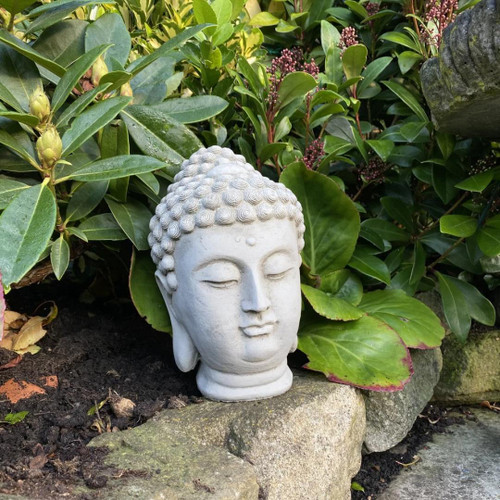
The image of Buddha is very widespread and one can get a statue down the garden centre or a poster to put up on the walls of your home. The vibe associated is often calm tranquillity. Never is it in battle with Mara, Māra. In the west Buddha is often seen as wholly benign and passive. Those fond of smoking joints may have a Buddha statuette or have paraphernalia which is Buddha themed. One can get a vegetarian meal called a Buddha Bowl. Back when I was a vegan and visiting Japan I used to eat “Monk’s Meals” there.
–
–
Most of the statues have a Buddha who is not emaciated and with Thai style hair, a bit fat. Rarely is he seen as skinny. He is often depicted with a halo as might be perceived by a quasi-clairvoyant.
It is not as weird as the blonde, blue eyed Aryan representations of Jesus who was probably semitic, Jewish, in appearance. But Buddha is often not quite as brown as he might have been in real life. He lived alfresco and would have tanned up well.
In the West people do not imagine the power, sometimes magical of a Buddha or evolved Bodhisattva. The imaginations do not extend beyond some dude sitting on a mat cross legged meditating.
“Hey man, that is Zen…”
Tibetan Buddhism is perhaps unique in representing wrathful forms of various Bodhisattvas. They do battle with evil. In Vajrayana there is black and white magic. Force sometimes needs met. There is significant power in a Buddha or evolved Bodhisattva. Power beyond normal ken.
The various canons have a list of special powers attained as a Bodhisattva proceeds along their journey to enlightenment. These supra-mundane powers are not to be found in garden centres. Scientists may quibble as to whether they are real manifestations or not.
As a teenager I was fascinated by the TV series Monkey.
“Monkey eats many of the peaches, which have taken millennia to ripen, becomes immortal and runs amok. Having earned the ire of Heaven and being beaten in a challenge by an omniscient, mighty, but benevolent, cloud-dwelling Buddha (釈迦如来, Shakanyorai), Monkey is imprisoned for 500 years under a mountain in order to learn patience.
Eventually, Monkey is released by the monk Tripitaka (三蔵法師, Sanzōhōshi), who has been tasked by the Boddhisatva Guanyin (観世音菩薩, Kanzeon Bosatsu) to undertake a pilgrimage from China to India to fetch holy scriptures (implied to be the region of Gandhāra in the song over the closing credits).”
Which is about the spread of the threefold Tripitaka to China and hence Japan. Evil tries to stop the dharma from being propagated and many adventures ensue. Here Buddhism is proactive and not passive. There is struggle.
The Buddhist canons have many stories of remarkable miracles carried out both by Siddartha and other Bodhisattvas. Padmasambhava considered a Nirmāṇakāya of Shakyamuni Buddha is attributed with magical powers and miracles. Those steeped in the tradition are less likely to scoff than your common or garden Western scientist. Vajrayana differs from East Enders or Coronation Street and markedly so. Exposure and immersion in its depths is likely to blow the minds of anyone lacking openness and fluidity.
Without direct personal experience there is no way to assess what the power of a Buddha or evolved Bodhisattva might be. Common sense suggests caution and not arrogance.
A Buddha is not just a garden ornament, statuette or poster…


 Dreamyoga