How Many Fully Enlightened People Are There?

If you type various versions of this question into Google you see that there are people discussing it on line. I have even seen articles on Buddhism which states that the goal is to achieve nirvāṇa. Buddhism does not have KPIs and personal development planning, nor does your line manager tear you off a strip if you don’t achieve your goals.

I’ll speculate whoever considers nirvāṇa a goal is a long way indeed from said goal. He is in a gaol of Western thinking.

In various school of thought nirvāṇa is when the causal vehicle {Soul or reincarnating Jiva} has been blown off. This means there is no requirement to reincarnate, a strictly human thing. Humans are “bound” to the wheel of rebirth. Someone, some being, who has done that, nirvāṇa, is strictly speaking no longer human. In the context at death the being who has attained nirvāṇa achieves the state of parinirvāṇa at the dissolution of the meaty incarnate form. Thereafter “they” remain formless.

We could get into the gender debate about pronouns. What pronouns do you use for some entity which has no body, no observable physical plane presence? What is the correct pronoun for a fully enlightened Buddha? It?

The problem I have with enlightenment as a concept is that is enlightenment an absolute or a relative term? It might be said that someone got enlightenment, does that mean that they are a fully enlightened Buddha or does it mean that they are little less heavy than before. They have attained a quantum of enlightenment, a bit, one step further up the ladder. They are lighter, less dark and thereby enlightened. To progress one gains enlightenment in a stepwise fashion, realisation by realisation. At nirvāṇa the being is lighter because it no longer has a causal vehicle or personality, notions of self have dissolved. It is enlightened, unburdened.

There is the concept of returning high attainment Bodhisattvas, who on death put off the attainment of parinirvāṇa and come back of their own free will to teach. Because they have no causal vehicle, they create a nirmāṇakāya emanation for such a purpose. If I understand it correctly there may be many of these in the Tulku tradition. Arhats can be seen as selfish because they do not come back. But that is a transference of human personality onto someone who has no self. I have seen it prejudiced that Bodhisattvas are good, and Arhats not so. Human folly, methinks.

In esoteric thinking the end of the causal vehicle comes at the fourth initiation. If one cross references, this is nirvāṇa or blowing off. If I understand it correctly this phenomenon is associated often with physical plane death {but not always}. One gets nirvāṇa and sharpish thereafter parinirvāṇa. In that school of thinking there are a few more stages of development, the other initiations, after doing what Siddartha did in getting planetary nirvāṇa.

One might rephrase the question, “how many fully enlightened beings are there?”

In the esoteric school of thought the fourth degree initiate goes on to take the fifth and become what some call masters. This happens, according to my reading, relatively soon.

I think most people would struggle to envision or envisage a “living” awareness or consciousness in the absence of a physical plane body. So, people invent worlds and dimensions or abodes where they might picture some enveloping form even if that be nebulous. The inventions are inspired by life on earth. Being superstitious people like signs and miracles as circumstantial evidence or proof of nirvāṇa or parinirvāṇa. There must be a rainbow or a comet. If it is a wholly natural part of evolution why would this happen? It is kind of no big deal. There is a desire for sanctity and holiness where they may just be a natural evolutionary process.

The question itself seeks to quantify and scale because people like to compare, to play top trumps.

“My God is better and more real than yours”, being a root of many wars.

Going a step further “are” implies existence or being. Can something exist if there is no form, no measurable lump of meat. If something is formless, is it?

Instead of quantifying we may now rephrase.  “Are there enlightened beings?” “Do they exist?”

“It’s life Jim, but not as we know it!”

Astrobiology and astrochemistry are looking for life in a chemical-biological entity with a physical existence measurable by modern instrumentation. The assumption being that life can only exist in some kind of form, or particularly a corporeal form no matter how small. Science requires a form {and perhaps reproductive urge} as a basic component of life and its definition.

A formless Buddha after paranirvāṇa would not technically be alive according to human definition.

So maybe according to science enlightened beings do not exist.

The answer is therefore zero and not 42….

Which poses the ancillary question does, zero exist or not?
The Four Stages of Awakening

Some speculations and developing a train of thought….


This excerpted from Wikipedia

“The ordinary person

An ordinary person or puthujjana (Pali; Sanskrit: pṛthagjana; i.e. pritha: without, and jnana: knowledge) is trapped in the endless cycling of samsara. One is reborn, lives, and dies in endless rebirths, either as a deva, human, animal, male, female, neuter, ghost, asura, hell being, or various other entities on different categories of existence.

An ordinary entity has never seen and experienced the ultimate truth of Dharma and therefore has no way of finding an end to the predicament. It is only when suffering becomes acute, or seemingly unending, that an entity looks for a “solution” to and, persisting, finds the Dharma (the ultimate solution/truth).

The four stages of awakening in Early Buddhism and Theravada are four progressive stages culminating in full awakening (Bodhi) as an Arahant.

These four stages are Sotāpanna (stream-enterer), Sakadāgāmi (once-returner), Anāgāmi (non-returner), and Arahant (conqueror). The oldest Buddhist texts portray the Buddha as referring to people who are at one of these four stages as noble people (ariya-puggala) and the community of such persons as the noble sangha (ariya-sangha).

A stream-enterer, having abandoned the first three fetters, is guaranteed enlightenment within seven lifetimes, in the human or heavenly realms.

Sole dominion over the earth,
going to heaven,
lordship over all worlds:
the fruit of stream-entry
excels them.

Pratyekabuddhayāna is a Buddhist term for the mode or vehicle of enlightenment of a pratyekabuddha or paccekabuddha (Sanskrit and Pali respectively), a term which literally means “solitary buddha” or “a buddha on their own” (prati- each, eka-one). The pratyekabuddha is an individual who independently achieves liberation without the aid of teachers or guides and without teaching others to do the same. Pratyekabuddhas may give moral teachings but do not bring others to enlightenment. They leave no sangha (i.e. community) as a legacy to carry on the Dhamma (e.g. Buddha’s teachings).”

—————————————————

There are some elements of Buddhism which I struggle with. This stems from the notion of evolution, a planetary principle. Things change and generally get more efficient adapting to the times and circumstances. Therefore, to my eyes it is very unlikely that a “human” would reincarnate as an animal. If the being had progressed from monkey to human, it would not make a retrograde step even as karmic punishment. The being, a human, reincarnating, would need a human form. There are plenty of human forms in which life is difficult, so there is no need to invoke life as a dog.

Bearing in mind that the origins of Buddhism are ~2500 years old, humanity was very different back then. Life was different and complex abstract thought very uncommon. The majority were illiterate and living in a manner not so very different from their livestock. Life was generally short and hard. Animism as a basis for interpreting world was using the available daily template, a reality encountered on a day to day basis. The teaching metaphor and allegory available to Siddartha would reflect daily life, belief and superstition.

I am not a member of any mundane Sangha and do not go to “teachings”. I am a trained academic researcher and have read widely on Buddhism. It seems to me there remains debate about what the various teachings mean. I am aware that discussion and/or arguing the toss is not the same as attainment. Being attached to wanting to be right or winning an argument does not seem enlightened to me, it seems petty.

People like definitions, especially those educated in modern ways. People might then discuss what an arahant is and profess on the subject. It is human nature. I’ll speculate that most people pertaining to being Buddhist have never nor will they ever meet one. The arahants can be seen aloof and uncaring.

A cornerstone of Buddhism is taking refuge in the Buddha, the Dharma and the sangha. Some schools of Buddhism subscribe to the Bodhisattva ideal. A Bodhisattva roughly means one who will {one day} become a Buddha. They can be “beginners” or be very highly realised. These realised Bodhisattvas put off their own nirvana in order to come back to teach. They can put if off for multiple lifetimes. There is entreaty and prayer begging them, so to do. There is a prejudice perhaps in that they are more compassionate than an Arahant who pisses off, but too much compassion can be a weakness.

If we see evolution as a ladder, if you are on the top step, you need to vacate it so that someone else can use it.

There is perhaps a prejudice against pratyekabuddhas in that they do not need a sangha or teachers nor do they have a sangha of their own.

Implicit is that people seek and need teachers or guides. The student can thereby hand his/her power over to a guru or teacher. In so doing the responsibility for development is shunned to an extent. The teacher becomes partially responsible for progress.  

Those in a sangha do not “like” those not in a sangha. The human “we” does not like the rejection of the outsider “they”.  They are not a part of the/our gang. I have seen pratyekabuddhas talked down as lesser Buddhas. A little thought suggests that THE Buddha was pratyekabuddha. The sangha came later. This snobbishness is logically unwarranted.

If you boil it down the fetters are simply human foibles, without which there would be no television soap operas. Getting rid of anger, envy, hatred and jealousy. Lessening attachment, ambition and pride makes for a less exciting and emotional script. One could say that the core direction of Buddhist development is a reduction in human folly, even a tendency to be less “human”. In the limit one no longer wants to partake of the drama and simply stops coming back, stops taking on more meat. Someone like that would be weird to society and not readily integrated therein. If they wore robes it might be easier for society to accept them.

The sangha is a stepping stone offering camaraderie as one lessens engagement with the socio-political world view prevalent at the time of a life. The sangha is kind of like a crutch or support mechanism for those ordained monastic.

I personally have doubts that monasticism is altogether good. The temptation is to an extent removed. It is easier to remain calm and detached when removed from the mundane “lunacy”. Celibacy can cause deviance; suppression can cause explosion.

The basic requirement to enter the stream is to see and acknowledge the truth of the Dharma, the impermanence of all conditioned things. Attaining and realising impermanence starts to untie attachment. “They” say that there is a maximum of seven lifetimes before nirvana once the stream has been entered.

The sixteen close disciples of Buddha are given arahant “status”. They are almost deified and their intervention sought via prayer. There are statues, painting and thangkas.

If they came to Siddartha as a fresh disciple when the Dharma was in infancy it seems to me that to go from zero to hero in such a short time and achieve arahant in one lifetime was some pretty fast work. Religious hagiography is often exaggerated and idealised. One could say through the power of the Buddha evolution was vastly accelerated.

There was no stream until Siddartha, in this context.

If I use the dreams in the blog as a basis I have had three Buddhist lifetimes, one Indian, one Thai and one Japanese. In all of these I was monastic. The next lifetime was as a Christian priest / soldier. The most recent prior lifetime I was a civilian. This current life started with science, a lot of it.

I have reason to believe that my first Buddhist life was at the dawn of Buddhism ~2500 years ago. If I entered the stream then I am now five lifetimes on. Which means I may not be doing an Arnie many more times.

Of course, the only way that I will know for sure is to pop my clogs and see what happens.

I’ll speculate that the human love of ritual and ceremony has lead to quasi-deification. The social need of groups is for some kind of celebratory focus or rite. This has little to do with what I understand to be the core teachings. In some texts removal or ritual is at a later stage of the enlightenment journey. It serves a good social purpose but must be transcended, being attached to ritual is an attachment after all.

My hunch is that the days of guru-yoga are drawing to a close. There have been many scandals and some far out cults.

Humanity might need to do more for and by itself.  

The Tibetan – Djwhal Khul – Dream 16 – 06 – 2008.

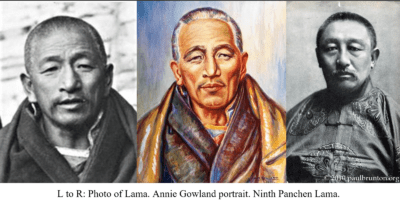
We are in a mountain village – a sort of base camp. We have just been up Everest and look back at its snow covered peak. We walk around the village and go to see the Tibetan. He welcomes us and we spend some time with him. He has five golden circles in a row interlinked with him. He gives us these five golden rings.

We wander back in the village to our flat which is there. We comment that it has gotten a bit touristy. We show others the mountain.

Someone is coming to see us. We go down onto the river and are in a modern pedalo style boat with a motor. The authorities know that this person is coming. I must ensure that the Tibetan has his head set so that he can communicate with whoever is coming.

Dream ends

Gold is the dreaming symbol for the spirit or Nagal

Ring is the symbol for power or circle the symbol for inclusiveness and unity

Five is the freedom and change {need for}

Mountain is the dreaming symbol for hope

Djwal Khul (variously spelled ‘Djwhal Khul’, ‘Djwal Kul’, the ‘Master D.K.’, ‘D.K.’, or simply ‘DK’), is believed by some Theosophists and others to be a Tibetan disciple in “The Ageless Wisdom” esoteric tradition. The texts describe him as a member of the ‘Spiritual Hierarchy’, or ‘Brotherhood’, of Mahatmas, one of the Masters of the Ancient Wisdom, defined as the spiritual guides of mankind and teachers of ancient cosmological, metaphysical, and esoteric principles that form the origin of all the world’s great philosophies, mythologies and spiritual traditions. According to Theosophical writings, Djwal Khul is said to work on furthering the spiritual evolution of our planet through the teachings offered in the 24 books by Alice Bailey of Esoteric Teachings published by The Lucis Trust (then named the Lucifer Publishing Company); he is said to have telepathically transmitted the teachings to Bailey and is thus regarded by her followers as the communications director of the Masters of the Ancient Wisdom.”

Elephant – Bodh Gaya – India – Dream 1-9-2013

In the dream and the dreaming…

I show Piero my second thesis. I explain there was / is no need to get it marked.

The page then opens up to reveal a massive three-dimensional palace garden. In which there are tables, mirrors, candles and plants. The detail is exquisite as is the furniture. I light the candles and take Piero on a tour of the garden and when we have completed a full circuit, I notice that candles have gone out. The attendants notice me lighting the candles again and join in. There is no need to light the candles anymore. The story continues.

I take Piero over to a map. It is a map of India. I say to him that India looks like an Elephant from the front. We look closer and zoom in onto an Elephant like structure. Closer and closer we zoom at what appears to be a bindi on the Elephant’s head. We zoom in even more and see that it is a cluster of small tables under a tree.

This is where Buddha began the Bodhicitta it is Bodh Gaya.

I am now in the streets alone walking towards the Bodhi tree. There are market stalls everywhere selling souvenirs and changing money. At one stall I overhear a young woman who is a seer. “He has come. Let us watch and see what he does.”

I go over to her to give her some money as a donation. My coins are blue. I now have a guide standing with me. He says that Sunchita (or something similar an Indian female name) will have sex with me at the dinner should I so want.  I move on with the guide to show many more pictures of Elephants.

“This is my dreaming class”, I say. “I am an Elephant.”

“What colour is that?”, he asks.

I point him towards a magnificent picture of an Elephant done in Indigo Blue.

“I am Indigo Blue.” I say, “it runs in my veins.”

We continue to wander around under the Bodhi tree looking at the stalls as my guide chats with the locals. The girl re-iterates her offer which is of little interest to me.

Dream Ends

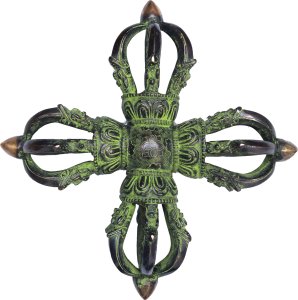
Double Vajra Tattoo – Dream 16-12-20

After a bit of a sleepless night, I awake to find my former university in the news and not in a good way. There are various comments on the nature of the working environment there.

Here is last night’s dreaming segment.

I am in a room with others, we are being threatened by a group of people with dogs on leashes. The dogs are straining to attack. They are like pit bulls. The owners are having trouble holding them back. I am quite relaxed. One of the pit bulls has inordinately long fangs and is angrily taking an interest in me. I offer it my right arm. It bites down hard and strong and will not let go. I am not worried about this. The owner of the dog tries to get it to let go. It will not. I place my left hand around the side of its jaws and squeeze. The dog opens its jaws and backs off happy.

I look down and it has left a mark reminiscent of a double vajra in oranges and red. There is no blood simply what looks like a tattoo on the inside of my forearm. I show everyone in the room my new tattoo.

Later I am working at the checkout in a supermarket and I show each of the customers my new tattoo about which I am slightly excited.

Dream ends

Excerpted from Rigpa Wiki

The double vajra (Skt. vishva-vajra; Tib. རྡོ་རྗེ་རྒྱ་གྲམ་, dorje gyadram, Wyl. rdo rje rgya gram) or crossed vajra is formed from four lotus-mounted vajra-heads that emanate from a central hub towards the four cardinal directions and symbolizes the principle of absolute stability.

In the cosmographic description of Mount Meru, a vast crossed vajra supports and underlies the entire physical universe. Similarly in the representation of the mandala, a vast crossed vajra serves as the immoveable support or foundation of the mandala palace and here the central hub of the vajra is considered to be dark blue in colour with the four heads coloured to represent the four directions-white (East), yellow (South), red (West) and green (North). These also correspond to the five elements and the buddhas of the five families with blue Akshobhya in the centre.

It’s also an emblem of the green buddha of the north, Amoghasiddhi, and represents his all-accomplishing wisdom as lord of the karma family of activity.

The raised throne upon which masters are seated when teaching is traditionally decorated on the front by a hanging square of brocade displaying the image of a crossed vajra in the centre, often with four small swastikas in the corners. This emblem represents the unshakeable ground or reality of the Buddha’s enlightenment.

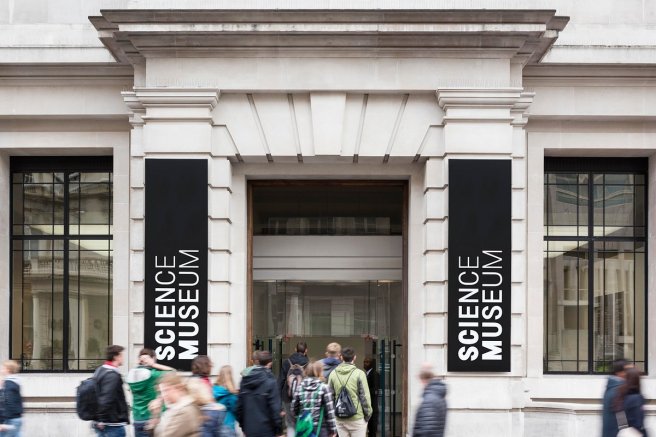
Three Science Museum – Buddhism – Knowledge Dreams

Three Golden Crosses – Science Museum – Caretaker of Knowledge Dream 18-06-2009

The dream starts with a vison of three golden and radiant crosses spaced equally on a golden-sun-like orb with a golden radiance.

I am then walking along beside a river dressed in my Yukata with some loose change in my hand. I come upon a family, and they are wondering about falling in the river. They have some shoes and I say that the ones with the heels are the best. Don’t worry about falling in the river you are very far from any waterfalls and the water is cool and refreshing.

The woman wonders if I am holding something back as all the gossip says I say that no I am not.

Then I am in the Science Museum. I am caretaker. What better place for me than to be the caretaker of knowledge. I go into a room and there are some beautiful postcards of Buddha.

I hear deep melodious voices:

“We knew when you first came into being all those millions of years ago that this is how you would always live.  A life full of compassion and that you would always be a little mis-understood. A beautiful thing and that you would always do this for evermore.”

Dream ends.


Buddhism – Science – Museum Dream 02-06-2012

I am in a white building with a high ceiling. It is a place of learning perhaps a museum. Over to one side I see a young dark-haired man. He is wearing a pink polo shirt as am I. I start to speak to him of Buddhism in the West. This piques his interest. I say that more Tulkus are incarnating here. This piques his interest even more. He says that a part of his research is regarding Buddhism. His job at the museum is to do with this. It is also to do with the relationship between science and religion. He takes me back behind the scenes in the museum. As we walk, I tell him that I am an ex-science academic from Imperial College. This piques his interest even more. I comment that is it not a coincidence that we are similarly dressed in pink polo shirts? His eyes start to show some blue in them, a subtle glow.

We walk into his offices just as his female supervisor is leaving. I am not sure if I should shake hands with her or not. She walks past in any case.

Next, I am wandering around the museum, in the areas where people, the public, do not go. I come across a young woman who has her face painted in vibrant colours. The painting is of things like feathers arranged in a circle around her left eye. It is stunning. We walk off together.

Soon I am standing on a lawn. It is in a dip with a ridge around it about 5-10 metre away.  There are some colonnades. On the ridge are some people including the young man and the painted woman.

I am talking to them about the spread of Buddhism to the West. I am walking as I talk. The people are all staff at the museum. A dark-haired Russian girl who is of some considerable intellectual prowess tells the others to listen to what I am saying, it is right.

Behind me two men, one with white hair, are walking along the path. They hear what I am saying but because they know me from a science context they cannot “accept” it. It is a non sequitur to them.

Dream ends.


Quartz – Diamond NV Vacancies – Science Museum Dream 09-06-21

I am at the entrance to the Science Museum. I am met by a young woman who is an events organiser. She walks me through my event plan, from where we will have coffee to the seating in the auditorium to where we have lunch. Then we move to where we will do the exercises. The idea is that this is a course for young scientists from the nearby university. It all looks nicely planned and the improvement work they have done on the museum is smart and clean.

I am then walking along a corridor and am met by three young men they want to know what the full schedule is for tomorrow. I tell them that I was planning to send out an email that morning.

One of them with blonde hair says that he was told to ask me about the spectroscopy of doping vacancies in quartz.

I say to him that under pressure the interatomic potentials in quartz change. As the atoms are pushed together the two potentials overlap to produce a little potential energy well at the top. The well is split such that it has two wells and a low barrier in between. Because of the low barrier there can be some electron tunnelling between the wells giving rise to a splitting of the energy levels.

I suggest that he look into the case of NV sites in diamond as this will inform him.

The dream ends.