Das Glasperlenspiel – Reincarnation – Missing Pieces

It was not until I read Das Glasperlenspiel – The Glass Bead Game – that I gave much thought to past lives. Somehow the scope of the book and the Three Lives of Knecht appended caught my attention. Hesse was the first person whose mind was so comprehensive. At last. Somebody who thought a bit like me….

Based on the circumstantial evidence inter alia of dreams I can draw up a rough chronology of putative previous lives.

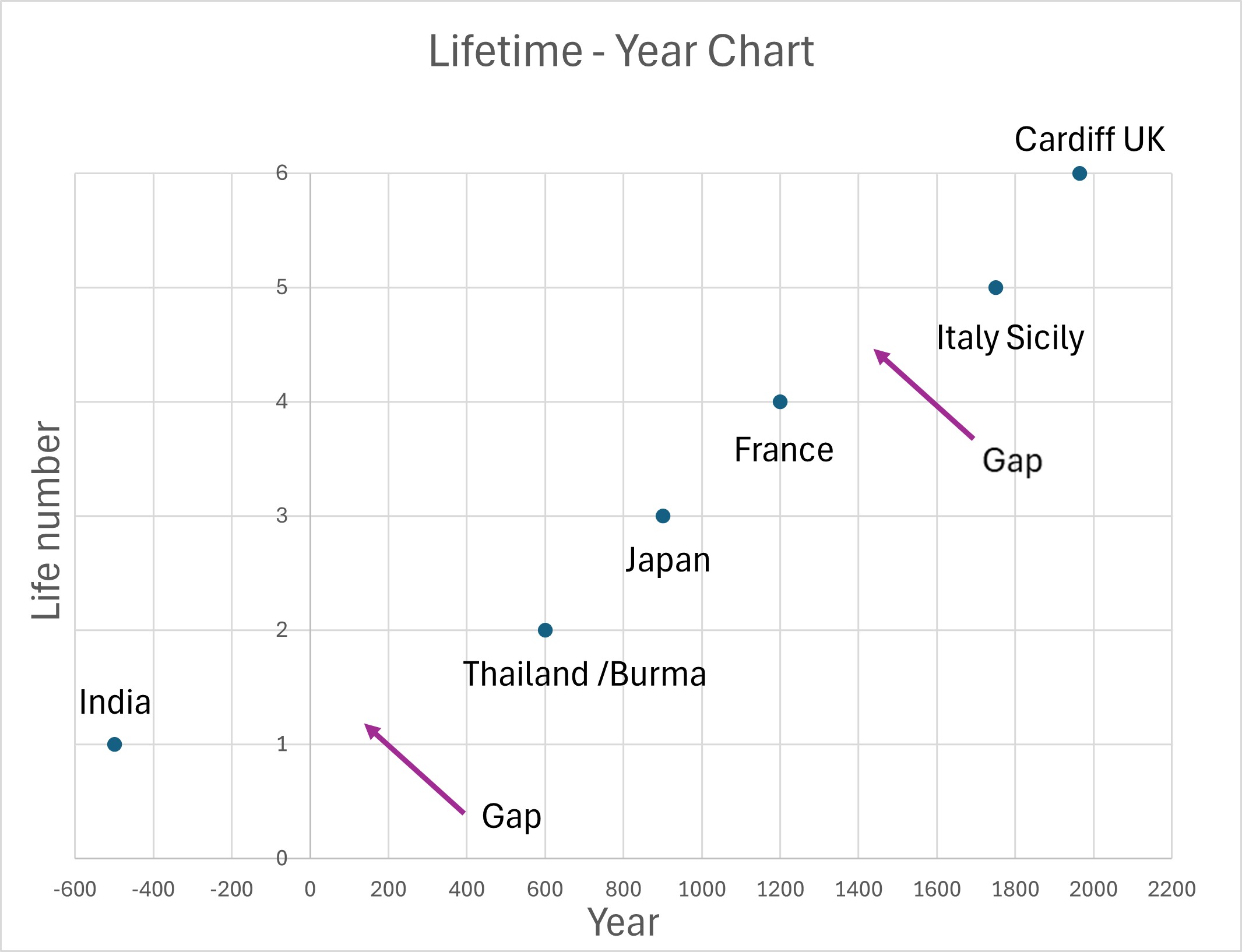
The more recent graph starts ~2500 years ago as a disciple of Siddartha, possibly with a named individual. In principle I may have heard the esoteric Kālacakra first hand. It then proceeds with two further Buddhist lives, one Theravada Thai/Burmese and one Vajrayana Japanese. This is followed by a Christian priest-soldier in France and a seeker / occultist in Sicily Italy. Finally, I incarnated as a proto-scientist in Wales.

Inspection of the chart shows two “gaps”. One of a thousand years and one of ~ six hundred. It does not mean that I did not incarnate then. One can conclude that no memory / data has yet come through for these periods. A thousand years is a big gap. Looks a bit iffy.

Being cynical there is little history written for the -500 to + 600 time period. Therefore, it is more difficult for me to fabricate an internally consistent story / legend / delusion for that period.

I can cobble together a satisfactory rough explanation for this graph. What I cannot explain, what perhaps is the missing piece, is the occurrence of all the Tibetan “stuff” in my dreams.

Speculating the most likely time for any “Tibetan” incarnation would be in the ~1200-1750 window.

No western “scientist” could publish a definitive claim for proof of reincarnation and expect a career of longevity, peer kudos and substantial research funding. A country {Tibet} can choose its leaders entirely on the basis of the Tulku phenomenon and “circumstantial” evidence.

The practice in London/Oxford/Cambridge differs from that in Lhasa and Shigatze.

Only very recently have I had imagery consistent with a Tibetan “maroon” life. I could have snuck one in before Wales.

We shall see what the dreaming brings….

Gelugpa Wrasse – Dreams and Snippets 21-02-2025

The first thing to say here is that what follows is inordinately difficult to verbalize.

Leading up to the last few days and despite numerous appearances of Tibetan based themes in dreaming I have been fairly certain that I have never had a Tibetan-Bhutanese-Nepalese incarnation. In whatever visions or dreams I have had with a Buddhist flavour I have never been wearing the maroon robes of that locality and certainly never any groovy hats.

Nevertheless, the tulku {or nirmāṇakāya} phenomenon has been resident at the periphery. I have never had the Mahayana urge or thought form pertaining to a bodhisattva training journey of coming back for the benefit of all sentient beings, to teach and to aid. This idealised wish form projected onto would be bodhisattvas seems a human thing and potentially prevents beings from leaving when they ought to be exiting the wheel of rebirth. “Please don’t leave us”, is not an empowering or enabling sentiment.

A few days ago, in the twilight between sleep and wakefulness I had a few images of me dressed in maroon monks robes with a yellow hat characteristic of the Gelug lineage of Tibetan Buddhism. I was surprised. It was a “turn up for the books” and does not fit with my hypothetical chronology. The only Tibetan stuff I have felt akin with are the tales of Chögyam Trungpa though I met at a distance Akong Rinpoche. Their relationship was complex if I understand it correctly. I have a hypothesis as to why Trungpa resonated.

What is safe to say is that the thought-forms associated with and to centuries old Buddhist traditions, studied and recited by thousands are firm, almost solid. The lineage has a “mind” all of its own, nurtured by devotees of and with a ruthless and tireless devotion. It exists in the mental and emotional space of humanity. People reciting and chanting for centuries make something almost tangible in a physical sense. The traditions and practice are kept vital and alive by regular enactment, quasi-archaic though they may be. They are alive.

Newtonian mechanics dominated the human psyche to be improved upon around a century ago for microscopic systems. Yet Newton is useful to this day in our everyday reality. These mechanics are a part of the mental space of humanity. They have merit. They work. There is a loose analogy.

This morning, I had a brief dreaming sequence in which I encountered a fish in a tank. The tank was large, beautiful and with coral. The fish was an ocean going wrasse. It introduced it self as a Gelugpa Wrasse. It told me that even if I had been previously associated with the Gelug, there was no place for me therein in this life. Such a thing would be way too disruptive. The wrasse was calm and relaxed. It was just conveying without colouration.

It said that way back in the 1990s in Switzerland there had been a possibility but life circumstances had scuppered that. “Not to worry”, it said. It showed me some images of Bern.

I struggled to hold more of the dream but the wrasse part remained clear. Fish is the dreaming symbol for awareness or the need to be wide awake. The wrasse was pretty enough though contained in a tank. It was not free.

I am not sure what to make of it.

Last night we watched the Netflix programme “Adolescence” in which life for a family changes dramatically overnight. It was very good and left one with a breathless reminder of how normality can be completely flipped in a matter of hours.

We have had a few flips over the years.

Freaky Friday, an equinox talking with fish again…

Termas, Tertöns and Toltec Time Capsules

During the evening before I had my dream with a blue manifestation of Padmasambhava in, we watched “University Challenge” and “The Crying Game” on TV neither of which has much to do with Guru Rinpoche who is fundamental to Tibetan Buddhism. Over a decade ago I participated in a Guru Rinpoche empowerment given by Akong Rinpoche Tulku at the Kagyu Samye Dzong London. It looked mightily shamanic to me as I had been engaged in prior shamanic rituals.  Something happened. I do not know what. Yet I have used the tantric generating mantra “blessings of the diamond master born of lotus” in deep voice chanting on and off since then, but not for a long while. I instinctively knew this to be utmost Vajrayana, tantric vehicle and have always treated it with great respect.

{Note: this has nothing to do with trendy tantra sex practice.}

The hagiography of Guru Rinpoche has him as a second Buddha and leaving treasures, teachings as terma, {gter ma – གཏེར་མ } time capsules of hidden treasures, waiting for discovery when the time was right and ripe. These can be texts often written in Dakini script, or mind-forms waiting for a suitably susceptible recipient {Tertön} to download into conscious thought.  It is all a bit “Raiders of the Lost Ark” and I am a little surprised that Hollywood has not yet cottoned on. It would make a good movie and Richard Gere might produce it.

Way back Théun Mares used to bang on a little about Toltec Time Capsules. These are hidden teachings from the hay-day of the Toltecs {Atlantis?}. They are {allegedly} secreted around the globe waiting to be discovered and opened. They can be a bit of a Pandora’s box.

Needless to say, both ideas are prone to a glamour, excitement and a sense of salacious secrecy. Hidden treasure is “sexy” and promises a quick fix, a kind of magic. Like the Philosopher’s Stone promises immortality and the Alchemist changes base metal into gold. Which would be handy right now given the Trump effect on global gold prices.

People are prone to imagine some kind of physical tangible artefact. Terma play an important role in the evolution of Tibetan Dzogchen and Buddhism. They are an integral part of the canon. This may seem odd to a Western mind, but Christianity has it saints and their divine visions, and Islam The Prophet.

Teachings from “on high” are a part of most religions /philosophies. The structure of benzene was revealed in a serpentine dream!

Quite why I am getting a blue Guru Rinpoche, here, in rural Brittany, is unknown and a bit odd. I have not seen Lara Croft or Indiana Jones hanging out at the local bar or market. There are no time travelling Nazis with Schmeissers or Lugers yet….

Fingers crossed it remains that way…

Padmasambhava – Blue manifestations

looking a little into this and from RigpaWiki

Guru Sengé Dradrok (Skt. Siṃhanāda; Tib. གུ་རུ་སེང་གེ་སྒྲ་སྒྲོག་, Wyl. gu ru seng ge sgra sgrogs; Eng. ‘The Lion’s Roar’) — one of the Eight Manifestations of Guru Rinpoche.

From A Great Treasure of Blessings, page 30: Guru Rinpoche challenged and defeated five hundred upholders of wrong views in debate at Bodhgaya. He reversed their magic with the aid of a wrathful mantra given him by the lion-faced dakini Marajita. He is known as Sengé Dradok, ‘The Lion’s Roar’.

and

Guru Orgyen Dorje Chang (Skt. Guru Oddiyāna Vajradhara; Tib. གུ་རུ་ཨོ་རྒྱན་རྡོ་རྗེ་འཆང་, Wyl. gu ru o rgyan rdo rje ‘chang) is one of the Eight Manifestations of Guru Rinpoche. This aspect of Guru Rinpoche is sometimes visualized at the centre of the field of merit in the Nyingma tradition. Orgyen Dorje Chang is in sambhogakaya form, with its specific ornaments; holding vajra and bell and his legs in full vajra posture, he embraces white Vajravarahi.

More on the roaring lion Senge Dradog

Senge Dradog Thank

and more on the sambhogakaya Urgen Dorje Chang not necessarily counted in the normal eight.

Urgen Dorje Chang Thank

These are the two “blue” manifestations here is a thangka:

Padmasambhava – 8 Forms: Orgyen Dorje Chang

———————————————————————–

Past Life CVs or Resumés

As a part of application for jobs it is not uncommon to be asked to provide a curriculum vitae (CV) or resumé. Often one is asked for references of referees. The offer of job is therefore based on something one writes oneself and what some other geezers say about you. If I understand it correctly it is not uncommon {these days} to do a social media trawl on an applicant and get them to sign some corporate social media usage contract if the application is successful. If people want to work, they must not express any controversial opinion or behaviour in public, there is a kind of thought police. PR concerns may be more important than ability to do the tasks required, adequately or well. The world is an edgy place with PR driven cancel culture.

In this context I can say that my current incarnation is as a retired person specialising in gardening and DIY. The only person on earth who could write me a reference which is less than five years old is the wife. I have not been employed by a company or institution for nearly twenty years, so there is nobody who could write me, with any honesty, a reference less than ~ two decades old. The logic of this is that I am not qualified for any job which requires a current written or oral reference.

I could say that in a prior incarnation I was a university lecturer. The phlebotomist yesterday asked me why I needed a Ph.D. in chemistry and I said that a long time ago in a land far away I once taught at a university in London.

It is very much like a prior incarnation, an entirely different and pressured existence in a place with a high human density per cubic metre, a prior life. A different world entirely. I said to her, “Londres, c’est fou!”

Why do CVs not extend to prior incarnations?

Few actually check in detail what is claimed in CVs for even the current life. Though no doubt there will be CV fraud and certainly exaggeration. People are encouraged to big up the CV and add a hype polish. It may be interesting to do a statistical analysis of distortion in CVs submitted.

As far as I know only one culture is interested in past-life CVs, prior incarnations and that is the Tibeto-Bhutanese-Nepalese one, which extends by exile into India. Reincarnated Rinpoche Lamas, Tulkus, have travelled to and taught in the west. In that context a great deal of respect is offered to these beings and they get the throne of a lamasery or even to lead a country based upon their rebirth CV which may extend back more than ten incarnations.

How would you behave if you met a Rinpoche tulku lama? Would that differ to the criticism in your head about hocus pocus? Would you go through the motions or refuse to go along with charade?

People who may not believe in reincarnation might offer respect to a high tulku lama if they meet in a certain cultural context. How they might behave in a pub or coffee shop could be a different matter. Kudos is of course culture specific, yet there is some transferability. An anointed Nobel prizewinning scientist has kudos in Academica and more widely, they have the stardust of deity attached. There are even questions about them on University Challenge!! This ranks them with Tintoretto and Da Vinci.

A CV is meant to be a witness of experience and kudos harvested. If you have been to a famous institution {not asylum} you get CV brownie points. A mere whisper of Harvard sprinkles some magic dust of assumed elite braininess and knowledge. You could have been shit, but the name-kudos camouflages this.

It is very difficult to check the truth of many CV claims. Employers tend not to keep aged records. I could make factual claims {according to my recollections} about where I was employed. But to get supportive records from human resources there may not be facile. I could, knowing this, make some shit up. Proof may not exist, not even in the pudding. There is an unwritten assumption that CVs are not complete packs of lies.

I have circumstantial evidence which suggests that I have had two {three} lifetimes as a Buddhist practitioner {monk / priest}. Does that mean I can put it on my CV to apply for jobs as a Buddhist teacher? Nobody alive could offer me a current reference because they all carked it centuries ago and I have not found them again in this lifetime. If things for prior lives are as difficult to prove as those from current lives why not put them on the CV.

There is a part of me, which might like to submit a CV dating back 3000 B.C.E for a job position just to see if they responded, binned it or kept in “on file” because there were other applicants more suited to the job description dogma grid. My bet would be zero response. I could then telephone to inquire…

Perhaps I could then write a movie script…

“A long time ago in a land far away…”

“A long time ago in a galaxy far, far away….”

3000 B.C.E. Son of a Brahman Indus Valley, Northern India

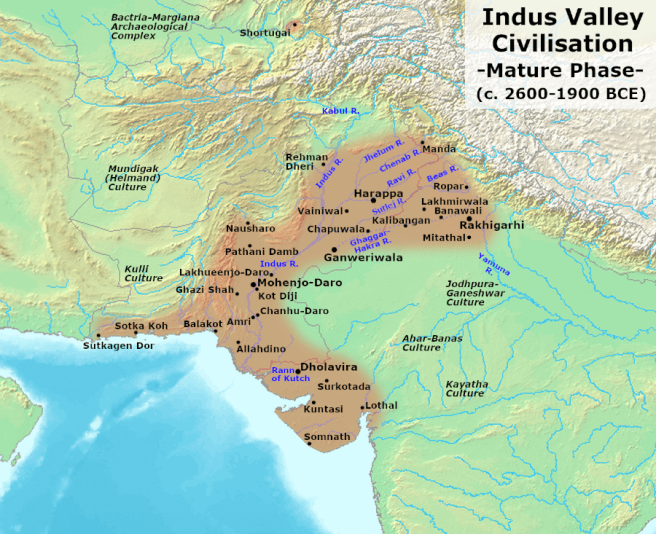
The Bronze Age in the Indian subcontinent begins around 3000 BCE, and in the end gives rise to the Indus Valley Civilisation, which had its (mature) period between 2600 BCE and 1900 BCE. It continues into the Rigvedic period, the early part of the Vedic period. It is succeeded by the Iron Age in India, beginning in around 1000 BCE.

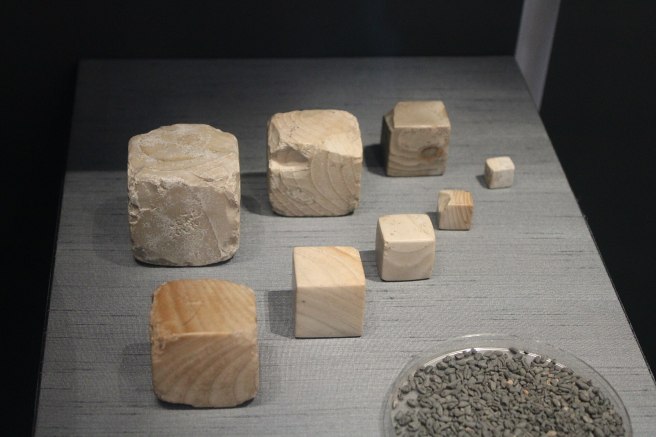
Standard cubic weights from the Indus Valley 2600-1900 BCE

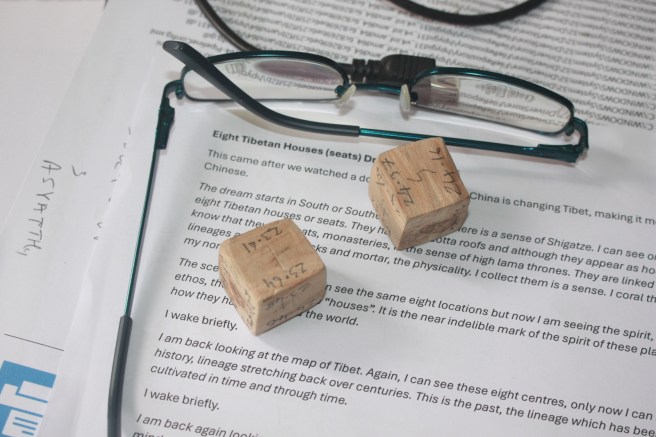
Cubic “dice” made by me {unknowing} for Tibetan Mo divination, Brittany 2024 CE.

The measurments are made with a high precision capacitance micrometer and are accurate to plus or minus 0.01 mm..

Eight Tibetan Houses (seats) Dream 19-02-2025

This came after we watched a documentary on how China is changing Tibet, making it more Han Chinese.

The dream starts in South or Southeastern Tibet. There is a sense of Shigatze. I can see on a map eight Tibetan houses or seats. They have terracotta roofs and although they appear as houses, I know that they are seats, monasteries, in the sense of high lama thrones. They are linked to lineages and are the bricks and mortar, the physicality. I collect them in a sense. I coral them in my non-physical arms. I am wearing magenta and saffron Buddhist robes.

The scene changes and I can see the same eight locations but now I am seeing the spirit, the ethos, the essence of these “houses”. It is the near indelible mark of the spirit of these places, how they have energized the world.

I wake briefly.

I am back looking at the map of Tibet. Again, I can see these eight centres, only now I can see history, lineage stretching back over centuries. This is the past, the lineage which has been cultivated in time and through time.

I wake briefly.

I am back again looking at the map with these eight houses highlighted. Now I can see mind, mind-stream and even the awareness or consciousness associated with these centres. I sense in the dream that this represents future in that the centres live not necessarily physically but in the mind-stream, the Buddha field.

As I awake, I joke to myself that is must be weird Wednesday as opposed to freaky Friday.

More Tibetan Phrase Dream Follow Up

“I start out on my route and part the way along in or near Mongolia I am given two white plaques of an irregular shape. Phonetically these plates speak in the dream. They say, “Mon yet {yat} Dzong” and “Sprul yet Tsaay” I can see the associated Tibetan script but cannot associate it directly with the phonetics.”

—————————————————————————-

The name “Khyentse,” often equated with the Rimé movement, is the union of two Tibetan words, khyen (མཁྱེན་པ་,“ken,” or sometimes “chen”) and tsé (བརྩེ་བ་, “tsay”), meaning “wisdom” and “compassion.”

From web site of Dzongsar Jamyang Khyentse Rinpoche

————————————————————————————–

“Sprul yet Tsaay”

ཡེ – primordial – ye or je

བརྩེ་བ – compassion – tsay

—————

ཡེ

waldo1) first, primordial, beginning, original, eternal[ly] fundamental; 2) always, constant
valbyfrom the beginning, from eternity, utterly, perfectly, highly, quite, from the very beginning, principle of light & being, basic
barrontimeless; atemporal

བརྩེ་བ

rangjungbenevolent, affection, compassion, love, merciful, care for. love; to love (v); loving kindness; to love/ feel affection; to love, love, kindness, to count up, mercy, affection, playing with; {brtse ba, brtse ba, brtse ba} intr. v.; ft. of {rtse ba}
waldo1) will play [f rtse ba]; 2) (Tha mi dad pa,, 1 be unbearable; 2) affection, compassionate, pity, [p brtses],, love, have concern/ compassion, merci[ful], kind[ness], benevolent affection, compassion, love, care for, count up, play w
valbyresponsive, kindness, tenderness, benevolent, affection, compassion, love, merciful, mercy, fervent love

སྤྲུལ་

Sprul

Hopkins 2015send forth an emanation; emanate; emanation
Rangjung Yeshecreated, ཡིད་ mentally. emanated, “incarnated”, apparitional, magical, emanating, emanation, nirmanakaya, miraculous, transformed [into], manifested. vi. to change / transform [miraculously]; imp. of སྤྲུལ་བ་
Hackett Defi­nitions 2015(PH) snake
James Valbyjuggle, make phantoms appear, transform creation, emanating, recasting oneself, snake, 1 of ‘jigs pa rnam par brgyad, abbr for sprul sku
Ives Waldo1) mentally created/ emanated [as]; 2) incarnated; 3) apparitional, magical, miraculous, transformed [~into] emanated[ing][tion]; 4) nirmanakaya; 5) manifest, change/ transform [miraculously]

སྤྲུལ་ ཡེ བརྩེ་བ

Sprul ye tsay

Emanation of primordial compassion

————————————————

Avalokiteshvara or  Avalokiteśvara

In Buddhism, Avalokiteśvara (meaning “the lord who looks down”, also known as Lokeśvara (“Lord of the World”) and Chenrezig (in Tibetan), is a tenth-level bodhisattva associated with great compassion (mahakaruṇā). He is often associated with Amitabha Buddha.

Wikipedia

Avalokiteshvara (Skt. Avalokiteśvara; Tib. སྤྱན་རས་གཟིགས་ or སྤྱན་རས་གཟིགས་དབང་ཕྱུག, Chenrezik or chenrezig wangchuk, Wyl. spyan ras gzigs or spyan ras gzigs dbang phyug) is said to be the essence of the speech of all the buddhas and the incarnation of their compassion.

As one of the Eight Great Close Sons, he is usually depicted as white in colour and holding a lotus.

He is of special importance to Tibetans, so much so that he is sometimes described as the patron deity of Tibet. Among his emanations are King Songtsen Gampo—who is credited with authoring the Mani Kabum, a cycle of teachings and practices dedicated to the deity—as well as the lineages of Dalai Lamas and Karmapas.

Rigpa Wiki

Hokkaido – Golden Pins – Tibetan Phrases – Road Trip – Dream 07-02-2025

Here is this morning’s dream had between 4 and 8 AM.

The dream opens in Japan specifically Hokkaido. I am indoors in a hectic setting, a kind of big event hall. I am competing in a game which is part physical plane sprint racing and part abstract computer intelligence game. Each round is set off by a buzzer and the contestants have to make their way to the finish line within the context of the duality. In the booth next to me is a tall slim Japanese man. The buzzer sounds and the race begins. In both scenarios he just beats me. I come second in the race.

We both go over the left of the finish line in the computer world and in the thing which holds up the finish flag are the positional pins. We each select a tiny golden micro-pin which has the positional letter. My pin ends in a golden 2, his a golden 1. I place the pin in my shirt pocket on the left hand side of my chest. The race repeats several times and each time the result is the same. I soon have quite a collection of golden two pins in my shirt pocket. The “competition” finishes.

I am then walking through a busy brightly lit mall. I am in a food court in which various Japanese food outlets are selling street food. The atmosphere is pungent and very lively. The food on offer is highly coloured and from around the globe. I cannot decide. I walk over to a burger joint and a Japanese woman asks me what I would like. It is her job to serve me and be of assistance. She is very friendly, lively and with excellent English {UK}. I say that I would like a small burger and fries and for her to surprise me. She brings my food over together with a large bottle of top-end Japanese spring water. She sits next to me and helps me to eat.

I go back to my rooms; they are executive and above parr. I am unsure as to what to do next. I have no return flight. So, I start to look up flights from Sapporo to Queensland Australia. The Idea being that I land in Townsville or Brisbane and buy a second hand car to drive to the Isa {Mt Isa}.

I pause and take a stroll. Outside in the car park is my ex-wife. She is in a beat up camper van and I can hear her snoring. The van is a mess. I go back inside. She knocks on the door. I open it. She asks how I am coping with the water. Just fine. She says that she had problems getting served at the food court and did not like the tap water. I say that she probably had problems communicating. With the Japanese it is very important to listen. If you don’t listen carefully to what they say they consider you rude and vulgar. I say that listening was never one of her skills. I point to the bottle of top-end spring water on the side and say that she can take it back to her camper van, her brumby. This she does…

I hear the song from Men at Work, I come from the land down under, “travelling in a beat up brumby”.

I decide against going to Queensland.

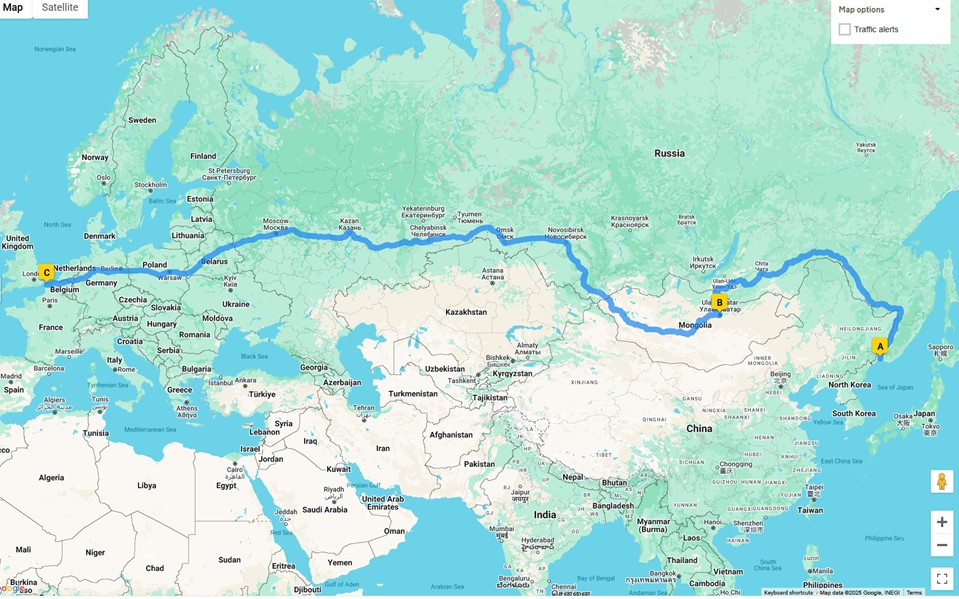
Instead, I must take a road trip. I see in my minds eye a map showing Hokkaido and Sapporo with mainland Asia and Vladivostok. I know that I can easily get a boat to Vladivostok and that I could drive from there to Wiltshire. I resolve in the dream to look up a route on AA route planner when I get up. I know that I must go via Mongolia and that it will be a long trip.


Here is AA Router planner route Vladivostok to Calais. Distance ~ 8000 miles.


I start out on my route and part the way along in or near Mongolia I am given two white plaques of an irregular shape. Phonetically these plates speak in the dream. They say, “Mon yet {yat} Dzong” and “Sprul yet Tsaay” I can see the associated Tibetan script but cannot associate it directly with the phonetics.

The dream ends

————————————–

Sprul

The concept of tulpas has origins in the Buddhist nirmāṇakāya, translated in Tibetan as sprul-pa (སྤྲུལ་པ་): the earthly bodies that a buddha manifests in order to teach those who have not attained nirvana. The western understanding of tulpas was developed by twentieth-century European mystical explorers, who interpreted the idea independently of Buddhahood

——-

1) Trulku (in Tibetan: sprul sku) — Literally the “emanation body” of a buddha. In a Tibetan context, a trulku (often given the epithet rinpoché, “precious one”) denotes the chosen reincarnation of a lama of high spiritual stature. A trulku usually inherits his (or her) predecessor’s prestige, wealth, and institutional seat. Important trulku lineages include the Dalai and Panchen Lamas and the Karmapas, who originated the tradition in the thirteenth century

2) sprul sku (སྤྲུལ་སྐུ) (Tibetan; in Sanskrit: nirmāṇakāya) — (lit. “Emanation body”) — Within the compass of the formbody, the aspect of a buddha that appears for the sake of ordinary sentient beings. A single buddha may manifest multiple emanation bodies, which may be in human, animal, or inanimate form. The “historical Buddha” Śākyamuni is generally regarded as an emanation body. The Tibetan term for emanation body, trulku, is used to designate a deliberately reincarnated lama

Sprul

སྤྲུལ་ send forth an emanation; emanate; emanation

————————–

Mon

མོན་

Bhutan; Mon, a district in Tibet

Mön

Mon. Name for lands to the south and southwest of Tibet

Dzong

Dzong (Tib. རྫོང་, Wyl. rdzong) — literally a ‘fortress’, the equivalent of a monastery in Bhutan.

—————————————————————-

Le dzong du Bhoutan est un monastère-forteresse bouddhiste caractéristique du Bhoutan.

Les premiers dzongs furent construits dans le pays dès le XIIe siècle, mais leur âge d’or fut la première moitié du XVIIe siècle qui vit le renforcement défensif du pays par le shabdrung ou grand lama Ngawang Namgyal (1594-1651), l’unificateur du Bhoutan moderne.