
Kaivalya-pâdaï – Freedom
In book IV Patañjali writes on the cessastion of samsara and therefore freedom from rebirth. This is the end-point of Rāja Yoga.
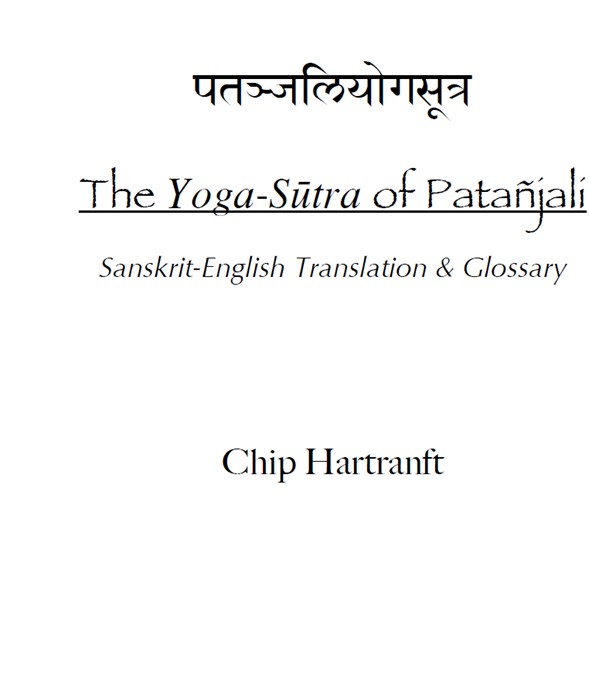
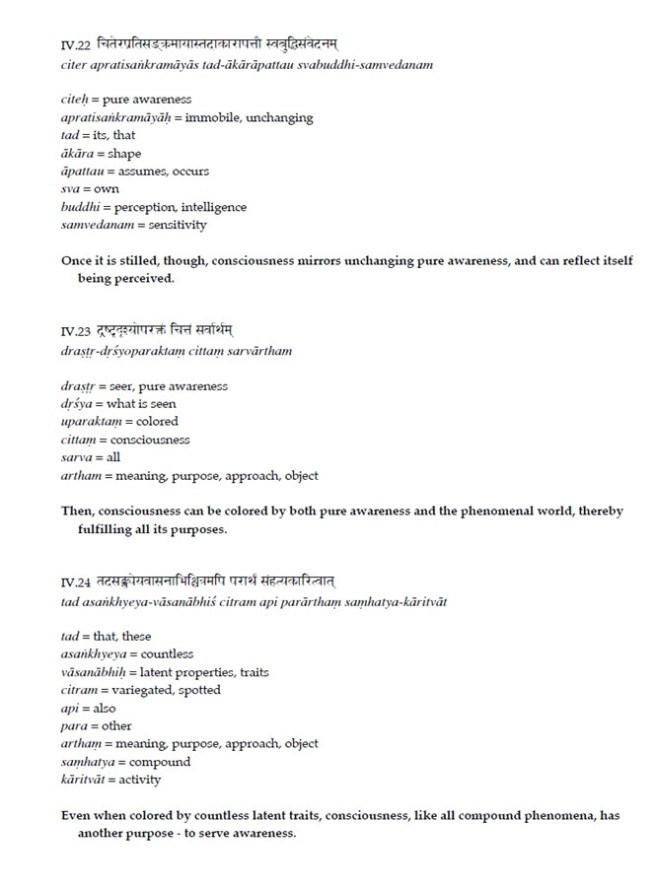
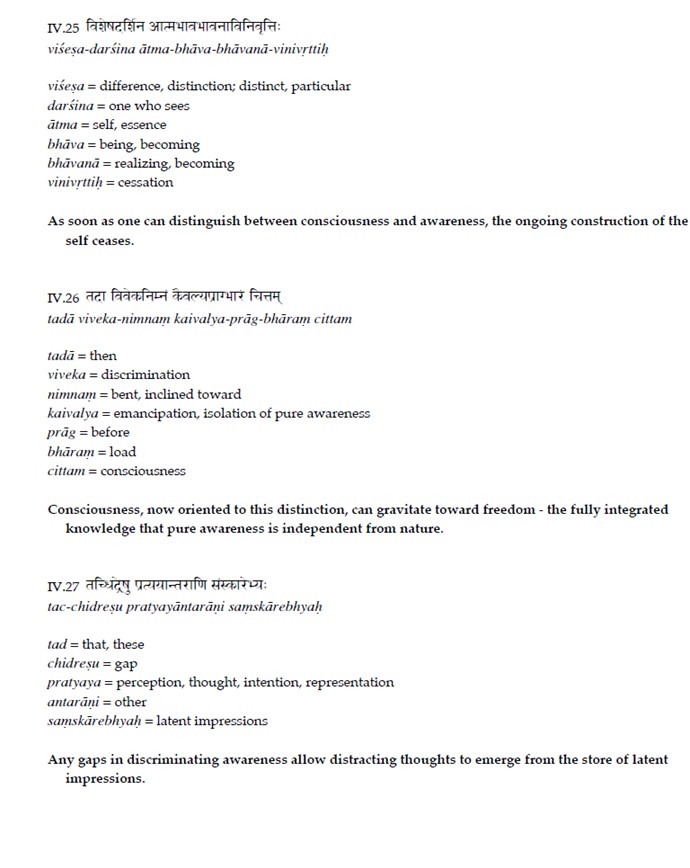
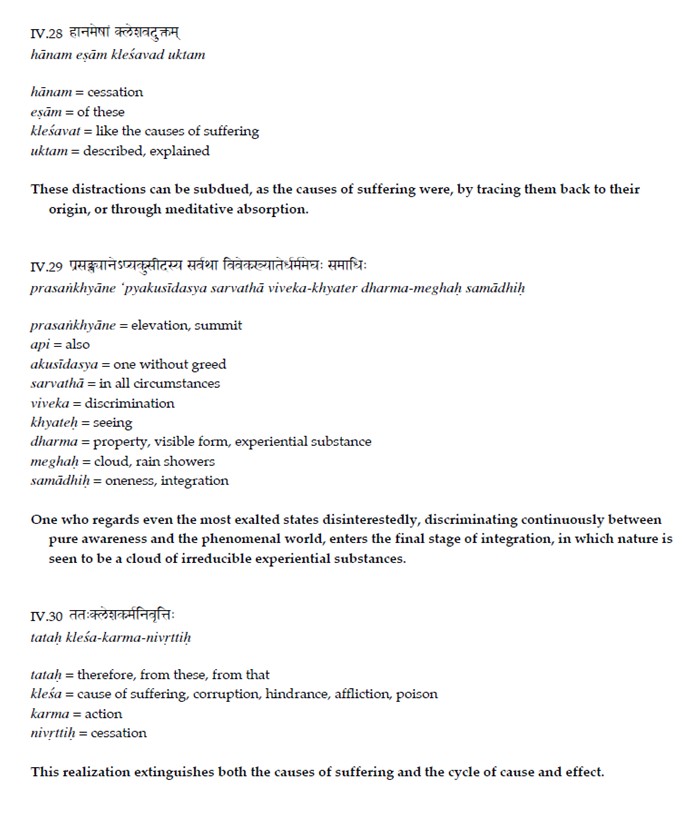
Here are some excerpts from an excellent book by Chip Hartranft




The Eternal Now
Kaivalya-pâdaï – Freedom
In book IV Patañjali writes on the cessastion of samsara and therefore freedom from rebirth. This is the end-point of Rāja Yoga.
Here are some excerpts from an excellent book by Chip Hartranft
The Eternal Now
In the context of karma, if you don’t {yet} believe in karma then it is your current karma so to do and be. It does not alter the fact of karma but your denial and disbelief thereof is karmic. Eventually karma will teach you about karma and cause & effect. In the context of karma there is an inevitability.
Do you believe in karma?
Answering this simple question has karmic consequences which may be wide ranging.
If, however, there is no such thing as karma the answer is a facile no.
To plump for an agnostic maybe suggests that karma exists, sometimes and in some circumstances. You might cherry pick the circumstances in which you give a nod to karma. Picking and choosing thus implies you want life on your own terms. You are selective.
To answer yes, implies that you acknowledge at least some responsibility for your actions.
To fully believe in karma at first might cause you to freeze and say, think and do nothing. You may not wish to cause anything.
A belief in karma has scaling to it. I have looked into its applicability and the concept of karma is for me sound and can be observed in many situations and events.
There are numerous social media, and YouTube videos entitled “instant karma”. There is a song by Lennon and Ono. People enjoy watching comeuppance. As a loose concept karma is held by many. But it is not as simple as prompt and obvious payback. Enjoying people getting comeuppance is not in itself wise or pleasant.
It is my observation that karma can be very subtle and by way of a complex conundrum which is difficult to solve.
An obvious hurdle or bar to solving some karmic “problems” is the notion of face. People might want to resolve a situation but the only way to do that is to maybe apologise and lose some “face”. Thus, the problem never gets solved and it acts like a burr under the skin. It does not go away. Prompt action eases situations quickly, putting things off makes them worse. Boris Johnson struggled to admit he was wrong in Partygate because his sense of entitlement had it that rules did not apply to him the world king, they were for little people. Truss still refuses to accept she caused the markets to plummet. “Face” can exact a high price. And that price may come in the twilight of a life. Payment is due and with interest. Her political relevance wanes.
It is my thesis that much karma ripens and bears fruit near end of days. Challenges put off due to inconvenience re-appear just when one no longer has as much faculty to solve or face them.
In my experience karma has a lot to with attitude. Hoity toity and arrogant people can be knelt by the universe, taught a lesson of humility. To suggest to an arrogant person that this might happen is a thankless task and unlikely to succeed at first, it might sow a seed, however.
Those who believe they are able to act with impunity are the most likely not to believe in karma nor accept that they are responsible for the consequences of their actions. An example in case is the migrations from Iraq and Afghanistan. We caused this by invasion and destruction yet are unwilling to accept the consequence of immigration. We moan and complain and demand that it stops. We fail to acknowledge the lesson and are likely to repeat the same folly as a result.
Karma can take many cycles to teach.
A typical karmic conundrum may involve wanting to resolve a situation but being unwilling to take the necessary risks or appropriate steps. In some cases, those steps which once were possible and facile have become very difficult. The longer resolution has been delayed the harder it becomes. The “problem” has grown, spread or bifurcated.
The poor attitude has acted as a growth factor for the problem. What was once simple has become highly complex and entangled. Escapism, avoidance and denial have fertilized the karma.
The saying, “what a tangled web we weave when first we practise to deceive”, is a statement of karma. With an inevitability one lie requires more to prop it up. An early stage fess-up prevents a massive web of lies, metastasising.
If is the word which most stops karmic resolution. People want to put conditions on their actions and keep apparent control. By trying to control a situation and not resolve it one can make it a lot worse. This seldom occurs to some. They can be very adamant and stubborn.
“If I do that what is in it for me?”
Is a mindset which negates the law of karma.
Accepting responsibility for one’s actions and how they ripple out into the trajectories of the wider world is not something that most people do. Being me or egocentric they fail to appreciate the wider connectivity.
Karma ultimately teaches that we are all connected in the same world. We are a part and not as separate as we might insist or imagine.
At the moment global karma is being initiated in the middle east violence. What will the longer term effects be? Will they be widespread or localised?
Do you believe in karma?
Place your bets…spin the wheel…
I’ll speculate that many believe things, ideologies and religions for which there in no possibility of proof. Half of the UK “believed” that Brexit was a good idea, many were adamant even though the outcome was unknown. They professed with absolute certainty about something which had not yet happened. Some Americans chant the MAGA mantra. Exactly when was America ever a great and equal place? Bad stuff has always gone on there to some extent.
People will believe whatever it is they want to believe. The strength of belief may vary. The war in Vietnam seemed like a good idea at first. Someone thought agent orange was good.
The church had a vested interest in making people God-fearing. Bums on seats meant coins on collection plates and salaries for clergy. The gold held by the churches and all that chavvy stuff goes against my interpretation of New Testament Christianity which differs from Old Testament Torah. Yet many who name themselves Christian believe in an eye for an eye instead of turning a cheek. I personally cannot envisage any deity in human or anthropomorphic form. {With the exception of Ganesh} I was made to draw God as a white bearded white geezer at the convent school in Zambia.
People born with penises believe that they can be “women” after a few hormones and a change of clothes, a new frock.
Some of the conspiracy theories floating about are to my eyes far-fetched, yet they have their devotees. I do believe that the world is controlled loosely by rich people. The extent to which they conspire is moot. It is all about profit and the best way to get that is by being good at business and ensuring calm by means of pecuniary compliance. There is no need to do weird far-out stuff.
Yep, some get corrupted by power and this can be expressed by abuse, sexual abuse and coercion. There are a number of ring-like groups that take advantage of those who are corruptible by promise of an easy ticket. Sometimes the cost of association to/with a powerful figure is high. Savile, Epstein, Al-Fayed. There are mini-mes of these scattered through the population, the degree of unpleasantness varies.
–

–
Between belief and proof, we might have working hypothesis. In which one tries out a framework or context to see how well it works, what the generality is like. There are “proofs” which are more circumstantial than direct. There are things which suggest or point at an idea.
I believe in the concept of karma, there is sufficient observable causality for me to trust it as a concept, a working hypothesis. However, the subject is vast. I once did a whole blog exploring karma. The cornerstone of karma is evolution. One needs to learn from mistakes. Evolution and karma are of the same process. There is a cost associated with some actions which “the universe” wants paid. Karma not worked at in a timely fashion and with willing mood accrues karmic debt, much like a bank loan. One learns the effect of a causal action or behaviour. Sometimes people are slow learners.
The coypu no longer trouble our lotuses. Electric shock training with 0.25 Joule pulses at kilovolts works. We have a low electric fence which I installed. Cause and effect. Coypu karma.
I have had sufficient circumstantial evidence via visions and dreaming to believe in reincarnation. There is no way, on this planet, that I could ever prove reincarnation to the satisfaction of my scientific training. I could not put data into a spreadsheet and plot a graph with a fitted equation and a statistical quality of fit metric. I share the belief in reincarnation with millions. I probably believe it more strongly than most.
Karma and reincarnation as concepts are internally consistent. Karma spans lifetimes so that we can evolve. Karma is a teacher of sorts, in my world. It takes lifetime after lifetime to learn somethings.
Is it significant that I who once was a pukka scientist at a pukka institution can remember three lives as a Buddhist monastic?
Depends upon what you think is significant. To your average common or garden UK football supporter it means nothing. To someone who is a committed Buddhist it would not be a huge surprise, it might be tad interesting. Why not a scholar scientist and a scholar monk? It is not so different. Both have cerebral elements. To a bunch of scientists, it might be a red flag which needs disproved.
Have you noticed how science has a negation bias?
I’ll speculate that most people have a host of things which they believe which cannot be proven and moreover they do not question their beliefs or the provenance of the source from which they were obtained / picked up. Gossip and tittle tattle being a common currency which can become Gospel or God’s honest truth. “They” know and say an awful lot, do they not?
People can be very adamant about things which they have not checked or researched themselves. There is heavy reliance on hearsay. There are a lot of soap box orators both in real life and on-line. Hearsay has it that the spread of disinformation is huge and increasing. This is consistent with what I see on Twitter.
If you watch BBC, Sky, France 24 and Al-Jazeera the reporting on Gaza is very different. The British news is very sanitized and biased. People trust the BBC but it is reporting on a very different “war” to Al-Jazeera. Chalk and cheese. The UK right think the BBC is luvvie-socialist oriented.
People will believe whatever they want to believe. Convenience is a major factor in belief. They will believe what is the most convenient for them to believe. Inconvenient truths are generally not preferred. Coming round to an inconvenient belief takes time and is resisted, exemplified by the three individuals mention previously. So far nobody has said a great deal about the Princess Diana – Al-Fayed relationship. That narrative is altered by recent news. Did King Charles have her bumped off? Is he still the villain or are there other factors now?
Belief is also mutable…
What you believe today is impermanent…I can’t prove it to you…I can offer it as a working hypothesis which you might see to be applicable.
———————————
How many of your beliefs are convenient?
Why did you prefer them?
There are some people, some nations, who believe they can do whatever they like, be barbaric for example and feel thoroughly justified in their right to slaughter. They imagine quasi-divine impunity and do not subscribe to the notion of cause and effect or karma.
The karma of empire is decay and loss of significance. History shows time and again that no empire lasts forever and towards the end corruption and decadence arrive for the wind-up party.
This afternoon I watched a news programme in which it was mooted that the economies of China and India would in time be larger than the USA. Things change, nothing lasts forever. The technological revolution in China has soared after the so-called cultural revolution of Mao Zedong. The USA has behaved like a bullying teenager for a long time now. It has funded the destruction of Gaza and now Lebanon too. The United Nations has never looked so toothless as it does today.
The word is a scary place right now. I used to have a lot of respect for USA, but now with things like Iraq and an attempted coup d’état by mob a few years back, respect wanes. My foray into Twitter has done little to improve my opinion. There are some nut-jobs out there. In a few short weeks there will be an election. Some Americans are suggesting “Kamunism” that Harris is left wing! Really? She is a tory to my eyes.
Americans it seems know very little about socialism or communism.
There is a real prospect of the nasty orange sociopath man getting back into power and sending cultural evolution backwards in time. Trump is a part of national karma. You get the leaders you need/deserve.
The rise of nationalism and me-first isolationism is swift. Brexit being an example of a withdrawal from internationalism of the saddest and most unnecessary kind. Everything has some kind of consequence. No divorce is 100% amicable, to expect a miracle is misguided. Yet some still yearn for the fairy godmother.
France very nearly had a right-wing nationalist government.
Wasn’t the 20s and 30s last century when the nationalists grew in popularity? Are we doing Groundhog Day? Zieg Heil!
I saw a post suggesting that the Confederate States could leave the union, USA, and still compete effectively globally as a new country on the world stage.
That which takes ages to put together can be rent asunder in a fit of pique.
The level of division in the USA is very high it was preceded by the remainer-brexiteer name calling which divided families in the UK.
It does not look to me that people are learning to grow up and live together. Sandpit politics dominates.
There is a significant chance that the USA could implode and who is going to repay the ginormous national debt of the biggest economy if it does? How will Moody’s, Standard and Poor, and Fitch rate them.
Overriding, rewriting International Law to suit in order to bomb the fuck out of another country is an example set by the land of the free and home of the brave. You don’t have to be very brave in a F35 equipped with the latest electronic countermeasures. They set the precedent. Don’t worry they are only Muslims, kill them. Get Saddam. Take your shots and lie down dead.
In the fullness of time apparent impunity fades. Unexpected consequences start to arrive. USA has been caught sleeping twice.
I wonder what drama remains in geo-politics this year.
We have had five years of stuff happening which we did not expect. Covid, Ukraine, Gaza. What else is coming in?
Where we live is a pretty safe if there is a major escalation. We are not close to a likely target in a nuclear war. That I am evening thinking that is telling.
I have yet to hear of any situation in which mass death and destruction is the best answer. It seems an all too human default…
Humanity fails to learn by mistake…
Homo Sapiens is an arrogant misnomer…
 Dreamyoga