Savoir distinguer douleur physique et souffrance ajoutée.

Sallatha Sutta (SN 36.6)

La flèche : Savoir distinguer douleur physique et souffrance ajoutée.

Traduit par Jeanne Schut

Excerpted from The Dharma of the Forest

« Moines, une personne ordinaire a des sensations de plaisir, des sensations de douleur et des sensations qui ne sont ni agréables ni désagréables. Le noble disciple bien entraîné connaît lui aussi des sensations de plaisir, des sensations de douleur et des sensations qui ne sont ni agréables ni désagréables. Alors, quelle différence, quelle distinction, quel signe distinctif y a-t-il entre le noble disciple bien entraîné et la personne ordinaire? »

« Pour nous, Vénérable, les enseignements ont pour origine, pour guide et pour arbitre l’Éveillé, le Bouddha lui-même. Il serait donc bien que vous nous expliquiez le sens de votre question. L’ayant entendu de la bouche de l’Éveillé lui-même, les moines s’en souviendront. »

« Dans ce cas, moines, écoutez attentivement ces paroles. »

« Nous écoutons attentivement, Vénérable. »

Le Bouddha dit alors: « Lorsqu’une personne ordinaire ressent une douleur physique, elle s’inquiète, s’attriste et se lamente; elle se frappe la poitrine, pleure et se désespère. Ainsi, elle ressent deux sortes de douleurs: l’une physique et l’autre mentale. C’est comme si un homme était blessé par une flèche et qu’on lui en lançait une seconde juste après; il sentirait la douleur de chacune des deux flèches reçues. De même, lorsqu’une personne ordinaire ressent une douleur physique, elle s’inquiète, s’attriste et se lamente; elle se frappe la poitrine, pleure et se désespère. Ainsi, elle ressent deux sortes de douleurs: l’une physique et l’autre mentale.

« Ressentant une douleur, la personne y résiste avec amertume. Du fait de cette résistance et de cette amertume, une tendance sous-jacente de résistance à la douleur physique remonte à la surface de son esprit. Sous l’effet de cette douleur, elle se tourne vers la recherche de plaisirs sensoriels. Pourquoi ? Parce qu’une personne ordinaire ne voit aucune échappatoire à la douleur en dehors des plaisirs des sens. Du fait qu’elle recherche le bonheur dans les plaisirs sensoriels, une tendance sous-jacente d’avidité pour les sensations agréables remonte à la surface de son esprit. Elle n’a pas connaissance de la réalité ; elle ne sait pas que toutes les sensations agréables apparaissent puis disparaissent, qu’elles sont aussi attirantes que dangereuses et qu’il est difficile d’y échapper. N’ayant pas cette connaissance, une tendance sous-jacente à l’ignorance des sensations neutres remonte à la surface de son esprit. Qu’elle ressente du plaisir, de la douleur ou une sensation neutre, cette personne est comme enchaînée par ses ressentis, elle s’y identifie complètement. Voilà pourquoi il est dit que c’est une personne ordinaire, quelqu’un qui est piégé par la naissance, le vieillissement et la mort, par le chagrin, les lamentations, la douleur, la tristesse et le désespoir. Quelqu’un qui est enchaîné par la souffrance.

« Par contre, moines, lorsque le noble disciple bien entraîné ressent une douleur physique, il ne s’inquiète pas, ne s’attriste pas, ne se lamente pas; il ne se frappe pas la poitrine, ne pleure pas et ne désespère pas non plus. Il ne ressent qu’une seule sorte de douleur : une douleur physique, pas une douleur mentale. C’est comme si un homme était blessé par une flèche et n’en recevait pas une seconde juste après; il percevrait la sensation causée par une seule flèche. De même, lorsqu’un noble disciple bien entraîné ressent une douleur physique, il ne s’inquiète pas, ne s’attriste pas, ne se lamente pas; il ne se frappe pas la poitrine, ne pleure pas et ne désespère pas non plus. Il ne ressent qu’une seule sorte de douleur: une douleur physique.

« Conscient de cette sensation douloureuse, il n’y résiste avec amertume. De ce fait, aucune tendance sous-jacente de résistance à la douleur physique ne remonte à la surface de son esprit. Sous l’effet de cette douleur, il ne se tourne pas vers la recherche du plaisir sensoriel. Pourquoi? Parce qu’un noble disciple bien entraîné sait que l’on peut échapper à la douleur autrement que par le plaisir des sens. Du fait qu’il ne recherche pas le bonheur dans les plaisirs sensoriels, aucune tendance sous-jacente d’avidité pour les sensations agréables ne remonte à la surface de son esprit. Il a connaissance de la réalité; il sait que toutes les sensations agréables apparaissent puis disparaissent, qu’elles sont aussi attirantes que dangereuses et qu’il est difficile d’y échapper. Ayant cette connaissance, aucune tendance sous-jacente à l’ignorance des sensations neutres ne remonte à la surface de son esprit. En ressentant du plaisir, de la douleur ou une sensation neutre, il n’est aucunement enchaîné par ses ressentis, il ne s’y identifie absolument pas. Voilà pourquoi il est dit que c’est un noble disciple bien entraîné, quelqu’un qui n’est pas piégé par la naissance, le vieillissement et la mort, par le chagrin, les lamentations, la douleur, la tristesse ou le désespoir. Quelqu’un qui n’est pas enchaîné par la souffrance.

« Moines, voilà quelle est la différence, la distinction, le signe distinctif entre le noble disciple bien entraîné et une personne ordinaire. Le sage qui a pleinement réalisé le Dhamma n’est pas charmé par les objets désirables selon les critères du monde et les situations non désirables selon les critères du monde n’éveillent en lui aucune résistance. Désir et aversion n’existent plus en lui. Il a atteint l’autre rive. »


To paraphrase:

Whilst physically incarnated pain is very likely, how you respond to this phenomenon is up to you. You have a choice.

Pain is inevitable, suffering optional.
The Power of a Buddha or Evolved Bodhisattva

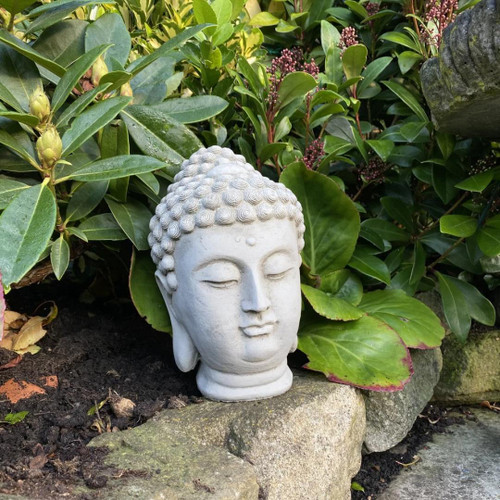
The image of Buddha is very widespread and one can get a statue down the garden centre or a poster to put up on the walls of your home. The vibe associated is often calm tranquillity. Never is it in battle with Mara, Māra. In the west Buddha is often seen as wholly benign and passive. Those fond of smoking joints may have a Buddha statuette or have paraphernalia which is Buddha themed. One can get a vegetarian meal called a Buddha Bowl. Back when I was a vegan and visiting Japan I used to eat “Monk’s Meals” there.

Most of the statues have a Buddha who is not emaciated and with Thai style hair, a bit fat. Rarely is he seen as skinny. He is often depicted with a halo as might be perceived by a quasi-clairvoyant. 

It is not as weird as the blonde, blue eyed Aryan representations of Jesus who was probably semitic, Jewish, in appearance. But Buddha is often not quite as brown as he might have been in real life. He lived alfresco and would have tanned up well.

In the West people do not imagine the power, sometimes magical of a Buddha or evolved Bodhisattva. The imaginations do not extend beyond some dude sitting on a mat cross legged meditating.

“Hey man, that is Zen…”

Tibetan Buddhism is perhaps unique in representing wrathful forms of various Bodhisattvas. They do battle with evil. In Vajrayana there is black and white magic. Force sometimes needs met. There is significant power in a Buddha or evolved Bodhisattva. Power beyond normal ken.

The various canons have a list of special powers attained as a Bodhisattva proceeds along their journey to enlightenment. These supra-mundane powers are not to be found in garden centres. Scientists may quibble as to whether they are real manifestations or not.

As a teenager I was fascinated by the TV series Monkey.

“Monkey eats many of the peaches, which have taken millennia to ripen, becomes immortal and runs amok. Having earned the ire of Heaven and being beaten in a challenge by an omniscient, mighty, but benevolent, cloud-dwelling Buddha (釈迦如来, Shakanyorai), Monkey is imprisoned for 500 years under a mountain in order to learn patience.

Eventually, Monkey is released by the monk Tripitaka (三蔵法師, Sanzōhōshi), who has been tasked by the Boddhisatva Guanyin (観世音菩薩, Kanzeon Bosatsu) to undertake a pilgrimage from China to India to fetch holy scriptures (implied to be the region of Gandhāra in the song over the closing credits).”

Which is about the spread of the threefold Tripitaka to China and hence Japan. Evil tries to stop the dharma from being propagated and many adventures ensue. Here Buddhism is proactive and not passive. There is struggle.

The Buddhist canons have many stories of remarkable miracles carried out both by Siddartha and other Bodhisattvas. Padmasambhava considered a Nirmāṇakāya of Shakyamuni Buddha is attributed with magical powers and miracles. Those steeped in the tradition are less likely to scoff than your common or garden Western scientist. Vajrayana differs from East Enders or Coronation Street and markedly so. Exposure and immersion in its depths is likely to blow the minds of anyone lacking openness and fluidity.

Without direct personal experience there is no way to assess what the power of a Buddha or evolved Bodhisattva might be. Common sense suggests caution and not arrogance.

 A Buddha is not just a garden ornament, statuette or poster…

Buddha Pronounces the Sūtra of the Total Annihilation of the Dharma

This prompted by my dream see previous post.


Translated from Sanskrit into Chinese

by

An Unknown Person

Thus I have heard:

    At one time the Buddha, together with bhikṣus and Bodhisattvas, was staying in the city kingdom of Kuśinagara, where He would enter parinirvāṇa in three months. Countless multitudes came to the Buddha and bowed their heads down to the ground. Surrounded by His devotees longing to hear the Dharma, the World-Honored One remained silent, and His radiance did not manifest.

    The venerable Ānanda made obeisance to the Buddha and asked Him, “When the World-Honored One pronounces the Dharma, His awesome radiance is always displayed before and after. Now in this huge assembly, His radiance does not appear. Why is this so? There must be a reason. I pray to hear its implication.”

    The Buddha remained silent, not responding. After Ānanda asked this question for the third time, the Buddha told Ānanda, “After my parinirvāṇa, as the Dharma comes to an end, the way of the māras will thrive in this world of the five turbidities. Māras will appear as śramaṇas so as to undermine and destroy my Way. They will wear lay clothes and delight in the monk’s robe dyed with a mixture of five colors. To gratify ravenous appetites, they will drink alcohol, eat flesh, and kill sentient beings. Devoid of lovingkindness, they will hate and envy others.

    “At that time, there will be Bodhisattvas, Pratyekabuddhas, and Arhats, who energetically cultivate virtue and treat all with respect. Esteemed by all, they will teach and transform others impartially. They will pity the poor and old, and help the needy and unfortunate. They will teach others to revere and uphold the sūtras and the holy images. Kind and benevolent in nature, they will do meritorious karmas. Never harming others, they will disregard any harm to themselves in order to help others. Kind and friendly, they will endure abuse, not protecting themselves.

    “Although there will be such good people, all māra bhikṣus will be jealous of them. They will slander, malign, and banish them. Afterward, individually and as a group, the māra bhikṣus will not cultivate virtue. Temples will be deserted, falling into disrepair then into ruins. Greedy for material wealth, they will accumulate things, not using them to acquire merit. They will sell slaves to work in the fields. Devoid of lovingkindness, they will burn mountain forests, harming sentient beings. Male slaves will become bhikṣus, and female slaves will become bhikṣuṇīs. Devoid of morality, they will engage in sexual debauchery and perversion, whether with men or women. Such people will cause my Way to fade away.

    “Some of them will seek sanctuary in my Order to escape prosecution by the law. They will become śramaṇas but will not observe the precepts or regulations. Although they will, in appearance, recite the precepts on new-moon and full-moon days, they will be reluctant and indolent, not wanting to hear the recitation. They will omit some precepts, not wanting to recite all of them. They will not recite or study the sūtras. If there are readers who do not know the words [in the sūtras], they will claim that they know them. They will not consult the learned ones, but will instead seek fame for self-elevation. They will glorify themselves with fake elegant ways, expecting offerings from others. For committing any of the five rebellious sins, after death, these māra bhikṣus will fall into the hell of uninterrupted suffering. They will then be reborn as animals or hungry ghosts for as many kalpas as the sands of the Ganges. After their sins have been purged, they will be reborn [as humans] in a fringe country where the Three Jewels will not be accessible.

    “When the Dharma is ending, women will diligently do meritorious karmas while men will be indolent and arrogant. Men, having no faith, will not use the words in the Dharma, but will regard śramaṇas as feces and dirt. When the Dharma is ending, gods will shed tears. Flood and drought will ravage, and five kinds of grain will not ripen. Epidemics will be prevalent and many will die. People will endure a hard life, and government officials will exploit them. People will not follow good principles, thinking only of pleasure and strife. The evil ones will become as numerous as the sands in the sea. The good ones will decrease to one or two. As a kalpa is ending, the sun and the moon will be unstable and human lifespan will shorten. At the age of 40, one’s hair will turn white. Men indulging in sexual acts may die prematurely from depletion of their semen, or may live to only 60. While men will live short lives, women will live long to 70, 80, 90, or even 100 years. Faithless people will say that the situation can be permanent.

    “A massive flood will suddenly rise, lasting endlessly. Various species of sentient beings, lofty or lowly, will drown or drift in the waters, and they will be eaten by fish and other sea creatures. Bodhisattvas, Pratyekabuddhas, and Arhats, driven away by the māras, will not convene. [These holy beings of] the Three Vehicles will enter the meritorious grounds in the mountains. There they will live a long life, tranquilly biding their time. They will meet with one another when the god-kings escort Moonlight Bodhisattva to appear in the world. Together they will revitalize my Dharma for fifty-two years.

    “Then the Śūraṅgama Sūtra and the Pratyutpanna Buddha Sammukhāvasthita Samādhi Sūtra will be destroyed, to be followed by all other sūtras in the twelve categories. Their words will not be seen again. The monk’s robe will naturally turn white. When my Dharma perishes, it will be like [the flame of] an oil lamp. When it is dying, its light becomes brighter for a while then dies out. When my Dharma perishes, it will be like the extinction of a lamp. What will happen afterward is hard to describe. Eventually, after tens of millions of years, Maitreya Bodhisattva will descend to this world to become a Buddha. All toxic gases will then be eliminated, and the world will be safe and peaceful. The rains will be harmonious and the five grains will thrive. The trees will be tall, and humans will each be eighty feet tall, with a lifespan of 84,000 years. Innumerable sentient beings will be delivered.”

    The venerable Ānanda made obeisance to the Buddha and asked Him, “What should we call this sūtra? How should we uphold it?”

    The Buddha replied, “Ānanda, this sūtra is called Total Annihilation of the Dharma. Pronounce it to all and let them know its significance. Your merit will be immeasurable, beyond reckoning.”

    The four groups of disciples, having heard this sūtra, were distressed and downcast, but they all activated their resolve to attain the unsurpassed bodhi. Then they made obeisance to the Buddha and departed.

The Four Stages of Awakening

Some speculations and developing a train of thought….


This excerpted from Wikipedia

“The ordinary person

An ordinary person or puthujjana (Pali; Sanskrit: pṛthagjana; i.e. pritha: without, and jnana: knowledge) is trapped in the endless cycling of samsara. One is reborn, lives, and dies in endless rebirths, either as a deva, human, animal, male, female, neuter, ghost, asura, hell being, or various other entities on different categories of existence.

An ordinary entity has never seen and experienced the ultimate truth of Dharma and therefore has no way of finding an end to the predicament. It is only when suffering becomes acute, or seemingly unending, that an entity looks for a “solution” to and, persisting, finds the Dharma (the ultimate solution/truth).

The four stages of awakening in Early Buddhism and Theravada are four progressive stages culminating in full awakening (Bodhi) as an Arahant.

These four stages are Sotāpanna (stream-enterer), Sakadāgāmi (once-returner), Anāgāmi (non-returner), and Arahant (conqueror). The oldest Buddhist texts portray the Buddha as referring to people who are at one of these four stages as noble people (ariya-puggala) and the community of such persons as the noble sangha (ariya-sangha).

A stream-enterer, having abandoned the first three fetters, is guaranteed enlightenment within seven lifetimes, in the human or heavenly realms.

Sole dominion over the earth,
going to heaven,
lordship over all worlds:
the fruit of stream-entry
excels them.

Pratyekabuddhayāna is a Buddhist term for the mode or vehicle of enlightenment of a pratyekabuddha or paccekabuddha (Sanskrit and Pali respectively), a term which literally means “solitary buddha” or “a buddha on their own” (prati- each, eka-one). The pratyekabuddha is an individual who independently achieves liberation without the aid of teachers or guides and without teaching others to do the same. Pratyekabuddhas may give moral teachings but do not bring others to enlightenment. They leave no sangha (i.e. community) as a legacy to carry on the Dhamma (e.g. Buddha’s teachings).”

—————————————————

There are some elements of Buddhism which I struggle with. This stems from the notion of evolution, a planetary principle. Things change and generally get more efficient adapting to the times and circumstances. Therefore, to my eyes it is very unlikely that a “human” would reincarnate as an animal. If the being had progressed from monkey to human, it would not make a retrograde step even as karmic punishment. The being, a human, reincarnating, would need a human form. There are plenty of human forms in which life is difficult, so there is no need to invoke life as a dog.

Bearing in mind that the origins of Buddhism are ~2500 years old, humanity was very different back then. Life was different and complex abstract thought very uncommon. The majority were illiterate and living in a manner not so very different from their livestock. Life was generally short and hard. Animism as a basis for interpreting world was using the available daily template, a reality encountered on a day to day basis. The teaching metaphor and allegory available to Siddartha would reflect daily life, belief and superstition.

I am not a member of any mundane Sangha and do not go to “teachings”. I am a trained academic researcher and have read widely on Buddhism. It seems to me there remains debate about what the various teachings mean. I am aware that discussion and/or arguing the toss is not the same as attainment. Being attached to wanting to be right or winning an argument does not seem enlightened to me, it seems petty.

People like definitions, especially those educated in modern ways. People might then discuss what an arahant is and profess on the subject. It is human nature. I’ll speculate that most people pertaining to being Buddhist have never nor will they ever meet one. The arahants can be seen aloof and uncaring.

A cornerstone of Buddhism is taking refuge in the Buddha, the Dharma and the sangha. Some schools of Buddhism subscribe to the Bodhisattva ideal. A Bodhisattva roughly means one who will {one day} become a Buddha. They can be “beginners” or be very highly realised. These realised Bodhisattvas put off their own nirvana in order to come back to teach. They can put if off for multiple lifetimes. There is entreaty and prayer begging them, so to do. There is a prejudice perhaps in that they are more compassionate than an Arahant who pisses off, but too much compassion can be a weakness.

If we see evolution as a ladder, if you are on the top step, you need to vacate it so that someone else can use it.

There is perhaps a prejudice against pratyekabuddhas in that they do not need a sangha or teachers nor do they have a sangha of their own.

Implicit is that people seek and need teachers or guides. The student can thereby hand his/her power over to a guru or teacher. In so doing the responsibility for development is shunned to an extent. The teacher becomes partially responsible for progress.  

Those in a sangha do not “like” those not in a sangha. The human “we” does not like the rejection of the outsider “they”.  They are not a part of the/our gang. I have seen pratyekabuddhas talked down as lesser Buddhas. A little thought suggests that THE Buddha was pratyekabuddha. The sangha came later. This snobbishness is logically unwarranted.

If you boil it down the fetters are simply human foibles, without which there would be no television soap operas. Getting rid of anger, envy, hatred and jealousy. Lessening attachment, ambition and pride makes for a less exciting and emotional script. One could say that the core direction of Buddhist development is a reduction in human folly, even a tendency to be less “human”. In the limit one no longer wants to partake of the drama and simply stops coming back, stops taking on more meat. Someone like that would be weird to society and not readily integrated therein. If they wore robes it might be easier for society to accept them.

The sangha is a stepping stone offering camaraderie as one lessens engagement with the socio-political world view prevalent at the time of a life. The sangha is kind of like a crutch or support mechanism for those ordained monastic.

I personally have doubts that monasticism is altogether good. The temptation is to an extent removed. It is easier to remain calm and detached when removed from the mundane “lunacy”. Celibacy can cause deviance; suppression can cause explosion.

The basic requirement to enter the stream is to see and acknowledge the truth of the Dharma, the impermanence of all conditioned things. Attaining and realising impermanence starts to untie attachment. “They” say that there is a maximum of seven lifetimes before nirvana once the stream has been entered.

The sixteen close disciples of Buddha are given arahant “status”. They are almost deified and their intervention sought via prayer. There are statues, painting and thangkas.

If they came to Siddartha as a fresh disciple when the Dharma was in infancy it seems to me that to go from zero to hero in such a short time and achieve arahant in one lifetime was some pretty fast work. Religious hagiography is often exaggerated and idealised. One could say through the power of the Buddha evolution was vastly accelerated.

There was no stream until Siddartha, in this context.

If I use the dreams in the blog as a basis I have had three Buddhist lifetimes, one Indian, one Thai and one Japanese. In all of these I was monastic. The next lifetime was as a Christian priest / soldier. The most recent prior lifetime I was a civilian. This current life started with science, a lot of it.

I have reason to believe that my first Buddhist life was at the dawn of Buddhism ~2500 years ago. If I entered the stream then I am now five lifetimes on. Which means I may not be doing an Arnie many more times.

Of course, the only way that I will know for sure is to pop my clogs and see what happens.

I’ll speculate that the human love of ritual and ceremony has lead to quasi-deification. The social need of groups is for some kind of celebratory focus or rite. This has little to do with what I understand to be the core teachings. In some texts removal or ritual is at a later stage of the enlightenment journey. It serves a good social purpose but must be transcended, being attached to ritual is an attachment after all.

My hunch is that the days of guru-yoga are drawing to a close. There have been many scandals and some far out cults.

Humanity might need to do more for and by itself.  

Double Vajra Tattoo – Dream 16-12-20

After a bit of a sleepless night, I awake to find my former university in the news and not in a good way. There are various comments on the nature of the working environment there.

Here is last night’s dreaming segment.

I am in a room with others, we are being threatened by a group of people with dogs on leashes. The dogs are straining to attack. They are like pit bulls. The owners are having trouble holding them back. I am quite relaxed. One of the pit bulls has inordinately long fangs and is angrily taking an interest in me. I offer it my right arm. It bites down hard and strong and will not let go. I am not worried about this. The owner of the dog tries to get it to let go. It will not. I place my left hand around the side of its jaws and squeeze. The dog opens its jaws and backs off happy.

I look down and it has left a mark reminiscent of a double vajra in oranges and red. There is no blood simply what looks like a tattoo on the inside of my forearm. I show everyone in the room my new tattoo.

Later I am working at the checkout in a supermarket and I show each of the customers my new tattoo about which I am slightly excited.

Dream ends

Excerpted from Rigpa Wiki

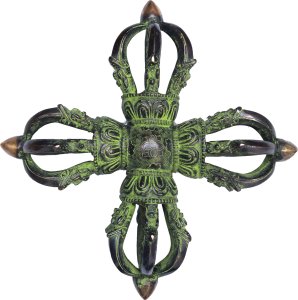
The double vajra (Skt. vishva-vajra; Tib. རྡོ་རྗེ་རྒྱ་གྲམ་, dorje gyadram, Wyl. rdo rje rgya gram) or crossed vajra is formed from four lotus-mounted vajra-heads that emanate from a central hub towards the four cardinal directions and symbolizes the principle of absolute stability.

In the cosmographic description of Mount Meru, a vast crossed vajra supports and underlies the entire physical universe. Similarly in the representation of the mandala, a vast crossed vajra serves as the immoveable support or foundation of the mandala palace and here the central hub of the vajra is considered to be dark blue in colour with the four heads coloured to represent the four directions-white (East), yellow (South), red (West) and green (North). These also correspond to the five elements and the buddhas of the five families with blue Akshobhya in the centre.

It’s also an emblem of the green buddha of the north, Amoghasiddhi, and represents his all-accomplishing wisdom as lord of the karma family of activity.

The raised throne upon which masters are seated when teaching is traditionally decorated on the front by a hanging square of brocade displaying the image of a crossed vajra in the centre, often with four small swastikas in the corners. This emblem represents the unshakeable ground or reality of the Buddha’s enlightenment.