Maybe I Was an Alpaca?

This morning’s dream points {again} to some kind of Tibetan incarnation, perhaps some lama-dude. I have long held this possibility at arm’s length because I have had no waking memory of such a thing. The dream indicates a time stamp roughly of 1960 when things were bad in Tibet and a number of lamas left. We hear about the ones who made it. We don’t hear about the ones who did not.

They may have been vulture food.

I did once go to a dzong in London and had an “empowerment” by Tulku Akong Rinpoche. A lama who along with Chögyam Trungpa escaped from Tibet during the Chinese excess.

I have often wondered why no waking recall. The only answer I came up with is that life as a monk is so very boring that there is little to remember, no outstanding dramatic events. Tedium, day after day routine.

If the dream points at a very recent incarnation, then that hints at something like a tulku incarnation, where one life follows quickly.

That does not really impinge on the current health problems and search for a nanna-flat. In a sense it is little more than a phenomenological possibility when viewed from life circumstance. I do not see nor feel that there is much / anything left for me to do.

I have hypothesised that there have been many failures, way more than “successes”. We only hear of the latter because it is they who have ongoing wider significance. In a way quiet failure fertilizes the ground for success.

I am at something of an impasse on the health front and cannot currently see any further steps. There is nothing urgent and I can tolerate the pain and lack of sleep. We need to move house before even thinking about any operation. It is not a complicated equation, for now.

I am currently where I am not seeing medical intervention as something positive and healing. It seems like a necessary thing and to be endured even. It does not fill me with hope for an easier existence.

Do I have to? Well maybe it is sensible.

Who knows what if any dreams will follow tonight…

Tibetan Plateau, Gold, Lama Dream 1-11-2011

Prompted by this morning’s dream I found this one in the vaults, so to speak.

Dream Diary 1-11

I am outside with Charlie. He and I are loading bricks into the trunk / boot of a car. The bricks have curly writing on them, it is not Sanskrit or Tibetan. They are golden and more like large ingots of gold.

He and I are now on a long journey across the mountains on a plateau which is in Tibet. With us is a smiling lama who is our guide, guard and escort. He is showing us the way. The landscape is very sparse and rocky with scree falls. I look at the lama’s physique and it is very similar to mine only that he is shorter and obviously Tibetan. I say that I didn’t know that they built Tibetans like that…

As we continue on our journey. Charlie and I are now wearing saffron and magenta monk’s robes. This journey is to be extensive. As we move forward Charlie is often out in front exploring the different routes. At one stage we need to pick up speed. The Tibetan monk picks up his companion, also a monk, and carries him piggy-back. I do the same with Charlie. I am not sure that I can walk and climb at this altitude like this. After a few steps I realise that I can and easily so.

A little later the trail becomes tortuous and Charlie is way ahead up the hill. He comes down back to me via a slippery and windy route. I find a more direct route. This is a part of a long journey together.  

Back now in London, we are at a Tibetan Dzong as guests of honour. Sat waiting are Charlie , the wife and I. We are offered some western food. I turn to her and say that she had better tuck in before they come out with the yak’s butter….

Dream ends

Tibetan Phrase Dream Follow up

“I start out on my route and part the way along in or near Mongolia I am given two white plaques of an irregular shape. Phonetically these plates speak in the dream. They say, “Mon yet {yat} Dzong” and “Sprul yet Tsaay” I can see the associated Tibetan script but cannot associate it directly with the phonetics.”

ཡེ (ye, “primordial”)

Ye{t} could have been je or jay

DEFINING THE TERM MON

According  to  Neeru  Nanda  in  her  article,  “Monpas  in  their  borderland-A  historical  review”  she  stated  that  the  Monpas have a local saying that; “We are neither of Gyasar(Tibet) nor of Gyagar(India),we are the Mon”. The Monpa tribe of Arunachal Pradesh represents the dominant ethnic group of the region. The term Monpa meaning someone from Mon, is used either for people living in the region of Mon or for someone who is of Mon, irrespective of region. The term Monpa or Mon are hence used as a blanket terms by Tibetan to designate certain neighbouring region or people situated to the south. In many Tibetan writings, Mon, Monyul, Lho Mon or Shar Mon refers to a region, specifying a location mostly to the south of Central Tibet. According to early Tibetan sources, Monyul is situated in South Tibet, it was also known as Lho Mon, the southern belt of Tibet before the emergence of Kingdom in Bhutan and Sikkim Lho Mon was reffered to the people who lived in south Tibet. According to the historical sources of Bhutan, Sikkim and Tibet Lho-Mon is referred to as the inhabitant of south Tibet  which  includes  Bhutanese  and  Monpa.  Lho means south in Tibetan and Mon means people inhabiting in the region. Old Mon is largely connected to an area, which includes the whole of Sikkim state, Bhutan and the Mon region i.e. the Tawang and West kameng district in the westernmost tribe of Arunachal Pradesh.

Old Mon even included the southernmost counties of Lhoka and Shigatse Prefectures, such as Mon Tsho sna and Mon Gro mo in the TAR, which are adjoining border areas to Sikkim, Bhutan and Tawang district . Besides the description of the Monpa people of the Mon region as a “Scheduled tribes” in the state of Arunachal Pradesh, the term Mon is also widely used in other parts of the Himalayan region. Presently from the eastern Himalaya to the western Himalayas, Mon or Monpa is used as an unspecific meaning of an ethnic group. In the case of the eastern Himalayas, it is used in Bhutan, Sikkim and adjoining district of the west Bengal state. The trend of differentiating these regions as being not referred to Mon prior to the eighteenth century is strong in contemporary writings from the region.

Presently in Bhutan, Mon refers to an ethnic group living in the south-central districts and to a cluster of villages in Monmola  Trashithangyed,  Chiwog  of  Serthi  Gewog  region  in  the  Samdrup  Jongkhar  district.  In Sikkim and  n  the  adjoining district, Mon is referred to the region as well as to the Lepcha tribe and other ethnic group in the region.In the western Himalayas, the region of Ladakh and Kargil of Jammu and Kashmir as well as Lahaul, spiti and Kinnaur areas of Himachal  Pradesh,  Mon  and  sometimes  Mon pa  represent  group  of  sedentary  musicians  who  are  situated  low  in  the  social hierarchy. This lower social status of Mon is further recorded in Baltistan of Pakistan. The usage of term mon is also found in Central Himalayas region, where the upland hill people called or named their southern valley neighbours Mon.

The historical understanding of the different key term Mon, in its ancient and orginal term Man, is applied by the Chinese to several ‘barbarian’  groups  related  to  the  ch’iang  including  the  people  of  rGyal  rong.  The term is found in Tibetan text of the eighth and ninth centuries in the forms of Mon and Mong, and thereafter it is applied to all kinds of groups throughout the Himalaya with whom the Tibetan come in contact. The term lost any specificity it might once have had and came to mean little more than ‘southern or western mountain-dwelling non-Indian non-Tibetan barbarian’. The present range of term must have had its first impetus in a movement from the east to the south-east, and the affinities noted above incline one to look for the main point of secondary diffusion in the centre and east of ‘proto-bhutan’; not only the language but also some of social institution peculiar to the area may have served to link it in Tibetan eyes to the true Mon of rGyal rong.  The old towers  and  fortresses  in  the  Sino-Tibetan  marches,  the  mong-dzong  of  the  Nam  text,  are  parralled by many such building which have disappeared or lie in ruins in central and eastern Bhutan and in Kameng .

Sangey Phurpa, Rajiv Gandhi University

Journal of Visual and Performing Arts June 2024 5(6), 1889–1893

————————

“Sprul yet Tsaay”

At a push yet {yat} tsay could be yantse

—— Sprul {emanation} from (g)yantse

About Gyantse Dzong

Gyantse Dzong is a historic fortress perched majestically on a hill overlooking the charming town of Gyantse in Tibet. Gyantse Dzong, also known as Gyantse Fortress, is a symbol of Tibet’s rich cultural heritage and a testament to its strategic importance in the region’s history. You can trek to the top of Gyantse Dzong and overlook Pelkor Chode Monastery.

Dating back to the 14th century, Gyantse Dzong served as a military stronghold, administrative center, and royal palace, playing a crucial role in the defense of the town and surrounding areas. The fortress’s imposing walls, watchtowers, and strategic location offer a glimpse into Tibet’s past as a land of ancient kingdoms, epic battles, and enduring traditions.

Gyantse is often called the “Hero City” by local people, because of the determined resistance of the Tibetans against far superior forces during the British invasion of Tibet in 1903 and 1904. It was a slow and bloody massacre of hundreds of Tibetan people, who were only equipped with antiquated matchlock guns, swords spears, and slingshots at that time. What they faced were Maxim machine guns and 10-pound cannons.

As you wander through the corridors and chambers of Gyantse Dzong, you will encounter relics of the past, including ancient murals, prayer halls, and artifacts that speak to the fortress’s role as a center of governance and spirituality. The peaceful ambiance of the fortress, coupled with its commanding presence against the backdrop of the Himalayas, creates a sense of awe and reverence for the history and heritage it embodies.

Whether you are a history enthusiast, a cultural explorer, or simply a traveler seeking to immerse yourself in the beauty and legacy of Tibet, a visit to Gyantse Dzong promises a memorable experience filled with insights into the region’s past and the enduring spirit of its people. Join us on a journey to Gyantse Dzong and discover the stories, legends, and architectural marvels that make this fortress a cherished landmark in the heart of Tibet.

—————————–

Gyantse, officially Gyangzê Town (also spelled Gyangtse; Tibetan: རྒྱལ་རྩེ, Wylie: rgyal rtse, ZYPY: Gyangzê; simplified Chinese: 江孜镇; traditional Chinese: 江孜鎮; pinyin: Jiāngzī Zhèn), is a town located in Gyantse County, Shigatse Prefecture, Tibet Autonomous Region, China. It was historically considered the third largest and most prominent town in Tibet (after Lhasa and Shigatse), but there are now at least ten larger Tibetan cities.

Wikipedia

—————-

“Sprul yet Tsaay”

Ye-tsaay

Wisdom of the emanation?

Or emanation of wisdom?

—————–

ɕ is a sshh sound

ཡེ་ཤེས

Tibetan Etymology

From ཡེ (ye, “primordial”) +‎ ཤེས (shes, “to know, understand, realise, cognise”).

Pronunciation

    Old Tibetan: /*je.ɕes/

    Lhasa: /ji˩˨.ɕi˥˨/

Noun

ཡེ་ཤེས • (ye shes)

  • wisdom, awareness, knowledge
  •   (Buddhism) jnana

Proper noun

ཡེ་ཤེས • (ye shes)

    a unisex given name, Yeshe

From Wiktionary
Hokkaido – Golden Pins – Tibetan Phrases – Road Trip – Dream 07-02-2025

Here is this morning’s dream had between 4 and 8 AM.

The dream opens in Japan specifically Hokkaido. I am indoors in a hectic setting, a kind of big event hall. I am competing in a game which is part physical plane sprint racing and part abstract computer intelligence game. Each round is set off by a buzzer and the contestants have to make their way to the finish line within the context of the duality. In the booth next to me is a tall slim Japanese man. The buzzer sounds and the race begins. In both scenarios he just beats me. I come second in the race.

We both go over the left of the finish line in the computer world and in the thing which holds up the finish flag are the positional pins. We each select a tiny golden micro-pin which has the positional letter. My pin ends in a golden 2, his a golden 1. I place the pin in my shirt pocket on the left hand side of my chest. The race repeats several times and each time the result is the same. I soon have quite a collection of golden two pins in my shirt pocket. The “competition” finishes.

I am then walking through a busy brightly lit mall. I am in a food court in which various Japanese food outlets are selling street food. The atmosphere is pungent and very lively. The food on offer is highly coloured and from around the globe. I cannot decide. I walk over to a burger joint and a Japanese woman asks me what I would like. It is her job to serve me and be of assistance. She is very friendly, lively and with excellent English {UK}. I say that I would like a small burger and fries and for her to surprise me. She brings my food over together with a large bottle of top-end Japanese spring water. She sits next to me and helps me to eat.

I go back to my rooms; they are executive and above parr. I am unsure as to what to do next. I have no return flight. So, I start to look up flights from Sapporo to Queensland Australia. The Idea being that I land in Townsville or Brisbane and buy a second hand car to drive to the Isa {Mt Isa}.

I pause and take a stroll. Outside in the car park is my ex-wife. She is in a beat up camper van and I can hear her snoring. The van is a mess. I go back inside. She knocks on the door. I open it. She asks how I am coping with the water. Just fine. She says that she had problems getting served at the food court and did not like the tap water. I say that she probably had problems communicating. With the Japanese it is very important to listen. If you don’t listen carefully to what they say they consider you rude and vulgar. I say that listening was never one of her skills. I point to the bottle of top-end spring water on the side and say that she can take it back to her camper van, her brumby. This she does…

I hear the song from Men at Work, I come from the land down under, “travelling in a beat up brumby”.

I decide against going to Queensland.

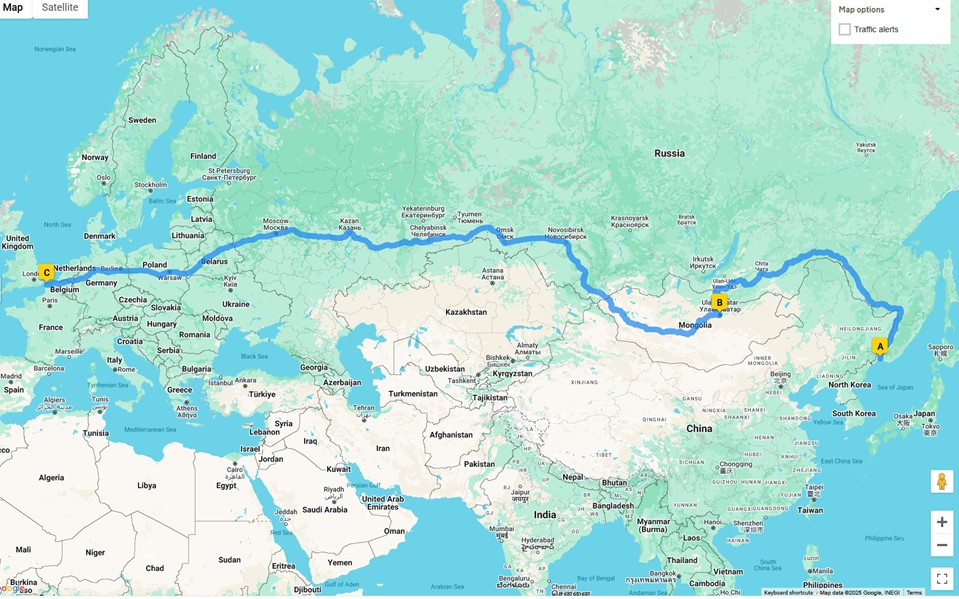
Instead, I must take a road trip. I see in my minds eye a map showing Hokkaido and Sapporo with mainland Asia and Vladivostok. I know that I can easily get a boat to Vladivostok and that I could drive from there to Wiltshire. I resolve in the dream to look up a route on AA route planner when I get up. I know that I must go via Mongolia and that it will be a long trip.


Here is AA Router planner route Vladivostok to Calais. Distance ~ 8000 miles.


I start out on my route and part the way along in or near Mongolia I am given two white plaques of an irregular shape. Phonetically these plates speak in the dream. They say, “Mon yet {yat} Dzong” and “Sprul yet Tsaay” I can see the associated Tibetan script but cannot associate it directly with the phonetics.

The dream ends

————————————–

Sprul

The concept of tulpas has origins in the Buddhist nirmāṇakāya, translated in Tibetan as sprul-pa (སྤྲུལ་པ་): the earthly bodies that a buddha manifests in order to teach those who have not attained nirvana. The western understanding of tulpas was developed by twentieth-century European mystical explorers, who interpreted the idea independently of Buddhahood

——-

1) Trulku (in Tibetan: sprul sku) — Literally the “emanation body” of a buddha. In a Tibetan context, a trulku (often given the epithet rinpoché, “precious one”) denotes the chosen reincarnation of a lama of high spiritual stature. A trulku usually inherits his (or her) predecessor’s prestige, wealth, and institutional seat. Important trulku lineages include the Dalai and Panchen Lamas and the Karmapas, who originated the tradition in the thirteenth century

2) sprul sku (སྤྲུལ་སྐུ) (Tibetan; in Sanskrit: nirmāṇakāya) — (lit. “Emanation body”) — Within the compass of the formbody, the aspect of a buddha that appears for the sake of ordinary sentient beings. A single buddha may manifest multiple emanation bodies, which may be in human, animal, or inanimate form. The “historical Buddha” Śākyamuni is generally regarded as an emanation body. The Tibetan term for emanation body, trulku, is used to designate a deliberately reincarnated lama

Sprul

སྤྲུལ་ send forth an emanation; emanate; emanation

————————–

Mon

མོན་

Bhutan; Mon, a district in Tibet

Mön

Mon. Name for lands to the south and southwest of Tibet

Dzong

Dzong (Tib. རྫོང་, Wyl. rdzong) — literally a ‘fortress’, the equivalent of a monastery in Bhutan.

—————————————————————-

Le dzong du Bhoutan est un monastère-forteresse bouddhiste caractéristique du Bhoutan.

Les premiers dzongs furent construits dans le pays dès le XIIe siècle, mais leur âge d’or fut la première moitié du XVIIe siècle qui vit le renforcement défensif du pays par le shabdrung ou grand lama Ngawang Namgyal (1594-1651), l’unificateur du Bhoutan moderne.