
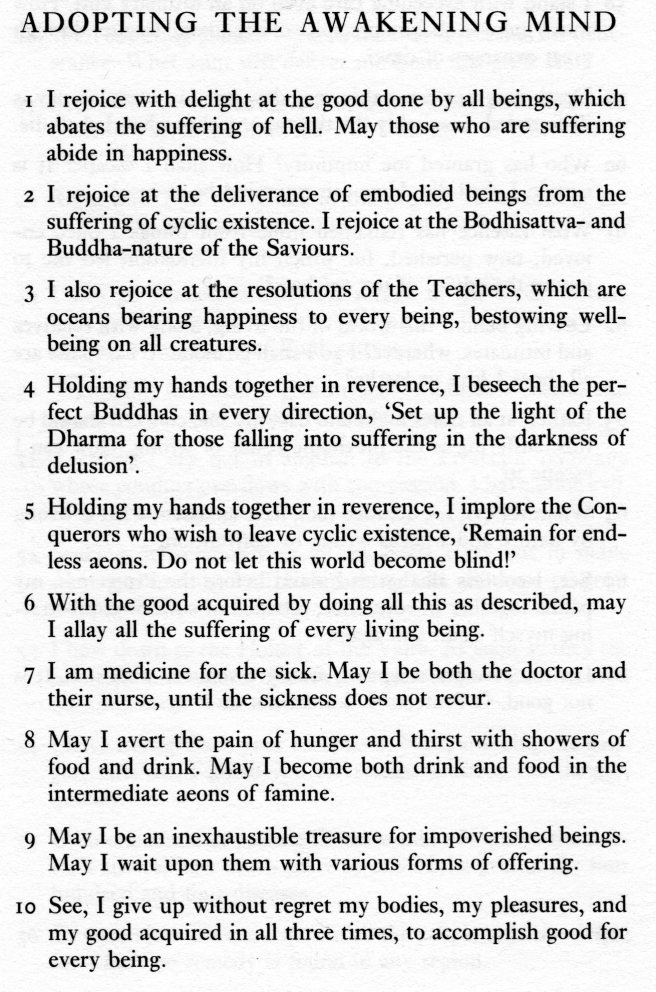
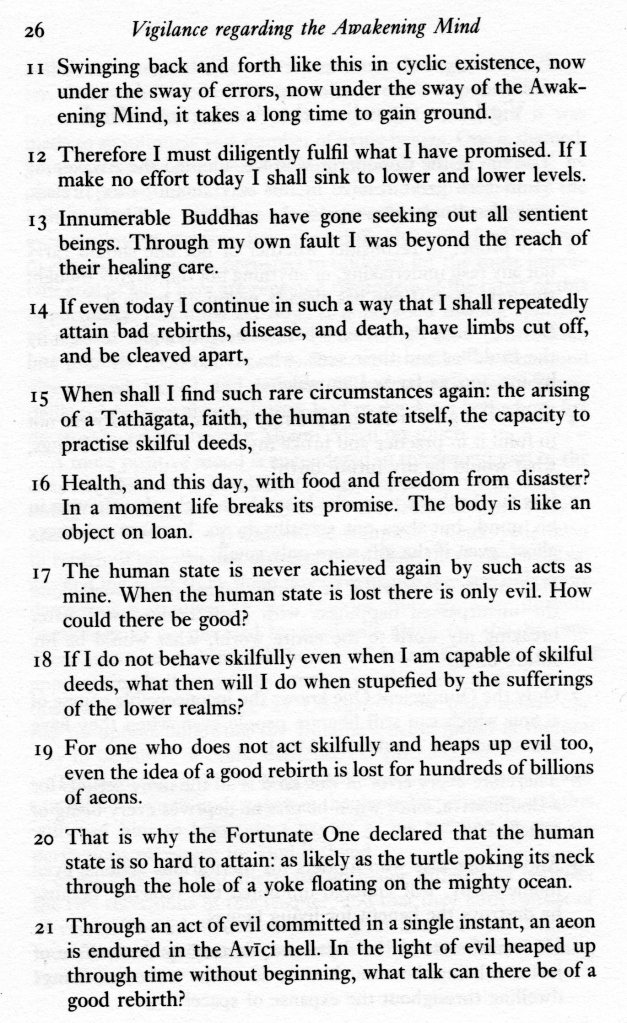
For whatever reason I am back with Śāntideva today…
–


—–
For whatever reason I am back with Śāntideva today…
–
—–
IT was night. The prince found no rest on his soft pillow; he arose and went out into the garden. “Alas!” he cried “all the world is full of darkness and ignorance; there is no one who knows how to cure the ills of existence.” And he groaned with pain.
Siddhattha sat down beneath the great jambu-tree and gave himself to thought, pondering on life and death and the evils of decay. Concentrating his mind he became free from confusion. All low desires vanished from his heart and perfect tranquility came over him.
In this state of ecstasy he saw with his mental eye all the misery and sorrow of the world; he saw the pains of pleasure and the inevitable certainty of death that hovers over every being; yet men are not awakened to the truth. And a deep compassion seized his heart.
While the prince was pondering on the problem of evil, he beheld with his mind’s eye under the jambu tree a lofty figure endowed with majesty, calm and dignified. “Whence comest thou, and who mayst thou be asked the prince.
In reply the vision said: “I am a samana. Troubled at the thought of old age, disease, and death I have left my home to seek the path of salvation. All things hasten to decay; only the truth abideth forever. Everything changes, and there is no permanency; yet the words of the Buddhas are immutable. I long for the happiness that does not decay; the treasure that will never perish; the life that knows of no beginning and no end. Therefore, I have destroyed all worldly thought. I have retired into an unfrequented dell to live in solitude; and, begging for food, I devote myself to the one thing needful.
Siddhattha asked: “Can peace be gained in this world of unrest? I am struck with the emptiness of pleasure and have become disgusted with lust. All oppresses me, and existence itself seems intolerable.”
The samana replied: “Where heat is, there is also a possibility of cold; creatures subject to pain possess the faculty of pleasure; the origin of evil indicates that good can be developed. For these things are correlatives. Thus where there is much suffering, there will be much bliss, if thou but open thine eyes to behold it. Just as a man who has fallen into a heap of filth ought to seek the great pond of water covered with lotuses, which is near by: even so seek thou for the great deathless lake of Nirvana to wash off the defilement of wrong. If the lake is not sought, it is not the fault of the lake. Even so when there is a blessed road leading the man held fast by wrong to the salvation of Nirvana, if the road is not walked upon, it is not the fault of the road, but of the person. And when a man who is oppressed with sickness, there being a physician who can heal him, does not avail himself of the physician’s help, that is not the fault of the physician. Even so when a man oppressed by the malady of wrong-doing does not seek the spiritual guide of enlightenment, that is no fault of the evil-destroying guide.”
The prince listened to the noble words of his visitor and said: “Thou bringest good tidings, for now I know that my purpose will be accomplished. My father advises me to enjoy life and to undertake worldly duties, such as will bring honor to me and to our house. He tells me that I am too young still, that my pulse beats too full to lead a religious life.”
The venerable figure shook his head and replied: “Thou shouldst know that for seeking a religious life no time can be inopportune.”
A thrill of joy passed through Siddhattha’s heart. “Now is the time to seek religion,” he said; “now is the time to sever all ties that would prevent me from attaining perfect enlightenment; now is the time to wander into homelessness and, leading a mendicant’s life, to find the path of deliverance.”
The celestial messenger heard the resolution of Siddhattha with approval. “Now, indeed he added, is the time to seek religion. Go, Siddhattha, and accomplish thy purpose. For thou art Bodhisatta, the Buddha-elect; thou art destined to enlighten the world. Thou art the Tathagata, the great master, for thou wilt fulfill all righteousness and be Dharmaraja, the king of truth. Thou art Bhagavat, the Blessed One, for thou art called upon to become the savior and redeemer of the world. Fulfill thou the perfection of truth. Though the thunderbolt descend upon thy head, yield thou never to the allurements that beguile men from the path of truth. As the sun at all seasons pursues his own course, nor ever goes on another, even so if thou forsake not the straight path of righteousness, thou shalt become a Buddha. Persevere in thy quest and thou shalt find what thou seekest. Pursue thy aim unswervingly and thou shalt gain the prize. Struggle earnestly and thou shalt conquer. The benediction of all deities, of all saints of all that seek light is upon thee, and heavenly wisdom guides thy steps. Thou shalt be the Buddha, our Master, and our Lord; thou shalt enlighten the world and save mankind from perdition.
Having thus spoken, the vision vanished, and Siddhattha’s heart was filled with peace. He said to himself: “I have awakened to the truth and I am resolved to accomplish my purpose. I will sever all the ties that bind me to the world, and I will go out from my home to seek the way of salvation. The Buddhas are beings whose words cannot fail: there is no departure from truth in their speech. For as the fall of a stone thrown into the air, as the death of a mortal, as the sunrise at dawn, as the lion’s roar when he leaves his lair, as the delivery of a woman with child, as all these things are sure and certain-even so the word of the Buddhas is sure and cannot fail. Verily I shall become a Buddha.”
The prince returned to the bedroom of his wife to take a last farewell glance at those whom he dearly loved above all the treasures of the earth. He longed to take the infant once more into his arms and kiss him with a parting kiss. But the child lay in the arms of his mother, and the prince could not lift him without awakening both. There Siddhattha stood gazing at his beautiful wife and his beloved son, and his heart grieved. The pain of parting overcame him powerfully. Although his mind was determined, so that nothing, be it good or evil, could shake his resolution, the tears flowed freely from his eyes, and it was beyond his power to check their stream. But the prince tore himself away with a manly heart, suppressing his feelings but not extinguishing his memory.
The Bodhisattva mounted his noble steed Kanthaka, and when he left the palace, Mara stood in the gate and stopped him: “Depart not, O my Lord,” exclaimed Mara. “In seven days from now the wheel of empire will appear, and will make thee sovereign over the four continents and the two thousand adjacent islands. Therefore, stay, my Lord.”
The Bodhisattva replied: “Well do I know that the wheel of empire will appear to me; but it is not sovereignty that I desire. I will become a Buddha and make all the world shout for joy.”
Thus Siddhattha, the prince, renounced power and worldly pleasures, gave up his kingdom, severed all ties, and went into homelessness. He rode out into the silent night, accompanied only by his faithful charioteer Channa. Darkness lay upon the earth, but the stars shone brightly in the heavens.
Excerpted from:
BUDDHA, THE GOSPEL
By Paul Carus
Chicago, The Open Court Publishing Company,
[1894]
At Sacred Texts
I have been pondering a notion, a question. It is this, “is it enlightenment or old age?”
Many of the things that people seem bothered about such as ‘phones, clothing, hairstyle, general appearance, apps, shagging, ‘phones, career advancement, kudos and internet fwiends don’t hold any fascination for me.
Now is this because of all my meditation that I have seen them to be impermanent and thereby illusory?
Or is it that just like any old git, I have experimental life evidence that these things ain’t all that?
Buggered if I know…
Recently I have been on the receiving end of my first bit of internet banking fraud. I do not use open networks in public spaces, nor do I visit and pay at dodgy web sites. Nevertheless some bastard has been able to pay for Uber in Amsterdam and Food Panda in Karachi of all places.
Given the location here in the wilds of Brittany I doubt anyone has had a bank card reader on an auto bank. There is just not enough footfall.
The signal from our Wi-Fi router does not reach off the property and unless someone has spliced into the fibre optic cable our internet has the low-level security of distance and isolation. We do not “surf” in public nor at Byron Bay. Of course some “actor” with skill could access our traffic. Because it is boring and not commercial I doubt anyone can be properly arsed. I haven’t yet fitted quantum key encryption.
There has been a data breach somewhere else…
We tend not to answer the ‘phone. Any attempt at ‘phone coercions would be met with English and not French. Random callers are ignored. If a French ‘phone scammer was able to persuade me in English, they would have probably earned a few quid. I used to keep the Jehovah’s Witnesses busy for hours discussing comparative theology and world philosophy. With a smile. They even used to “blood” new recruits because they knew I had no ill will.
The bank have replaced my card but set its ability to purchase on line to zero euros as a safety measure. For some reason they want me to use the mobile app to put this right. I only turn on my mobile when I am going out to the physio or the shops alone. A battery charge usually last several months! So why would I want to use a mobile app?
This seems to be the answer for everything down load our mobile app tear you hair out and have a myocardial infarction…
OK as a ’64 child I am still technically a boomer. But hey I used the internet back in the mid-late eighties.
In the hitchhiker’s guide the answer to the Ultimate Question of Life, the Universe, and Everything is obviously download our mobile app…
Obvs…
Simple…
No! I do not want to download your effing app!!
Clearly, I have just answered my own question. I must be an enlightened being because I no longer salaciously obsess about juicy smartphone apps.
There is no need to reincarnate to feed off/at the Google and Apple stores.
Final liberation is mine. I am a free being…
I have a pet theory that the hagiography of all religions exaggerates and glosses. From knowledge of human behaviour and Chinese whispers, things passed down get embellished so as to confer kudos on the teller, the raconteur. Rarely are things made greyer and more boring. This means that taking things with a pinch of salt might offer some balance.
To the faithful there is nothing quite like a miracle to prove truth and religious figures are given, in narrative, super-human abilities and qualities. These days they would be told with enhanced computer CGI and special effects on a big budget. Bigging up martyrs and buddhas is good PR for the various churches. Who in the past had control of the proles as a raison d’être. The Sacerdotes have always had ritual magic and theatre in their playbook. Simplifying the message to an all fire-consuming hell and blissful pearly-gated paradise could be writ large on the side of big red double decker “Brexit” bus. Nobody could come back to provide a TripAdvisor rating for either holiday destination.
What if all that exaggeration has gotten completely out of hand?
Christianity, depending on flavour has a host of saints. Jesus’ crew, his disciples, are sanctified and portrayed. That depiction has taken place over two millennia. They are represented as holy. When if you think about it, they were learners, disciples, in the act of being taught and trained. Similarly, Buddha’s sixteen {18} arhats are seen as holy, saintly. When they were hanging out listening to Buddha and learning his ideas. It is said they achieved enlightenment. Lessening of burden is enlightenment, full liberation may not be the same as the partial enlightenment.
People pray to the saints and the arhats.
The canon’s of both Buddhism and Christianity were/are written by human beings and therefore by logic are coloured with bias and wishful thinking. There may well be some idealising.
Mahayana promotes the bodhisattva ideal where enlightened or near enlightened beings come back to teach out of the kindness of their hearts for the benefit of all sentient beings. This is seen by some as more worthy. Whereas the haughty arhats are too arrogant to teach, the pratyekabuddhas who do it all by themselves are not sufficiently omniscient to teach. They leave no legacy. They shun the sangha; they are not one of the gang. They are too arrogant, snobby, aloof, to be with normal people. The arhats, perhaps at one with the awesome and austere nature of reality and universe, lack the cosy human compassion are biased against and not as “nice” and the smiling friendly bodhisattva. They cannot be arsed to come back time and time again, the bastards.
People who do not know what these states of consciousness are like, make judgments thereupon. This {scholarly?} interpretation gets incorporated into the ongoing cannon, the creed, the gospel. People like definitions and will roll out comparison between, all knowing, earning bragging rights about something which they do not know. One could look it up in “Buddhism for Dummies”.
Religious thinking likes its “signs”. A rainbow appearing when someone achieves Parinirvana.
What if all these processes are entirely natural, relatively low key and nothing to shout about?
The hagiography diverges from reality…what is natural becomes miraculous. Which may inhibit application. The idea of a miracle is out of reach; the idea of continuous improvement and stepwise attainment is less daunting. Toning it down might increase genuine uptake of practice.,
Status pissing contests are a common human practice and are to be found in religion and science. People like to bullshit each other and pretend to know shed loads.
I have a pet theory that the hagiography of all religions exaggerates and glosses.
One day when he was sitting under the Bodhi Tree a question popped into Buddha’s mind.
“Why do people make such a big fuss about everything, why are they overly dramatic and highly emotional about their normal lives and how they think life ought to be? Why are they forever whinging and complaining about their lot?”
And then he had it, the essence.
“Don’t be such a drama queen!”
The Bhagavad, the Tathāgata, the Venerable one, the Blessed, had come up with a simple piece of advice which would help people ease the imagined burdens in their lives. To lighten their imagined loads and to thereby enlighten them.
“Don’t be such a drama queen!”
He had found the precious jewel of wisdom. If people could live life as it is rather than with an overly dramatic soap opera style overlay there would be much less suffering in the world. People would stop flailing about and over-reacting. Calmness, harmlessness and peace might abide.
So, whenever you find yourself reacting to a situation remember and enact the precious jewel of wisdom garnered under the mighty Bodhi Tree.
Buddha says, “don’t be such a ridiculous drama queen about everything!”
If you type various versions of this question into Google you see that there are people discussing it on line. I have even seen articles on Buddhism which states that the goal is to achieve nirvāṇa. Buddhism does not have KPIs and personal development planning, nor does your line manager tear you off a strip if you don’t achieve your goals.
I’ll speculate whoever considers nirvāṇa a goal is a long way indeed from said goal. He is in a gaol of Western thinking.
In various school of thought nirvāṇa is when the causal vehicle {Soul or reincarnating Jiva} has been blown off. This means there is no requirement to reincarnate, a strictly human thing. Humans are “bound” to the wheel of rebirth. Someone, some being, who has done that, nirvāṇa, is strictly speaking no longer human. In the context at death the being who has attained nirvāṇa achieves the state of parinirvāṇa at the dissolution of the meaty incarnate form. Thereafter “they” remain formless.
We could get into the gender debate about pronouns. What pronouns do you use for some entity which has no body, no observable physical plane presence? What is the correct pronoun for a fully enlightened Buddha? It?
The problem I have with enlightenment as a concept is that is enlightenment an absolute or a relative term? It might be said that someone got enlightenment, does that mean that they are a fully enlightened Buddha or does it mean that they are little less heavy than before. They have attained a quantum of enlightenment, a bit, one step further up the ladder. They are lighter, less dark and thereby enlightened. To progress one gains enlightenment in a stepwise fashion, realisation by realisation. At nirvāṇa the being is lighter because it no longer has a causal vehicle or personality, notions of self have dissolved. It is enlightened, unburdened.
There is the concept of returning high attainment Bodhisattvas, who on death put off the attainment of parinirvāṇa and come back of their own free will to teach. Because they have no causal vehicle, they create a nirmāṇakāya emanation for such a purpose. If I understand it correctly there may be many of these in the Tulku tradition. Arhats can be seen as selfish because they do not come back. But that is a transference of human personality onto someone who has no self. I have seen it prejudiced that Bodhisattvas are good, and Arhats not so. Human folly, methinks.
In esoteric thinking the end of the causal vehicle comes at the fourth initiation. If one cross references, this is nirvāṇa or blowing off. If I understand it correctly this phenomenon is associated often with physical plane death {but not always}. One gets nirvāṇa and sharpish thereafter parinirvāṇa. In that school of thinking there are a few more stages of development, the other initiations, after doing what Siddartha did in getting planetary nirvāṇa.
One might rephrase the question, “how many fully enlightened beings are there?”
In the esoteric school of thought the fourth degree initiate goes on to take the fifth and become what some call masters. This happens, according to my reading, relatively soon.
I think most people would struggle to envision or envisage a “living” awareness or consciousness in the absence of a physical plane body. So, people invent worlds and dimensions or abodes where they might picture some enveloping form even if that be nebulous. The inventions are inspired by life on earth. Being superstitious people like signs and miracles as circumstantial evidence or proof of nirvāṇa or parinirvāṇa. There must be a rainbow or a comet. If it is a wholly natural part of evolution why would this happen? It is kind of no big deal. There is a desire for sanctity and holiness where they may just be a natural evolutionary process.
The question itself seeks to quantify and scale because people like to compare, to play top trumps.
“My God is better and more real than yours”, being a root of many wars.
Going a step further “are” implies existence or being. Can something exist if there is no form, no measurable lump of meat. If something is formless, is it?
Instead of quantifying we may now rephrase. “Are there enlightened beings?” “Do they exist?”
“It’s life Jim, but not as we know it!”
Astrobiology and astrochemistry are looking for life in a chemical-biological entity with a physical existence measurable by modern instrumentation. The assumption being that life can only exist in some kind of form, or particularly a corporeal form no matter how small. Science requires a form {and perhaps reproductive urge} as a basic component of life and its definition.
A formless Buddha after paranirvāṇa would not technically be alive according to human definition.
So maybe according to science enlightened beings do not exist.
The answer is therefore zero and not 42….
Which poses the ancillary question does, zero exist or not?
 Dreamyoga