The Secret Life of Walter Mitty and Fantasy

“The Secret Life of Walter Mitty” (1939) is a short story by James Thurber. The most famous of Thurber’s stories, it first appeared in The New Yorker on March 18, 1939, and was first collected in his book My World and Welcome to It (Harcourt, Brace and Company, 1942).

Plot

The short story deals with a vague and mild-mannered man who drives into Waterbury, Connecticut, with his wife for their regular weekly shopping and his wife’s visit to the beauty parlor. During this time, he has five heroic daydream episodes, each inspired by some detail of his mundane surroundings. The first is as a pilot of a U.S. Navy flying boat in a storm, followed by Mrs. Mitty’s complaint that Mitty is “driving too fast”. As he drives past a hospital, he imagines himself a magnificent surgeon performing a one-of-a-kind surgery. Later, a newsboy shouting about the “Waterbury Trial” begins Mitty’s third fantasy, as a deadly assassin testifying in a courtroom. While waiting for his wife, he picks up an old copy of Liberty, reading “Can Germany Conquer the World Through the Air?”, and begins his fourth daydream, as a Royal Air Force pilot volunteering for a daring suicide mission to bomb an ammunition dump. As the story ends, Mitty stands against a wall, smoking, and imagines himself facing a firing squad, “inscrutable to the last.”

Popular Culture

The character’s name has come into more general use to refer to an ineffectual dreamer and appears in several dictionaries. The American Heritage Dictionary defines a Walter Mitty as “an ordinary, often ineffectual person who indulges in fantastic daydreams of personal triumphs”. The most famous of Thurber’s inept male protagonists, the character is considered “the archetype for dreamy, hapless, Thurber Man”.

——————————–

Something struck his shoulder. “I’ve been looking all over this hotel for you,” said Mrs. Mitty. “Why do you have to hide in this old chair? How did you expect me to find you?” “Things close in,” said Walter Mitty vaguely. “What?” Mrs. Mitty said. “Did you get the what’s-its-name? The puppy biscuit? What’s in that box?” “Overshoes,” said Mitty. “Couldn’t you have put them on in the store?” “I was thinking,” said Walter Mitty. “Does it ever occur to you that I am sometimes thinking?” She looked at him. “I’m going to take your temperature when I get you home,” she said.

They went out through the revolving doors that made a faintly derisive whistling sound when you pushed them. It was two blocks to the parking lot. At the drugstore on the corner she said, “Wait here for me. I forgot something. I won’t be a minute.” She was more than a minute. Walter Mitty lighted a cigarette. It began to rain, rain with sleet in it. He stood up against the wall of the drugstore, smoking. . . . He put his shoulders back and his heels together. “To hell with the handkerchief,” said Walter Mitty scornfully. He took one last drag on his cigarette and snapped it away. Then, with that faint, fleeting smile playing about his lips, he faced the firing squad; erect and motionless, proud and disdainful, Walter Mitty the Undefeated, inscrutable to the last. 

—————————–

Fantasy-prone personality (FPP) is a disposition or personality trait in which a person experiences a lifelong, extensive, and deep involvement in fantasy. This disposition is an attempt, at least in part, to better describe “overactive imagination” or “living in a dream world”. An individual with this trait (termed a fantasizer) may have difficulty differentiating between fantasy and reality and may experience hallucinations, as well as self-suggested psychosomatic symptoms. Closely related psychological constructs include daydreaming, absorption and eidetic memory.

History

American psychologists Sheryl C. Wilson and Theodore X. Barber first identified FPP in 1981, said to apply to about 4% of the population. Besides identifying this trait, Wilson and Barber reported a number of childhood antecedents that likely laid the foundation for fantasy proneness in later life, such as, “a parent, grandparent, teacher, or friend who encouraged the reading of fairy tales, reinforced the child’s … fantasies, and treated the child’s dolls and stuffed animals in ways that encouraged the child to believe that they were alive.” They suggested that this trait was almost synonymous with those who responded dramatically to hypnotic induction, that is, “high hypnotizables”.

————————————-

Fantasy (psychology)

In psychology, fantasy is a broad range of mental experiences, mediated by the faculty of imagination in the human brain, and marked by an expression of certain desires through vivid mental imagery. Fantasies are generally associated with scenarios that are impossible or unlikely to happen.

Conscious fantasy

In everyday life, individuals often find their thoughts “pursue a series of fantasies concerning things they wish they could do or wish they had done … fantasies of control or of sovereign choice … daydreams.”

George Eman Vaillant in his study of defence mechanisms took as a central example of “an immature defence … fantasy — living in a ‘Walter Mitty’ dream world where you imagine you are successful and popular, instead of making real efforts to make friends and succeed at a job.”

Other researchers and theorists find that fantasy has beneficial elements — providing “small regressions and compensatory wish fulfilments which are recuperative in effect.” Research by Deirdre Barrett reports that people differ radically in the vividness, as well as frequency of fantasy, and that those who have the most elaborately developed fantasy life are often the people who make productive use of their imaginations in art, literature, or by being especially creative and innovative in more traditional professions.

——————————————-

Narcissistic personality disorder

Two characteristics of someone with narcissistic personality disorder are:

  • A pervasive pattern of grandiosity (in fantasy or behavior)
  • A preoccupation with fantasies of unlimited success, power, brilliance, beauty, or ideal love.

———————————————

From Wikipedia, the free encyclopaedia

Homunculus – Homuncule – Children – Hidden Doorway Dream 25-01-24

I had this dream between 7:07 and 7:30 this morning. I checked the clock on the way back from the loo and went back to bed. I was woken by the central heating clicking on at 7:30 AM.

The dream starts in the living room of a house in France. I am there with the wife. I can see the cat ferreting around on the top shelf of a bookcase. It is trying to get into a black plastic container. I get a small step on stool and reach the black plastic container taking it off the shelf. The cat is very curious and tries to get into the box and I have to shoo it away.

I take the container over to the window. There is no lid. In it I can see a small ~20cm high homuncule {homunculus}. It is curled up and seems to be dead. It looks a bit like an alien “grey”. I prod it gently with a pencil and it does not move.

{The dream is specific homuncule in French.}

I move away from the window. The cat nearly trips me up and I spill the contents of the container onto the floor. The homuncule lands and the carpet is covered with a shiny silver-grey powder from him which glistens iridescent. The homuncule stands up and walks off to the kitchen. As it moves small mouse like turds fall from off its back. It has been asleep for a very long time. I know that he is very thirsty and is going to get some water. The cat watches but seems too startled to do anything.

I turn around and there are a few, around half a dozen, children standing behind me. They are boys and girls aged around 7 or 8. They are dressed like children in a 1950s US TV programme. The have freckles and are clean and tidy.

I ask them, “quelle langue parles-tu?”

One of the girls say, “um, English, we are from Kivingden in Kent. We have been here a long time.”

I follow the path of the homuncule towards the kitchen. I notice a new white painted metal door has appeared. The door is reminiscent of a naval door designed to prevent water ingress. It has a white metal lever clamped shut which I lift to open the door. I open it and lock the door fully open with a metal rod.

It is a kind of portal.

I can see an industrial metallic staircase spiralling down. It is painted white. The bunker below is very well lit and also painted white. I know it to be extensive and to be a nuclear shelter. I know it is well provisioned and that the homuncule has made it appear and that it is from whence the children came.

I call the wife to come and inspect.

Dream ends.  

—————

Homuncule : Homme de taille réduite auquel les sorciers ou les alchimistes prétendaient pouvoir donner la vie.

Double Vajra Tattoo – Dream 16-12-20

After a bit of a sleepless night, I awake to find my former university in the news and not in a good way. There are various comments on the nature of the working environment there.

Here is last night’s dreaming segment.

I am in a room with others, we are being threatened by a group of people with dogs on leashes. The dogs are straining to attack. They are like pit bulls. The owners are having trouble holding them back. I am quite relaxed. One of the pit bulls has inordinately long fangs and is angrily taking an interest in me. I offer it my right arm. It bites down hard and strong and will not let go. I am not worried about this. The owner of the dog tries to get it to let go. It will not. I place my left hand around the side of its jaws and squeeze. The dog opens its jaws and backs off happy.

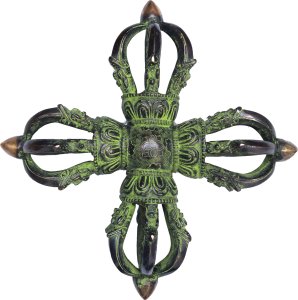
I look down and it has left a mark reminiscent of a double vajra in oranges and red. There is no blood simply what looks like a tattoo on the inside of my forearm. I show everyone in the room my new tattoo.

Later I am working at the checkout in a supermarket and I show each of the customers my new tattoo about which I am slightly excited.

Dream ends

Excerpted from Rigpa Wiki

The double vajra (Skt. vishva-vajra; Tib. རྡོ་རྗེ་རྒྱ་གྲམ་, dorje gyadram, Wyl. rdo rje rgya gram) or crossed vajra is formed from four lotus-mounted vajra-heads that emanate from a central hub towards the four cardinal directions and symbolizes the principle of absolute stability.

In the cosmographic description of Mount Meru, a vast crossed vajra supports and underlies the entire physical universe. Similarly in the representation of the mandala, a vast crossed vajra serves as the immoveable support or foundation of the mandala palace and here the central hub of the vajra is considered to be dark blue in colour with the four heads coloured to represent the four directions-white (East), yellow (South), red (West) and green (North). These also correspond to the five elements and the buddhas of the five families with blue Akshobhya in the centre.

It’s also an emblem of the green buddha of the north, Amoghasiddhi, and represents his all-accomplishing wisdom as lord of the karma family of activity.

The raised throne upon which masters are seated when teaching is traditionally decorated on the front by a hanging square of brocade displaying the image of a crossed vajra in the centre, often with four small swastikas in the corners. This emblem represents the unshakeable ground or reality of the Buddha’s enlightenment.