Prompted by this morning’s dream I found this one in the vaults, so to speak.
Dream Diary 1-11
I am outside with Charlie. He and I are loading bricks into the trunk / boot of a car. The bricks have curly writing on them, it is not Sanskrit or Tibetan. They are golden and more like large ingots of gold.
He and I are now on a long journey across the mountains on a plateau which is in Tibet. With us is a smiling lama who is our guide, guard and escort. He is showing us the way. The landscape is very sparse and rocky with scree falls. I look at the lama’s physique and it is very similar to mine only that he is shorter and obviously Tibetan. I say that I didn’t know that they built Tibetans like that…
As we continue on our journey. Charlie and I are now wearing saffron and magenta monk’s robes. This journey is to be extensive. As we move forward Charlie is often out in front exploring the different routes. At one stage we need to pick up speed. The Tibetan monk picks up his companion, also a monk, and carries him piggy-back. I do the same with Charlie. I am not sure that I can walk and climb at this altitude like this. After a few steps I realise that I can and easily so.
A little later the trail becomes tortuous and Charlie is way ahead up the hill. He comes down back to me via a slippery and windy route. I find a more direct route. This is a part of a long journey together.
Back now in London, we are at a Tibetan Dzong as guests of honour. Sat waiting are Charlie , the wife and I. We are offered some western food. I turn to her and say that she had better tuck in before they come out with the yak’s butter….
Here is this morning’s dream had between 4 and 8 AM.
The dream opens in Japan specifically Hokkaido. I am indoors in a hectic setting, a kind of big event hall. I am competing in a game which is part physical plane sprint racing and part abstract computer intelligence game. Each round is set off by a buzzer and the contestants have to make their way to the finish line within the context of the duality. In the booth next to me is a tall slim Japanese man. The buzzer sounds and the race begins. In both scenarios he just beats me. I come second in the race.
We both go over the left of the finish line in the computer world and in the thing which holds up the finish flag are the positional pins. We each select a tiny golden micro-pin which has the positional letter. My pin ends in a golden 2, his a golden 1. I place the pin in my shirt pocket on the left hand side of my chest. The race repeats several times and each time the result is the same. I soon have quite a collection of golden two pins in my shirt pocket. The “competition” finishes.
I am then walking through a busy brightly lit mall. I am in a food court in which various Japanese food outlets are selling street food. The atmosphere is pungent and very lively. The food on offer is highly coloured and from around the globe. I cannot decide. I walk over to a burger joint and a Japanese woman asks me what I would like. It is her job to serve me and be of assistance. She is very friendly, lively and with excellent English {UK}. I say that I would like a small burger and fries and for her to surprise me. She brings my food over together with a large bottle of top-end Japanese spring water. She sits next to me and helps me to eat.
I go back to my rooms; they are executive and above parr. I am unsure as to what to do next. I have no return flight. So, I start to look up flights from Sapporo to Queensland Australia. The Idea being that I land in Townsville or Brisbane and buy a second hand car to drive to the Isa {Mt Isa}.
I pause and take a stroll. Outside in the car park is my ex-wife. She is in a beat up camper van and I can hear her snoring. The van is a mess. I go back inside. She knocks on the door. I open it. She asks how I am coping with the water. Just fine. She says that she had problems getting served at the food court and did not like the tap water. I say that she probably had problems communicating. With the Japanese it is very important to listen. If you don’t listen carefully to what they say they consider you rude and vulgar. I say that listening was never one of her skills. I point to the bottle of top-end spring water on the side and say that she can take it back to her camper van, her brumby. This she does…
I hear the song from Men at Work, I come from the land down under, “travelling in a beat up brumby”.
I decide against going to Queensland.
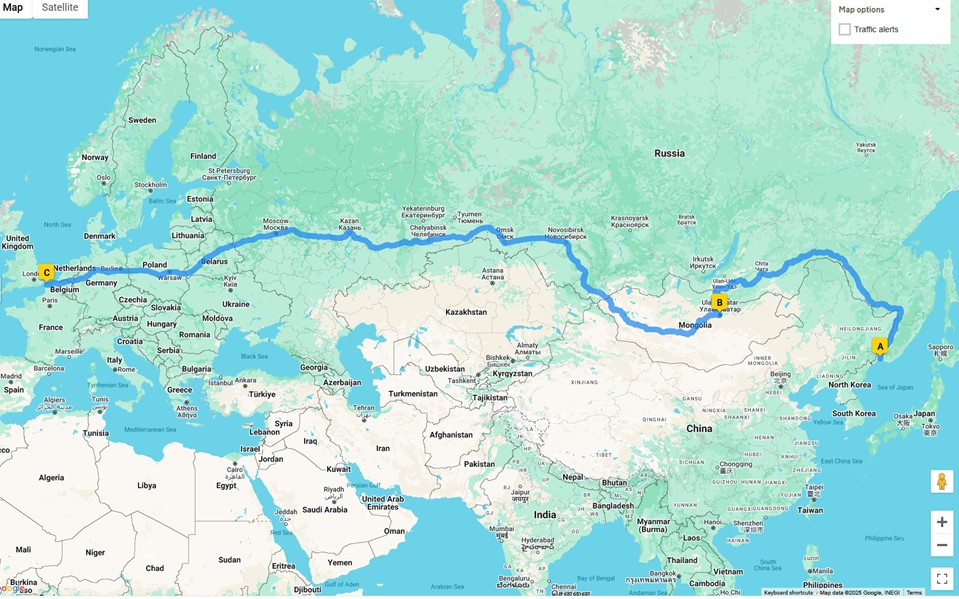
Instead, I must take a road trip. I see in my minds eye a map showing Hokkaido and Sapporo with mainland Asia and Vladivostok. I know that I can easily get a boat to Vladivostok and that I could drive from there to Wiltshire. I resolve in the dream to look up a route on AA route planner when I get up. I know that I must go via Mongolia and that it will be a long trip.
Here is AA Router planner route Vladivostok to Calais. Distance ~ 8000 miles.
–
I start out on my route and part the way along in or near Mongolia I am given two white plaques of an irregular shape. Phonetically these plates speak in the dream. They say, “Mon yet {yat} Dzong” and “Sprul yet Tsaay” I can see the associated Tibetan script but cannot associate it directly with the phonetics.
The dream ends
————————————–
Sprul
The concept of tulpas has origins in the Buddhist nirmāṇakāya, translated in Tibetan as sprul-pa (སྤྲུལ་པ་): the earthly bodies that a buddha manifests in order to teach those who have not attained nirvana. The western understanding of tulpas was developed by twentieth-century European mystical explorers, who interpreted the idea independently of Buddhahood
——-
1) Trulku (in Tibetan: sprul sku) — Literally the “emanation body” of a buddha. In a Tibetan context, a trulku (often given the epithet rinpoché, “precious one”) denotes the chosen reincarnation of a lama of high spiritual stature. A trulku usually inherits his (or her) predecessor’s prestige, wealth, and institutional seat. Important trulku lineages include the Dalai and Panchen Lamas and the Karmapas, who originated the tradition in the thirteenth century
2) sprul sku (སྤྲུལ་སྐུ) (Tibetan; in Sanskrit: nirmāṇakāya) — (lit. “Emanation body”) — Within the compass of the formbody, the aspect of a buddha that appears for the sake of ordinary sentient beings. A single buddha may manifest multiple emanation bodies, which may be in human, animal, or inanimate form. The “historical Buddha” Śākyamuni is generally regarded as an emanation body. The Tibetan term for emanation body, trulku, is used to designate a deliberately reincarnated lama
Sprul
སྤྲུལ་ send forth an emanation; emanate; emanation
————————–
Mon
མོན་
Bhutan; Mon, a district in Tibet
Mön
Mon. Name for lands to the south and southwest of Tibet
Dzong
Dzong (Tib. རྫོང་, Wyl. rdzong) — literally a ‘fortress’, the equivalent of a monastery in Bhutan.
—————————————————————-
Le dzong du Bhoutan est un monastère-forteresse bouddhiste caractéristique du Bhoutan.
Les premiers dzongs furent construits dans le pays dès le XIIe siècle, mais leur âge d’or fut la première moitié du XVIIe siècle qui vit le renforcement défensif du pays par le shabdrung ou grand lama Ngawang Namgyal (1594-1651), l’unificateur du Bhoutan moderne.
For in him we live, and move, and have our being; as certain also of your own poets have said, for we are also his offspring.
Acts 17:28
Esoteric thought suggests that our entire planetary schema is the effect of the thought from or dream of the Sanat Kumara, the lord of the world. He holds this thought form for billions of years and it is this which currently sustains our beingness. It is in this manifest thought form where we have our existence. There is only The One Life though many consider themselves separate entities. We are each of us a part of a whole. His meditation evolves.
To imagine a being capable of sustaining such a complex and dynamic thought form is extremely difficult and certainly beyond my ken. I cannot envisage a consciousness or awareness so vast and comprehensive. We might call this created manifest thought form Gaia or earth. The interconnectedness is thorough and complete though our separative minds struggle to accept this. What happens in Kabul has an impact in Edinburgh. That awareness holds together quarks and gives rise to what we call the strong and the weak forces. It makes electrons and mountains. It is responsible for the properties of water and the miracle of new birth. It contains evil and good. And it makes flowers so beautiful for our upliftment.
A being capable of this is beyond our comprehension. He could envisage Atlantis so that it existed and then wipe it from his rāja yoga meditation so that no traces are found, there is no evidence of the capital city and not a single skeleton. We as humans map the evolution of thought form, trace evidence of plate tectonics floating on the fiery inner core. We imagine ourselves omniscient and “homo sapiens” when our intellect can in no way encompass even a tiny fraction of that of the Sanat Kumara.
If he chose to alter his held image, his meditation, a continent might sink.
The thought form materialises the dream onto the physical plane so that you can drink coffee and take a shower. Your consciousness is a tiny spark in a magnificent whole. It seeks its journey back to the source from whence it came. To be one again, all-one.
Anthropogenic change brought about by the karma, the cause and effect, inherent in the world and the sparks of free will in each being impacts on his meditation. His great experiment plays out and he observes and adjusts…
And yet we bomb and kill our brothers and sisters our fellow human beings…we demand and are very ungrateful. Like a plague of locusts, we deplete and render barren. We waste and despoil. And we feel oh so justified in our greed…and we imagine that we are entitled so to do, that we have “rights”.
The dream of the Sanat Kumara can sometimes be a nightmare…
This is one of a recent series of “out of the blue” dreams which seems to have little or no relevance to my current life circumstance and events therein.
I am shown a dice/die which is a cube with rounded corners. It has the feel of ivory and looks ancient. I know beyond doubt that it is a Tibetan dice. I know that Tibetan dice are unlike any other dice in the world because of their special properties. I can only see the face of the die with a singular dot to denote one. I know the others are there, but the dream zooms in.
A little later I see two dice. I see that they are carved out of a deep root of a tree and shaped and polished. It is a long process and a labour of love. These are my Tibetan dice. They are perfect cubes with sharp edges and corners. I hold them in my hand and throw the dice, and I see two faces each with a singular dark blue dot. I have thrown two. They are made of root and Tibetan. The workmanship is exquisite. I know the meaning of two and its significance,
Dream ends.
I had not heard of this but when I put Tibetan Dice into Google…
From Wikipedia
Mo (divination)
Mo (Tibetan: མོ་, Wylie: mo), is a form of divination that is part of the culture and religion of Tibet. The Tibetan people consult Mo when making important decisions about health, work or travel. Mo employs dice and there are books written by various lamas on interpretations for the casting of dice. The answers given by the Mo are regarded as coming from Manjushri, the Bodhisattva of wisdom. Mo is considered to represent a blend of Tibetan shaman traditions and Buddhist beliefs.
One Mo prediction manual was composed by Jamgon Ju Mipham Gyatso, a great scholar and saint of the Nyingmapa tradition of Tibetan Buddhism. This Mo prediction manual is based primarily upon the Kalachakra Tantra and supplementary explanations from the ‘Ocean of Dakinis’. To use this Mo divination, one must have a question in mind and roll the dice. The dice’s outcome will indicate an answer in the prediction manual. The answer in the manual should answer your question but may need some interpretation.
The Dalai Lama consults the Mo divination when making important decisions.
Somewhat unusually this dream was in the earlier part of the night.
I am walking through a London piazza in summer. A group of young women are sat having a picnic and chatting. Amongst that group are several who I knew and they are the age I knew them as students. As I walk past, I can hear them chatting about me. I say that I heard that. The mood is jocular, teasing, and light-hearted. I walk further on about one hundred metres. They are still talking about me. I whisper under my breath, “I heard that”. They are surprised that I can hear them and that they in turn can hear my whisper.
I say that I will know the exact place and time of my death. It is one of the five siddhis. Even at that distance they can “hear” that. They are astonished.
I get out a large multi-coloured balloon in the shape of a man. I start to blow it up and it grows in size at a truly rapid rate. My lungs are providing big gusts of air. It has been a part of a science outreach effort. As the balloon gets to be about my size the young women all come over. They are very friendly with me. They ask if the balloon can say inflated. I show them a tear in the fabric. I say that it cannot last and it starts to deflate.
I move on into a part of Kensington where there are swish hotels. I find myself in an immaculate dining room, where the tables have been set with crisp white linen and pristine glassware. I am wandering through the restaurant towards an exit. The maître d’, in black and whites come over towards me. I am glancing at the prices on the menus which are inlaid in a golden italic script.
Caringly he places his arm on my right shoulder. I sense he is homosexual. He is very warm with me.
“Good afternoon sir will you be joining us for dinner tonight?”
“No, I don’t think so, the prices are a little out of my league.”
“That is a shame sir, perhaps another day. The exit you seek is over there on the left.”
I go towards a bar area where there is a crowd of youngish men having some kind of party. There is a clearly marked exit.
Instead of taking that exit I go into a seminar room off the main restaurant.
In the seminar room there are five pairs of men. One of whom is Liam and his father.
On the floor are five pairs of bright royal blue spheres. These pairs consist of one sphere about 6 inches in diameter and another one about 24 inches. They are perfect spheres and vividly coloured.
There are five suitcases and five briefcases. The suitcases are for the larger spheres, the brief cases for the smaller ones.
I explain to the men that they must take these spheres to the locations in London as specified in their instructions. They must take care of them and I ask if there are any questions.
The dream ends.
——————————————————-
Excerpted from Wikipedia
Siddhi
In Indian religions, Siddhis (Sanskrit: सिद्धि siddhi; fulfillment, accomplishment) are material, paranormal, supernatural, or otherwise magical powers, abilities, and attainments that are the products of yogic advancement through sādhanās such as meditation and yoga. The term ṛddhi (Pali: iddhi, “psychic powers”) is often used interchangeably in Buddhism.
Siddhi is a Sanskrit noun which can be translated as “knowledge”, “accomplishment”, “attainment”, or “success”
Vaishnavism
In Vaishnavism, the term siddhi is used in the Sarva-darśana-saṃgraha of Madhvacharya (1238–1317), the founder of Dvaita (dualist) philosophy.
Five siddhis, according to Vaishnava doctrine
In the Bhagavata Purana, the five siddhis brought on by yoga and meditation are:
trikālajñatvam: knowing the past, present and future.
advandvam: tolerance of heat, cold and other dualities.
para citta ādi abhijñatā: knowing the minds of others, etc.
agni arka ambu viṣa ādīnām pratiṣṭambhaḥ: checking the influence of fire, sun, water, poison, etc.
aparājayah: remaining unconquered by others.
Ten secondary siddhis, according to Vaishnava doctrine
In the Bhagavata Purana, Krishna describes the ten secondary siddhis:
anūrmimattvam: Being undisturbed by hunger, thirst, and other bodily appetites.
dūraśravaṇa: Hearing things far away.
dūradarśanam: Seeing things far away.
manojavah: Moving the body wherever thought goes (teleportation/astral projection).
kāmarūpam: Assuming any form desired.
parakāya praveśanam: Entering the bodies of others.
svachanda mṛtyuh: Dying when one desires.
devānām saha krīḍā anudarśanam: Witnessing and participating in the pastimes of the gods.
yathā saṅkalpa saṁsiddhiḥ: Perfect accomplishment of one’s determination.
ājñāpratihatā gatiḥ: Orders or commands being unimpeded.
I show Piero my second thesis. I explain there was / is no need to get it marked.
The page then opens up to reveal a massive three-dimensional palace garden. In which there are tables, mirrors, candles and plants. The detail is exquisite as is the furniture. I light the candles and take Piero on a tour of the garden and when we have completed a full circuit, I notice that candles have gone out. The attendants notice me lighting the candles again and join in. There is no need to light the candles anymore. The story continues.
I take Piero over to a map. It is a map of India. I say to him that India looks like an Elephant from the front. We look closer and zoom in onto an Elephant like structure. Closer and closer we zoom at what appears to be a bindi on the Elephant’s head. We zoom in even more and see that it is a cluster of small tables under a tree.
This is where Buddha began the Bodhicitta it is Bodh Gaya.
I am now in the streets alone walking towards the Bodhi tree. There are market stalls everywhere selling souvenirs and changing money. At one stall I overhear a young woman who is a seer. “He has come. Let us watch and see what he does.”
I go over to her to give her some money as a donation. My coins are blue. I now have a guide standing with me. He says that Sunchita (or something similar an Indian female name) will have sex with me at the dinner should I so want. I move on with the guide to show many more pictures of Elephants.
“This is my dreaming class”, I say. “I am an Elephant.”
“What colour is that?”, he asks.
I point him towards a magnificent picture of an Elephant done in Indigo Blue.
“I am Indigo Blue.” I say, “it runs in my veins.”
We continue to wander around under the Bodhi tree looking at the stalls as my guide chats with the locals. The girl re-iterates her offer which is of little interest to me.

 Dreamyoga