Medical – Mistaken Identity – Language Choice Dream 12-02-2026

Here is the second of last night’s dreaming snippets.

The dream starts in a waiting room of a seemingly English medical practice. I am sat there next to a rack of magazines and a large window sill upon which is a green indoor plant. In walk two nurses, dressed in old fashioned white nurse uniform with little white cardboard “hats” pinned into their hair. They are chatting loudly and are white corpulent of build. One of them is older than the other. They are not strangers to food. The older nurse comes up to me and asks me, “what drives people (you) to strong drink?”

I have never been  much of a spirits sort of person. So I wonder why she is asking me about strong drink. I think. I then say that it is most likely peer influence that pushes one towards strong drink, that or partners. The two nurses look at each other and exchange conspiratory looks. They move through the waiting room and into another room, giggling slightly.

In walks a man who says a loud hello to the receptionist and comes into the waiting room. He is a doctor but somehow is dressed like a catholic priest with black shirt and white dog collar. He is about my age, ruddy of complexion and with unkempt fair hair and balding pate. He claims me as a long lost friend of his. I have never seen him before. He continues to claim me as a friend recounting some exploits we are supposed to have done together. The man is clearly mistaken and possibly intoxicated. I say to him that he is mistaken. He says no he is certain that he remembers me and knows who I am. I say no he is mistaken. He will not accept this. I then say that he is wrong and has mistaken me in French. He is now usure because of the change of language. He gets up and follows the nurses into the room.

I am called into a doctor’s office. The wife comes with me and we sit across the desk from a dark haired query Hispanic woman of around 50 years. Under her white lab coat she has a bright red floral design dress. She has a stethoscope around her neck. She proceeds to ask me what ails me in English. I reply and she looks non-plussed. This goes on for some while. I say to her,

« Nous pouvons parler en français »

At which she relaxes and the consultation continues in French with ease. She writes me a prescription for my normal medication. As we are about to leave she pulls out a packet of cigarettes and takes one for herself. She sparks up. She offers me a cigarette and I decline saying that I don’t smoke. I think it odd that the doctor is smoking in her office.

We then go to a pharmacy in an arcade. It is very busy and the green pharmacy sign outside is bright. There is a queue in the pharmacy. There is a young man and a young woman in lab coats. They see the name on my prescription and try to speak to me in English. They are trying to show off to some of the other customers. The transaction is very slow. So I switch to French  and then everything progresses well and quickly.

The dream ends.

Sanskrit at The Royal Institution of Great Britain…

This morning I had a dream concerning Sanskrit at The Royal Institution. I did research there 1985-88 for my Ph.D.

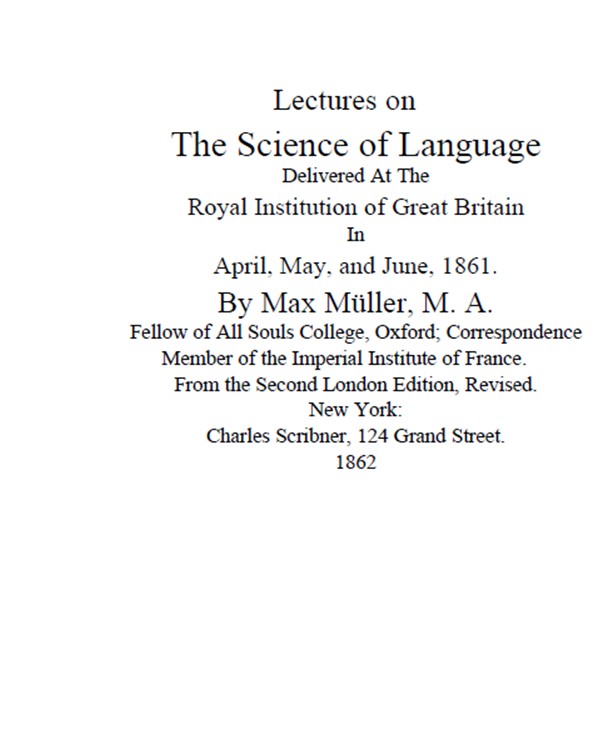
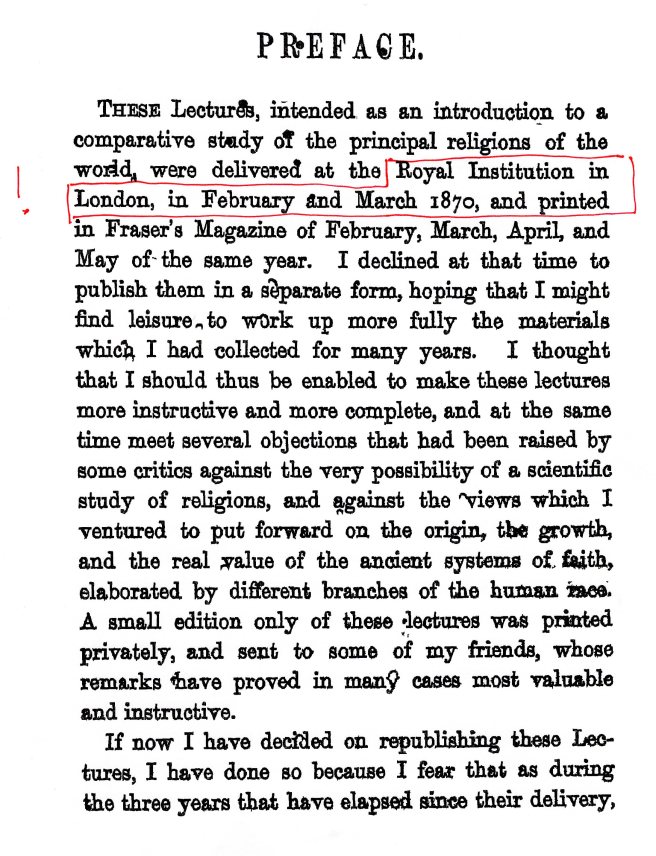
In 1861 and 1863 Friedrich Max Müller gave lectures there whilst Michael Faraday was director on the science of language.


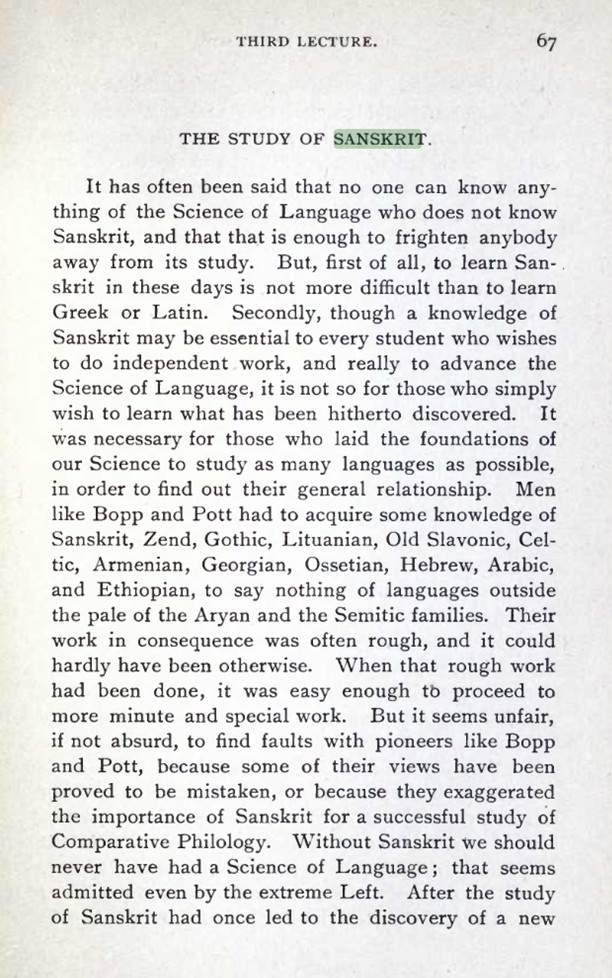
One of these was on Sanskrit the Indo-European mother tongue.


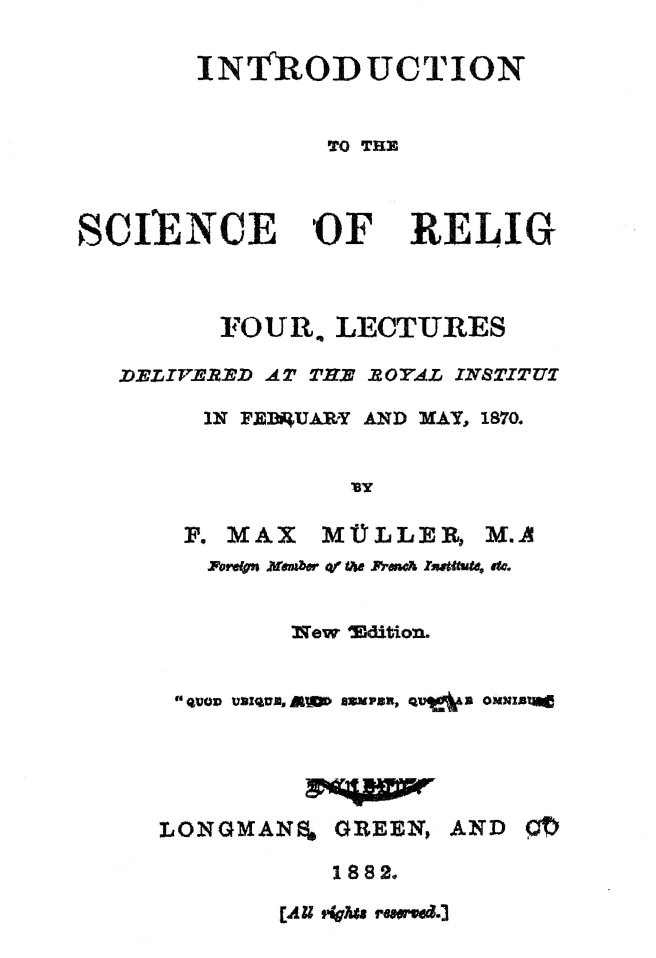
In 1870 he gave a series of lectures on the Science of Religion when John Tyndall was director.


Back then people may have been more open minded and less strictly subject specific in orientation.


Friedrich Max Müller

(6 December 1823 – 28 October 1900) was a British philologist and Orientalist of German origin. He was one of the founders of the Western academic disciplines of Indian studies and religious studies. Müller wrote both scholarly and popular works on the subject of Indology. The Sacred Books of the East, a 50-volume set of English translations, was prepared under his direction. He also promoted the idea of a Turanian family of languages.

Academic career

In 1850 Müller was appointed deputy Taylorian professor of modern European languages at Oxford University. In the following year, at the suggestion of Thomas Gaisford, he was made an honorary M.A. and a member of the college of Christ Church, Oxford. On succeeding to the full professorship in 1854, he received the full degree of M.A. by Decree of Convocation. In 1858 he was elected to a life fellowship at All Souls’ College.

He was defeated in the 1860 election for the position of Boden Professor of Sanskrit, which was a “keen disappointment” to him. Müller was far better qualified for the post than the other candidate (Monier Monier-Williams), but Müller’s broad theological views, Lutheranism, German birth, and lack of practical first-hand knowledge of India spoke against him. After the election he wrote to his mother, “all the best people voted for me, the Professors almost unanimously, but the vulgus profanum made the majority”.

Later in 1868, Müller became Oxford’s first professor of comparative philology, a position founded on his behalf. He held this chair until his death, although he retired from its active duties in 1875.

Language – 800 years ago.

The spoken language around here in Brittany would be evolving back then. The founding saints, purportedly mostly Welsh, and from near Llantwit Major in Glamorgan would have spoken Welsh.  There was St Illtud’s “academy”. They moved here around 500 AD as Welsh was changing from the other Brittonic languages such as Cornish or old Cornish Kernewek Koth. In around 500 Welsh would have been more similar to Kernewek.  There was migration from all the west coast of Britain. Cornish resembles Breton well.

There would be residual Latin which was slowly morphing into medieval French. So far, I have found out that there are few texts in rakkrennvrezhoneg or pre-medieval Breton. There are plenty of Welsh texts.

There are old texts from Brittany in Latin. I am guessing that the clergy and those with money were versed in Latin and it was used to “translate” a sort of universal.

So, if I was incarnate around 800 years ago as a “priest” or member of a religious order I would have had to speak Latin and if on crusade medieval French. I would have spoken rakkrennvrezhoneg with the locals

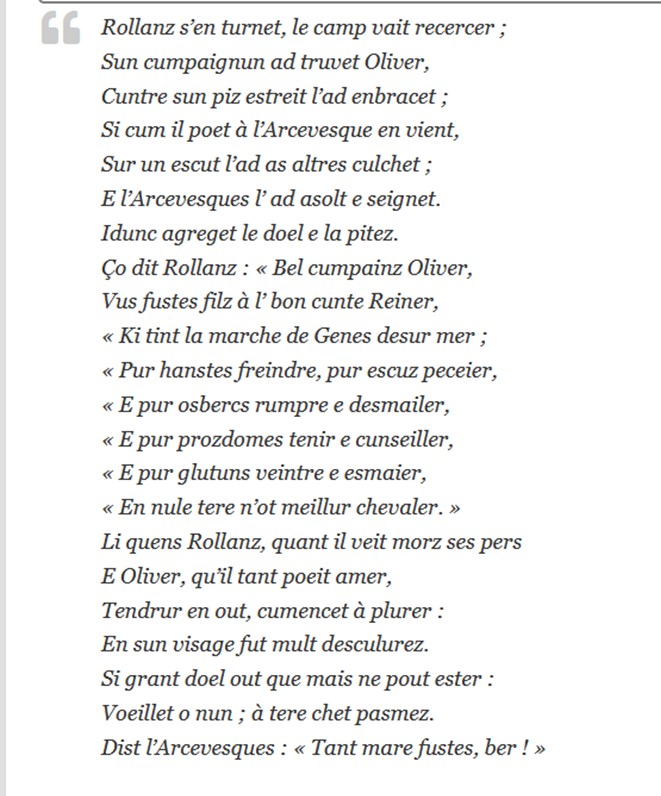
One can see that the shape of word in Medieval French is closer to Breton than modern French

The word order in The Song of Roland is different but I can interpolate some meaning using French and my rusty “O” level Latin.

Looks like I have a new thing to invetsigate on the rainy days.


Quotations from English French and Breton Wikipedia

Medieval Welsh literature is the literature written in the Welsh language during the Middle Ages. This includes material starting from the 5th century AD, when Welsh was in the process of becoming distinct from Common Brittonic and continuing to the works of the 16th century.

The Welsh language became distinct from other dialects of Old British sometime between AD 400 and 700; the earliest surviving literature in Welsh is poetry dating from this period. The poetic tradition represented in the work of Y Cynfeirdd (“The Early Poets”), as they are known, then survives for over a thousand years to the work of the Poets of the Nobility in the 16th century.

The core tradition was praise poetry; and the poet Taliesin was regarded as the first in the line. The other aspect of the tradition was the professionalism of the poets and their reliance on patronage from kings, princes and nobles for their living, similar to the way Irish bards and Norse skalds were patronized for the production of complex, often highly alliterative forms of verse. The fall of the Kingdom of Gwynedd and the loss of Welsh independence in any form in 1282 proved a crisis in the tradition, but one that was eventually overcome. It led to the innovation of the development of the cywydd meter, a looser definition of praise, and a reliance on the nobility for patronage.

——————-

Le moyen breton (krennvrezhoneg en breton moderne) est le nom que l’on donne à la langue brittonique parlé en Bretagne de la fin du XIe siècle à la première partie du XVIIe siècle. On place généralement la date de fin en 1659 lors de la sortie du dictionnaire du père Julien Maunoir. Il a été précédé par le vieux breton et suivi par le breton moderne.

Elle a fourni une littérature, une poésie, mais surtout un théâtre, d’inspiration religieuse.

Chronologie du moyen breton

On distingue plusieurs périodes :

  • 1100 – 1450 : pré moyen breton
  • 1450 – 1600 : moyen breton classique
  • 1600 – 1659 : moyen breton tardif

Caractéristiques du moyen breton

Les emprunts au français deviennent très nombreux. Le français est alors la langue la plus influente de l’Europe et influence également l’anglais. D’une manière étonnante quand un mot breton ressemble à de l’anglais, il provient généralement du moyen français. Ex. : to strive; strivañ : s’efforcer de

  • Le -ff traduit un v nasalisé. Cependant, à la fin du moyen breton le v disparaîtra complètement, à l’exception du dialecte guérandais ou du Goélo (prononcé f),
  • Le son dh est marqué par z (menez, scoaz…),
  • Le son th est transcrit par z, tz ou zz (scuiz, bartz, hennez, harzaff),
  • Le son ts, qui vient la plupart du temps de nom français est transcrit par ç, cc, cz,
  • Le son [oe] évolue en oa (sauf en vannetais-guérandais et Haute-Cornouaille où il reste oe. Il reste oe également au Pays de galles),
  • Le son eu venant des débuts de l’ancien breton.

——————

krennvrezhoneg

Ar c’hrennvrezhoneg eo ar stumm eus ar brezhoneg a veze komzet ha skrivet etre dibenn an XIvet kantved ha kreiz ar XVIIvet kantved.

Mareadoù ar C’hrennvrezhoneg

  • 1100 – 1450 : rakkrennvrezhoneg
  • 1450 – 1600 : krennvrezhoneg klasel
  • 1600 – 1659 : krennvrezhoneg diwezhat

Ar rakkrennvrezhoneg

Eus ar rakkrennvrezhoneg ne vez anavezet nemet spisc’herioù, anvioù-tud hag anvioù-lec’h.

Ivonet Omnes en deus skrivet ur varzhoneg war marzh an dornskrid e oa o sevel dre eilskrivañ war-dro ar bloavezhioù 1350 ; setu amañ ar varzhoneg hag he reizhiad klotennoù :

An guen heguen am laouenas,

An hegarat an lacat glas,

Mar ham guorant va karantic,

Da vout in nos o he kostic.

Vam garet, nep pret.

————-

Catholicon, geriadur brezhoneg-galleg-latin Jehan Lagadeuc, skrivet e 1464 ha moullet e 1499

Catholicon eo anv ar geriadur kentañ e brezhoneg, a oa bet skrivet e teir yezh, brezhoneg, galleg ha latin : ennañ e vez kavet an droidigezh c’hallek eus ar gerioù brezhonek kement hag o c’hevatal e latin.

Ar c’hentañ geriadur galleg an hini eo ivez enta ha war an dro ar c’hentañ geriadur teiryezhek er bed.

Savet e voe, pe beurechuet da vihanañ, e 1464 (d’ar 16 a viz Eost hervez) gant Jehan Lagadeuc, person e Plougonven, ha moullet e voe evit ar wech kentañ d’ar 5 a viz Du 1499 e Landreger gant Jehan Calvez (Euzen Roperz e lizherennour). O soñjal e kloareged yaouank Breizh o vont war o studi e oa bet savet an oberenn-mañ evit o skoazellañ da zeskiñ latin evel ma vez diskouezet splann amañ dindan (bet treuzskrivet e brezhoneg a-vremañ) :

    Me, Yann Lagadeg, eus parrez Plougonven, en eskopti Treger, Bachelour war an arzoù hag an dekredoù, goude ma n’on ket dellezek d’en ober, savet am eus al levr bihan-mañ evit talvezout da gloer vihan baour Breizh peotramant d’ar re zo dizesk war al latin.

Anvet e oa bet Catholicon (geriadur hollel), pa ne oa ket bet roet an anv-se gant an oberour, moarvat diwar anv ur geriadur all, ar geriadur latin brudet a oa anvet Catholicon ivez (Summa grammaticalis quae vocatur Catholicon), savet gant an Dominikan Giovanni Balbi (Johannes Januensis de Balbis), eus Genova, hag echuet d’ar 7 a viz Meurzh 1286.

—-

La Chanson de Roland

Bern – 90GHz­—UBS Dream 02-07-2021

I woke up this morning at 6AM and was pretty sure that I would not go back to sleep. I did and had this dream. When I tried to wake up my right eye was difficult to open it been sealed with sleep. As an aside since I stopped smoking, I have had much more gummy eyes with loads of sleep. Here is the dream.

I am in a vast laboratory. It is filled with optical benches upon which are optical components and lasers. I know this laboratory to be in Bern Switzerland. Unusually for this kind of laboratory one can see out of the windows and to the town below. W is excited he has received a parcel and is busy unwrapping it. It is a new slim, top of the range, Tektronix digital storage oscilloscope. It has all of the functions of the bulkier models but is slimmed down. I say to W that I can help him understand how to use it because all of the experiments at the lab of S used one of these. All we need first is a square wave waveform generator so that we can have a play. Ben C says that he thinks there is one in the store. I go with him to the store and there is a pile of instrumentation. I see one with the name GR on it and note that it is odd that it should be here in Bern. BC finds a square wave generator and hands it to me. He says that it starts at 90GHz. I comment that it might be a bit too high frequency for the oscilloscope. He says that probably not, the scope may not capture all of the waveform but should be Ok for us to play with. I go over to W.

Next, we are back in the flat. It is full of youngish men who all work at the laboratory. We are all sleeping in one bed. It is somehow on a veranda outside the house. I wake up and decide to go shopping. I look across the valley where this is a night club called Bodhisattva. We all sometimes go there. I think that it will be nice to look at Migros again. As I go into the shop there is a queue for baskets, and I am behind an old Swiss man. He unpacks the baskets and hands me one. I go into the store and am at the fruit counter. It is immaculately laid out with very high-quality produce from around the world. It is even better than I remembered it. I get some groceries and take them back to the flat. Where I put them in a bag in the pantry. I explain to W that it is very nice to see high quality Swiss produce as things here are not so consistent.

In the dream I have paid with a UK credit card but to my surprise my UBS bank card is also in my wallet.

We are back in the laboratory, and I know that I have a job there. It has been easy to set up because my Swiss Bank account at UBS is still active {in reality this is not the case}. We play with the oscilloscope for a while.

Next, I am back in the flat asleep in the big bed with a whole bunch of other people. The wife is there next to me. I am on the extreme edge of the bed, and she is nestled in my left arm. I kiss her on the brow, and everybody wakes up. I ask what time it is. Close to midday. I comment that is late. Not if you were up drinking and smoking {implied cannabis}.

I had better rush to get to the bank before it closes. I rush of down hill concerned that I will fall because of my left hip. I am a bit awkward running down the hill. I need to get to the bank to ask them for a new PIN number for my bank card. I know that all I have to do is ask because they will recognise me. I could ask in English or German or even French. As I am running down the hill, I rehearse what words I would need first in Hoch Deutsch and second in French. In my mind I know that the language I will choose depends upon who I meet at the bank counter.

Dream ends.