Impermanence and Complacency

I have had eight decent length dreams in October so far this year. I haven’t published them because recognisable individuals are in them. These are out of the blue as I haven’t spoken to/with them for well over a decade. I don’t really know what to make of them. They may be pointing at something going on in the “real” world.

In the Toltec tradition the “place” of dreams is the South. I spent quite a bit of my early life in the Southern Hemisphere and can get on well with Kiwis, Aussies and South Africans. I was a part of the itinerant barman subculture in London for a number of years. In the Toltec tradition people have a predilection for stalking of dreaming. I am the latter. Dreams can re-present possibilities in the web of life, a kind of aperture in space-time where events might manifest. These apertures do not stay open forever. They close and what once might have been possible ceases to be. Failure to act on the appropriate time scale makes things no longer possible.

I’ll make a statement, there is a tendency for arrogant people to be complacent and get caught napping.

One could argue we have seen this take place recently in the middle east, at 9/11 and Pearl Harbour. People who think themselves invulnerable, important and powerful can get surprises.

Impermanence as a concept is logical, nothing lasts forever. But people do not get it. To truly attain impermanence is to understand the eternal now. Impermanence lessens the manacles of clinging and attachment; it exemplifies the preciousness of time. Many imagine they have all the time in the world and are slow to get around to things which they prefer not to do. Timely action delayed reduces likelihood of positive outcome. Impermanence teaches appreciation and the fact we only borrow things for at most a lifetime.

People who work in universities need to be seen and heard in order to get promoted. They need to have measures of esteem; they need a web presence and various public metrics. They have a semi-permanent web footprint. Several ex-students of mine have commented to me that I am now hard to find on the internet. I was on Research Gate. They won’t give me an account now. I was on LinkedIn. I have no need to be seen, to be present. So, I can build up a profile, write a blog and then bin it. They are impermanent things. I do not cling; I have back-ups of text on the off chance I might need it again. People can imagine that one will want to remain in touch and contactable. They may be complacent about this. The nature of academia is that it is a large heavy slow moving object with momentum, it is not fluid nor are research funding mechanisms, the turn around time is quarterly at best. There are institutional and annual rhythms. If one is institutionalised life dances {slowly} to that beat. There is assumed a quasi-permanence.

It is perhaps non-standard to suggest that attainment of impermanence gives one a sense of urgency at the same time as detachment from outcome, specifically desired outcome. The land of “there is always tomorrow” runs out. The world of mañana means possibility and opportunity lost.

Carpe diem is interred in a mausoleum.

There is a saying attributed to Buddha; “The trouble is you think you have time.”

People spend their time unwisely and there is a lot of wasted time, escapism and avoidance.  Complacency about time is brought about by the illusion of permanence. “It will always be there tomorrow.”

There is vast global complacency about climate change because of the illusion of permanence. People do not get that our mode of living is subject to change and over the next decade it will become obvious. Instead of cooperating to reduce consumption the mantra of economic growth underpins jaded economic dogma. People indulge in petty vengeance games where hundreds of thousands of tonnes of high explosive munitions are detonated to get revenge by obliteration. How much energy and carbon dioxide has been released in Gaza, in Ukraine?

Has that cooled the climate?

I suspect that humanity could well be on its way to being shaken violently out of its complacency as the weather patterns get ever more extreme and chaotic. Humanity, especially in the rapacious West, has taken so very much for granted and for a long time.

Pride often comes before a fall.

Before long the aperture in space-time in which to meaningfully act on climate change will close. It has already started.

Karmic Conundrums

In the context of karma, if you don’t {yet} believe in karma then it is your current karma so to do and be. It does not alter the fact of karma but your denial and disbelief thereof is karmic. Eventually karma will teach you about karma and cause & effect. In the context of karma there is an inevitability.

Do you believe in karma?

Answering this simple question has karmic consequences which may be wide ranging.

If, however, there is no such thing as karma the answer is a facile no.

To plump for an agnostic maybe suggests that karma exists, sometimes and in some circumstances. You might cherry pick the circumstances in which you give a nod to karma. Picking and choosing thus implies you want life on your own terms. You are selective.

To answer yes, implies that you acknowledge at least some responsibility for your actions.

To fully believe in karma at first might cause you to freeze and say, think and do nothing. You may not wish to cause anything.

A belief in karma has scaling to it. I have looked into its applicability and the concept of karma is for me sound and can be observed in many situations and events.

There are numerous social media, and YouTube videos entitled “instant karma”. There is a song by Lennon and Ono. People enjoy watching comeuppance. As a loose concept karma is held by many. But it is not as simple as prompt and obvious payback.  Enjoying people getting comeuppance is not in itself wise or pleasant.

It is my observation that karma can be very subtle and by way of a complex conundrum which is difficult to solve.

An obvious hurdle or bar to solving some karmic “problems” is the notion of face. People might want to resolve a situation but the only way to do that is to maybe apologise and lose some “face”. Thus, the problem never gets solved and it acts like a burr under the skin. It does not go away. Prompt action eases situations quickly, putting things off makes them worse. Boris Johnson struggled to admit he was wrong in Partygate because his sense of entitlement had it that rules did not apply to him the world king, they were for little people. Truss still refuses to accept she caused the markets to plummet. “Face” can exact a high price. And that price may come in the twilight of a life. Payment is due and with interest. Her political relevance wanes.

It is my thesis that much karma ripens and bears fruit near end of days. Challenges put off due to inconvenience re-appear just when one no longer has as much faculty to solve or face them.

In my experience karma has a lot to with attitude. Hoity toity and arrogant people can be knelt by the universe, taught a lesson of humility. To suggest to an arrogant person that this might happen is a thankless task and unlikely to succeed at first, it might sow a seed, however.

Those who believe they are able to act with impunity are the most likely not to believe in karma nor accept that they are responsible for the consequences of their actions. An example in case is the migrations from Iraq and Afghanistan. We caused this by invasion and destruction yet are unwilling to accept the consequence of immigration. We moan and complain and demand that it stops. We fail to acknowledge the lesson and are likely to repeat the same folly as a result.

 Karma can take many cycles to teach.

A typical karmic conundrum may involve wanting to resolve a situation but being unwilling to take the necessary risks or appropriate steps. In some cases, those steps which once were possible and facile have become very difficult. The longer resolution has been delayed the harder it becomes. The “problem” has grown, spread or bifurcated.

The poor attitude has acted as a growth factor for the problem. What was once simple has become highly complex and entangled. Escapism, avoidance and denial have fertilized the karma.

The saying, “what a tangled web we weave when first we practise to deceive”, is a statement of karma. With an inevitability one lie requires more to prop it up. An early stage fess-up prevents a massive web of lies, metastasising.

If is the word which most stops karmic resolution. People want to put conditions on their actions and keep apparent control. By trying to control a situation and not resolve it one can make it a lot worse. This seldom occurs to some. They can be very adamant and stubborn.

“If I do that what is in it for me?”

Is a mindset which negates the law of karma.  

Accepting responsibility for one’s actions and how they ripple out into the trajectories of the wider world is not something that most people do. Being me or egocentric they fail to appreciate the wider connectivity.

Karma ultimately teaches that we are all connected in the same world.  We are a part and not as separate as we might insist or imagine.

At the moment global karma is being initiated in the middle east violence. What will the longer term effects be? Will they be widespread or localised?

Do you believe in karma?

Place your bets…spin the wheel…

Removal of the Ten Buddhist Fetters and Psychology

Removal of the Ten Buddhist Fetters and Psychology

I have always thought that Buddhism is pretty radical. If one removes all ten fetters one no longer reincarnates, so the theory goes.  In the context of Abhidhamma Pitaka the vast majority of humans have no experience beyond the first couple of fetters. Discussion therefore is based on scripture and not personal experience; it is by way of speculation.

The first fetter of self can be thought of as the business of psychology, one is encouraged therein to have a notion of self, an identity. If you lack many of the emotions in the second enumeration you might get a diagnosis of Aspergers’ or clinical depression. You certainly would not have a starring role in Dallas or East Enders.

The teachings of Buddha if applied take one way beyond psychology and the socio-political framing of mundane human experience. It, the fetter, could be called the limitation of and by social conditioning, complying with societal ideas and trying to fit therein. Making an image to attempt to convey to others. If you think in terms of social media Abhidhamma Pitaka’s list of ten fetters are perhaps the guidebook to social popularity, the more you express the more likes and followers you get. Does Trump exhibit any of these fetters?

I find some of the available Buddhist interpretations a bit absolutist. Complete removal of reproductive urge is probably not possible. Porn hub reinforces the first fetter kāma-rāga.   

Getting things in perspective and balanced is probably a healthier way. After all the Diamond sutra admonishes against seeking the absolute. A classic sign of depression is loss of libido. Psychologists may contest the teachings of Siddhartha.


What are the ten fetters in Buddhist tradition?

 This by Andrei Palskoi on Quora

https://www.quora.com/What-are-the-ten-fetters-in-Buddhist-tradition

The fetters are attachments to illusory ideas about how reality is built and operates. They are the rules that you believe are solid and unbreakable, whereas in fact they are nothing more than ephemeral mental contracts.

Each of them can be seen as a counterweight applied to balance the scales after they’ve been originally tipped off by the 10th fetter, culminating with the 1st fetter like a cork sealing the jinn’s bottle. They are intended to create and/or restore the illusion of stability, and the price for having that illusion is the lack of freedom – that’s why they called “fetters”. They feel important to abide by, even when they result in suffering.

There are many different interpretations of their meaning. Below is mine – by no means accurate or even orthodox, but it’s one of those things where you cannot rely on dogmas (see fetter #3).

  1. Person – thinking that there is an actual object with fixed properties called “a person”, or “self”. Once the imaginary description of “who you are” is formed, there is a strong feeling of being obligated to act in accordance with how that “you” would act. Essentially, in this fetter you are bound by the mental model of yourself. The fear of violating this fetter is that for your reputation in your own or someone else’s eyes. Also, many other stories and beliefs are predicated on the idea of “you” as an actor playing a crucial role in them.
  2. Doubt – traditionally by this it is meant doubt in Buddha’s teachings. Effectively, it is doubt that there is indeed a way back out of your existential conundrum. It binds you into arguing about everything, rather than putting sincere whole-hearted effort into looking at the facts and be willing to honestly admit what they show, even if it goes against your preconceived beliefs.

{often very specifically about the teachings of Buddha and the Dharma my addition}.

  1. Rites and rituals – this includes dogmas, habits and any other kind of mind automation. It binds you into thinking that if “things were this way before”, they are expected to continue the same way. This fetter is an inertia of mind, i.e. repeating what it was accustomed to doing. It is also a belief in magic that merely by doing some rituals that you don’t understand you can control the experiences and prevent unwanted ones from happening. Basically, relying on stale old recipes and ignoring the new realities of the moment.
  2. Desire, or lust – belief that you can want a form and when you do, you must run after it. Effectively, it is imagining some experience and feeling irresistible draw to falling into it, as well as aversion to the idea of not getting what’s desired. Together the 4th and 5th fetters are manifestations of the false belief that by mastering the art of pulling in pleasant experiences and pushing out unpleasant ones it is possible to achieve ever-lasting comfort.
  3. Aversion, or ill will – when something goes against your expectations (which is inevitable), you feel in your guts some invisible force that is presumably pushing you towards resistance in all its forms (hatred, fear, suppression, avoidance, etc.). Rather than an attachment to experiencing pleasant experiences, it is an attachment to reacting to unpleasant ones. This is where the suffering is born out of refusal to accept that ultimately there is no control of what happens.
  4. Forms – belief that reality consists of fixed objects with properties and feeling of being bound by those forms and their importance. Subject-object separation.
  5. Attachment to formless ideas – belief that apart from the pure “being”, there are other fundamental qualities of experience such as time and space, and there is witnessing of these qualities through perception. This is where the idea of “independent reality” is born.
  6. Conceit – belief that the mental idea of what is going on is more important than the actual experience. This is a belief that the experience must “make sense”, which begins with the simplest sense of pure “being” – the first fixed mental construct, the first attempt to fabricate an illusion of something reliable, predictable and lasting, something that can be grasped at.
  7. Restlessness – the outcome of the original ignorance, chaotic flow of ever-changing experiences with no fixed structure whatsoever. The first anxiety of having nothing to grasp at. The other 8 fetters are essentially failed attempts to hide this anxiety, which can be felt again at any time when they don’t work.
  8. Ignorance – The beginning of the “flame” – falling for the false appearance of experiences and ignoring the true knowledge that there can be no experience that has any substance, permanence, satisfactoriness. A “big bang” manifestation of experiential reality, i.e. samsara. Conscious emptiness that accidentally confused itself into dreaming up the realm of experiences and cannot awaken back from its dream.

This from Wikipedia:

Abhidhamma Pitaka’s list of ten fetters

The Abhidhamma Pitaka’s Dhamma Sangani (Dhs. 1113-34) provides an alternate list of ten fetters, also found in the Khuddaka Nikaya’s Culla Niddesa (Nd2 656, 1463) and in post-canonical commentaries. This enumeration is:

  1. sensual lust (Pali: kāma-rāga)
  2. anger (paṭigha)
  3. conceit (māna)
  4. views (diṭṭhi) {opinions my addition}
  5. doubt (vicikicchā)
  6. attachment to rites and rituals (sīlabbata-parāmāsa)
  7. lust for existence (bhava-rāga)
  8. jealousy (issā)
  9. greed (macchariya)
  10. ignorance (avijjā).

The commentary mentions that views, doubt, attachment to rites and rituals, jealousy and greed are thrown off at the first stage of Awakening (sotāpatti); gross sensual lust and anger by the second stage (sakadāgāmitā) and even subtle forms of the same by the third stage (anāgāmitā); and conceit, lust for existence and ignorance by the fourth and final stage (arahatta).


The Wolf of Wall Street is not close to enlightenment, “greed is good!”

If you encountered someone who had overcome to a great extent these ten fetters how would you interact?

The notion of transactional “you scratch my back…” interaction would not work. They would not have the same emotional soap-opera buttons. They may even seem very boring and dead-pan.

Are they still alive? Are they completely overcome with anhedonia?

We are seeing the first fetter of “person” or “self” as a battleground for the so-called gender “debate” or slinging match. Self-image plays a role in anorexia and bulimia. Social media has created a zombie army of influencers, self-obsessed. People forget that image is imaginary and not real.  Yet they devote a lot of time and effort to image.

Removal of the Abhidhamma Pitaka’s fetters might imply a saintly person, an impossible thing. But there again human idealisation and absolutism comes in. The passage above suggests a sequential list based removal, a tick box approach. Done that, got the t-shirt. Isn’t it more likely that one would be working at removing the dramas/fetters all at the same time? Tick box thinking is not a high level overview. Goals achieved can cause conceit and ambition.

Twitter is full of aversion, or ill will. It fills our news programmes in Israel and Gaza, in the US presidential elections.

I’ll speculate that a psychologist / psychiatrist might have trouble framing and understanding a being largely free from these fetters. Maybe they would invent a new syndrome to categorize them…

Or they could lock them up in a loony bin, especially if they were not an ordained monk or priest in robes.


.

The Four Stages of Awakening

Some speculations and developing a train of thought….


This excerpted from Wikipedia

“The ordinary person

An ordinary person or puthujjana (Pali; Sanskrit: pṛthagjana; i.e. pritha: without, and jnana: knowledge) is trapped in the endless cycling of samsara. One is reborn, lives, and dies in endless rebirths, either as a deva, human, animal, male, female, neuter, ghost, asura, hell being, or various other entities on different categories of existence.

An ordinary entity has never seen and experienced the ultimate truth of Dharma and therefore has no way of finding an end to the predicament. It is only when suffering becomes acute, or seemingly unending, that an entity looks for a “solution” to and, persisting, finds the Dharma (the ultimate solution/truth).

The four stages of awakening in Early Buddhism and Theravada are four progressive stages culminating in full awakening (Bodhi) as an Arahant.

These four stages are Sotāpanna (stream-enterer), Sakadāgāmi (once-returner), Anāgāmi (non-returner), and Arahant (conqueror). The oldest Buddhist texts portray the Buddha as referring to people who are at one of these four stages as noble people (ariya-puggala) and the community of such persons as the noble sangha (ariya-sangha).

A stream-enterer, having abandoned the first three fetters, is guaranteed enlightenment within seven lifetimes, in the human or heavenly realms.

Sole dominion over the earth,
going to heaven,
lordship over all worlds:
the fruit of stream-entry
excels them.

Pratyekabuddhayāna is a Buddhist term for the mode or vehicle of enlightenment of a pratyekabuddha or paccekabuddha (Sanskrit and Pali respectively), a term which literally means “solitary buddha” or “a buddha on their own” (prati- each, eka-one). The pratyekabuddha is an individual who independently achieves liberation without the aid of teachers or guides and without teaching others to do the same. Pratyekabuddhas may give moral teachings but do not bring others to enlightenment. They leave no sangha (i.e. community) as a legacy to carry on the Dhamma (e.g. Buddha’s teachings).”

—————————————————

There are some elements of Buddhism which I struggle with. This stems from the notion of evolution, a planetary principle. Things change and generally get more efficient adapting to the times and circumstances. Therefore, to my eyes it is very unlikely that a “human” would reincarnate as an animal. If the being had progressed from monkey to human, it would not make a retrograde step even as karmic punishment. The being, a human, reincarnating, would need a human form. There are plenty of human forms in which life is difficult, so there is no need to invoke life as a dog.

Bearing in mind that the origins of Buddhism are ~2500 years old, humanity was very different back then. Life was different and complex abstract thought very uncommon. The majority were illiterate and living in a manner not so very different from their livestock. Life was generally short and hard. Animism as a basis for interpreting world was using the available daily template, a reality encountered on a day to day basis. The teaching metaphor and allegory available to Siddartha would reflect daily life, belief and superstition.

I am not a member of any mundane Sangha and do not go to “teachings”. I am a trained academic researcher and have read widely on Buddhism. It seems to me there remains debate about what the various teachings mean. I am aware that discussion and/or arguing the toss is not the same as attainment. Being attached to wanting to be right or winning an argument does not seem enlightened to me, it seems petty.

People like definitions, especially those educated in modern ways. People might then discuss what an arahant is and profess on the subject. It is human nature. I’ll speculate that most people pertaining to being Buddhist have never nor will they ever meet one. The arahants can be seen aloof and uncaring.

A cornerstone of Buddhism is taking refuge in the Buddha, the Dharma and the sangha. Some schools of Buddhism subscribe to the Bodhisattva ideal. A Bodhisattva roughly means one who will {one day} become a Buddha. They can be “beginners” or be very highly realised. These realised Bodhisattvas put off their own nirvana in order to come back to teach. They can put if off for multiple lifetimes. There is entreaty and prayer begging them, so to do. There is a prejudice perhaps in that they are more compassionate than an Arahant who pisses off, but too much compassion can be a weakness.

If we see evolution as a ladder, if you are on the top step, you need to vacate it so that someone else can use it.

There is perhaps a prejudice against pratyekabuddhas in that they do not need a sangha or teachers nor do they have a sangha of their own.

Implicit is that people seek and need teachers or guides. The student can thereby hand his/her power over to a guru or teacher. In so doing the responsibility for development is shunned to an extent. The teacher becomes partially responsible for progress.  

Those in a sangha do not “like” those not in a sangha. The human “we” does not like the rejection of the outsider “they”.  They are not a part of the/our gang. I have seen pratyekabuddhas talked down as lesser Buddhas. A little thought suggests that THE Buddha was pratyekabuddha. The sangha came later. This snobbishness is logically unwarranted.

If you boil it down the fetters are simply human foibles, without which there would be no television soap operas. Getting rid of anger, envy, hatred and jealousy. Lessening attachment, ambition and pride makes for a less exciting and emotional script. One could say that the core direction of Buddhist development is a reduction in human folly, even a tendency to be less “human”. In the limit one no longer wants to partake of the drama and simply stops coming back, stops taking on more meat. Someone like that would be weird to society and not readily integrated therein. If they wore robes it might be easier for society to accept them.

The sangha is a stepping stone offering camaraderie as one lessens engagement with the socio-political world view prevalent at the time of a life. The sangha is kind of like a crutch or support mechanism for those ordained monastic.

I personally have doubts that monasticism is altogether good. The temptation is to an extent removed. It is easier to remain calm and detached when removed from the mundane “lunacy”. Celibacy can cause deviance; suppression can cause explosion.

The basic requirement to enter the stream is to see and acknowledge the truth of the Dharma, the impermanence of all conditioned things. Attaining and realising impermanence starts to untie attachment. “They” say that there is a maximum of seven lifetimes before nirvana once the stream has been entered.

The sixteen close disciples of Buddha are given arahant “status”. They are almost deified and their intervention sought via prayer. There are statues, painting and thangkas.

If they came to Siddartha as a fresh disciple when the Dharma was in infancy it seems to me that to go from zero to hero in such a short time and achieve arahant in one lifetime was some pretty fast work. Religious hagiography is often exaggerated and idealised. One could say through the power of the Buddha evolution was vastly accelerated.

There was no stream until Siddartha, in this context.

If I use the dreams in the blog as a basis I have had three Buddhist lifetimes, one Indian, one Thai and one Japanese. In all of these I was monastic. The next lifetime was as a Christian priest / soldier. The most recent prior lifetime I was a civilian. This current life started with science, a lot of it.

I have reason to believe that my first Buddhist life was at the dawn of Buddhism ~2500 years ago. If I entered the stream then I am now five lifetimes on. Which means I may not be doing an Arnie many more times.

Of course, the only way that I will know for sure is to pop my clogs and see what happens.

I’ll speculate that the human love of ritual and ceremony has lead to quasi-deification. The social need of groups is for some kind of celebratory focus or rite. This has little to do with what I understand to be the core teachings. In some texts removal or ritual is at a later stage of the enlightenment journey. It serves a good social purpose but must be transcended, being attached to ritual is an attachment after all.

My hunch is that the days of guru-yoga are drawing to a close. There have been many scandals and some far out cults.

Humanity might need to do more for and by itself.  

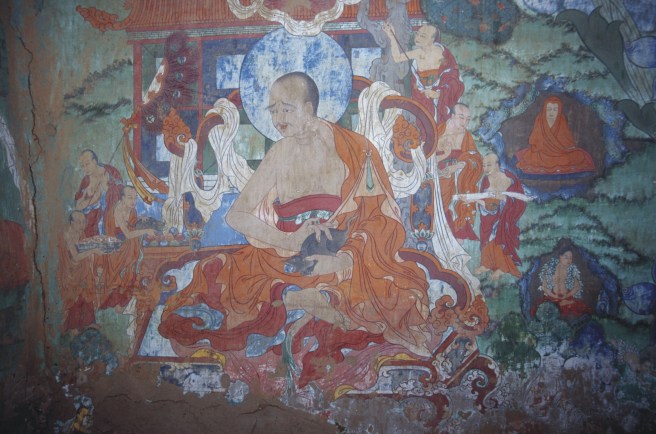
Bakula – Buddhist Arhat – Dream 12-08-2011

A thangka depicting Bakula, one of Buddha’s sixteen arhats, with his mongoose.

I am in a roof top garden, there is some sort of party going on with loads of people sat around and at tables. There are people of many ethnicities from all over the world. They are dressed in brightly coloured “hippie” style clothes. As the party carries on, they draw a curtain around one part of the garden and gather around some Buddhist icons. A south American man there starts to do some chanting. I butt in with Tibetan deep voice chanting. They do not recognise me and are annoyed at my interruption. I point out to them that it is my garden which they are in. I strike up again and do White Tara. I need a drink of water before I can find my voice. After several cups I strike the right note and do some White Tara. Everyone joins in and after a while the party resumes happily.

The wife and I are in one segment of the garden when Anna L and a friend turn up. They have been travelling in India. She has remained pale but her friend has gone brown. She talks of her travels and I say that we will in time need to have a proper talk. She has something for me. At which point she shoots straight up into the air and then lands. She has brought many “ethnic”, clothes and trinkets.


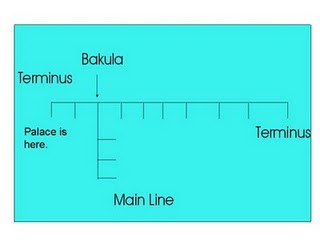
Next I am on a mountain train. I arrive at a terminus in a hillside town way up in the mountains. It is very much like Nepal / Tibet / Bhutan. I get out of the train and wander along the high street. Turning instinctively to the right I go up a hill to “my” palace. Again, there is a vibrant garden with peacocks. It is “my” garden.


Later I make another journey on the mountain train and end up at another terminus. Here the streets are filled with market traders selling saffron and magenta clothes, together with gold trinkets and jewellery. I have time to explore. Everyone is trying to barter with the merchants trying to buy goods in various currencies. The merchants will not trade unless the currency matches the passport of the person trying to buy.


I am not interested in bartering and look on watching. Somehow, I am “in tune” with the locals. I wander back to the main street and notice various pins sticking in my back. Somehow, I am now in an off the shoulder monk’s robe. One by one I pull the pins out of my back. They are made of a very fine gold pin topped with a tiny ivory chess figure. There is a castle, a knight, a king and a queen. I have also been adorned with much golden jewellery.


I go into an emporium as I am pulling out these pins and sit down. I ask the shopkeeper about what has been happening. She says that they have done this to me so as to make me unattractive to the locals so that they won’t fall for me and want to have sex with me.


Anna L comes into the shop and sits next to me. We start talking about my palace. An old Indian man with very short hair suddenly starts to talk in a very proper English accent. He says that she holds for me a key and that we must find it. It relates back to 1773. He says that I must get back to Bakula.


We leave the shops and seek out the train station. “All trains go through Bakula”, says the station announcer. We look at the map and it is configured like this.

  • Before this dream I had never heard of Bakula nor the sixteen arhats.
  • It is possible that Anna L is dakini.