Are Prophecies Powerful?

Insofar as they have a huge hold on the wish-life of human consciousness, yes. They also add spice to the narratives in fiction and cinema. Who has not heard of the four horsemen of the apocalypse? The prophet Higgs foretold a boson which now bears his name, billions of dollars later. The newspaper red tops like to quote the utterings of a blind eastern European woman. We may need to excise and inspect the entrails of an ox. The tea leaves foretold a dark handsome stranger though they did not mention his HIV status.

People can look to prophetic fulfilment and imagine that they are acting in accord with a pre-ordained destiny if they strive to manifest what they think a prophecy means. How they try to manifest  prophecy may suit their preferences and biases. They may refer to their holy books and say, “God ordained that this was our land”. This as if a human authored text is binding in a court of international law. Proof of authorship my Lord? We can get into arguments as to whose God is bigger, harder, more omniscient and more important. Whose God has shares in Lockheed Martin. Many people have died according to human interpretation as to what God is alleged to have said, wished and desired. One could say that it comes down to whose imaginary friend is the more potent. One may seek to precipitate Armageddon because it was written. One has no idea as to which prophecies people are trying to enact or are perhaps beholden to.

The notion of prophecy and things foretold runs through human history, human imagination and human religion. Were it not for the dreams of the pharaoh and Joseph, the Egyptians would have starved. Foretelling is an attractive notion. People hold prophecies in their religious texts as gospel, literally. There is something otherworldly about prophecy and even the ardent sceptic senses something, a hint of it, wafting on the breeze. Prophecy around the campfire and by candlelight enraptures more, a sophisticated ritual oracle becomes near definitive. The shaman says and so it will be. People may resist the prophecy only for it to manifest verbatim in a totally unlikely and perhaps infeasible way. To doubt prophecy is to spit arrogantly in the eyes of the Fates, to defy the will of Olympus.

Humans may not be as scientific and rational as they profess. Some things run primordial in our veins.

Of course the most powerful prophecies are the secret ones, hidden, far from the eyes of the profane. These secret prophecies are only for the adepts, the in-crowd and the big cheeses. They are written in arcane runic script by the Bards for eyes of their Kings. They are etched in stone and jewel. And these prophecies are often about power and things of global import. They speak to the fate of the planet, of kingdoms and of mankind. The prophecies of climate change are discounted because they lack the shaman’s hocus pocus. They have spectacles and beards, simulations and error bars. They are cold and graphical. Time will tell on the incoming disasters wrought by human folly, the belief that there is always tomorrow. If true the foretold will come around no matter what the nay-sayers wish. It was written and prophesised thus and in peer reviewed journals.

A flavour of the enticing nature of prophecy can be found in The Secret Doctrine.

——————————-

Yet this secrecy and this profound mystery are indeed disheartening, since they alone – the Initiates of India and Tibet – could thoroughly dissipate the thick mists hanging over the history of Occultism, and force its claims to be recognized. The Delphic injunction “Know Thyself”, seems for few in this age. But the fault ought not be laid at the door of the Adepts, who have done all that could be done, and have gone as far as Their rules permitted, to open the eyes of the world. Only while the European shrinks from public obloquy and the ridicule unsparingly thrown on Occultsists, the Asiatic is being discouraged by his own Pandits. These profess to labour under the gloomy impression that no Bija Vidyǎ, no Arhatship (Adeptship), is possible during the Kali Yuga ( the “Black Age”) we are now passing through. Even the Buddhists are taught that the Lord Buddha is alleged to have prophesised that the power would die out in “one millennium after His death”.  But this is an entire mistake. In the Digha Nikǎya the Buddha says:

Hear, Subhadra; The world will never be without Rahats, if the ascetics in my congregations well and truly keep my precepts.

A similar contradiction of the view brought forward by the Brahmans is made my Krishna in the Bhagavd Gita, and there is further actual appearance of many Saddhus and miracle-workers in the past, and even in the present age. The same holds good for China and Tibet. Among the commandments of Tsong-Kha-pa there is one that enjoins the Rahats (Arhats) to make an attempt to enlighten the world, including the “white barbarians”, every century, at a certain specified period of the cycle. Up to the present day none of these attempts have been very successful. Failure has followed failure. Have we to explain the fact by the light of a certain prophecy? It is said that up to the time when Pban-chhen-rin-po-chhe (The Great Jewel of Wisdom) condescends to be reborn in the land of the P’helings (Westerners) and appearing as Spiritual Conqueror (Chom-den-da), destroys the errors and ignorance of the ages, it will be of little use to try to uproot the misconceptions of P’heling Pa (Europe): her sons will listen to no one. Another prophecy declares that the Secret Doctrine shall remain in all its purity in Bhod-yul (Tibet), only to the day that is kept free from foreign invasion. The very visits of Western natives, however friendly, would be baneful to the Tibetan populations. This is the true key to Tibetan exclusiveness.

Page 396, The Secret Doctrine, Volume V, Adyar Edition, (1950), H.P.Blavatsky,

The Theosophical Publishing House, London UK.

 ——————————————————————

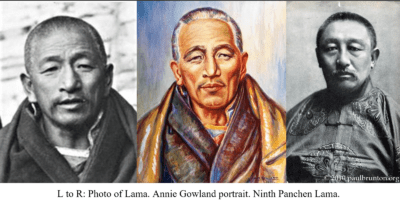
Written long ago she writes of Tsongkhapa and the Panchen Lama. The succession in Tibet now of political import after the invasion decades after her writing. Now there are “two” Panchen Lamas and an ageing Dalai Lama.

The problem with prophecy is that political narrative can be adapted to fit and thereby claim provenance. Human resourcefulness remains. The desire to spin and use propaganda is strong and a prophetic belief in supremacy can fuel war and destruction. The crusader set sail to the {un} Holy Land to claim some turf in the name of his God. Imagined Divine right fertilises the soil with blood, bone and sinew. The cleavage of body by sword and munition seems justified in the minds and perhaps hearts of the brutal, punitive and primitive.

Not a lot changes. Humans do the same thing over and over. They may even cite the supposed glory of victorious precedent. It is not very evolved.

The impact of prophecy on human doings and history is profound. So yes, prophecy is powerful. It is also very weird in the magical sense of the word weird. Prophecy is a harbinger of portent. It is a messenger of sorts. Of course all good prophecies need to be vague and to an extent open to interpretation.

These ones always comes true.
Looking for Kuthumi or Koot Hoomi Lalsingh

In various texts Kuthumi is said to have been educated at one of the British Universities. In the mid nineteenth century that meant Oxford, Cambridge, St Andrews, Edinburgh, Glasgow, Aberdeen or maybe Durham. Logic says that if he graduated, he would be on alumni lists, BUT in those days, many attended and never sat the qualifying exams. I have searched provisionally and found some Singhs at Cambridge, Edinburgh and Glasgow. Most of these were to the end of the century but none corresponded to him.

University could be a metaphor.  

It could also mean college or private school.

Some say he was a Rajput Prince though others confer this to Morya.

Leadbetter suggests that they together with Djwhal Kuhl lived in a ravine in Tibet.  They are placed not far from Shigatze and the Tashi Lhunpo Monastery the seat of the previous Panchen lamas

It is suggested that Kuhl, previously a follower of Kuthumi, became a master in his own right in 1875. He is said to be involved in the running of a certain lamasery.

Morya is anecdotally placed in London for the 1851 Great Expedition whilst Faraday was at The Royal Institution of Great Britain. I’ll speculate that anyone travelling from the sub-continent interested in science and knowledge might have swung by Albermarle Street.

In a piece of text, I cannot now find, Blavatsky suggested that she had been to some talks there. She speaks of Müller and other writers on eastern religions. Blavatsky is said to have visited the Masters in Tibet.

Minds were more like blotting paper, once. There was no Netflix so people had to find other things to keep the grey matter ticking over.

—————-

There was a great melting pot of ideas back then. William Crookes was a member of the Society for Psychical Research

“The Society for Psychical Research (SPR) originated from a discussion between journalist Edmund Rogers and the physicist William F. Barrett in autumn 1881. This led to a conference on 5 and 6 January 1882 at the headquarters of the British National Association of Spiritualists, at which the foundation of the Society was proposed. The committee included Barrett, Rogers, Stainton Moses, Charles Massey, Edmund Gurney, Hensleigh Wedgwood and Frederic W. H. Myers. The SPR was formally constituted on 20 February 1882 with philosopher Henry Sidgwick as its first president.

The SPR was the first organisation of its kind in the world, its stated purpose being “to approach these varied problems without prejudice or prepossession of any kind, and in the same spirit of exact and unimpassioned enquiry which has enabled science to solve so many problems, once not less obscure nor less hotly debated.”

In 1882 Mary Everest Boole became the first female member of the SPR; however, she resigned after six months. Some other early members included the author Jane Barlow, the renowned chemist Sir William Crookes, physicist Sir Oliver Lodge, Nobel laureate Charles Richet, artist Lewis Charles Powles and psychologist William James.”

Sir William Crookes (17 June 1832 – 4 April 1919) was an English chemist and physicist who attended the Royal College of Chemistry, now part of Imperial College London, and worked on spectroscopy. He was a pioneer of vacuum tubes, inventing the Crookes tube, which was made in 1875. This was a foundational discovery that eventually changed the whole of chemistry and physics.

He is credited with discovering the element thallium, announced in 1861, with the help of spectroscopy. He was also the first to describe the spectrum of terrestrial helium, in 1865. Crookes was the inventor of the Crookes radiometer but did not discern the true explanation of the phenomenon he detected. Crookes also invented a 100% ultraviolet blocking sunglass lens. For a time, he was interested in spiritualism and became president of the Society for Psychical Research.

From Wikipedia

————————————————

Do you think there is some PR in this wiki page trying to discount the whacko spiritualism?

————————————————–

Crookes attended the Royal College of Chemistry

“The Royal College of Chemistry (RCC) was a college originally based on Oxford Street in central London, England. It operated between 1845 and 1872.

The original building was designed by the English architect James Lockyer in 1846 with the foundation stone being laid by Albert, Prince Consort on June 16, 1846.

The College was set up to teach practical chemistry. Many politicians donated funds to establish the college, including Benjamin Disraeli, William Gladstone and Robert Peel. It was also supported by Prince Albert.

The first director was August Wilhelm von Hofmann. Frederick Augustus Abel studied under von Hofmann. Sir William Crookes, Edward Divers and J. A. R. Newlands also attended the college.

The young William Henry Perkin studied and worked at the college under von Hofmann but resigned his position after discovering the first synthetic dye, mauveine, in 1856. Perkin’s discovery was prompted by his work with von Hofmann on the substance aniline, derived from coal tar, and it was this breakthrough which sparked the synthetic dye industry, a boom which some historians have labelled ‘the second chemical revolution’.

The college was merged into the Royal School of Mines in 1853. It was the first constituent college of Imperial College London and eventually became the Imperial College Chemistry Department.”

From Wikipedia

————————–

The description from Leadbetter (extended in the book) is entirely consistent with various images I have had in dreaming and which started with this dream about The Tibetan.

Logic suggests that things have changed in the last >125 years. The invasion of China is likely to have been more than a slight perturbation.

Where are they now?

The Tibetan – Djwhal Khul – Dream 16 – 06 – 2008.

We are in a mountain village – a sort of base camp. We have just been up Everest and look back at its snow covered peak. We walk around the village and go to see the Tibetan. He welcomes us and we spend some time with him. He has five golden circles in a row interlinked with him. He gives us these five golden rings.

We wander back in the village to our flat which is there. We comment that it has gotten a bit touristy. We show others the mountain.

Someone is coming to see us. We go down onto the river and are in a modern pedalo style boat with a motor. The authorities know that this person is coming. I must ensure that the Tibetan has his head set so that he can communicate with whoever is coming.

Dream ends

Gold is the dreaming symbol for the spirit or Nagal

Ring is the symbol for power or circle the symbol for inclusiveness and unity

Five is the freedom and change {need for}

Mountain is the dreaming symbol for hope

Djwal Khul (variously spelled ‘Djwhal Khul’, ‘Djwal Kul’, the ‘Master D.K.’, ‘D.K.’, or simply ‘DK’), is believed by some Theosophists and others to be a Tibetan disciple in “The Ageless Wisdom” esoteric tradition. The texts describe him as a member of the ‘Spiritual Hierarchy’, or ‘Brotherhood’, of Mahatmas, one of the Masters of the Ancient Wisdom, defined as the spiritual guides of mankind and teachers of ancient cosmological, metaphysical, and esoteric principles that form the origin of all the world’s great philosophies, mythologies and spiritual traditions. According to Theosophical writings, Djwal Khul is said to work on furthering the spiritual evolution of our planet through the teachings offered in the 24 books by Alice Bailey of Esoteric Teachings published by The Lucis Trust (then named the Lucifer Publishing Company); he is said to have telepathically transmitted the teachings to Bailey and is thus regarded by her followers as the communications director of the Masters of the Ancient Wisdom.”