The Tendency to Literal Dead Letter Interpretations – Nāga

In our times there is, allegedly, a lot of fake news. People try to find titbits of “facts” to try and catch people out as proof of lying. It is almost like three year olds trying to get mummy or daddy to tell someone off or punish them. It is what I call sandpit politics. Some believe the bible verbatim and others use this verbatim interpretation to prove that it is not true, that there are errors. The hunt for the resting place of Noah’s Ark continues….

Two thousand years ago they did not have CGI nor for that matter AI. People were largely illiterate and stories had to be crafted in a way that people would remember. There was animistic religion. They had to speak in the parable of the times.

Take a look at the Mucalinda Sutta, – Mucalindavaggo.

Here soon after enlightenment Siddartha is sat deep in thought.

He might have been trying to figure out what to do next. “Ok so what next?”

Mucalindo Nāgarājā notes the incoming poor weather and wraps him in seven coils and protects his head with the hood of a king Cobra risen in threatening manner. They sit for seven days until the weather changes and Mucalinda morphs into a brahmin to praise Buddha the new Bhagavhad.

Naga can also mean Elephant, a semi divine Nāga part snake human who comes from another world Nāga-loka and Buddha is sometimes called Nāga-muni.

Iconography can be easily found with the nascent Buddha protected by a king cobra like Nāga with 1,5 or 7 heads. It is a core piece of iconography. It is core Buddhism.

In occult literature snakes and dragons are words use to hint at wise and sagacious beings, initiates and the like. In the Toltec tradition there are nagal/nagual beings who live in a nagual’s world an alternate assimilation of the one that is commonly held.

Snake is the dreaming symbol for wisdom or need for wisdom.

Rain is the process of life.

Seven is guidance or need for guidance.

Head is intuitive mentality.

Coil or circle is sobriety/ inclusiveness/ unity.

If we interpret this sutta like a dream. Siddartha having awoken as a Buddha had just radically changed his whole view on life the universe and everything. This was mind-blowing. Even for a Buddha. He would need time to assimilate and process things after his ordeal with Mara and the whole shebang. So, he sat in contemplation seeking guidance from his now Buddhic intuition looking at how to apply his Nāga – rājā {very big, king-snake, top notch wisdom} feeling protected by his new found knowledge and had insight, inner guidance, on how to use it to embrace and enlighten all the world.

And he said to himself, perhaps with a chuckle. His intuition had summed it all up for him

Blissful is solitude for one who is content, who has heard the Dhamma, who sees. Blissful is non-affliction with regard for the world, restraint for living beings. Blissful is dispassion with regard for the world, the overcoming of sensuality. But the subduing of the conceit “I am”— That is truly the ultimate bliss.

Tibetan Dice Dream 1-11-2024

This is one of a recent series of “out of the blue” dreams which seems to have little or no relevance to my current life circumstance and events therein.

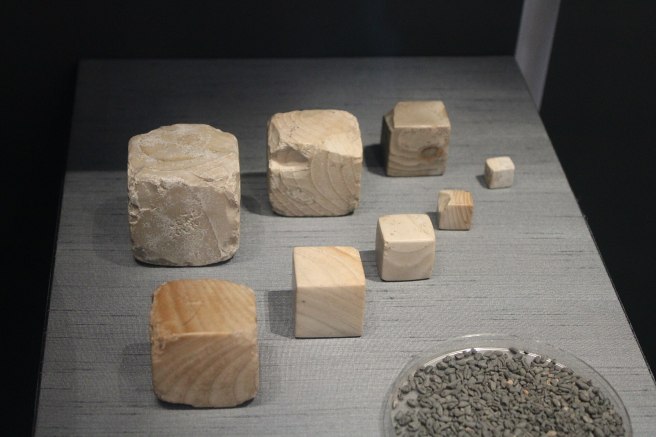
I am shown a dice/die which is a cube with rounded corners. It has the feel of ivory and looks ancient. I know beyond doubt that it is a Tibetan dice. I know that Tibetan dice are unlike any other dice in the world because of their special properties. I can only see the face of the die with a singular dot to denote one. I know the others are there, but the dream zooms in.

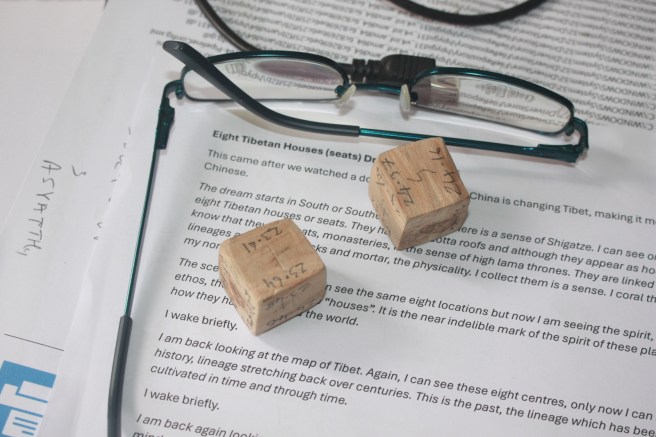
A little later I see two dice. I see that they are carved out of a deep root of a tree and shaped and polished. It is a long process and a labour of love. These are my Tibetan dice. They are perfect cubes with sharp edges and corners. I hold them in my hand and throw the dice, and I see two faces each with a singular dark blue dot. I have thrown two. They are made of root and Tibetan. The workmanship is exquisite. I know the meaning of two and its significance,

Dream ends.

I had not heard of this but when I put Tibetan Dice into Google…

From Wikipedia

Mo (divination)

Mo (Tibetan: མོ་, Wylie: mo), is a form of divination that is part of the culture and religion of Tibet. The Tibetan people consult Mo when making important decisions about health, work or travel. Mo employs dice and there are books written by various lamas on interpretations for the casting of dice. The answers given by the Mo are regarded as coming from Manjushri, the Bodhisattva of wisdom. Mo is considered to represent a blend of Tibetan shaman traditions and Buddhist beliefs.

One Mo prediction manual was composed by Jamgon Ju Mipham Gyatso, a great scholar and saint of the Nyingmapa tradition of Tibetan Buddhism. This Mo prediction manual is based primarily upon the Kalachakra Tantra and supplementary explanations from the ‘Ocean of Dakinis’. To use this Mo divination, one must have a question in mind and roll the dice. The dice’s outcome will indicate an answer in the prediction manual. The answer in the manual should answer your question but may need some interpretation.

The Dalai Lama consults the Mo divination when making important decisions.

Losing Your Mind – Zen

Some people might think that I am/was a complete nut job for getting out of a contract which would have paid 8000 euros a month tax free, over a decade ago. I must have been out of my mind. Others might think me whacko for a number of my beliefs and that I have lost my mind. Why would a trained scientist not strive for recognition and research funding. Why renounce his job at a world “top ten” university? He must be barking mad and batshit crazy to boot.

I have lost my mind but not in the way people might think.

In general, my mind / head is a very quiet place. There is no continuous chatter of internal dialog. I am not busy with should and ought, nor is comparison mind resident there. My mental default is silence. I can observe, I can experience and absorb. I can hear and see, but there is no mind making endless qualitative thinking. If I want to think I have to actively engage my mind. It does not run off like a horse when the stable door is opened.

I could say that my “mind” differs from most. I know that it has changed markedly over the last two decades. But there is no way that I can explain or illustrate in a meaningful way what my “mind” is like to anyone suffering from internal dialogue or very attached to the common socio-political assimilation of world and society. I once experienced that world first hand as an active participant. I no longer do/am.

I still look much the way I used to but the animating contents of the meaty body are now changed. People might struggle to understand that I am not as I was and interpret me in terms of an old look up table of behaviour and manner. I’ll speculate that many would not get it or me. My assimilation of world is different, I cannot prove this to you or anyone really. It would take sharing a considerable amount of time and circumstance to appreciate and I would have to extrovert my thoughts and thinking in order for people to see just how different. I can still interpret events from a “normal” perspective but I do not share the emotions many are beholden to. I can appear to fit in and comply with the common world views.

In the Zen literature there is a lot of mention of Buddha nature. If I understand Zen at all it is to live fully in the present and at the point before mind knowing that as observer you are also participant and not separate from the arising phenomena. Zen does not like definitions because that is a feature of comparison mind and a definition by definition invites comparison to said definition which is “mind”. People stress over definition and argue the toss. Buddha nature is offered as a way of being, a nebulous ideal which exists when mind is fully quiescent. Most of the Zen koans are devised to show just how much mind trips one up and self-entangles. They point at not using mind the way which it is customary so to do.

In order to be “Zen”, one has to lose one’s mind and yet remain sane.

However, what is considered sane in the common socio-political assimilation of world, is all “mind” and therefore insane. If people like their possessions and acquisitional materialism, to detach from these would be considered lunacy by many. A wide empty path is the road of the lunatic who disavows possession, grabbing and the socio-political accumulation of kudos and social power.

Kudos is illusion in Zen and Buddhism as a whole. Yet many seek it with a passion.

Although people use Zen as an adjective for calm, they are not interested in attaining it because it requires that they forego the common world view. As we all know you cannot have your cake and eat it.

How is my logic?

Do we live in a sane world?

Is there an increasing problem with mental health as measured to the normative socio-political construct?

I have lost my “mind” does that make more or less sane than you?

Are you saner than I?

Discuss….

Impermanence and Complacency

I have had eight decent length dreams in October so far this year. I haven’t published them because recognisable individuals are in them. These are out of the blue as I haven’t spoken to/with them for well over a decade. I don’t really know what to make of them. They may be pointing at something going on in the “real” world.

In the Toltec tradition the “place” of dreams is the South. I spent quite a bit of my early life in the Southern Hemisphere and can get on well with Kiwis, Aussies and South Africans. I was a part of the itinerant barman subculture in London for a number of years. In the Toltec tradition people have a predilection for stalking of dreaming. I am the latter. Dreams can re-present possibilities in the web of life, a kind of aperture in space-time where events might manifest. These apertures do not stay open forever. They close and what once might have been possible ceases to be. Failure to act on the appropriate time scale makes things no longer possible.

I’ll make a statement, there is a tendency for arrogant people to be complacent and get caught napping.

One could argue we have seen this take place recently in the middle east, at 9/11 and Pearl Harbour. People who think themselves invulnerable, important and powerful can get surprises.

Impermanence as a concept is logical, nothing lasts forever. But people do not get it. To truly attain impermanence is to understand the eternal now. Impermanence lessens the manacles of clinging and attachment; it exemplifies the preciousness of time. Many imagine they have all the time in the world and are slow to get around to things which they prefer not to do. Timely action delayed reduces likelihood of positive outcome. Impermanence teaches appreciation and the fact we only borrow things for at most a lifetime.

People who work in universities need to be seen and heard in order to get promoted. They need to have measures of esteem; they need a web presence and various public metrics. They have a semi-permanent web footprint. Several ex-students of mine have commented to me that I am now hard to find on the internet. I was on Research Gate. They won’t give me an account now. I was on LinkedIn. I have no need to be seen, to be present. So, I can build up a profile, write a blog and then bin it. They are impermanent things. I do not cling; I have back-ups of text on the off chance I might need it again. People can imagine that one will want to remain in touch and contactable. They may be complacent about this. The nature of academia is that it is a large heavy slow moving object with momentum, it is not fluid nor are research funding mechanisms, the turn around time is quarterly at best. There are institutional and annual rhythms. If one is institutionalised life dances {slowly} to that beat. There is assumed a quasi-permanence.

It is perhaps non-standard to suggest that attainment of impermanence gives one a sense of urgency at the same time as detachment from outcome, specifically desired outcome. The land of “there is always tomorrow” runs out. The world of mañana means possibility and opportunity lost.

Carpe diem is interred in a mausoleum.

There is a saying attributed to Buddha; “The trouble is you think you have time.”

People spend their time unwisely and there is a lot of wasted time, escapism and avoidance.  Complacency about time is brought about by the illusion of permanence. “It will always be there tomorrow.”

There is vast global complacency about climate change because of the illusion of permanence. People do not get that our mode of living is subject to change and over the next decade it will become obvious. Instead of cooperating to reduce consumption the mantra of economic growth underpins jaded economic dogma. People indulge in petty vengeance games where hundreds of thousands of tonnes of high explosive munitions are detonated to get revenge by obliteration. How much energy and carbon dioxide has been released in Gaza, in Ukraine?

Has that cooled the climate?

I suspect that humanity could well be on its way to being shaken violently out of its complacency as the weather patterns get ever more extreme and chaotic. Humanity, especially in the rapacious West, has taken so very much for granted and for a long time.

Pride often comes before a fall.

Before long the aperture in space-time in which to meaningfully act on climate change will close. It has already started.

How Many Fully Enlightened People Are There?

If you type various versions of this question into Google you see that there are people discussing it on line. I have even seen articles on Buddhism which states that the goal is to achieve nirvāṇa. Buddhism does not have KPIs and personal development planning, nor does your line manager tear you off a strip if you don’t achieve your goals.

I’ll speculate whoever considers nirvāṇa a goal is a long way indeed from said goal. He is in a gaol of Western thinking.

In various school of thought nirvāṇa is when the causal vehicle {Soul or reincarnating Jiva} has been blown off. This means there is no requirement to reincarnate, a strictly human thing. Humans are “bound” to the wheel of rebirth. Someone, some being, who has done that, nirvāṇa, is strictly speaking no longer human. In the context at death the being who has attained nirvāṇa achieves the state of parinirvāṇa at the dissolution of the meaty incarnate form. Thereafter “they” remain formless.

We could get into the gender debate about pronouns. What pronouns do you use for some entity which has no body, no observable physical plane presence? What is the correct pronoun for a fully enlightened Buddha? It?

The problem I have with enlightenment as a concept is that is enlightenment an absolute or a relative term? It might be said that someone got enlightenment, does that mean that they are a fully enlightened Buddha or does it mean that they are little less heavy than before. They have attained a quantum of enlightenment, a bit, one step further up the ladder. They are lighter, less dark and thereby enlightened. To progress one gains enlightenment in a stepwise fashion, realisation by realisation. At nirvāṇa the being is lighter because it no longer has a causal vehicle or personality, notions of self have dissolved. It is enlightened, unburdened.

There is the concept of returning high attainment Bodhisattvas, who on death put off the attainment of parinirvāṇa and come back of their own free will to teach. Because they have no causal vehicle, they create a nirmāṇakāya emanation for such a purpose. If I understand it correctly there may be many of these in the Tulku tradition. Arhats can be seen as selfish because they do not come back. But that is a transference of human personality onto someone who has no self. I have seen it prejudiced that Bodhisattvas are good, and Arhats not so. Human folly, methinks.

In esoteric thinking the end of the causal vehicle comes at the fourth initiation. If one cross references, this is nirvāṇa or blowing off. If I understand it correctly this phenomenon is associated often with physical plane death {but not always}. One gets nirvāṇa and sharpish thereafter parinirvāṇa. In that school of thinking there are a few more stages of development, the other initiations, after doing what Siddartha did in getting planetary nirvāṇa.

One might rephrase the question, “how many fully enlightened beings are there?”

In the esoteric school of thought the fourth degree initiate goes on to take the fifth and become what some call masters. This happens, according to my reading, relatively soon.

I think most people would struggle to envision or envisage a “living” awareness or consciousness in the absence of a physical plane body. So, people invent worlds and dimensions or abodes where they might picture some enveloping form even if that be nebulous. The inventions are inspired by life on earth. Being superstitious people like signs and miracles as circumstantial evidence or proof of nirvāṇa or parinirvāṇa. There must be a rainbow or a comet. If it is a wholly natural part of evolution why would this happen? It is kind of no big deal. There is a desire for sanctity and holiness where they may just be a natural evolutionary process.

The question itself seeks to quantify and scale because people like to compare, to play top trumps.

“My God is better and more real than yours”, being a root of many wars.

Going a step further “are” implies existence or being. Can something exist if there is no form, no measurable lump of meat. If something is formless, is it?

Instead of quantifying we may now rephrase.  “Are there enlightened beings?” “Do they exist?”

“It’s life Jim, but not as we know it!”

Astrobiology and astrochemistry are looking for life in a chemical-biological entity with a physical existence measurable by modern instrumentation. The assumption being that life can only exist in some kind of form, or particularly a corporeal form no matter how small. Science requires a form {and perhaps reproductive urge} as a basic component of life and its definition.

A formless Buddha after paranirvāṇa would not technically be alive according to human definition.

So maybe according to science enlightened beings do not exist.

The answer is therefore zero and not 42….

Which poses the ancillary question does, zero exist or not?

Karmic Conundrums

In the context of karma, if you don’t {yet} believe in karma then it is your current karma so to do and be. It does not alter the fact of karma but your denial and disbelief thereof is karmic. Eventually karma will teach you about karma and cause & effect. In the context of karma there is an inevitability.

Do you believe in karma?

Answering this simple question has karmic consequences which may be wide ranging.

If, however, there is no such thing as karma the answer is a facile no.

To plump for an agnostic maybe suggests that karma exists, sometimes and in some circumstances. You might cherry pick the circumstances in which you give a nod to karma. Picking and choosing thus implies you want life on your own terms. You are selective.

To answer yes, implies that you acknowledge at least some responsibility for your actions.

To fully believe in karma at first might cause you to freeze and say, think and do nothing. You may not wish to cause anything.

A belief in karma has scaling to it. I have looked into its applicability and the concept of karma is for me sound and can be observed in many situations and events.

There are numerous social media, and YouTube videos entitled “instant karma”. There is a song by Lennon and Ono. People enjoy watching comeuppance. As a loose concept karma is held by many. But it is not as simple as prompt and obvious payback.  Enjoying people getting comeuppance is not in itself wise or pleasant.

It is my observation that karma can be very subtle and by way of a complex conundrum which is difficult to solve.

An obvious hurdle or bar to solving some karmic “problems” is the notion of face. People might want to resolve a situation but the only way to do that is to maybe apologise and lose some “face”. Thus, the problem never gets solved and it acts like a burr under the skin. It does not go away. Prompt action eases situations quickly, putting things off makes them worse. Boris Johnson struggled to admit he was wrong in Partygate because his sense of entitlement had it that rules did not apply to him the world king, they were for little people. Truss still refuses to accept she caused the markets to plummet. “Face” can exact a high price. And that price may come in the twilight of a life. Payment is due and with interest. Her political relevance wanes.

It is my thesis that much karma ripens and bears fruit near end of days. Challenges put off due to inconvenience re-appear just when one no longer has as much faculty to solve or face them.

In my experience karma has a lot to with attitude. Hoity toity and arrogant people can be knelt by the universe, taught a lesson of humility. To suggest to an arrogant person that this might happen is a thankless task and unlikely to succeed at first, it might sow a seed, however.

Those who believe they are able to act with impunity are the most likely not to believe in karma nor accept that they are responsible for the consequences of their actions. An example in case is the migrations from Iraq and Afghanistan. We caused this by invasion and destruction yet are unwilling to accept the consequence of immigration. We moan and complain and demand that it stops. We fail to acknowledge the lesson and are likely to repeat the same folly as a result.

 Karma can take many cycles to teach.

A typical karmic conundrum may involve wanting to resolve a situation but being unwilling to take the necessary risks or appropriate steps. In some cases, those steps which once were possible and facile have become very difficult. The longer resolution has been delayed the harder it becomes. The “problem” has grown, spread or bifurcated.

The poor attitude has acted as a growth factor for the problem. What was once simple has become highly complex and entangled. Escapism, avoidance and denial have fertilized the karma.

The saying, “what a tangled web we weave when first we practise to deceive”, is a statement of karma. With an inevitability one lie requires more to prop it up. An early stage fess-up prevents a massive web of lies, metastasising.

If is the word which most stops karmic resolution. People want to put conditions on their actions and keep apparent control. By trying to control a situation and not resolve it one can make it a lot worse. This seldom occurs to some. They can be very adamant and stubborn.

“If I do that what is in it for me?”

Is a mindset which negates the law of karma.  

Accepting responsibility for one’s actions and how they ripple out into the trajectories of the wider world is not something that most people do. Being me or egocentric they fail to appreciate the wider connectivity.

Karma ultimately teaches that we are all connected in the same world.  We are a part and not as separate as we might insist or imagine.

At the moment global karma is being initiated in the middle east violence. What will the longer term effects be? Will they be widespread or localised?

Do you believe in karma?

Place your bets…spin the wheel…

Removal of the Ten Buddhist Fetters and Psychology

Removal of the Ten Buddhist Fetters and Psychology

I have always thought that Buddhism is pretty radical. If one removes all ten fetters one no longer reincarnates, so the theory goes.  In the context of Abhidhamma Pitaka the vast majority of humans have no experience beyond the first couple of fetters. Discussion therefore is based on scripture and not personal experience; it is by way of speculation.

The first fetter of self can be thought of as the business of psychology, one is encouraged therein to have a notion of self, an identity. If you lack many of the emotions in the second enumeration you might get a diagnosis of Aspergers’ or clinical depression. You certainly would not have a starring role in Dallas or East Enders.

The teachings of Buddha if applied take one way beyond psychology and the socio-political framing of mundane human experience. It, the fetter, could be called the limitation of and by social conditioning, complying with societal ideas and trying to fit therein. Making an image to attempt to convey to others. If you think in terms of social media Abhidhamma Pitaka’s list of ten fetters are perhaps the guidebook to social popularity, the more you express the more likes and followers you get. Does Trump exhibit any of these fetters?

I find some of the available Buddhist interpretations a bit absolutist. Complete removal of reproductive urge is probably not possible. Porn hub reinforces the first fetter kāma-rāga.   

Getting things in perspective and balanced is probably a healthier way. After all the Diamond sutra admonishes against seeking the absolute. A classic sign of depression is loss of libido. Psychologists may contest the teachings of Siddhartha.


What are the ten fetters in Buddhist tradition?

 This by Andrei Palskoi on Quora

https://www.quora.com/What-are-the-ten-fetters-in-Buddhist-tradition

The fetters are attachments to illusory ideas about how reality is built and operates. They are the rules that you believe are solid and unbreakable, whereas in fact they are nothing more than ephemeral mental contracts.

Each of them can be seen as a counterweight applied to balance the scales after they’ve been originally tipped off by the 10th fetter, culminating with the 1st fetter like a cork sealing the jinn’s bottle. They are intended to create and/or restore the illusion of stability, and the price for having that illusion is the lack of freedom – that’s why they called “fetters”. They feel important to abide by, even when they result in suffering.

There are many different interpretations of their meaning. Below is mine – by no means accurate or even orthodox, but it’s one of those things where you cannot rely on dogmas (see fetter #3).

  1. Person – thinking that there is an actual object with fixed properties called “a person”, or “self”. Once the imaginary description of “who you are” is formed, there is a strong feeling of being obligated to act in accordance with how that “you” would act. Essentially, in this fetter you are bound by the mental model of yourself. The fear of violating this fetter is that for your reputation in your own or someone else’s eyes. Also, many other stories and beliefs are predicated on the idea of “you” as an actor playing a crucial role in them.
  2. Doubt – traditionally by this it is meant doubt in Buddha’s teachings. Effectively, it is doubt that there is indeed a way back out of your existential conundrum. It binds you into arguing about everything, rather than putting sincere whole-hearted effort into looking at the facts and be willing to honestly admit what they show, even if it goes against your preconceived beliefs.

{often very specifically about the teachings of Buddha and the Dharma my addition}.

  1. Rites and rituals – this includes dogmas, habits and any other kind of mind automation. It binds you into thinking that if “things were this way before”, they are expected to continue the same way. This fetter is an inertia of mind, i.e. repeating what it was accustomed to doing. It is also a belief in magic that merely by doing some rituals that you don’t understand you can control the experiences and prevent unwanted ones from happening. Basically, relying on stale old recipes and ignoring the new realities of the moment.
  2. Desire, or lust – belief that you can want a form and when you do, you must run after it. Effectively, it is imagining some experience and feeling irresistible draw to falling into it, as well as aversion to the idea of not getting what’s desired. Together the 4th and 5th fetters are manifestations of the false belief that by mastering the art of pulling in pleasant experiences and pushing out unpleasant ones it is possible to achieve ever-lasting comfort.
  3. Aversion, or ill will – when something goes against your expectations (which is inevitable), you feel in your guts some invisible force that is presumably pushing you towards resistance in all its forms (hatred, fear, suppression, avoidance, etc.). Rather than an attachment to experiencing pleasant experiences, it is an attachment to reacting to unpleasant ones. This is where the suffering is born out of refusal to accept that ultimately there is no control of what happens.
  4. Forms – belief that reality consists of fixed objects with properties and feeling of being bound by those forms and their importance. Subject-object separation.
  5. Attachment to formless ideas – belief that apart from the pure “being”, there are other fundamental qualities of experience such as time and space, and there is witnessing of these qualities through perception. This is where the idea of “independent reality” is born.
  6. Conceit – belief that the mental idea of what is going on is more important than the actual experience. This is a belief that the experience must “make sense”, which begins with the simplest sense of pure “being” – the first fixed mental construct, the first attempt to fabricate an illusion of something reliable, predictable and lasting, something that can be grasped at.
  7. Restlessness – the outcome of the original ignorance, chaotic flow of ever-changing experiences with no fixed structure whatsoever. The first anxiety of having nothing to grasp at. The other 8 fetters are essentially failed attempts to hide this anxiety, which can be felt again at any time when they don’t work.
  8. Ignorance – The beginning of the “flame” – falling for the false appearance of experiences and ignoring the true knowledge that there can be no experience that has any substance, permanence, satisfactoriness. A “big bang” manifestation of experiential reality, i.e. samsara. Conscious emptiness that accidentally confused itself into dreaming up the realm of experiences and cannot awaken back from its dream.

This from Wikipedia:

Abhidhamma Pitaka’s list of ten fetters

The Abhidhamma Pitaka’s Dhamma Sangani (Dhs. 1113-34) provides an alternate list of ten fetters, also found in the Khuddaka Nikaya’s Culla Niddesa (Nd2 656, 1463) and in post-canonical commentaries. This enumeration is:

  1. sensual lust (Pali: kāma-rāga)
  2. anger (paṭigha)
  3. conceit (māna)
  4. views (diṭṭhi) {opinions my addition}
  5. doubt (vicikicchā)
  6. attachment to rites and rituals (sīlabbata-parāmāsa)
  7. lust for existence (bhava-rāga)
  8. jealousy (issā)
  9. greed (macchariya)
  10. ignorance (avijjā).

The commentary mentions that views, doubt, attachment to rites and rituals, jealousy and greed are thrown off at the first stage of Awakening (sotāpatti); gross sensual lust and anger by the second stage (sakadāgāmitā) and even subtle forms of the same by the third stage (anāgāmitā); and conceit, lust for existence and ignorance by the fourth and final stage (arahatta).


The Wolf of Wall Street is not close to enlightenment, “greed is good!”

If you encountered someone who had overcome to a great extent these ten fetters how would you interact?

The notion of transactional “you scratch my back…” interaction would not work. They would not have the same emotional soap-opera buttons. They may even seem very boring and dead-pan.

Are they still alive? Are they completely overcome with anhedonia?

We are seeing the first fetter of “person” or “self” as a battleground for the so-called gender “debate” or slinging match. Self-image plays a role in anorexia and bulimia. Social media has created a zombie army of influencers, self-obsessed. People forget that image is imaginary and not real.  Yet they devote a lot of time and effort to image.

Removal of the Abhidhamma Pitaka’s fetters might imply a saintly person, an impossible thing. But there again human idealisation and absolutism comes in. The passage above suggests a sequential list based removal, a tick box approach. Done that, got the t-shirt. Isn’t it more likely that one would be working at removing the dramas/fetters all at the same time? Tick box thinking is not a high level overview. Goals achieved can cause conceit and ambition.

Twitter is full of aversion, or ill will. It fills our news programmes in Israel and Gaza, in the US presidential elections.

I’ll speculate that a psychologist / psychiatrist might have trouble framing and understanding a being largely free from these fetters. Maybe they would invent a new syndrome to categorize them…

Or they could lock them up in a loony bin, especially if they were not an ordained monk or priest in robes.


.

Belief and Proof

I’ll speculate that many believe things, ideologies and religions for which there in no possibility of proof. Half of the UK “believed” that Brexit was a good idea, many were adamant even though the outcome was unknown. They professed with absolute certainty about something which had not yet happened. Some Americans chant the MAGA mantra. Exactly when was America ever a great and equal place? Bad stuff has always gone on there to some extent.

People will believe whatever it is they want to believe. The strength of belief may vary. The war in Vietnam seemed like a good idea at first. Someone thought agent orange was good.

The church had a vested interest in making people God-fearing. Bums on seats meant coins on collection plates and salaries for clergy. The gold held by the churches and all that chavvy stuff goes against my interpretation of New Testament Christianity which differs from Old Testament Torah. Yet many who name themselves Christian believe in an eye for an eye instead of turning a cheek. I personally cannot envisage any deity in human or anthropomorphic form. {With the exception of Ganesh} I was made to draw God as a white bearded white geezer at the convent school in Zambia.

People born with penises believe that they can be “women” after a few hormones and a change of clothes, a new frock.

Some of the conspiracy theories floating about are to my eyes far-fetched, yet they have their devotees. I do believe that the world is controlled loosely by rich people. The extent to which they conspire is moot. It is all about profit and the best way to get that is by being good at business and ensuring calm by means of pecuniary compliance. There is no need to do weird far-out stuff. 

Yep, some get corrupted by power and this can be expressed by abuse, sexual abuse and coercion. There are a number of ring-like groups that take advantage of those who are corruptible by promise of an easy ticket. Sometimes the cost of association to/with a powerful figure is high. Savile, Epstein, Al-Fayed. There are mini-mes of these scattered through the population, the degree of unpleasantness varies.

Between belief and proof, we might have working hypothesis. In which one tries out a framework or context to see how well it works, what the generality is like. There are “proofs” which are more circumstantial than direct.  There are things which suggest or point at an idea.

I believe in the concept of karma, there is sufficient observable causality for me to trust it as a concept, a working hypothesis. However, the subject is vast. I once did a whole blog exploring karma. The cornerstone of karma is evolution. One needs to learn from mistakes. Evolution and karma are of the same process. There is a cost associated with some actions which “the universe” wants paid. Karma not worked at in a timely fashion and with willing mood accrues karmic debt, much like a bank loan. One learns the effect of a causal action or behaviour. Sometimes people are slow learners.

The coypu no longer trouble our lotuses. Electric shock training with 0.25 Joule pulses at kilovolts works. We have a low electric fence which I installed. Cause and effect. Coypu karma.

I have had sufficient circumstantial evidence via visions and dreaming to believe in reincarnation. There is no way, on this planet, that I could ever prove reincarnation to the satisfaction of my scientific training. I could not put data into a spreadsheet and plot a graph with a fitted equation and a statistical quality of fit metric. I share the belief in reincarnation with millions. I probably believe it more strongly than most.

Karma and reincarnation as concepts are internally consistent. Karma spans lifetimes so that we can evolve. Karma is a teacher of sorts, in my world.  It takes lifetime after lifetime to learn somethings.

Is it significant that I who once was a pukka scientist at a pukka institution can remember three lives as a Buddhist monastic?

Depends upon what you think is significant. To your average common or garden UK football supporter it means nothing.  To someone who is a committed Buddhist it would not be a huge surprise, it might be tad interesting. Why not a scholar scientist and a scholar monk? It is not so different. Both have cerebral elements. To a bunch of scientists, it might be a red flag which needs disproved.

Have you noticed how science has a negation bias?

I’ll speculate that most people have a host of things which they believe which cannot be proven and moreover they do not question their beliefs or the provenance of the source from which they were obtained / picked up. Gossip and tittle tattle being a common currency which can become Gospel or God’s honest truth. “They” know and say an awful lot, do they not?

People can be very adamant about things which they have not checked or researched themselves. There is heavy reliance on hearsay. There are a lot of soap box orators both in real life and on-line. Hearsay has it that the spread of disinformation is huge and increasing.  This is consistent with what I see on Twitter. 

If you watch BBC, Sky, France 24 and Al-Jazeera the reporting on Gaza is very different. The British news is very sanitized and biased. People trust the BBC but it is reporting on a very different “war” to Al-Jazeera. Chalk and cheese. The UK right think the BBC is luvvie-socialist oriented.

People will believe whatever they want to believe. Convenience is a major factor in belief. They will believe what is the most convenient for them to believe. Inconvenient truths are generally not preferred. Coming round to an inconvenient belief takes time and is resisted, exemplified by the three individuals mention previously.  So far nobody has said a great deal about the Princess Diana – Al-Fayed relationship. That narrative is altered by recent news. Did King Charles have her bumped off? Is he still the villain or are there other factors now?

Belief is also mutable…

What you believe today is impermanent…I can’t prove it to you…I can offer it as a working hypothesis which you might see to be applicable.

———————————

How many of your beliefs are convenient?

Why did you prefer them?

National Karma and Impunity

There are some people, some nations, who believe they can do whatever they like, be barbaric for example and feel thoroughly justified in their right to slaughter. They imagine quasi-divine impunity and do not subscribe to the notion of cause and effect or karma.

The karma of empire is decay and loss of significance. History shows time and again that no empire lasts forever and towards the end corruption and decadence arrive for the wind-up party.

This afternoon I watched a news programme in which it was mooted that the economies of China and India would in time be larger than the USA. Things change, nothing lasts forever. The technological revolution in China has soared after the so-called cultural revolution of Mao Zedong.  The USA has behaved like a bullying teenager for a long time now. It has funded the destruction of Gaza and now Lebanon too. The United Nations has never looked so toothless as it does today.

The word is a scary place right now. I used to have a lot of respect for USA, but now with things like Iraq and an attempted coup d’état by mob a few years back, respect wanes. My foray into Twitter has done little to improve my opinion. There are some nut-jobs out there. In a few short weeks there will be an election. Some Americans are suggesting “Kamunism” that Harris is left wing! Really?  She is a tory to my eyes.

Americans it seems know very little about socialism or communism.

There is a real prospect of the nasty orange sociopath man getting back into power and sending cultural evolution backwards in time. Trump is a part of national karma. You get the leaders you need/deserve.

The rise of nationalism and me-first isolationism is swift. Brexit being an example of a withdrawal from internationalism of the saddest and most unnecessary kind. Everything has some kind of consequence. No divorce is 100% amicable, to expect a miracle is misguided. Yet some still yearn for the fairy godmother.

France very nearly had a right-wing nationalist government.

Wasn’t the 20s and 30s last century when the nationalists grew in popularity? Are we doing Groundhog Day? Zieg Heil!

I saw a post suggesting that the Confederate States could leave the union, USA, and still compete effectively globally as a new country on the world stage.

That which takes ages to put together can be rent asunder in a fit of pique.

The level of division in the USA is very high it was preceded by the remainer-brexiteer name calling which divided families in the UK.

It does not look to me that people are learning to grow up and live together.  Sandpit politics dominates.

There is a significant chance that the USA could implode and who is going to repay the ginormous national debt of the biggest economy if it does? How will Moody’s, Standard and Poor, and Fitch rate them.

Overriding, rewriting International Law to suit in order to bomb the fuck out of another country is an example set by the land of the free and home of the brave. You don’t have to be very brave in a F35 equipped with the latest electronic countermeasures. They set the precedent. Don’t worry they are only Muslims, kill them. Get Saddam. Take your shots and lie down dead.

In the fullness of time apparent impunity fades. Unexpected consequences start to arrive. USA has been caught sleeping twice.

I wonder what drama remains in geo-politics this year.

We have had five years of stuff happening which we did not expect. Covid, Ukraine, Gaza. What else is coming in?

Where we live is a pretty safe if there is a major escalation. We are not close to a likely target in a nuclear war. That I am evening thinking that is telling.

I have yet to hear of any situation in which mass death and destruction is the best answer. It seems an all too human default…

Humanity fails to learn by mistake…

Homo Sapiens is an arrogant misnomer…

Circumstantial Evidence For Reincarnations In Dreaming

I’ll speculate that the modern short attention span is inconsistent with developing depth of insight and profound, for want of a better word, spiritual, connectivity. If it can’t be done in a TikTok it is of no interest. Further if there is no app for it, it can’t be good. There is a tendency to conclude without investigation and pooh-pooh without research. The provenance of “they” as a font of wisdom is rarely questioned. Fear of missing out, FOMO, keeps people stuck in the hamster wheel.

Even when I was young, I tended to look into things in depth. Despite being a rugby player, I was also an avid book/library user. I think it accurate to say that I seek greater depth of knowledge than the majority of humanity. In order to form a complete pattern which my intuition is happy with I need quite a large amount of data and imagery.

In the post previous the putative reincarnation chronology is roughly Egyptian, Egyptian, Hindu Brahmin, Mexican South American(?), Persian, Indian Buddhist, Japanese Buddhist, Thai Buddhist, Christian Priest/crusader and my Sicilian life. There is a possibility of a more recent female birth. There are reasons why this may not be the case. One could call these dreams circumstantial evidence for reincarnation in dreaming.

There is a feeling that the Mexican life might be more recent. I had a bit of a thing about Teotihuacán which places it before my Japanese life. The reincarnations stretch back thousands of years. One could speculate that I am an old “soul”.

Were I still employed at a world top ten university as a science academic I would not talk in public about this kind of thing and it might even be contrary to the internet etiquette guidelines of my employment contract. It might raise the odd eyebrow or two. Luckily, I no longer need to get research grant income so my, within peer group reputation, is of no import. It is possible people would not want to be associated in public with a “whacko” like me. I could be a LinkedIn leper. Physical scientists are sceptical and conservative.

In addition to these dreams, I have had multiple déjà vu experiences concerning my Sicilian and Christian “lives”. There have been visions of myself as a Buddhist monk with om mane padme hum tattooed on my forearm in Sanskrit and a traumatic end to the crusader life, in full smell-o-vision. It has been indicated to me that this is my last incarnation here. That would make me a non-returner, anāgāmin.

I’ll speculate that no main stream psychologist or psychiatrist would be able to give a satisfactory explanation from within the common view of the world for these dreams in total (~250), especially when taken together or in themed groups.

On the basis of my personal experience reincarnation with partial life recall is the best-fit explanation but by no means intellectually conclusive. It is not proven.

A point of interest for me that while I have been revisiting these dreams, I have had something of a dream drought.

“Remembering one’s former abodes” (pubbe-nivāsanussati), causal memory, recalling one’s own past lives is one of the higher “powers” in the Pali Buddhist canon. It suggests that evolution is required for this to happen. It is not a common or garden thing. This is consistent with continuous evolution. The sense is for all but two of my “lives” I have been involved with the “priest hood”.

The new religion is perhaps science. So, one could argue that I was a priest at a science and technology university, in this incarnation too. I have lived like a “hermit” for over decade and meditated daily for two. I am perhaps more yogi than geek.

In order for anyone else to appreciate things effort would be required. In our hectic modern world taking the time to read through the dreams of a retired person, will be very low priority. It is perhaps only of interest to the wife and me.

It has been, for me, quite fun to re-examine my dream archive.

It is 29˚ C in the shade here so it is too hot to do any gardening…