The spoken language around here in Brittany would be evolving back then. The founding saints, purportedly mostly Welsh, and from near Llantwit Major in Glamorgan would have spoken Welsh. There was St Illtud’s “academy”. They moved here around 500 AD as Welsh was changing from the other Brittonic languages such as Cornish or old Cornish Kernewek Koth. In around 500 Welsh would have been more similar to Kernewek. There was migration from all the west coast of Britain. Cornish resembles Breton well.
There would be residual Latin which was slowly morphing into medieval French. So far, I have found out that there are few texts in rakkrennvrezhoneg or pre-medieval Breton. There are plenty of Welsh texts.
There are old texts from Brittany in Latin. I am guessing that the clergy and those with money were versed in Latin and it was used to “translate” a sort of universal.
So, if I was incarnate around 800 years ago as a “priest” or member of a religious order I would have had to speak Latin and if on crusade medieval French. I would have spoken rakkrennvrezhoneg with the locals
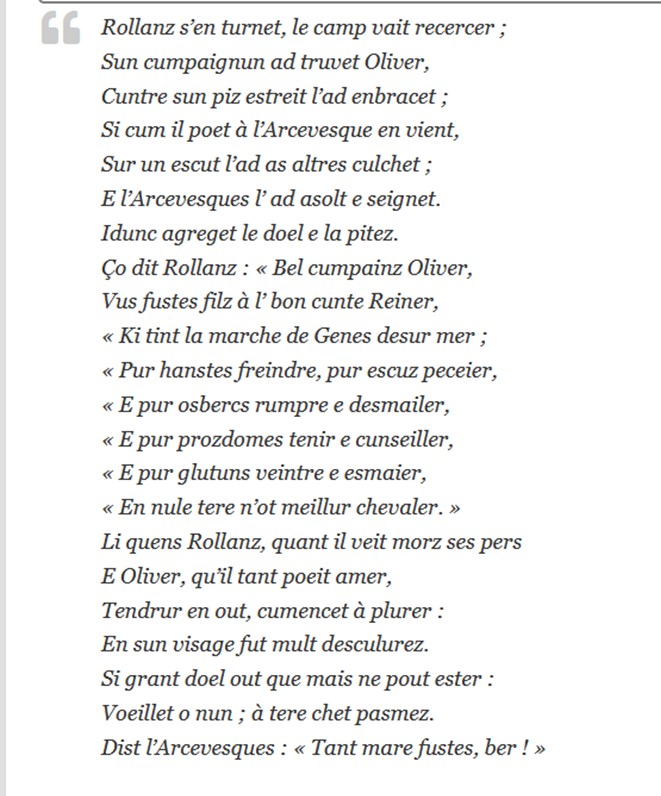
One can see that the shape of word in Medieval French is closer to Breton than modern French
The word order in The Song of Roland is different but I can interpolate some meaning using French and my rusty “O” level Latin.
Looks like I have a new thing to invetsigate on the rainy days.
Quotations from English French and Breton Wikipedia
Medieval Welsh literature is the literature written in the Welsh language during the Middle Ages. This includes material starting from the 5th century AD, when Welsh was in the process of becoming distinct from Common Brittonic and continuing to the works of the 16th century.
The Welsh language became distinct from other dialects of Old British sometime between AD 400 and 700; the earliest surviving literature in Welsh is poetry dating from this period. The poetic tradition represented in the work of Y Cynfeirdd (“The Early Poets”), as they are known, then survives for over a thousand years to the work of the Poets of the Nobility in the 16th century.
The core tradition was praise poetry; and the poet Taliesin was regarded as the first in the line. The other aspect of the tradition was the professionalism of the poets and their reliance on patronage from kings, princes and nobles for their living, similar to the way Irish bards and Norse skalds were patronized for the production of complex, often highly alliterative forms of verse. The fall of the Kingdom of Gwynedd and the loss of Welsh independence in any form in 1282 proved a crisis in the tradition, but one that was eventually overcome. It led to the innovation of the development of the cywydd meter, a looser definition of praise, and a reliance on the nobility for patronage.
——————-
Le moyen breton (krennvrezhoneg en breton moderne) est le nom que l’on donne à la langue brittonique parlé en Bretagne de la fin du XIe siècle à la première partie du XVIIe siècle. On place généralement la date de fin en 1659 lors de la sortie du dictionnaire du père Julien Maunoir. Il a été précédé par le vieux breton et suivi par le breton moderne.
Elle a fourni une littérature, une poésie, mais surtout un théâtre, d’inspiration religieuse.
Chronologie du moyen breton
On distingue plusieurs périodes :
- 1100 – 1450 : pré moyen breton
- 1450 – 1600 : moyen breton classique
- 1600 – 1659 : moyen breton tardif
Caractéristiques du moyen breton
Les emprunts au français deviennent très nombreux. Le français est alors la langue la plus influente de l’Europe et influence également l’anglais. D’une manière étonnante quand un mot breton ressemble à de l’anglais, il provient généralement du moyen français. Ex. : to strive; strivañ : s’efforcer de
- Le -ff traduit un v nasalisé. Cependant, à la fin du moyen breton le v disparaîtra complètement, à l’exception du dialecte guérandais ou du Goélo (prononcé f),
- Le son dh est marqué par z (menez, scoaz…),
- Le son th est transcrit par z, tz ou zz (scuiz, bartz, hennez, harzaff),
- Le son ts, qui vient la plupart du temps de nom français est transcrit par ç, cc, cz,
- Le son [oe] évolue en oa (sauf en vannetais-guérandais et Haute-Cornouaille où il reste oe. Il reste oe également au Pays de galles),
- Le son eu venant des débuts de l’ancien breton.
——————
krennvrezhoneg
Ar c’hrennvrezhoneg eo ar stumm eus ar brezhoneg a veze komzet ha skrivet etre dibenn an XIvet kantved ha kreiz ar XVIIvet kantved.
Mareadoù ar C’hrennvrezhoneg
- 1100 – 1450 : rakkrennvrezhoneg
- 1450 – 1600 : krennvrezhoneg klasel
- 1600 – 1659 : krennvrezhoneg diwezhat
Ar rakkrennvrezhoneg
Eus ar rakkrennvrezhoneg ne vez anavezet nemet spisc’herioù, anvioù-tud hag anvioù-lec’h.
Ivonet Omnes en deus skrivet ur varzhoneg war marzh an dornskrid e oa o sevel dre eilskrivañ war-dro ar bloavezhioù 1350 ; setu amañ ar varzhoneg hag he reizhiad klotennoù :
An guen heguen am laouenas,
An hegarat an lacat glas,
Mar ham guorant va karantic,
Da vout in nos o he kostic.
Vam garet, nep pret.
————-
Catholicon, geriadur brezhoneg-galleg-latin Jehan Lagadeuc, skrivet e 1464 ha moullet e 1499
Catholicon eo anv ar geriadur kentañ e brezhoneg, a oa bet skrivet e teir yezh, brezhoneg, galleg ha latin : ennañ e vez kavet an droidigezh c’hallek eus ar gerioù brezhonek kement hag o c’hevatal e latin.
Ar c’hentañ geriadur galleg an hini eo ivez enta ha war an dro ar c’hentañ geriadur teiryezhek er bed.
Savet e voe, pe beurechuet da vihanañ, e 1464 (d’ar 16 a viz Eost hervez) gant Jehan Lagadeuc, person e Plougonven, ha moullet e voe evit ar wech kentañ d’ar 5 a viz Du 1499 e Landreger gant Jehan Calvez (Euzen Roperz e lizherennour). O soñjal e kloareged yaouank Breizh o vont war o studi e oa bet savet an oberenn-mañ evit o skoazellañ da zeskiñ latin evel ma vez diskouezet splann amañ dindan (bet treuzskrivet e brezhoneg a-vremañ) :
Me, Yann Lagadeg, eus parrez Plougonven, en eskopti Treger, Bachelour war an arzoù hag an dekredoù, goude ma n’on ket dellezek d’en ober, savet am eus al levr bihan-mañ evit talvezout da gloer vihan baour Breizh peotramant d’ar re zo dizesk war al latin.
Anvet e oa bet Catholicon (geriadur hollel), pa ne oa ket bet roet an anv-se gant an oberour, moarvat diwar anv ur geriadur all, ar geriadur latin brudet a oa anvet Catholicon ivez (Summa grammaticalis quae vocatur Catholicon), savet gant an Dominikan Giovanni Balbi (Johannes Januensis de Balbis), eus Genova, hag echuet d’ar 7 a viz Meurzh 1286.
—-
La Chanson de Roland






 Dreamyoga