
A Shed Load of Rinpoche(s)

Following on from my various dreams I have been looking at internet based information on Tulkus and Rinpoche types. The first comment is that there are shed loads of these. There seems to be a pecking order.

In some circles it seems that their words are hung upon and that they may be put on a pedestal. On-line there is controversy about iffy teacher-student practices. This provokes heated commentary and in some cases attack. It seems very emotive.

Looks like a minefield to me.

Academic practice in the UK has changed considerably in the last few decades. In the past people used to get shit-faced drunk and there was “intermingling”. This is frowned upon these days. Though no doubt some non standard interaction continues. Many academics marry students…

If people want to check my academic credentials feel free…

Based on what I am reading it looks like a barge pole jobby. That is steer well clear…

I know that I don’t know but I am now less inclined to find out. I am not glamoured thereby.

Some Rinpoche dudes get to meet presidents of countries…

If you are famous and well known you can charge a few hundred dollars for online courses…

The comment that I have in general is that a lot of the teaching material on line is of a somnambulance inducing length. It would not pass muster at a modern higher education establishment. The presentation skills need polish and focus is better than rambling…

It reaffirms for me that “guru yoga” is dangerous both for the acolyte and the guru. It also suggests that the time for gonadal basal yoga is passing. That stuff is old…wrong century…

It has been interesting having a good read around. The “discussion” on line reminded me of the Sutra below.

This idealism in which people are deified and then crucified for their failings remains a problem not just in religion. A well loved star can be cancelled and lambasted on the whim of an allegation. The worshipper takes no responsibility for the down fall of the previously worshipped.

I don’t know what those hundreds if not thousands of Tulkus and Rinpoches are doing with their lives.

They can’t all be angels…

———————–

The Sutra Preached By The Buddha On The Total Extinction Of The Dharma

(Taisho Tripitaka 0396)

The Buddha was silent, and made no response. After Ananda had repeated the question three times, the Buddha told him, “After my nirvana, when the Dharma is about to be extinct, the Five Mortal Sins will foul the world, and the demonic-way will flourish exceedingly. The demons will become monks, to spoil and wreck my Way. They will wear lay dress [rejoicing in cassocks] and multicolored clothing. They will drink wine and eat meat, killing living things in their desire for fine flavors. They will not have compassionate minds, and will hate and envy each other.”

“At times, there will be Bodhisattvas, Pratyeka-buddhas, and Arhats, who cultivate merits diligently and treat all beings with reverence; being the objects of the people’s devotion, they will impartially preach and convert. They will pity the poor and keep the old in their thoughts, and take care of those in poverty and difficulty. They will constantly persuade the people to worship and serve Sutras and images, doing all good acts that bring merit; their wills and natures will be kind and good. They will not harass or injure people, but sacrifice themselves to save others. They will not spare themselves, but will put up with insult, being benevolent and harmonious.”

“Should there be such a being, the gang of demonic monks will unite in hating him, slandering him and blazoning forth his errors. He will be expelled and banished; they will not let him remain at that place. From then onwards, they will all fail to cultivate merit according to the Way. Temples will be empty and desolate, and will no longer be repaired, but will be allowed to fall into ruin. The monks will covet nothing but material goods, accumulating them without distribution, not doing good deeds. They will deal in male and female slaves, plow the fields and plant them, burning off the mountain forests and harming all living things; they will not have compassionate minds. Male slaves will become monks, female slaves will become nuns; they will have none of the merit that comes from practicing the Way, but rather will be filthy and depraved, foul and turbulent; men and women will not be kept separate. The reason the Way will become shallow and weak, is all because of that type of person.”
Impermanence – Cop Out or Motivation?

The trouble is you think you have time...

Siddhartha Gautama

I have paraphrased here something I read in the Dhammapada. In this the notion that there is always tomorrow or mañana and demain is hinted at. People can put things off over and over. This especially  true of anything which is inconvenient. Even though they know that they need to address something they put it off. People can justify inaction to themselves rather than put themselves out or do something positive perhaps transformative. The safety of the unpleasant status quo of life is so tempting; the inertia of sameness is like a duvet. The fear of risk forbids any reward for courage.

It is evident that life is impermanent. Everyone without exception dies. Which means that allotted time is finite.

It is easy to fall into the trap of “hey man all is impermanent” and use that as a cop out for not doing anything. If nothing lasts, nothing matters, so why bother? If  all of life is an illusion then why interact, why take part?

It is easy to take an overly passive view on karma. If everything is pre-ordained and fated because of past actions why try to ameliorate? That is a gist of karma. At some stage you have to interact in a meaningful way to work with your karma and acquire karmic merit. You have to learn the lessons that karma has in store and which you have selected for yourself by your actions. Karma is there to teach. You need to learn your lessons otherwise you repeat your folly ad infinitum.

Impermanence teaches that you have little or no time in which to act and yet you must not be obsessed about result or outcome because these are not permanent or real.

It is easy to get the balance wrong and be overly dismissive and fatalistic or to try to force things to fit how you want them to be and thereby create more karma. If you put things off you are deciding so to do. Procrastination cannot work on karma.

You have no time, much less leisure than you imagine, so get busy but do so without obsession or desire for guarantee. Impermanence teaches that all forms of obsession are folly. It also teaches that you have little time to figure out what it is you need to learn and then to seek out those lessons.

In any given life, time is not a luxury which one in reality has.

Copping out because things are impermanent is copping out, it is a form or “reasoned” and “excused” inertia and avoidance.

Whereas impermanence might encourage you not to waste a single second of your allotted time.

Working with impermanence as a fact to acquire skill and discernment is a very profound and meaningful practice.

Impermanece teaches balance and the middle way.

Geocentrism and Perception

For many centuries the powers that be and the so-called wise held a view that the heavens rotated around the centre of the universe, aka Earth. Looking out from Earth it was assumed that we were the very epicentre of all God’s creation. This understanding has been proven wrong by the use of modern electromagnetic astronomy. Yet people were adamant that the world revolved around them and any disagreement in public could be fatal, a taboo punishable by excommunication, shunning and execution.

This innate human tendency towards self-diagnosed omniscience persists to this day in various forms.

One could postulate that a self-centred world view is very common. This holds for institutions and individuals. Moreover a kind of gravitational attraction is assumed. Say for example you were a Harvard or an Oxford university you might assume that would be scholars of merit would be irrevocably attracted to you, both to share in your divine reputation and the chance to participate in highbrow scholarly intercourse. People see things from their own point of view. To some a “Hogwarts” school dinners form of collegiate catering may be attractive to others it is not.

Those with power and reputation might assume that this is attractive to others and these exert a quasi-gravitational pull. Moths are drawn to the candle flame. Seen from the inside one sees an attractiveness which externally may not hold. A self-centred perception may lack accuracy.

I have seen some of the mythos associated with a university I worked at briefly. It was held in high regard by some less so by me. My perception was based upon experience and not PR or mythos.

Some people are very corporate in their thinking. Imagining that some corporate or institutional identity is attractive. I once went to an Accenture “do” while I was a start-up founder with a lot of dosh in the bank. All the young guns were full of themselves and very Accenture on-board. All they could see were the internecine pecking order, rankings and power struggles. They knew best. They did not leave a good impression on me. I thought that they were a bunch of wankers. These ambassadors for Accenture left me thinking that the organisation was full of bellends. I wanted no more to do with it ever.

When you are caught up in an institution, church or cult it is very easy to become enamoured and imagine oneself the best thing since sliced bread. The group perception internally may differ significantly from that held externally.  For example other Buddhist groups may think that the Dzogchen and Bon influenced Tibetan Buddhism is bad for Buddhism as a whole. Although the Dalai Lama is arguably the most famous Buddhist one might question as to the type of being this attracts towards Buddhism. The difference between high Tibetan ritual and Thai Forest simplicity is marked. There is a cultural agenda in Tibetan Buddhism which extends past sutra and towards a national historical identity. I don’t know to what extent reflection is made. Evangelism of any kind suggests an imagined innate superiority of world view which must be shared with others. A similar story might hold for STEM advocacy in schools. Everyone must be blessed by the all-encompassing wisdom of the STEM doctrine and creed. All hail the standard model. Blessed be its name.

When you are within the encircled wagons out on the wild prairie armed with your trusty Winchester rifles, it is easier to kill the Apache. After all he is the ignorant savage and you are the God fearing pioneer enacting justified ethnic cleansing in the name of the Lord. It is your divine right to drive the indigenous off their lands. They need your conversion to go to heaven.

Humans can believe whatever it is convenient for them to believe and their ability to seemingly justify slaughter and murder to themselves continues unabated to this day.

When you look in a geocentric, self-centred  manner anything out there is an enemy to be conquered and slain. They must revolve around you or die.

Mathematically whether that be with spherical or cartesian coordinates perception starts at the origin, the self, which is placed at the centre of the world, the centre of the known universe. Many imagine that the entirety of creation revolves around them, their wants, their needs and their petty grudges and complaints.

Although historically Geocentrism has been determined to be inaccurate, a poor model of reality, many fail to see that their whole view is self-centred. Me-centrism. They fail to see that they too are old fashioned and archaic in their notions of world. This observation applies to even the most intelligent amongst us. Intelligence can confer a sense of entitled arrogance. Those on Olympus after all, know what is best for us plebs.

Many people whose perception is very self-centred imagine that it is right and dandy that this should be the case.

——————

Does the entire universe revolve around you, are you the very centre of all creation?

Are you the flame to which all moths are irresistibly drawn by your magnificence?

Buddhism – Rinpoche – Dream 22-12-2025

Here is this morning’s dream had after 6 AM this morning. It is out of the blue considering what I have been exploring in terms of old French manuscripts.

The dream opens in the front room – sitting room in a large home in the English home counties. The wife and I are visiting a young woman and her family. She is a younger version of Dupinder from Aussie MasterChef. In the dream context she is an ex-student of mine and early twenties. She has a nice posh English accent with only the faintest hint of Indian accent. We are there with her sister and mother and father. They are middle-upper class and moderately wealthy. They are highly educated. I say that people like her family have added a great deal to UK culture and life. Their springer spaniel dog comes in and they are worried that the dog will bite or snap at me. This is its usual behaviour with strangers. It comes over to me and I offer it my right hand in a loose fist to sniff. It is very suspicious and growls slightly. I re-offer my hand and emanate warmth along it. The dog sniffs it and then sits to lick my hand. It lets me stroke it and then lies down in front of me, close, calm and happy.

I notice some Buddhist texts on the table and small statuette of Buddha. I comment to “Dupinder” that I did not know she was Buddhist.  She says that yes they have been going to the local temple/centre on a regular basis. Her parents have been life long and as of late she and her sister have taken to it too. I ask what denomination. She says that they are Theravada and no fuss Buddhism. I explain to her that I have more than a passing interest. She boots up her lap top and shows me pictures of her centre. It is housed in a wider building run by Tibetan Buddhists as a cross denominational dharma centre. On the outside of the building I can see Tibetan writing and roman scripts. The building has been purchased using the wealth of the Tibetan Buddhist “church” in exile. I ask who oversees the project and she says that Rinpoche does. I inquire further and she says that Rinpoche, a supposed Tulku, is titular head of the dharma centre but others run it day to day. The centre is in a town just outside the north of the M25.

At this point her father interjects. He asks me if I am a Rinpoche too. He has had a sudden intuition that I am. Caught slightly off-guard I say that yes it is more than possible that I am a Rinpoche, a reincarnated lama too. He says that he suspected this from the moment he first set eyes on me and from the way his daughter has spoken of me. He says that he thinks that I should go to the dharma centre to see if I am recognised. I say that I don’t think that it works like that. Me tipping up in such a manner would not go down well. For some reason he is very happy and he invites us all down into the big conservatory to have a light vegetarian snack / dinner. There are metallic thali plates with curries in little bowls, rice and breads.

The dream ends.

Shamballa and Guardians of the Race

Shambhala (Sanskrit: शम्भल, IAST: Śambhala), also spelled Shambala or Shamballa (Tibetan: བདེ་འབྱུང, Wylie: Bde’byung; Chinese: 香巴拉; pinyin: Xiāngbālā), is a spiritual kingdom in Tibetan Buddhist tradition. Shambhala is mentioned in the Kalachakra Tantra. The Bon scriptures speak of a closely related land called Tagzig Olmo Lung Ring.

The Sanskrit name is taken from the name of a city near the Ganges, sometimes identified with Sambhal in the Indian state of Uttar Pradesh, as mentioned in the Hindu Puranas. The mythological relevance of the place originates with a prophecy in Vishnu Purana (4.24) according to which Shambhala will be the birthplace of Kalki, the next incarnation of Vishnu, who will usher in a new age (Satya Yuga); and the prophesied ruling Kingdom of Maitreya, the future Buddha.

Excerpted from Wikipedia

In the blue books opus Kuhl makes numerous mentions of Shamballa and it is referred to in the Kalachakra Tantra. The obvious Lara Croft or Indiana Jones question is where? Where can I find this mysterious place which is perhaps imbued with secrets, power and treasure?

Kuhl suggests that initiates of a certain degree { 3 and above} can go “there” as members of the blue or white lodges. Here the term lodge has perhaps been adopted for the benefit of those inculcated into freemasonry. A lodge is hardly a Himalayan notion. He suggests that Shamballa acts as a kind of planetary chakra. It is “at” Shamballa that certain members of the so-called hierarchy meet and meditate. This so-called hierarchy correlates with those Théun Mares refers to as “The Guardians of the Race”. The notion is that these beings have since the beginning of humanity been looking over us and revealing various teachings to help humanity evolve. They distribute “energies” which are both causal and facilitative.

In this school of thought beings who have taken the fourth initiation no longer have a causal body which is blown off during the act of initiation. These beings are no longer required to incarnate by the laws of material karma. If you accept such a notion, if only as a working hypothesis, it should be reasonably clear that a being who no longer needs to incarnate will be markedly different to one who must. Technically they no longer have a reincarnating Jiva or Soul. They have transcended. They are now something else.

If you are not even partially soul infused it might be difficult to comprehend someone/something who has gone way past where you might find yourself now. It might be tempting to suggest that this is a bunch of codswallop and made up fairy tales.

To look for a physical plane manifestation of Shamballa would be a sign that one only believes in physically measurable physical materiality. The absence of stones or ruins mighty be deemed proof of the non-existence. History suggests that many things “proven” by humanity are subsequently found incomplete, inaccurate and wrong. Yet humanity remains adamant and vocal about the completeness of current “proof”. The soap box beckons. There is an in public alignment with the currently accepted dogma.

Shamballa is probably not a Disneyland style magic castle in the air…

As it is described it is an operative “sacred” thought form, a place of work and/or meditation. It is “there” that a gathering of consciousness occurs. Over a long while this thought form has been built refined and shared. One cannot construct it, imagine it, unless one is already able.

The thought form is more complex and extensive than one might imagine. Certain “areas” are available only to relatively few. One might say that physical limitations like brain and noisy mind can limit access.

The way Kuhl describes it is by analogy perhaps to some kind of temple in which there is an inner sanctuary open only to those evolved enough to enter. There can be found, depending upon the needs of the time, the three Buddhas of activity, the senior members of the hierarchy and the Sanat Kumara.

To expect a corporeal from, human shaped, points at the endless anthropomorphic ideation of humans. The one which casts God as a geezer on a cloud. Human imagination has a bit of a meat, bricks and mortar, fetish.

Not all members of the externalising hierarchy are linked or tied to Shamballa, according to Kuhl. One might take the published writings as merely a taster of a much wider plan. It is by way of, perhaps, a “for instance”.

He suggests that those working with the Shamballa impulse are developed meditatively in a particular way, trained to work therein and therewith. They may well be in a physical incarnation; there are others which are not.

The notion of a disincarnate being working on “energies” pertaining to the planet, is not currently provable, nor might it be swallowed easily by the modern omniscient scientist. These putative contemplatives are formless to mundane eye. The notion of a formless intellect or consciousness is an anathema to a neuroscientist who must publish and put dinner on the table. MRI machines cost shit loads and these must be justified. They could not measure a formless contemplative.

To accept that things which cannot be measured using the instrumentation based on The Standard Model exist, is not easy to accept. Yet dark matter and dark energy are mooted.

The more that minds construct the Shamballa thought form the more “concrete” and “real” it becomes.

If a lot of people think of “Gangnam Style” then one can be easily infected by a brain worm, which is difficult to shift. Thought forms have a non-material existence in the “aether” for want of a better word. We can easily tap into them whether we might wish to or not.

Shamballa then is by way of a meditative and intuitive “thought form” which has a non-material existence and “where” meditation and work can be carried out in a group like manner, in formation and en rapport

Archaic Deity – Archaic Iconography…

Many depictions of deity are a tad dated. They arose in times when the power of kings and emperors was quasi absolute. The iconography has “radioactive” halos around sainted beings, chariots, swords and thrones. There are arguments about who stands or sits around the throne and on which side various beings are to be found. There are crowns and often a patrilineal succession of power. Humanity obsesses about organisational flow charts of the heavens and in the past who had career advancement amongst the Gods depended upon level of obedience and sycophancy. The celestial “human” resources department had severance packages to negotiate.

Fear of God put bums on seats and pennies on the collection plate.

These days the power of kings is much diminished. We don’t drive roman chariots all that much. The machete has replaced the short sword. The Heckler and Koch automatic has replaced the spear. The ultimate symbol of mundane power is a ginormous nuclear powered aircraft carrier equipped with stealth bombers. Thrones are old hat.

In constructing a deity and a pecking order of them, whether that be of Gods and angels or Buddhas and bodhisattvas, the notions are related to the mundane order of things. The iconography perhaps an aid for the illiterate. In many cases the “clergy” asserted power over flock and encouraged supplication therefrom. The “clergy” encouraged a notion that they were higher, perhaps better and more revered than the lay. The churches and temples extracted wealth and called it meritorious. It might help your journey in the afterlife to fund the claret of a bishop. It was a good pitch. People can read and think now.

I am not sure older notions of Gods and Buddhas wash as well these days. Despite what fragrances Unilever might add. Subscription to religious providers it probably falling all over the world.

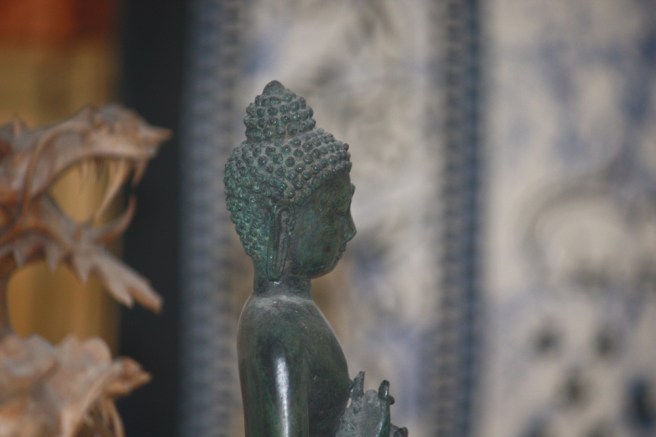
There is a glaring difference in iconography between the seated tranquil garden statue Buddha and the tortured crucified Christ bleeding from his crown of thorns. This despite much similarity in their teachings. Man has emphasised the suffering of Jesus over his peaceful message. It prefers to show images of internecine cruelty and suffering rather than brotherly love. In our time there is much need both for tranquillity and for love.

Religious iconography is very often chavvy and overly ornate. It is showy and “look at me”.

“We have shit loads of gold! We the clergy must be powerful! Kneel pleb!”

Modern military power does not lend itself to very personal, even familial iconography. There is no big hearted daddy on the throne. Rather a couple of old men, fingers above a red button, ready to embody Shiva the destroyer aspect of deity. It is not an image of fatherly love. It is one of pendant wrath and nuclear winter.

Notions of deity need updating in a manner more suitable for modern mind, modern living. And no I do not mean a Marvel escapist universe. The sublime needs divorced from the family drama and the incestuous and the Machiavellian.

Spirit and consciousness needs to evolve away from the zoomorphic whilst retaining the feelings and value. A new form of understanding might spring from where we find ourselves now, so very obsessed with corporeal image and public relations spin-bullshit. Petabytes of images are quite a quagmire for the minds of mankind.

Yup…I think the old forms of iconography and depictions of deity are looking rather dated and may no longer be fit for purpose.

We may even need a thorough review of what we imagine deity and/or a God to be.

I wonder how might we imagine and create a God 2.0 ?

The Lotus Eaters and a Logical If

As the nights draw in and the temperature drops the occurrence of wildlife in the garden goes up, becomes more frequent. Already the badger is looking for roots, soon we may get deer grazing. For sure the “lotus eaters” aka Coypu or Nutria will return. There was evidence of an attempted perimeter breach overnight. The charge on the battery driving the electric fence has dropped. I had a shock off it yesterday, a tickle. Today I have replaced the battery. This means if any of the Coypu family come to snack on our tasty lotuses Thor may release a lightning bolt to discourage. Since we have installed the electric fence by the river our display of lotuses has flourished. This year was magnificent.

Om mane padme hum

If we take dream content as evidence and consider visions as non hallucinatory then we might conclude that I have had at least four and probably five lives in a priestly or monk like Buddhist incarnation. It is therefore not too much of a stretch to suggest that the term bodhisattva might apply to me, I can be considered as someone seeking liberation. In one of these “visions” I was told that this is my very last incarnation, a suggestion which is internally consistent with the aforementioned logical if.  

This may not sit entirely easily in juxtaposition with a brief career as a pukka scientist. It might seem odd to the class professorial. To me there is no jarring.

We then come upon the Garry Glitter question, “to whose gang do I belong?”

Am I Toltec?

Am I Buddhist?

Am I boffinacious?

One could perhaps draw a Venn diagram, if one could be arsed.

I am unlikely to fall into worship of anti-scientific superstitious conspiracy theories. I am not science-phobic. Nor do I believe in the whole saviour fallacy. Nobody died to save you; it is up to you. Confessing your sins will not remove karmic debt even if you pay the pope a cool million quid. You cannot bribe karma.

To follow on from the logical if. There is an addendum.

If you have treated a bodhisattva badly then that is karmically “bad” for you.

We then get quickly into splitting karmic hairs about degree of bodhisattva and extent of transgression.

The basic rule of thumb is try not to be an arrogant bell end to anyone. It does not need to be any more complicated than this. It is not a bad mantram.

“Remember to try not to be an arrogant bell end…”

Bodhisattva

This from Britannica on line.

Click here

bodhisattva, in Buddhism, one who seeks awakening (bodhi)—hence, an individual on the path to becoming a buddha.

Pali: bodhisatta (“one whose goal is awakening”)

In early Indian Buddhism and in some later traditions—including Theravada, at present the major form of Buddhism in Sri Lanka and other parts of Southeast Asia—the term bodhisattva was used primarily to refer to the Buddha Shakyamuni (as Gautama Siddhartha is known) in his former lives. The stories of his lives, the Jatakas, portray the efforts of the bodhisattva to cultivate the qualities, including morality, self-sacrifice, and wisdom, which will define him as a buddha. Later, and especially in the Mahayana tradition—the major form of Buddhism in Tibet, China, Korea, and Japan—it was thought that anyone who made the aspiration to awakening (bodhicittotpada)—vowing, often in a communal ritual context, to become a buddha—is therefore a bodhisattva. According to Mahayana teachings, throughout the history of the universe, which had no beginning, many have committed themselves to becoming buddhas. As a result, the universe is filled with a broad range of potential buddhas, from those just setting out on the path of buddhahood to those who have spent lifetimes in training and have thereby acquired supernatural powers. These “celestial” bodhisattvas are functionally equivalent to buddhas in their wisdom, compassion, and powers: their compassion motivates them to assist ordinary beings, their wisdom informs them how best to do so, and their accumulated powers enable them to act in miraculous ways.

Avalokiteshvara

Bodhisattvas are common figures in Buddhist literature and art. A striking theme in popular literature is that of the concealed greatness of the bodhisattvas. In numerous stories ordinary or even distinctly humble individuals are revealed to be great bodhisattvas who have assumed common forms to save others. The lesson of these tales is that, because one can never distinguish between paupers and divinities, one must treat all others as the latter. In popular folklore bodhisattvas appear as something like saviour deities, a role they acquired both through the evolution of earlier ideas and through fusion with already existing local gods.

Buddhism: Celestial buddhas and bodhisattvas

A particularly important mythology in East Asia is that of Dharmakara. According to the Pure Land Sutra, Dharmakara was a bodhisattva whose vows were realized when he became the Buddha Amitabha. Pan-Buddhist bodhisattvas include Maitreya, who will succeed Shakyamuni as the next buddha in this world, and Avalokiteshvara, known in Tibet as Spyan ras gzigs (Chenrezi), in China as Guanyin (Kuan-yin), and in Japan as Kannon. Although all bodhisattvas act compassionately, Avalokiteshvara is considered the embodiment of the abstract principle of compassion. Bodhisattvas of more localized importance include Tārā in Tibet and Jizō in Japan.

The Old Guard and Toltecs – Speculations

The second instalment of the Old Guard series has recently hit Netflix. It has a shared plotline of sorts with the Highlander movies of ere. In this Old Guard dramatization physical plane immortals exist adjoint humanity and interact to either good or bad effect depending on mood and predilection. In Highlander in the end there can be only one in the battle between good and evil. In the Old Guard series “Andy” the main protagonist has fought to help, aid and otherwise nudge humanity in a “better” direction. Instead of reincarnating she has one contiguous and very long life in which she preserves her super model looks despite getting slashed and shot. A magical and miraculous healing occurs. She loses her regeneration powers and then regains them.

In each the burden of endless longevity / immortality is touched upon. They do not dwell overmuch on the boredom aspect rather the action and power angle. The omnipotence may appeal to the burdened and downtrodden. It may titillate the sociopath and the narcissist.

For dramatic impact pivotal points in global {human} history are referenced. An allied them is to be found in the “Assassins Creed” franchise though in this case reincarnation is invoked and a DNA bloodline is the bearer and propagator of ongoing conflicts.

It has been suggested to me that the so-called Toltecs were incarnated around pivotal times and played a role behind the scenes in the evolution of human and planetary history. Given that the technique of erasing personal history is part and parcel of the training, it is not surprising that little historical refence can be found. In the Old Guard Andy tries to avoid publicity. However in this day and age and thanks to internet monitoring and various intelligence services it is impossible to leave no trace. The times have changed.

In the Toltec tradition there is such a thing as a nagal being. The word Nagual in Spanish American is similar. The word Naga in the Indian tradition does not differ in root. In the hagiography of Buddhism Siddartha is protected by king cobra, a naga-raja, from the rain. These nagas live in the place or world of the nagas, naga-loka. Wisdom can be elicited from nagas and naga-loka. Serpents are the dreaming symbol for wisdom.

This suggests via speculation and extrapolation that a nagal being was a contemporary and perhaps companion of Shakyamuni Buddha.

——————-

“There is unanimous agreement that Nāgārjuna (ca 150–250 CE) is the most important Buddhist philosopher after the historical Buddha himself and one of the most original and influential thinkers in the history of Indian philosophy. His philosophy of the “middle way” (madhyamaka) based around the central notion of “emptiness” (śūnyatā) influenced the Indian philosophical debate for a thousand years after his death; with the spread of Buddhism to Tibet, China, Japan and other Asian countries the writings of Nāgārjuna became an indispensable point of reference for their own philosophical inquiries. A specific reading of Nāgārjuna’s thought, called Prāsaṅgika-Madhyamaka, became the official philosophical position of Tibetan Buddhism which regards it as the pinnacle of philosophical sophistication up to the present day.”

Stanford Encyclopedia of Philosophy

Nāgārjuna (नागार्जुन). – Name of an ancient Buddhist teacher of the rank of बोधिसत्त्व (bodhisattva).

Wisdom Library

The name also appears in the wider Hindu sources predating Shakyamuni Buddha

———————–

Typically a three pronged nagal is said to distribute knowledge widely. Like a stone thrown into a pond.  If Nāgārjuna is a wider term for a nagal teacher in the Indian sub-continent then this suggests that the core Toltec and Vedic / Buddhist teachings are similarly sourced and may differ only in method of expression and verbalisation. The term is a generic and not a specific and personal name.

I personally have not found any huge glaring clashes between these philosophies. There is a marked difference in emphasis and the cultural refence points and metaphors employed.

The entertainment mentioned above is not completely inconsistent with a hierarchy of spiritual “masters” on overwatch of humanity. However in order to make it dramatically appealing they must have meaty bits and interpersonal relations such as love with hints of corporeal hanky-panky.

Too abstract and the film would not sell. The immortals have to be beautiful people if good and have ugliness if bad. One is not allowed a minger of an immortal. They must be L’Oréal advert fresh out of the shower from time to time.

Having a “hot” teacher can badly detract from learning.

It is not difficult to see that the course of human history did indeed pivot around relatively small and local acts. The execution of Jesus ended up being a game changer. The invention of antibiotics added number density to humanity.  An assassination was used as a pretext for the first world war. If there is tension a simple fuse is all that is needed to ignite. A miscalculation in a Bay of Pigs might cause a nuclear winter. The simple protection of a Buddha from the rain enabled the propagation of the teachings for mind.

Humanity is prone to flying off the handle in rage and “self-righteous” indignation. Humanity has a “cob” on and is very prone to fits of angry pique which kill hundreds of thousands.

In the absence of overwatch might the history of humanity have been even more bloody and brutal?

We are heading into unknown territories with AI and Drone-robotics. What are the two biggest markets? War and sex. Thus humanity will expend effort into developing these for profit applications. Since the theoretical abolition of slavery humanity seeks a replacement.  I read yesterday that progress toward in vitro spermatogenesis is advancing, if the same continues for human eggs it may be possible to make a human-like foetus. A synthetic human is unlikely to have an indwelling Soul. This biological dabbling and getting a blind boner for technology represents a Pandora’s box the lid of which humanity will find difficult to resist. What is unleashed now and later in this century may cease to be readily controllable. The temptation of cash and the arrogant appeal of God-like potential may lead humanity down a very dark path indeed. It may regret…

How might Andy and the Highlander come to the rescue?