—–
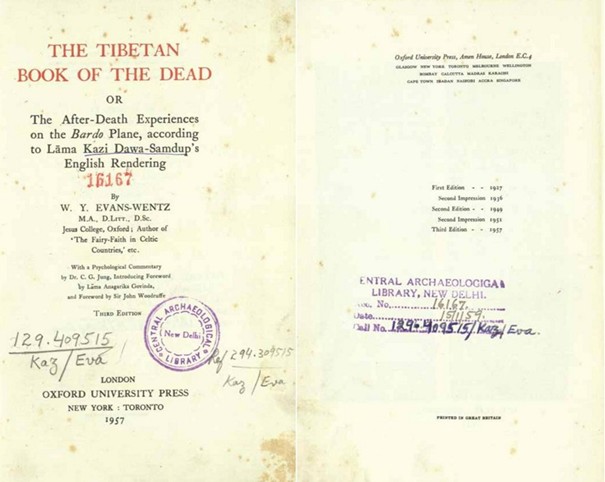
Excerpted from Bardo Thödol
–
–
“As elsewhere noted, our manuscript is arranged as one work in two parts or books, with thirteen folios of texts of Bardo prayers as an appendix at the end. The Block—Print is arranged as two distinct books and lacks the appendix of prayers. But at the end of the first book of the Block—Print there comes a very important account of the origin of the Bardo Thödol, which is not contained in our manuscript, and this is given in translation in the following Section.
XIV. THE ORIGIN OF THE BARDO THÖDOL
Thus, from the Block—Print, and also from other Tibetan sources, we learn that the Bardo Thödol text originated, or, what is perhaps more correct, was first committed to writing in the time of Padma Sambhava, in the eighth century A. D.; was subsequently hidden away, and then, when the time came for it to be given to the world, was brought to light by Rigzin Karma Ling—pa. The Block—Print account is as follows:
‘This has been brought from the Hill of Gampodar (Tib. Gatnpo—dar), on the bank of the Serdan (Tib. Gser—ldan, meaning ‘Possessing Gold’ or ‘Golden’) River, by Rigzin Karma Ling—pa (Tib. Rigs—hdzin Kar—ma Gling—pa).
Rigzin, as herein given, is a personal title, and Karma Ling—pa the name of a place in Tibet meaning ‘Karma Land’. The translator has pointed out that Rigs is an erroneous spelling of Rig; for, if Rigs were correct, the name Rigzin would mean (Rigs + hZin). That Rig is intended—thus making the name mean Knowledge—Holder (Rig+ hdzin), a caste or class designation—was confirmed by a small section of a Bardo Thödol manuscript in the possession of the translator, in which Rigzin Karma Ling—pa is otherwise called Tertön (Tib. Gter—bston) , or ‘Taker—Out of Treasures’. The Bardo Thödol is, therefore, one of the Tibetan Lost Books recovered by Rigzin of Karma Ling—pa, who is held to be an emanation or incarnation of Padma Sambhava, the Founder of Lāmaism.
It was in the eighth century A. D. that Lāmaism, which we may define as Tantric Buddhism, took firm root in Tibet. A century earlier, under the first king to rule over a united Tibet, King Srong—Tsan—Gampo (who died in A.D. 650), Buddhism itself entered Tibet from two sources: from Nepal, the land of the Buddha’s ancestors, through the Tibetan King’s marriage with a daughter of the royal family of Nepal; and from China, through his marriage—in the year 641— with a princess of the Chinese Imperial Family. The King had been nurtured in the old Bön faith of Tibet, which, with its primitive doctrine of rebirth, was quite capable of serving as an approach to Buddhism ; and under the influence of his two Buddhist wives he accepted Buddhism, making it the state religion; but it made little headway in Tibet until a century later, when his powerful successor, ThI—Srong—Detsan, held the throne from A.D. 740 to 786. It was Thl—Srong—Detsan who invited Padma Sambhava (Tib. Pednia Jungue, i.e.’ The Lotus—Born’), better known to the Tibetans as Guru Rin—po—che, ‘The Precious Guru ’ to come to Tibet. The famous Guru was at that time a Professor of Yoga in the great Buddhist University of Nālanda, India, and far—famed for expert knowledge of the Occult Sciences. He was a native of Udyāna or Swat, in what is now a part of Afghanistan.
The Great Guru saw the wonderful opportunity which the King’s invitation offered, and promptly accepted the call, passing through Nepal and arriving at Saniye (Sam—yas) Tibet, in the year 747. It was to Samye that the King had invited him, in order to have exorcized the demons of the locality; for as soon as the walls of a monastery which the King was having erected there were raised they were overthrown by local earthquakes, which the demons opposing Buddhism were believed to have caused. When the Great Guru had driven out the demons, all the local earthquakes ceased, much to the wonder of the people; and he himself supervised the completion of the royal monastery, and established therein the first community of Tibetan Buddhist lāmas, in the year .749.
During his sojourn in Tibet at that time, and during subsequent visits, Padma Sambhava had many Tantric books translated into Tibetan out of Indian Sanskrit originals— some of which have been preserved in the monasteries of Tibet—and hidden away with appropriate mystic ceremonies in various secret places. He also endowed certain of his disciples with the yogic power of reincarnating at the proper time, as determined by astrology, in order to take them out, along with the treasures hidden away with them and the requisites needed for properly performing the rites described in the texts. This is the generally accepted tradition; but according to another tradition the Tertons are to be regarded as various incarnations of the Great Guru. According to a rough estimate, the religious texts already taken out by such Tertons, from century to century, would form an encyclopaedia of about sixty—five volumes of block—prints, each, on an average, consisting of about four hundred ordinary—sized folios
Our text, the Bardo Thödol being one of these recovered apocryphal books, should, therefore, be regarded as having been compiled (for the internal evidence suggests that it was a Tibetan compilation rather than a direct translation from some unknown Sanskrit original) during the first centuries of Lāmaism, either—as it purports to have been—in the time of Padma Sambhava or soon afterwards. Its present general use all over Tibet as a funeral ritual and its acceptance by the different sects, in varying versions, could not have been the outcome of a few generations; it testifies rather convincingly to its antiquity, bears out the pre—Buddhistic and at least partially Bön origin which we attribute to it, and suggests some validity in the claims made for the Tertöns.
We are well aware of the adverse criticisms passed by European critics on the Tertön tradition. There is not lacking, nevertheless, sound reason for suspecting that the European critics are not altogether right. Therefore, it seems to us that the only sound attitude to assume towards the problem is to keep an open mind until sufficient data accumulate to pronounce judgement. Though the Tertön claim be proven false, the fact that the Bardo Thödol is now accepted as a sacred book in Tibet and has for some considerable time been used by the lāmas for reading over the dead would, of course, not be affected; only the theory concerning the textual compilation of what, in its essentials, is apparently a prehistoric ritual would be subject to revision.
As for Padma Sambhava’s own sources, apart from such congenial traditional teachings as no doubt he incorporated in some of his Tibetan treatises, we are told, by oral tradition now current among the lāmas, that he had eight gurus in India, each representing one of the eight chief Tantric doctrines.
In a Tibetan block—print, which belonged to the translator, purporting to record the history, but much mixed with myth, of the Great Guru entitled Orgyan—Padmas—mzad—paJti—bkah—thang—bsdüd—pa (pronounced Ugyan Padtnay—zad—pai—ba—thang—du—pa) , meaning’ The Abridged Testament made by Ugyan Padma’ (or ‘by the Lotus-Born Ugyan’—Padma Sambhava), consisting of but seventeen folios, there is recorded on the twelfth folio, sixteenth section, the following passage, confirming the historical tradition touching the origin of the Bardo Thödol text:
Behold! the Sixteenth Section, showing the Eight Ling—pas, the Leaders of Religion, is thus:
‘The Eight Incarnations of the Great Bodhisattvas are:
Ugyan—ling—pa, in the centre;
Dorje—ling—pa, in the east;
Rinchen—ling—pa, in the south;
Padma—ling—pa, in the west;
Karma—ling—pa, in the north;
Samten—ling—pa
And Nyinda—ling,
And Shig—po—ling (or Terdag—ling).
These Eight Great Tertöns shall come; ‘Mine own incarnations alone are they.’
Padma Sambhava himself is herein represented as declaring that the Tertöns , or “Takers—out’” of the hidden books, are to be his own incarnations. According to this account, the Tertön of our own book, the Bardo Thödol , is the fifth, named after the place called Karma Land, thus confirming the Block—Print of the Bardo Th’ódol* and Karma Land is in the northern quarter of Tibet. We have been unable to ascertain the exact time in which this Tertön lived, although he is a popular figure in the traditional history of Tibet. The name Rigzin, given to him in the Block Print first above quoted, meaning ‘Knowledge—Holder’, refers to his character as a religious devotee or lāma; Karma ling—pa, as given in both accounts, refers also to an ancient Tibetan monastery of primitive Lāmaism in the Kams Province, northern Tibet.
According to our view, the best attitude to take touching the uncertain history and origin of the Bardo Thödol is that of a critical truth—seeker who recognizes the anthropological significance of the passing of time, and of the almost inevitable reshaping of ancient teachings handed down at first orally and then, after having crystallized, being recorded in writing. As in the case of the Egyptian Bardo Thödol, popularly known as ‘The Egyptian Book of the Dead’, so in ‘The Tibetan Book of the Dead’, there is, no doubt, the record of the belief of innumerable generations in a state of existence after death. No one scribe could have been its author and no one generation its creator; its history as a book, if completely known, could only be the history of its compilation and recording; and the question, Whether this compilation and recording were done within comparatively recent times, or in the time of Padma Sambhava or earlier? could not fundamentally affect the ancient teachings upon which it is based.
Although it is remarkably scientific in its essentials, there is no need to consider it as being accurate in all its details; for, undoubtedly, considerable corruption has crept into the text. In its broad outlines, however, it seems to convey a sublime truth, heretofore veiled to many students of religion, a philosophy as subtle as that of Plato, and a psychical science far in advance of that, still in its infancy, which forms the study of the Society for Psychical Research. And, as such, it deserves the serious attention of the Western World, now awakening to a New Age, freed, in large measure, from the incrustations of medievalism, and eager to garner wisdom from all the Sacred Books of mankind, be they of one Faith or of another.”
————————————————————
From Lotsawa House web Site
Source: https://www.lotsawahouse.org/tibetan-masters/karma-lingpa/benefits-vajra-guru-mantra
The Benefits of the Vajra Guru Mantra
And an Explanation of Its Syllables
A Treasure Text Revealed by Tulku Karma Lingpa
I prostrate to the Guru, the Yidam and the Ḍākinī.
—————-
“At best, practitioners will attain the rainbow body; failing that, at the time of death, mother and child luminosities will meet; and at the very least, they will see me in the bardo and all their perceptions having been liberated into their essential nature, they will be reborn in Ngayab Ling and accomplish immeasurable benefit for sentient beings.”
Thus she spoke.
“Great Master, thank you for telling us about such infinite benefits and powers. You have been immensely kind. Although the explanation of the benefits and powers of the syllables of Guru Padma’s mantra is unfathomable, for the sake of sentient beings in the future, I humbly ask you to give us a brief description,” she asked.
Then the Great Master spoke thus:
“O, Noble Daughter, the Vajra Guru mantra is not only my essential mantra, it is the life-essence of the deities of the four classes of tantra, the nine vehicles, the 84,000 aspects of the Dharma, and so on. The heart essence of all the Buddhas of the three times, the lamas, deities, ḍākinīs, Dharma protectors, and the like is encompassed by this mantra. The reason for this is as follows. Listen well and hold this in your heart. Recite the mantra. Write it. Tell it to sentient beings in the future.
OṂ ĀḤ HŪṂ VAJRA GURU PADMA SIDDHI HŪṂ
OṂ ĀḤ HŪṂ is the supreme essence of enlightened body, speech and mind.
VAJRA is the supreme essence of the Vajra Family.
GURU is the supreme essence of the Ratna Family.
PADMA is the supreme essence of the Padma Family.
SIDDHI is the supreme essence of the Karma Family.
HŪṂ is the supreme essence of the Buddha Family.
–
OṂ ĀḤ HŪṂ VAJRA GURU PADMA SIDDHI HŪṂ
OṂ is the complete Sambhogakāya of the Five Buddha Families.
ĀḤ is the complete unchanging Dharmakāya.
HŪṂ is the complete Nirmāṇakāya—Guru Rinpoche.
VAJRA is the complete assembly of Heruka deities.
GURU is the complete assembly of Lama Awareness Holder deities.
PADMA is the complete assembly of Ḍākinīs and powerful female deities.
SIDDHI is the heart of all the wealth deities and protectors of hidden treasures.
HŪṂ is the heart of each and every Dharma protector.
–
OṂ ĀḤ HŪṂ VAJRA GURU PADMA SIDDHI HŪṂ
OṂ ĀḤ HŪṂ transfers one to the primordial pure realm.
VAJRA transfers one to the Eastern Buddhafield of Intense Joy.
GURU transfers one to the Southern Buddhafield of Glory.
PADMA transfers one to the Western Buddhafield of Bliss.
SIDDHI transfers one to the Northern Buddhafield of All-Accomplishing Action.
HŪṂ transfers one to the Central Buddhafield of Immutability.
OṂ ĀḤ HŪṂ VAJRA GURU PADMA SIDDHI HŪṂ
By OṂ ĀḤ HŪṂ, the level of the Three-Kāyas Awareness Holder is attained.
By VAJRA, the level of Level-Dwelling Awareness Holder is attained.
By GURU, the level of Immortal-Life Awareness Holder is attained.
By PADMA, the level of the Great-Seal Awareness Holder is attained.
By SIDDHI, the level of the Spontaneous-Presence Awareness Holder is attained.
By HŪṂ, the level of Fully-Ripened Awareness Holder is attained.
OṂ ĀḤ HŪṂ VAJRA GURU PADMA SIDDHI HŪṂ
One recitation of the Vajra Guru mantra will grant a physical body and entry into this world. Any sentient being who sees, hears, or thinks of the mantra will definitely be established among the ranks of the male and female Awareness Holders. The infallible Vajra Guru mantra is the word of truth; if what you wish for does not happen as I have promised, I, Padma, have deceived sentient beings—absurd! I have not deceived you—it will happen just as I’ve promised.
If you are unable to recite the mantra, use it to adorn the tops of victory banners and prayer flags; there is no doubt that sentient beings touched by the same wind will be liberated. Otherwise, carve it on hillsides, trees, and stones; after they are consecrated, anyone who merely passes by and sees them will be purified of illness, spirit possession, and obscurations. Spirits and demons dwelling in the area will offer wealth and riches. Write it in gold on pieces of indigo paper and hang them up; demons, obstacle-makers, and evil spirits will be unable to harm you. If you place the mantra upon a corpse immediately upon death and do not remove it, during cremation rainbow colors will flash out and the consciousness will definitely be transferred to the Blissful Realm of Amitābha. The benefits of writing, reading and reciting the Vajra Guru mantra are immeasurable. For the benefit of sentient beings in the future, write this down and conceal it. May it meet with those of fortune and merit. Samaya Gya Gya Gya
From those with wrong views, this is sealed to secrecy. Gya Gya Gya
It is entrusted to those with pure samaya. Gya Gya Gya
Tulku Karma Lingpa brought forth this treasure and copied it down from a golden scroll.
——–
Translated by Heidi Nevin in Darjeeling, India on August 9, 2002.
 Dreamyoga