
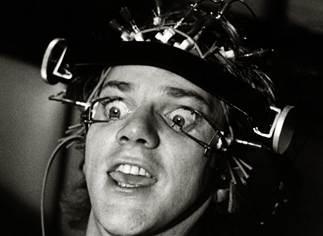
I’ll kick off with a speculation. This is that many people encounter their own personal room 101 in the dream state and experience that as a scary nightmare.
–
–
This morning I had imagery in the dream state which might have unsettled me. It did not. It is more likely to cause others to metaphorically “shit a brick”. If you are fully aware {and confident} of the fact of dreaming there is no need to fear. This skill can be transferred in to “real” life (IRL). You can face fears in your dreams and thereby realise that most of them are made up and nearly all of them are distinctly out of proportion.
I’ll speculate that dreaming practice can be used to face the illusory quality of many fears.
———-
Dream yoga or milam (Tibetan: རྨི་ལམ་རྣལ་འབྱོར་, Wylie: rmi lam rnal ‘byor, THL: milam naljor; Sanskrit: स्वप्नदर्शनयोग, svapnadarśanayoga)—the Yoga of the Dream State—is a suite of advanced tantric sadhana of the entwined Mantrayana lineages of Dzogchen (Nyingmapa, Ngagpa, Mahasiddha, Kagyu and Bönpo). Dream yoga consists of tantric processes and techniques within the trance Bardos of Dream and Sleep (Standard Tibetan: mi-lam bardo) Six Dharmas of Naropa. In the tradition of the tantra, the dream yoga method is usually passed on by a qualified teacher to his/her students after necessary initiation. Various Tibetan lamas are unanimous that it is more of a passing of an enlightened experience rather than any textual information.{{In Tibetan Buddhist traditions, dream yoga is often taught alongside the practices of the illusory body (gyulu) and the clear light (ösel). Classical sources such as the Six Dharmas of Naropa describe these as interconnected methods within a single cycle of tantric training, aimed at maintaining awareness across waking, dreaming, and deep sleep states. Contemporary teachers likewise present them as complementary practices: daytime illusory-body training supports lucid dreaming at night, and both practices are considered preparatory for recognizing the luminous nature of mind in clear-light meditation.
The ‘dream body’ and the ‘bardo body’ have been identified with the ‘vision body’ (Tibetan: yid lus):
In the bardo one has…the yilü (Wylie: yid lus), the vision body (yid, consciousness; lus, body). It is the same as the body of dreams, the mind body.
In the yoga of dreaming (rmi lam, *svapna), the yogi learns to remain aware during the states of dreaming (i.e. to lucid dream) and uses this skill to practice yoga in the dream
Bon
Mi-lam, also known as dream yoga in the Tibetan tradition, is a method for remaining aware during the dream state in order to realize the emptiness of dreams & apply this realization to both dreams & waking life. In Bön, dream yoga is part of Dzogchen teaching, which stresses the clear light nature of the mind, while inducing lucid dreaming and conscious transcending of dream imagery.
–
Excerpted from Wikipedia
–
The Six Dharmas of Nāropa (Wylie: na ro’i chos drug, Skt. ṣaḍdharma, “Naro’s six doctrines” or “six teachings”) are a set of advanced Tibetan Buddhist tantric practices compiled by the Indian mahasiddhas Tilopa and Nāropa (1016–1100 CE) and passed on to the Tibetan translator-yogi Marpa Lotsawa (c. 1012).
Another name for the six Dharmas is “the oral instruction transmission for achieving liberation in the bardo,” or “the Bardo Trang-dol system”. Bardo here, refers to the three bardos of waking, sleep and dying. They are also referred to as “the path of means” (thabs lam) in Kagyu literature. They are also sometimes called the Six Yogas of Nāropa (though not in the traditional literature which never uses the term ṣaḍaṅga-yoga or sbyor-drug)
Lineage
The teachings of Tilopa (988–1069 CE) are the earliest known work on the six dharmas. He received these from various teachers. According to Glenn Mullin, Tilopa’s lineage teachers were the mahasiddhas Nagarjuna (not to be confused with the Madhyamaka philosopher), Lawapa, Luipada, Shavari, and Krishnacharya. Furthermore, the sources for this compilation of tantric practices were said to be the Guhyasamaja Tantra, the Hevajra Tantra and the Chaturpitha Tantra.
Nāropa learned the six dharmas from Tilopa. Nāropa’s student Marpa taught the Tibetan Milarepa, renowned for his yogic skills. Milarepa in turn taught Gampopa, who wrote various meditation manuals (khrid chos or khrid yig) on the six dharmas, which are collected in the Dakpö Kambum (The Manifold Sayings of Dakpo) in a section titled “Meditation manuals on the six dharmas of Naropa” (na ro ‘i chos drug gi khrid yig). From Gampopa these teachings were passed on to the various Kagyu sub-schools and lineages where they remain a central practice.
Excerpted from Wikipedia
————————————–
I’ll speculate that it is possible to consider me reasonably skilled at dream yoga and without doubt, prolific at it.
A recent dream excerpt suggested familiarity with Naropa.
–
“The scene changes to some kind of school / dharma centre. There are a number of children playing there and they are under supervision. There is a teaching hierarchy and embedded method. I arrive with a couple of people and go through to look at the day book which records what happens. It is clear that I am there to teach more than just the children. I sit in the “staff room” and add a few elements to the book, specifically my dream about the Snow Tiger. A woman teases me that I will need to use shorthand and not full text. The centre is up in the mountains and has a great view over the valley below. I open up the blinds some more to look out. They are all wondering what it is that I will do.
I am joined by a tall woman with long blonde hair. She has a faint American accent and is heavily pregnant. I ask her how long she has got left. Not long. I say that she could have it on the 30th of August and have the same birthday as me. That way the kid will always be a bank holiday baby. She asks what it is that I am interested in. I say that I have an idea around Naropa and that I am well placed to speak on Naropa. In my orb are some things related. For some reason I have a distinct sense of familiarity with the woman. The young man from before will be joining us as some kind of understudy to me.”
—-
In the context solely of dreaming I am perhaps well placed to speak upon such things. It is clear to me that the so-called “spiritual” dream yogas may have little to do with the psychological approach to REM based studies and Western {psycho} interpretation. The aim of yoga being liberation and not having a groovy far-out time {man}. Nor is it about getting research papers published. An instrument based upon electromagnetism is not necessarily well-suited to the study of consciousness phenomena.
The basis {and goal} of dream yoga can be said to be waking up in the dream. That is waking up to that fact that you dream both at night and during the day. The “reality” in which you propagate your life is a largely social-political mental construct replete with wildly swinging emotions. What you think is real is illusion. That fear of missing out, is just some shit you made up. Yet somehow you place importance on something made up. Hence the endless cycle of rebirth.
If you can be lucid in your dreams at night, it follows that you have experimental evidence that you can be lucid in your dreams during the day. IRL…
If you know you are dreaming then you are less attached, less obsessed and a tad more free. To be aware and passive during dreaming is to observe in a detached manner. One can in this sense be mindfully aware of the dream as it evolves, reel to reel, on the inner screen. Thus one can transfer an operational observational mindfulness onto the apparent events and happenstance of the day. One has a clear mind, a clear light. One sees the folly of the day to day; one has to interact but can do so without obsession. After all it is only a dream. You have to live. You do not have to be so utterly beholden to what you imagine to be happening.
Dreaming loosens obsession and reduces the gripping clinging interpretations made of concrete mind. Things are less polarised, less black and white and adamant.
Dreaming above all opens mind to new perspectives and knowledge. It is never by way of what I call portcullis-mind.
If you can wake up in the dream at night, you can and must wake up during the day…
That is the inner logic of dreaming.
 Dreamyoga