What is on the Cards – Tarot – V&A

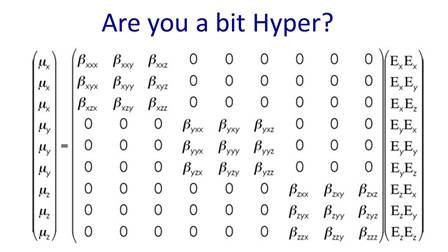
I first started looking into Tarot around 2001. At the time I was an academic in Physical Chemistry at Imperial College London. I was very busy and a part of my job involved considering the second order non linear susceptibility of surfaces and probing these with femtosecond laser pulses.

It probably wasn’t on the cards that I would share these two interests. Needless to say I did not soap box about tarot to my colleagues, lead ballons and all that.

Last night YouTube suggested a short video from the V&A about tarot and the history thereof. I watched it and found out about Minchiate and subsequently Sicilian tarot. I also found out that you can request to examine and handle some of the collection. The video was well made and interesting.

« Le minchiate est un jeu de cartes du début du XVIe siècle, originaire de Florence, en Italie, qui n’est quasiment plus joué depuis le XXe siècle. Très proche du tarot, mais plus complexe, il se caractérise par le nombre important d’atouts qu’il utilise : 40, là où le tarot n’en comprend généralement que 21, pour un total de 97 cartes. »

The V&A has a nice web page on the history of Tarot, click here.

In the past I was more often found across the road in the science museum where I, on occasion, explained various exhibits to a little person. Often I would attract a small crowd who pretended not to listen in to what I was saying. The science museum seemed more natural, home turf.

The idea of emailing the V&A collection room to ask to inspect tarot cards from my old Imperial address tickled my fancy. Would they note it and find it odd?

Anyway I have a PowerPoint slide pack course in which I relate tarot to the Kabbalah tree of life and the various paths thereupon, to the Toltec Jewels of Awareness and to the evolution of inherent and evolving awareness. If I remember correctly Théun used to say that it was the Toltecs who invented tarot as a means of communication under things like the catholic inquisition. Anyone who threatened the supremacy of the church was subject to torture and death. The church had a stake in keeping control and power and it burned others on stakes. Tarot being arcane could be hidden under a cover story from prying eyes.

I’ll wager that more people use tarot than second order non-linear hyperpolarizability tensors. Hyperpolarizability is more arcane than tarot.

Back then I looked in detail at much so-called occult literature with the skill set of someone who can read matrices, and spot patterns. I found a lot of the published work shoddy and inconsistent.

I have a weak notion, that I am probably uniquely placed to relate so-called occultism, Toltec, Tarot and Buddhism with the critical thinking of a once pukka scientist.

In the 1990s I never knew that tarot was on the cards for me, though I had started to use I Ching for divination and shamanic journeying to request guidance from the universe. The shaman’s drum and the optical parametric oscillator do not see natural bedfellows. Seemed pretty darned normal to me.

The history of things like tarot will always be largely the overt and exoteric because the esoteric and hidden, is not in the public domain.

I personally cannot get on with the more modern tarot decks, using the tarot de Marseilles almost all of the time. I don’t do cartomancy but allow the major arcana to add pictorial clues to whichever Jewel of Awareness is in play or needs to be used.

I do dream tarot cards from time to time. This may not be common.

Let me be clear occult as I use it means difficult to see, partially hidden from view and not the bleeding obvious. It has nothing to do with Satan nor any dark ritual magic.

There are enough evil people in the world who are successful in the ordinary socio-political and pecuniary sense. They don’t need upside down pentagrams and goat heads. They are just nasty evil selfish people.

I still don’t know what is on the cards for the rest of this year / life …

Master Morya in South Kensington 1851

The Great Exhibition

Six million people—equivalent to a third of the entire population of Britain at the time—visited the Great Exhibition. The average daily attendance was 42,831 with a peak of 109,915 on 7 October. Thomas Cook arranged travel to the event for 150,000 people and it was important in his company’s development. The event made a surplus of £186,000 (£33,221,701.65 in 2023), which was used to found the Victoria and Albert Museum, the Science Museum and the Natural History Museum. They were all built in the area to the south of the exhibition, nicknamed Albertopolis, alongside the Imperial Institute. The remaining surplus was used to set up an educational trust to provide grants and scholarships for industrial research; it continues to do so today.

  • The Koh-i-Noor, meaning the “Mountain of Light”, the world’s largest known diamond at the time, was one of the most popular attractions of the India exhibit.
  • The Daria-i-Noor, one of the rarest pale pink diamonds in the world, was shown.
  • The early 8th-century Tara Brooch, discovered only in 1850, the finest Irish penannular brooch, was exhibited by the Dublin jeweller George Waterhouse along with a display of his fashionable Celtic Revival jewellery..


Raman Spectroscopy – Lost Marbles – Dream 02-08-2024

In no way did I think about any of these individuals during the day. I have not met any of them in person for nearly two decades and in two cases more than that.

I am in some kind of office / seminar room taking with AP. He wants to know why I am there. I say that I am following up on an ex-student of mine and how things are going with the Raman spectroscopy.  Tony says that they have switched him to a rig with a CW laser of lower power which will mean longer acquisition time. I say he will just have to count for longer.

In walks DP, my Ph.D. supervisor. He seems a little anxious. He says that he would like to have a frank conversation with me. I say that I am fine with that. He comments that “they” thought I had completely lost the plot, lost my marbles and gone off the rails. I say that I always note that the collective noun for a group of academics is a gossip of academics.

He reiterates that they thought I was psychologically ill.

 I say, “And you did nothing?”

He says that they were nervous and did not know how to handle the situation.

I say that that was a bit shit and demonstrated a very low level of courage and poor interpersonal skills. It was a bit pathetic and all Basil Fawlty.

He says that they thought I had gone a bit pikey.

I gesture with my right hand at my immaculate suit and shiny black leather shoes. I point at my oxford button down collar shirt and neat tie. I can see that this does not fit his perception.

I walk out of the room and head out of campus onto Exhibition Road. I light up a cigarette whilst at the edge of campus. A security guard admonishes me. I mentally give him the finger.

I walk down towards the tube and after I have finished the cigarette I walk into the foyer of the science museum.

There is a pair of light blue handled aluminium walking sticks available for use and I use these to help with my arthritis. As I walk deeper into the building I bang into RC. He clearly recognises me and searches for a name.

“Martin?”

“No, I was in you tutor group at UCL about 400 years ago.”

“Alan, how are you?”

He shakes my hand effusively and greets me warmly. I say that I am fine.

He thanks me for finding Barony Castle which they have used as a venue ever since. Just as they are renting space from the science museum now.

I move on into a library at the back. Still using the walking sticks only I am carrying one and using the other. As I walk into the library, I see LB hosting a seminar. She recognises me but does not acknowledge. I go to the back and then leave. As I am leaving, I brush past DK who does not recognise me until I am well past the now closed door.

Dream ends.

Mount Sinai – The Clockmaker – Islam Dream 17-11-23

Here is this morning’s dream. The wife says that I was kicking about whilst having it.

The dream starts with me walking down from Mount Sinai past Saint Catherine’s monastery I am to meet someone there. I have just watched {again} the dawn on top of Mount Sinai. As I near the walls of the monastery I am taken suddenly to The clockmaker. I travel instantaneously to his workshop.

In front of me is small man with wispy grey hair who is wearing an Eastern European black cap. He has wire rimmed glasses with circular lens holders perched on his nose. He is wearing a light tan leather apron and a white collarless shirt. He shows me the clock. In front of him is an exquisite mechanical clock mechanism about one metre in diameter. There are fly wheels and rotor arms all in motion. It is truly something. He says to me in a Swiss-German accent that I should watch carefully.

The clock starts to move and transform. It self-organises via a different shape to a nearby part of the workshop. It stutters a bit then continues to mark time. It struggles to regain equilibrium.

The clockmaker says that the clock shows the current lack of harmony in the world. It is struggling to find the simple harmonic motion needed for it to count time. He says that world is dangerously out of balance. He says that he has never seen it this bad.

I am taken swiftly back to the foot of Mount Sinai. At the edge of the car park are two large prayer carpets. On each of them in a few rows about a dozen long are Muslim pilgrims. They are in full stretched out prayer position. One mat has men and the other has women with hijab. They are all dressed completely in white. I understand that they have done purification washing. The white is very marked. They are about to make a pilgrimage to the summit of Mount Sinai. I had shared the night there with another group.

I meet a tall dark haired English man in the car park. He is wearing khaki shorts and an army jacket. He is stood by a fancy black 4×4 vehicle. He greets me and gesticulates to the people in prayer. I say to him that in 2003 I spent the night of my birthday prior to dawn on top of Mount Sinai as I have just done. That time whilst there were a few Muslims the peak was full of Japanese tourists. I say that something profound happened to me back then which I understood to be an initiation. I came down a changed man. The peak this time had many followers of Islam and they were all atop in prayer. I say that the last time I was at Saint Catherine’s I discussed the coming of the Imam Mahdi with my Egyptian guide. I managed to get him to go against guidelines which said not to talk about Islam with the punters.

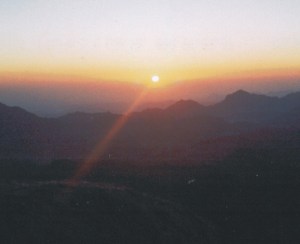
Dawn 31st August 2003.

He opens the boot of the car and shows me some tourist tatt he has bought. There is a small ornamental sword with red hieroglyph like writing on it he is keen to have my opinion. I look at the sword and say to him that it is a cheap fake. This confirms his opinion.

His wife and two sons arrive and he drives us all across the Sinai Peninsula to the Israel border. As we approach the border, we can see the sign in Hebrew and English saying Israel. There are several small calibre bullet marks in the sign. The border guard stops the car and ushers us into the border post to check our paperwork. He sees my passport and official Science Museum pass.

I go to a computer terminal in the post to check in. The children go to a drinks vending machine. The dark haired man come over to me. We are parting here. I am going back to London. He has a slim notebook computer. He asks me to take this back to the Science Museum, where I am curator, for examination. I explain to him that because I do not know what he has been up to on his computer that would be very, too, risky for me especially given the current world climate.

Dream ends.

*The clock maker aspect of this is reminiscent of Kālacakra tantra, the wheel of time. Perhaps the west “imagines” or “pictures” the same thing but with a different visual vocabulary.