Failure to Piss & Moan or Whinge & Complain…

—————————————————————————————————

From the Urban Dictionary:

whinge

Verb To whinge

A British/Australian/New Zealand (possibly South African and other commonwealth) English word which describes incessant complaining. A behaviour commonly associated with poms/pommes/pohms/pommies (people from England).

If you want to get anything done in this country you’ve gotta whinge till you’re blue in the face!

Aw piss off ya blardy whingin’ pommie!

Whinging pom

An joyless English person who complains incessantly.

See Piers Morgan.

That Piers Morgan is such a whinging pom oh my god.

———————————————————————————————

This morning whilst trying to go back to sleep I was reflecting on a phenomenon of non-plussed. This is when I observe other people being non-plussed when I fail to piss & moan or whinge & complain in line with their normal level of their expectations. They seem not to know what to do when I don’t bemoan my lot or plead how terrible life is and how much miserable pain I am in {poor me, pass the feather boa.}


People are accustomed to hearing high levels of whinging and moaning and therefore expect these.

I have an idea that the medical profession don’t take me as seriously as others because I am not complaining endlessly and asking of their deity for help with my suffering. They can’t gauge things on the whinge / complain / moan scale.  I am too close to the zero-whinge state to be taken seriously.

As a rule most people like to have others hear there whinges and go, “there, there, poor you”. They seek someone to join them in their misery and seek affirmation of how terrible their personal suffering is, Bless.

If you observe, a fair percentage of so-called conversation is about complaint and woe-sharing. If people stopped whinging there would be a lot less. One is supposed to offer succour to the woe-sharer. If one does not woe-share people can be non-plussed. They do not know what to do or how to behave.

A very large amount of woe-sharing comes from the notion of how unfair the world is imagined to be. It is very victim and poor me in source. It is a bit sandpit or nursery, toddler like.

Who said that life is fair? Why do people have such an expectation?

Anyway, is seems to me that my failure to piss & moan, whinge & complain sufficiently leaves people non-plussed. It is a non sequitur which does not make sense. It can cause unease.

Buddha Says, “Don’t Be a Drama Queen!”

One day when he was sitting under the Bodhi Tree a question popped into Buddha’s mind.

“Why do people make such a big fuss about everything, why are they overly dramatic and highly emotional about their normal lives and how they think life ought to be? Why are they forever whinging and complaining about their lot?”

And then he had it, the essence.

“Don’t be such a drama queen!”

The Bhagavad, the Tathāgata, the Venerable one, the Blessed, had come up with a simple piece of advice which would help people ease the imagined burdens in their lives. To lighten their imagined loads and to thereby enlighten them.

“Don’t be such a drama queen!”

He had found the precious jewel of wisdom. If people could live life as it is rather than with an overly dramatic soap opera style overlay there would be much less suffering in the world. People would stop flailing about and over-reacting. Calmness, harmlessness and peace might abide.

So, whenever you find yourself reacting to a situation remember and enact the precious jewel of wisdom garnered under the mighty Bodhi Tree.

Buddha says, “don’t be such a ridiculous drama queen about everything!”

Goal Orientation – Suffering and Dissatisfaction

If you search for “coaching” you will find many people offering their services as coaches and often a part of this is setting goals or targets for success and advancement. Few notice the similarity of goal and gaol. People can become prisoners of their goal orientation. Society is obsessed with measurable metrics and tick lists of things to do, to the extent that life can be a wearisome endless list of devoirs. It is de rigueur to have goals and ambition it seems.

Siddartha wanted so badly to end suffering for all sentient beings, suffering, or dukka, can be translated as dissatisfaction.

I’ll make a statement: goal orientation is directly causal of dissatisfaction.

If you fail to make a goal you are dissatisfied, if you make a goal, you are temporarily done but the next goal awaits lurking on the horizon. Any “satisfaction” is fleeting. This measurement obsession more often than not suggests some measure of inadequacy, could do better.

People then have massive internal dialogue about whether of not they are meeting their goals. Internal dialogue is nearly always negative and hence the being suffers unnecessarily because of this internal “mental” cacophony.

Goal orientation and rush often skip hand in hand. Focussed only on the goal there is a tendency to finish quick and this can cause poor application to task and lower standards. Goal orientation can prevent impeccability. Eye on goal one does not fully absorb into whatever it is one is doing. There are distractions from other pending goals. Quality suffers on the noose of measurable quantity. Goals hang.

The antithesis of spiritual development is rush. It is impossible to rush it, but many try and seek milestones to prove progress. The hangover of societal obsession with goal orientation is difficult to ease.

Striving is a form of suffering.

Relaxation and complete absorption is the antidote. Complete absorption brings completion but without obsessional suffering. Complete absorption quietens the internal dialogue and therefore reduces dissatisfaction. Everyone knows when they have been impeccable. Impeccability is not an absolute. If you give completely of your current very best that is all you can do, this never brings dissatisfaction. Subsequent comparative internal dialogue can cause the nine headed hydra of dissatisfaction to rise again.

Internal dialogue is a primary cause of dissatisfaction and suffering.

Endless measuring is causal of dissatisfaction and suffering.

Comparison mind is directly causal of dissatisfaction.

Rational thinking causes dissatisfaction. Therefore, rational thinking is an irrational unwise thing to do. It does not make sense.

Of course, under certain circumstances one needs some rationality.

If one is ever goal oriented one never experiences the moment, the eternal now, because the goal is very distracting. Not being fully present causes dissatisfaction. If one lives in the twin worlds of what if and if only, there is rarely now. The past whether melancholic or rose tinted, the future whether idealised or catastrophe is not now, it is mind-stuff often of the nature of internal dialogue. Trash.

Goal orientation causes impatience which is a form of dissatisfaction. Goal orientation when one is driving a car is a cause of road rage.

Letting go of goal orientation is liberating.

Try it, having no goals is harder than it might seem, because societal habituation near worships them.

Hence there is suffering and dissatisfaction, which we might call samsara or saṃsāra, which is another term for endless human folly.

Talking – Effective Personality Disorder – INFJ Dream 27-11-2024

This dream is from between 3 and 5 AM this morning. This is out of the blue.

The dream starts in the front room of my old house in Brixton. I am initially sitting on the coir carpet. It then shifts to a meeting room with psychological professionals discussing a case. I am to assist. One turns to the others and says about me, “I know that he is not a qualified professional, but he has an uncanny knack of putting people at their ease and getting them to talk freely. He is utterly nonjudgmental and very empathic.”

The scene changes and I am in a single bedded hospital ward. On the bed dressed in a hospital gown is a young man with wavy blonde hair which needs a trim. I say, “hi” and he replies. I go over and sit on the bed. I introduce myself. Implicit is that he has just survived a suicide attempt and is recovering. He is in a bad way. I ask how he is and what medication they had already tried. He says, “Xanax but it did not work very well!” I ask if they have a tentative diagnosis and he says, “effective personality disorder.” I already knew this in the dream.

The next day the staff wheel his bed down to the swimming pool. They are using water to help him walk again. I am dressed in my speedo swimming trunks. I lift him off the bed in my arms and walk into the water until such time that he can float. I let him float off my arms. He is smiling and very happy. We walk a few widths of the pool in the water and then I help him out of the pool. The healthcare assistants dry him and help him change into a new gown. I lift him back onto the bed.

The next day the scene is repeated but I also help him to swim a few lengths of breaststroke.

He asks me how I can make him relax. I say that we INFJs have tremendous and sometimes painful depths of empathy. We can feel the suffering of other beings and sometimes tune into it. We want that suffering to cease.

Dream ends.

A passing thought after the dream was, “is this pointing at helping others again”. A while back I started the process of joining Samaritans but was unsure of the other people seeking to join

The Waking Dream and Visions – Hallucination?

Modern psychology might have strict views as to the nature of reality. It rests firmly in the “common” sociopolitical construct and uses frameworks like self-image. Deviation from normal becomes an illness or disorder. Having a vision could be seen as a hallucination, something not real. Yet visions and religion are entwined, entangled even. There is a disconnect where psychology might see “religious” vision as psychosis, prophets could be deemed mentally ill in retrospect.

In the limit of Buddhist philosophy, the entire sociopolitical construct held as normality is, suffering. Attachment to status and possessions causes dissatisfaction, apparently many are unhappy about how they look. Is your cognitive assimilation of appearance reality? One could suggest that modern psychology encourages samsara. Whereas Buddhism works at the eradication of the notion of self, psychology seeks to prop it up.

You pay your money and join the club that suits.

I’ll comment that I have had a number of visions, waking dreams if you like. None of these have completely removed the physicality of what might be called physical plane material reality. Though the event flow in vision was markedly different from the event flow on “earth”. I perceived them as an extra overlay with a very different sense of spatiotemporal perception.

I have always been able to visualise, to hold and build images in my “mind’s eye”. I can do this, as I am now, and continue to type reasonably accurately on a different subject. In terms of the Toltec aphorisms on dreaming. I am dreaming and typing at the same time.

As a rule of thumb, I am open minded. I have been meaning to thank someone {on LinkedIn} who nearly forty years ago helped me to open my mind. Initially I thought he was a pretentious prick, it turned out it was me who was the pedant and knobhead. He did me an enormous favour in introducing me to David Lynch.

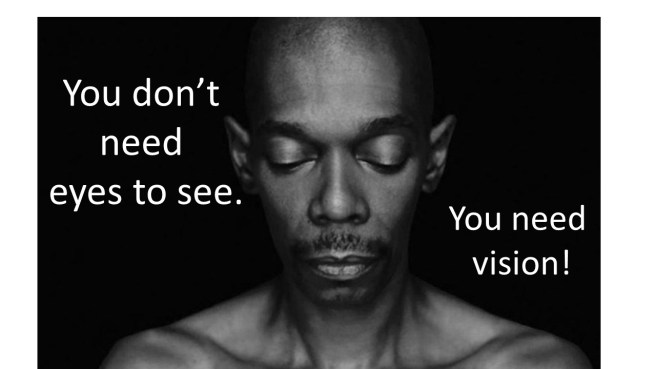
Writing a business plan could be said to be a visionary practice. In order to plan one has to have, at least in my case, a picture or vision of how things might work or look. It has to be en-vision-ed. A patent application can be seen to be a vision of something not yet real. By concretising it into text and diagrams, one starts to materialise a vision or dream. Is something subjective and not yet real like a patent, a hallucination?

Some of these visions I have had are not of the same time as when I am having them. These visions with a sense of “ago” are explainable by invoking the notion of past life recall. Some come in full smell-o-vision.  Of course, you could just say that I was hallucinating.  My awareness of surroundings, though slightly reduced, remained operable. I was able, for example, to walk along Upper Tulse Hill to catch a bus for work. I did not get run over or walk into a lamppost.

When I dream passively at night, I know that I am dreaming. When I en-vision during the day, I am in control. Some of my visions were not that well controlled but I knew where I was and that something “else” was taking place.

If we call the common sociopolitical construct a samsaric dream, I am aware that I am dreaming it and can participate roughly along the lines of the “rules” of the construct. I have a whole lot less fear of missing out, FOMO, than most people.

In the desire to overly categorize and rationalise things, it is possible that humans “throw the baby out with the bathwater”. Concrete mind can be very concrete and fixated. It can be very wrong, group insanity like Brexit can seize the minds of millions.

I’ll develop this a little more using the same subject header at another time.