
———————–
Mystic Lake Dream – 27-02-2026
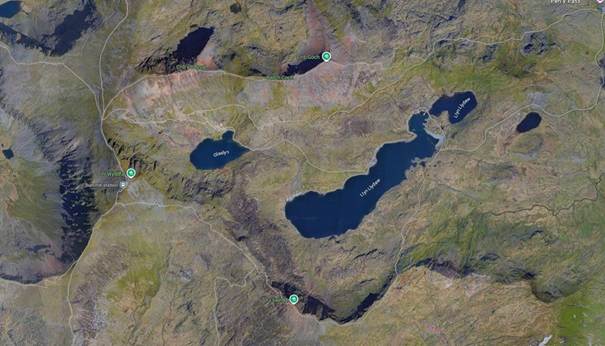
Here is last night’s dreaming it was in some parts accompanied by this song { I am my mother’s savage daughter} during the dreaming. There is a sense of something broadly shamanic incoming. I was reminded of Snowdon’s Glaslyn and Oeschinensee in the Berner Oberland.
The dream opens in a brightly lit indoor setting. It is like a pharmacy / clinic. Two young nurses, one female and one male, are struggling to calm down and contain a large older man with unruly blonde hair. He is panicking about his test results and upcoming injections. He will not listen to them. The woman turns to me and asks me to explain. I am of a similar age to the man. She explains to him that I am a trained scientist. I start to explain to him and slowly he calms. I show him a test tube in which the red blood cells from his blood have been sedimented out to the bottom. This means that for now he has not been infected which is why he needs to be vaccinated, something the nurse will gladly do for him. He is surprised that his blood liquid is light yellow murky over the small layer of sedimented red blood cells.
The scene changes and I am climbing a mountain track with a leather coracle on my back. I round the bend and go over the last lip into the corrie / cwm where there is a mountain lake of sublime beauty. It has been scoured out by glaciers of days gone by. I place the coracle and oar down on the rocky shore and marvel at the azure blue. I am home. I am back at the source of the river. I marvel at the rocky slopes plunging into the icy waters. I hear an all-encompassing silence. I will in time row out onto the lake because I have an appointment there.
The scene changes and I am in something of an ersatz physics laboratory. An experiment using lasers in being prepared for the school children. The technicians are struggling to get the experiment to work. They call for help and Ian M tips up and together we start to align the outdated clunky optics on a heavy metal rail. They are confident because of our laser expertise the experiment will work.
The scene changes and I am back lakeside. A magnificent mist has come in cloaking the lake and making the atmosphere heightened and mystical. At any time one might imagine the lady of the lake rising with Excalibur in her hand. The mist enshrouds and welcomes. I get into the coracle and row slowly out into the centre of the lake and the centre of the mist. I have a meeting and I have something to retrieve, to find again. I stroke my beard with my left hand. I am enlivened and energised. My palms are tingling with “electricity”. I have come for something and am reminded of the role of all the lakes in this life and beyond.
I am now outside a funeral parlour. There is a mass funeral taking place. Where members of two families are being sent off together following a huge violent brawl at a wedding. The two sides have been at war for generations. Yet they have decided to join together to remember their dead. Coffin after coffin is walked from the hearses into the crematorium. A newspaper photographer is there and goes to take a picture. I stop him and seize his camera. Such a thing would inflame and ignite.
Back out on the lake the mist clears and I can see far in the crisp pristine mountain air. I look down into the hyper-transparent water of the lake and several metres down I can see the rocky bottom with a few arctic fish like char. I remove my heavy fur jacket / long coat. It is bearskin. I am wearing a shirt fastened at the top with a shoelace like fastening. I stand in the coracle and am ready to plunge into the icy depths.
The scene changes to the carriage of a bus which is brightly lit and modern. The bus is only partially full. I am at the back of the bus and there are a few young people there. They are taking the piss out of me because I am not sitting down even though they are seats. I am holding on to a tube train style ceiling handle. They are all chatting and playing on their electronic devices.
The bus is coming to a stop. I have fallen asleep standing up much to the surprise of everyone except me. The bus has morphed into an airplane and we are taxying to the terminal. The doors open and because I am standing I am the first one to leave the plane.
The dreaming ends and as I awake I make a mental note to search my dream archive for dreams with lakes in and in writing I am reminded of the morning when I threw my katana souvenir into a lake in Hertfordshire.
–
Glaslyn and Llyn Lydaw
–
———–
Missing Person Dream 18-12-20
My run of strange dreams continues.
I am alone on a nice, wooded island in the middle of a freshwater lake. I am going about my business walking through the wood. I then, in the dream, get a very strong visual image of someone filing a missing person report about me. It is like a remote viewing. This missing person report will kick off an unneeded investigation into my whereabouts.
I decide that I must swim back to the mainland to say that I am not missing. I do not want the fuss to start. So, I go down to the water’s edge and jump in. The water is clear and quite warm. I start swimming a strong front crawl towards the mainland. I am enjoying the swim.
Dream ends
Tibetan and Buddhist Themed
Karmapa Dream 27th June 2014
Here is my dream from 27th June 2014.
It starts in a mountain setting. The wife and I are walking along a ridge either side of the ridge the mountain falls away into azure blue mountain lakes. There is no vegetation. The air is crisp and clear. We arrive in a small mountain village and go to our hotel.
Some while after, when we have settled in a young female child comes to visit us. Her eyes are most striking. They are blue despite the fact that she is Tibetan. I tell her she has beautiful eyes and she giggles happily. She says that the Karmapa will see me now and that I am to come to the monastery / palace for instructions. She skips off. She is the Karmapa’s little sister.
That night I go out onto the mountainside and see there the fish rearing pens. They are full of young hatchlings, which are moved from one pool to another as they mature. They must be raised like this otherwise the culture will die out. They change colour as they grow and mature. The pools are guarded by a Tibetan fish stock man who is dressed in traditional ceremonial costume.
I put my hand into the water and the fish swim to it.
The next morning, I go to the palace / monastery and am shown in. Before long I am in the presence of a young man. He shows me around and tells me that they have many visitors. He is wearing monk’s robes. He shows me a long object shaped like a barometer which holds important “relics” in it. It is a staff of office and is “magical”. He lets me take it out of its box and handle it. He repeats,
“We have had many visitors, many delegations…”
He watches how the staff interacts with me. It accepts me.
We must now get you ready to meet the Karmapa, you can meet him here at this mountain cave. He points at a map.
“You must come here at 2AM tomorrow morning. “
“Will you be OK walking in the mountains in the darkness?”
I reply,
“Yes! I was born in the mountains. I will meet you there!”
I know that the young man is in fact the Karmapa.
An older more wizened Tibetan then comes in to speak with me. He is shortish and thickset. He is a combination of Chöje Akong Rinpoche and Chögyam Trungpa Rinpoche and his appearance flits between these two.
He shows me a map of both the front and back faces of the mountain. It is in relief. I can zoom into the map to see the detail.
He makes emphasis on a little cabin. This is where the gatekeeper is. He keeps the keys. You will need to get a key from the gatekeeper before you meet the Karmapa.
In the dream I know it will not be the Karmapa who I will meet at the top of the mountain but the Akong / Trungpa being. I say that I will meet “them” there as they are the gatekeeper. This is a non-verbal communication “mind to mind”. This man is insistent upon the protocol, the tradition. The Karmapa however has already seen enough. He is satisfied.
The young man is now sat between two others, one of them is the Akong / Trungpa being. The Karmapa is reciting the mantra “Om Mane Padme Hum” quietly. He looks at me to see if I join in, in deep voice, or not. I do this in my head only. There is a silent acknowledgement between us that he can “hear” me doing this.
I walk out of the palace / monastery with the sensation that the Karmapa is in need of a friend. There is now a sense of inevitability “it” has now changed to when and not if.
————
Tibet / Nepal / Katmandu – Being Shot – .99 Calibre Dream 02-08-2018
I am waiting at a train station to get a train up to the top of a mountain in darkness. The idea is to get the train up during the night and then walk down as darkness yields to dawn. The trains station has an “Indian-Asian” flavour but is old school. There is a lot of hustle and bustle. The word comes that at last the train is ready. We all board the train and it chugs off, windows open, up the mountain. We are at sea level and the mountain train stop is at 3600m.
When we get there to the top it is like Nepal / Katmandu / Tibet. There are many “hippie” tourists here and what “we” are about to do is a part of THE “trail”. In my mind I wonder if I will be recognised by people at the top.
“We” set off down the hill past a small blue lake where there are Buddhist monks meditating and they bless us as is their custom. We continue on the trail down the hill as darkness continues to fade and dawn comes in. It is a long hike down.
Next, I am with a tall thin blonde woman with curly hair whom I do not recognise. We are in “Katmandu” or a town like it with many tourist “hippie” shops and hawkers. One of these latches on to the woman and I try to dissuade him. He draws a knife as if to attack. I disarm him and he runs off very displeased and very angry with me.
Sometime later the “air-raid” siren goes off and people are sheltering. I find myself a niche in the stone and lay down with my bag over my head. I remove this as there does not seem to be any attack. The man from earlier is now standing over me with a pistol. He shoots me in the left leg which stings a great deal. He says that he might kill me. I start to ask him why and move to get up. He shoots me again lower down my leg. I cry out for help. The police come running and he runs off. The “Indian” policeman says that I have been shot twice with a .99 calibre weapon.
Strangely despite this I am able to walk / limp.
Later the man finds me again and asks me if the blonde woman is my fiancée. I say that we have never met. He intimates that he will get even with me by getting at her. I tell him that before “yesterday” I had never met the woman.
He is doing a drug deal and wants me to skin up with his hashish. I attempt this but fail. The police then come and he runs off. His idea was that I am caught in possession of hashish. I throw this down a street drain. The police are not concerned about me rather the man who set me up.
“Wolfgang” is there and we are discussing how thing are very different at 3600m. He says, as he has done previously, that people are and have been gossiping about me.
Outside of town the lake has now frozen. The idea now is to ski down the mountain. Given my injured leg I am unsure about this. So, I try to ski / skate on the frozen lake which is covered in snow. I can do this easily. I am able to make turns on the ski-skate rink which in the dream I find highly enjoyable shouting, “Yaaaay”….
I wake up and the dream ends.
———-
13th Dalai Lama Dream 01-03-2024
Here is the second dream.
I am in a village hall here in Brittanny. There is an event going on organised by some of the British expat community. Sat at the back in monk’s robes is a man roughly my age with a small retinue. He is Tibetan. They are in monochrome. They are chatting amongst themselves. A woman turns to them and says to the man that he talks too much.
I turn to the wife and say that she has just told the Dalai Lama that he talks too much. He hears me and we lock eyes. He is grinning profusely and we both find the situation hysterically funny. He turns to his retinue and says, “The Dalai Lama talks too much!” They all giggle slightly because he is known for not saying that much at all.
In the dream I know that this is a previous incarnation of the current Dalai Lama. Because he looks different. I recognise him.
{On searching Google, it is the 13th Dalai Lama as an older man.}
The sense of fun at being told off we share is uplifting.
The scene changes and I am now deeper in the hall with the wife. I am making an herbal tea with citrus rind, bright yellow berries and ginger in a large Pyrex bowl. I pour this through a sieve into two cups. We go outside to let it cool.
I say that we have to go back in because the meeting is starting. We find that someone has tidied up our mugs. We sit down on a couple of chairs and the meeting kicks off in English. The expats are mobilising for some cause or other. They tell us we have every right to be there.
The scene changes and I am in a mountain {possibly Tibet} monastery. I am with a young boy aged around ten. We are in a bedroom and he is standing on the bed. He is of Tibetan origin with jet black hair. We are touching foreheads and playing a gentle game of headbutts with each other. His English is impeccable and I tell him so. He seems very familiar to me. We are having a great deal of fun.
Someone comes to the door and escorts us to a room with large step like seats. The boy instructs me to go some way up the steps and I am joined by the wife.
Some men come in and put a carved wooden chair on the floor. The boy says that the Dalai Lama likes to have people higher than he because it reminds him to stay humble. The Dalai Lama comes in and sits on the chair. The boy stands next to him. It is clear that they know each other well. In the dream I know that this is yet another prior incarnation of the Dalai Lama.
The scene changes and I am outside by the shore of a mountainous lake. I am sat with a young white American. A dharma bum. In the background the Dalai Lama is organising a spectacle a ritual with white flags and huge prayer wheels. There is a horse riding display. Implicit in the dream is that the Dalai Lama will see me soon.
I am talking with the American about the nature of reality. I say to him that I know that reincarnation is real because I have recollection of my prior lives in dreams.
As the dream is fading, I get a full colour image of the current the 14th Dalai Lama and a sensation of joining Ajna centres.
Dream ends
———————
Commentary – on the death of the Dalai Lama…
Step One: The Dalai Lama supposedly consciously dies (called phowa) and reincarnates by choice into a new body.
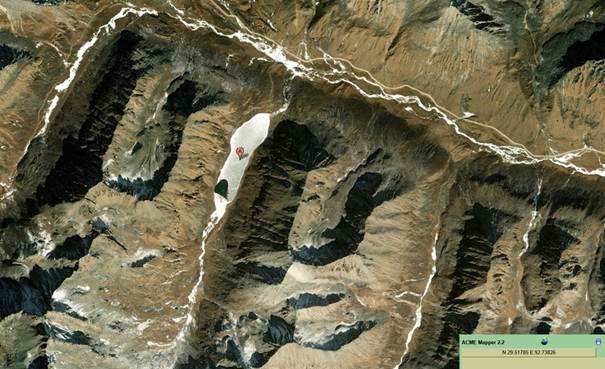
Step Two: A committee of high Lamas and government officials consult the Nechung Oracle, official Seer of Tibet. They also make a pilgrimage to a sacred spot, called Lhamo Lhatso and meditate beside the lake. They hope they will experience visions and dreams to guide their search. The search often starts by following the direction the wind blew when the Dalai Lama was cremated.
The search can take 2–4 years and can be changed by a 2/3 vote of the Tibetan people.
Step Three: When the High Lamas think they have found a child, they place articles in front of the child, and if he chooses the ones who belonged to the previous Lama, and also knows some signs (which are kept secret), he might be the Lama. Former servants of the previous Dalai Lama are asked to sign off on the process. If two or more boys have the signs, then the chosen one is the one whose name is picked out of a vase.
Satellite image of Lhamo Lhatso from coordinates in Wikipedia:
–
–
There are a number of sacred or spiritual lakes in Tibet
1. Namtso (Lake Nam) or the Heavenly Lake
2. Lake Manasarovar—The Mother of the Holy Lakes
3. Lake Yamdroktso— The Most Beautiful Lake in the World
4. Lake Rakshastal—The Blue Devil Lake
5. Tangra Yumco
6. Basumtso Lake
7. Lhamo La-tso— The Spiritual Lake of the Goddess
8. Siling Lake
9. Pangong Tso—The High Grassland Lake
10. Rawok lake
———-
From the greattibettour.com web site
Intellectual Property – VC Dreams.
The first one is a Buddhist – IP bridge dream.
Water Spirit – Misogi – Clean Water Venture Dream 22-02-2026
Here is last night dreaming which is in two related parts.
The first part opens on the shores of an alpine lake high up in the Japanese mountains. The lake is shaped like a glacial corrie or cwm and is of a pristine light turquoise blue colour. The water is hyper transparent and crystal cold. The air is crisp. To the rear of the lake is a snow covered peak. The scenery is magnificent with Japanese acers and maples. The water from the lake leaves by a small stream over a waterfall cascade which drops twenty-thirty metres over rock to a small plunge pool. The sound of the small waterfall is melody. The ambience of the environment is close to perfection. The view down from the mountains is far reaching out to the sea.
It is ago something like a thousand years ago. I am on the shore dressed as a Buddhist priest. It is definitely me and I am Japanese. In the dream I know this to be my prior life. The smell is also characteristic of Japan. With me on the shore is a spirit warlord and a small retinue of spirit warriors. There is a Japanese woman who is of high noble family and she has her retinue of ladies in waiting and an armed guard. They are dressed in great finery. The Japanese woman is part water spirit, the nature spirit of the high lake and part woman. Because of this and her relationship with the Imperial family in Shintō she is considered the goddess of the pure waters and an embodiment of misogi or purification. The water is already pure but must also always be blessed. The spirit warlord is angry and the woman must choose to either join him back in the spirit world entirely or relinquish her spirit part and remain human. In a sense I am adjudicating.
The woman does not take kindly to the angry demands of the spirit warlord. She walks over to me and places my hand firmly on her genitals on top of her clothes. She then slips it though her clothes and I can feel her flesh. Forcefully holding my hand there she rubs herself against it until she orgasms. At which point she shudders and relinquishes her water spirit aspect. She has become human.
The warlord watching says, “so you have chosen!!” He heads off into the pristine forest with his retinue of warriors. I reclaim my hand and the woman is surrounded by her ladies in waiting who comfort her. After she recovers she asks me to do a ritual of purification, of misogi, using the waters of the lake. Although it is Shintō I know the ritual well. I have a bamboo bucket and a small bamboo ladle. Which I prepare for the ritual with water from the stream.
I wake up for a visit and a 3 AM ibuprofen.
I am now in a busy city {London} office building. It is just East of The Strand and I am due to meet some financiers / venture capitalists. They have been funding a high end water business. The idea is to create ultra niche very expensive bottled water which is ritually purified and attracts a premium price. I have been asked to look into their investment. I am with a woman in a business suit who is in a rush. She is a bit “doff your cap” to the investors and anxious. She ushers me into a room in which there a number of “suits” sat around a boardroom style expensive table. They tell me that there is a prototype purification set up and pilot line that they want me to inspect. It takes impure near sewage water and makes it top end. They know I am a chemist-scientist-technologist with an entrepreneurial background.
The scene changes and I am in a laboratory. There is a huge blown glass apparatus with many coils of glass tubing. There are two sand-clay filtration stages and a long flow tube with an ultraviolet laser photolyzing chemicals and killing residual bacteria. The throughput is small and this is what is worrying the finance people. I look at the rig and it seems fine to me. It is obvious however that if they start with such impure water the throughput must be very slow. Purification is a process that takes time and effort. If they want top-end water they must start with a source which is already very good, premium and which only needs a bacteriological cleanse.
I am due to present my findings to the committee. As I walk through the building I am told that it is shutting up for the weekend. That I need to close off the lab and give my keys to the people on the third floor. The financiers have pretty much decided that they are going to pull the plug on the investment. I know that they have totally missed the point. All they can see is high throughput. They cannot see the value of purified water blessed by the likes of me. That brand which we might call misogi can attract premium price.
I go through the emptying building and I cannot find the office where I am supposed to deposit the keys. The occupants have rushed off for their hedonistic weekend jollies of excess. I walk past the front security desk and leave the keys with the uniformed man on the desk. I exit via the revolving door onto a busy central London street.
The dreaming ends.
———–
Investor Incognito – Quantum Modules – Sociopolitical Problems Dream 19-08-2025
Here is last night’s dreaming sequence.
“If you want my future, forget my past
If you wanna get with me, better make it fast”
————————————–
The dream opens in a splendid mansion and grounds of Italianate design situated somewhere like Lake Como or Lake Maggiore. It is upper class, rich and very swanky. It is an investor event for high net worth individuals and venture capital (VC) funds of diverse type and scale. It is late evening drawing into night. There is a string quartet and finger food. Presentations will be given in an outdoors setting once it has become fully dark. There is a stage and seating. Seating is round “ten” seater tables. In the meantime a pre-event wine tasting is going on. It feels European.
I am working incognito as one of the wine waiters. I am in black and whites with a white wine apron. I am opening a bottle of vintage red wine and offering to taste before decanting. I then fill a decanter with the rest of the wine. The idea being that they also taste after half an hour. I pour a taster around the table. Each in turns swirls the bright red wine and tastes. I move onto the next table who are trying an ice cold New Zealand white. In general the interaction is professional but I can tell that I am “staff” and not one of them. I am of no significance. I am not the main event.
Heading back to the kitchen an American woman who is a VC accidentally bangs in to me, she is partially drunk and is very rude to me. I apologise even though it is her fault. She is brash and convinced of her own importance. The event suggests to me that these are not the kind of people I seek.
The scene changes and I am at a booth in a trade show and technology event. On the table in front of me is a quantum module. It is a slot in for a 19 inch electronics frame wider unit. I have the side panel off the module. In it I can see a photonic circuit processor which is air-cooled by fan. Connected to it are several tight circle bundles of fibreoptic cable. These are cable tied and attached to the motherboard. A number of them lead to optical-optical low loss interconnects on the rear of the module. To the top of the board is a diode pumped fibre laser which I know to be single mode. The whole unit is a modular quantum logic gate, a plug and play module for an in-principle demonstrator. With me in the booth are Geri Horner and her husband. As a hobby he has led the engineering team and has managed to attract some not standard funding from Red Bull. I replace the side panel to the module and screw it in using a jeweller’s screw driver. I slot the module into the wider 19 inch parent rack. I then mount the whole unit into an electronics rack and attach the computer interface. Geri is excited and waiting for people to visit our booth. There is a Red Bull logo. The module is a large-scale building block prototype for a room temperature quantum computer. I have had to seek non-standard funding, hence Geri and Red Bull.
The scene changes and I am in my workshop / shed on top of a low rise several storey building. To my surprise a text message arrives on my ‘phone. The message asks “why, why am I packing it in?” I am very surprised that there is both a ‘phone and a text message in the dream. { A very rare thing} As I am dealing with this surprise a man appears at the door of my shed. He is older than me, very English and of the UK science hierarchy. I let him in. He wants to know why I am dropping this line of research / investigation. I explain to him that the establishment does not accept me and has difficulty interacting with me because I am not usual. I do not belong to any famous company / institution. He does not believe me. I explain to him in more depth and he starts to get offended imagining that I am attacking the entire science hierarchy. I ask him if he is personally offended. He says, yes.
“Now do you see the sort of thing I am up against. How resistant to me people are?”
“Yes, OK , I get the idea.”
He then asks me to hang fire for a while. He wants to know who I am working with. I explain that it is just me. On my bookshelf he see texts on superconducting and quantum circuits. He says that he might be able to get someone to work with me. I doubt it. There is no money.
I say to him that there is little which can be done. It is as it is. He does not like this.
The dream ends and I have the Spice Girls “Wannabe” to mind.
—
Patent Attorney Dream 8-12-17
I go back to bed for a snooze after breakfast, my body is tired after Aikido last night and the logs the day before. It is very unusual to dream in these snoozes.
I am in my garden, with a small house and a wooden fence. I go through the gate at the end of the garden onto the footpath that runs behind all the houses. The footpath is on the edge of hill which overlooks a large lake. The water in the lake is clear and azure blue. To the side of the big lake is a smaller similar coloured lake. From where I am standing I can see fish swimming in the lake. It is a clear sunny day of indeterminate season.
I go back into the garden and my sister has a telescopic fishing rod which looks to be a bit tangled with fishing line. I say, that was just what I was thinking. Let’s go and see if we can catch some fish. She follows with the rod. Attached to it are two pike fishing plugs. I say we won’t be needing these. We can find some hooks later. I have half a loaf of sliced bread. I start to roll some of the bread into balls and throw it from the hill into the water. It seems to attract the fish. But my throwing is off. I decide to go down to the lake.
At the edge of the lake I throw some bread balls in. The smaller fish are attracted. I then try to throw the bread out to where the bigger fish are. These are also attracted to the bread.
I go over to the smaller lake. To my surprise there are two women swimming in the lake. They are wearing fashionable, expensive, swimsuits. They are tall and athletic. I ask them what the water is like, one says cold. Just as I am asking I fall into the water fully clothed. The water is fine. One of them swims close to me and in a slightly sexually provocative manner. We talk for a bit and I can hear that she has an accent. We go over to the shallows and the two women get out as do I. They have to get back to work.
I ask them where they are from, Germany, south, I suggest. Yes one is German and the other Russian. I ask them why they are here. They are working, both of them, in patents, one is writing a patent and the other is a patent attorney. I say to them, in the dream, that I pay particular attention to strange things and explore them. Two women working in patents in a lake is strange thing, and because they are German, this is even stranger.
I ask them how they feel about living in the UK. It is OK they say. It isn’t very modern but green and has nice trees. I say that Germany has all changed since the reunification.
Dream ends.
Fishing Dreams
Behind Closed Doors – Nile Perch – Brockwell Park Dream Snippets 29-10-2025
Here are last night’s dream snippets some of them are at 90 mph…
The first part of the sequence begins in London. There are various meetings going on after hours and behind closed doors in which I am somehow the subject / object of the meeting. I am somehow seen as the “problem”. There is one among male UK academics roughly of my generation. I had acquaintance of these. There is one involving people who could be seen as the generation before me and a current university VC. Of these I had passing acquaintance of one female and longer of another male, they are near end of life. The VC is only a bit older than me. There is one meeting which is part virtual with people in the USA. I have never personally met the protagonists. This has a political / intelligence flavour. There is one meeting which is distinctly Tibetan and not London based. The scenes flash by at “90 mph”. In the dream I want to say that they have done nothing which is strictly speaking illegal nor overly dodgy in the view of current normal practices and behaviour. Therefore from my point of view there is nothing to discuss, nor do they have anything which needs attention. They do not need to do anything at all.
The scene now changes to Africa. We are at a camp site near an inland lake or reservoir. We are packing up to catch the plane home. In my pocket I have a small fishing lure, a spinner, a spinning spoon around a “pole” with a tri-pronged hook. It has a small purple feather. Before we leave I would like to try to catch a “bream” or Nile perch. The man I am with draws off some line from a rod reel combination. The line is very thick and strong. I need to tie the lure on with a leader. I try time and again to attach a leader to the line. Each time I do so and give a good tug the leader comes away from the main line. I think, “clearly I am not supposed to do this”. I give up my efforts and help load the safari Land Rovers to leave.
The scene changes to Brockwell Park in Brixton a place where I frequented a lot. It has a lot of stored memories and previously emotive things for me. It was very much a part of my former London life. I am with the wife and some kind of assistant / facilitator. His job is to look after me and my wants. I show him the ponds and explain that the local schools do biology lessons therefrom. I then show him one of the large old style Brixton converted “mansions”. I say that I want to explore to see if there is any draw. To see if it reminds me of my old flat. We break in through the ground floor back door and head out of the front door. The hallway is spacious and there is no damage we easily unlock the doors. I want to head up hill to show him where I used to live. As we go uphill I see a huge building project. A whole terrace has been demolished for a park side new build. It does not look good. Further up the hill another terrace has been removed by the diggers. They have yet to uproot the very old very large trees. They will need to dig deep to make good foundations. I cannot find the building in which my old flat was. I nip into one of the new build shells and hide from the builders to take a piss in a tiny pink WC. I finish and as I leave one of the builders shouts “oi”. I say that I used to live here and was bursting for a leak. He waves me on.
As I come to I note there is no point searching for the past because it no longer exists. I note that as we were non binary about France or England the future may lie elsewhere. I also note that the reason we love this house is the garden and nature, which I may rekindle after my operation(s). I am not seeing clearly.
The dreaming sequence ends…
———
Fishing – J – Dream 13-09-2024 {Wrong end of the stick}
Here is this morning’s dream
I am standing by the side of a river lake complex with a pukka English man type. He is older than me and of a slight build. He is dressed posh county fashion. We are discussing what might be in the water at the far side of the lake where there is a rocky overhang. The river runs along the bottom side of the rock face and the lake lies between us and the river. The scenery is reminiscent of Elstead and the Hampton Estate.
He asks if I fish. I explain that the last time I went fishing was in a tributary of the Zambezi and that was a very long time ago.
I have in my hand a hand reel of fishing line to which is attached a fishing lure, a plug. It is green in colour and fish shaped with two three pronged hooks.
I throw the lure out into the lake and retrieve it. It has not gone very far. I then whirl it around on a length of line and release it much further out into the water. I retrieve it.
The scene changes and I am talking with J. We are at her house which is around the coastline in the next bay. It looks Mediterranean. I have the lure and a different reel, the kind that fits onto a rod with me. She has some fishing rods. They have been given to her by her father. I ask if she would like to bring one of them with her and we can go fishing back at the lake and river. The rods do not look in good condition. I know that back at my place there is plenty of fishing tackle.
We set of on a path around the headland back to the bay in which I live. The path is narrow and etched into the cliff. I am confident she less so. As I round a buttress I drop the reel into the water by accident.
She asks what we shall do now. I explain that I have plenty of other reels.
I wake up and then drift back off to sleep.
I am now talking with an unknown woman who tells me that everyone thinks that I am a crazy loony and an alcoholic.
I comment that this is so typical. People conclude without knowing anything about the situation. They don’t ask me. They don’t talk to me. They do not research or look into things they jump to conclusions based upon their interpretation of how the world should be. Because of their prejudice they get entirely the wrong end of the stick. This has happened to me time and again. They have entirely the wrong end of the stick, again.
Dream ends
I have had other dreams along similar themes. Some people cannot accept that there are ways of living outside the norm and assimilations of world which differ significantly from theirs. In my experience the more intelligent a person is the more difficult they find accepting non-standard views and behaviours. They tend to be more critical and judgemental. They are unaware that they have the wrong end of the stick because in their omniscience that cannot be possible.
Job Interview at IMEC
Remote Controlled Dolphins Dream 27-6-2013
This is a part of the weird Leuven trip. We took the Eurostar from near Dartford to Brussels and picked up a hire car from Avis at the central station. The guy tried to rent us a satellite navigation system, he was mighty confused when I said, no. I had not driven in heavy city traffic for a long while. We made it out of Brussels and arrived in Leuven. We then went round and round the one way system trying to find the underground carpark of the hotel. It is a pretty small one way system and nevertheless we had great trouble finding our way into the hotel.
The start of this dream was extremely vivid.
We are staying in a lakeside residence which is up on stilts. At night-time and out of the window I can see some “dolphins” in the moonlight. I call for the wife to come and have a look. She comes over to observe.
The dolphins are in fact made of fluorescent plastic and are remote controlled. They are being driven by our next door neighbour R for his daughter.
I go to explore further and go out to the boatshed on the lake. We have been swimming in the lake. I am a little nervous about swimming across the lake because of the crocodiles. R is there too and we are collecting bits and pieces. I lock up after him. He comes through the back door and we lock up again.
I ask for a lift back across the lake. We sit of a blue plastic boat ski. There is a small motor and it is great fun. “How much do they cost?”, I ask. “£10”, he replies. I say we must get one of these.
Back in the house I open the windows on the veranda which is suspended on poles into the hillside.
There is a strange smell. I wonder if I can pump it through the house. I open the large roughing valve on the pump and it starts to draw fresh air into the house.
I turn off the pump.
I am adjusting something in the house and all of a sudden, the part of the house which is supported on the poles falls away down the hillside. I show this to the wife and we both stand there at the edge of the house. I move around a bit and hold onto a wooden partition. I have my mobile ‘phone in one hand. The wall breaks away and I fall with it down the mountainside. The wife watches in horror assuming I will die. I roll down the hillside and land at the bottom. I am covered in cuts and bruises. But not broken. I make my way up to the house. The wife is worried about something. I reassure her and say that we must tell R about the house. I try to start up my ‘phone but it only shows red numbers and then ceases to work completely. I will have to tell him in person.
I go up the hill and climb over the brick wall to R’s house. In doing so I get snagged in some barbed wire. That is all I need now, I think. I start to extract myself from the barbed wire. A woman comes along and offers to help. She starts to unpick me.
Now the wife and I are talking with R. He is very clear that the damage to the house is not our fault. I say that all our belongings are open to be damaged or stolen. He says that we should make a full inventory of everything. We start doing this.
Dream ends
We had prearranged to see some properties in and around Leuven and were contemplating moving there.
On the 29th of June we drove back to Brussels allowing plenty of time in case there was traffic to find Avis at the central station. I had memorised a part of the skyline to help us. We took a small turn almost by accident and bam, there we were right next to the central station. It was as if the universe had picked us up and said time to go home.
We dropped the car off at Avis and planned to have a bit of a wander and something to eat.
As we turned left onto the pedestrianised area the street was full of people with placards and inflated inflatable dolphins.
Freaky Friday…far out man…
It was the remnants of a larger protest on the 28th. People Going home.
We walked up to the ornate square. The mobile phone’ rang and there was no job. The whole idea of moving to Belgium fell off the face of the earth.
Then in a matter of hours we are back home in Blighty next to R.
——————
Just Before Hip Operation
Land Title – Medical Exam – Fox Island – Bern Dream 19-11-2025
Here is this morning’s dream.
The dream opens with me sat in an office, part real estate part solicitor. I am sat the other side of the desk to the person whose office it is. He is checking with me if I made inquiries into land titles. He has a mild Aussie accent. I say that yes I made an online inquiry into land to which my father once held title at the Queensland registry office a while back. He says that they are sorry that the search took so long but they are following up on two properties one in the Cairns area and one in Brisbane. He asks to see some identification documents which I show him. He says that he will get back to me soon. He thinks that the Cairns property might still belong to our family.
The scene changes and I am in an ultra modern hospital facility sat in a technical chair. I am with a young male doctor and a young female doctor. They are both wearing lab coats. Together with them is a technician. We are speaking in a mixture of French and English moving between according to our availability of vocabulary. We are in France. They are testing the function of my right lung only. I am being asked to exhale only from that lung and to cough only from that lung. I do this and they are very surprised at the result the lung is functioning way better than they thought. I am coughing up a clear white sputum which they suck with vacuum into a jar. I explain that I have not been coughing much because of the opium painkiller I am taking. They say it is time to take a break for lunch and that they will continue with the left lung later. In the meantime they ask if I will do an ecological survey of the island upon which the hospital finds itself. The hospital is on a hillock reached by a causeway well into a lake. It is a bit like a castle in construction.
I step out of the hospital and into the wooded hillock. They are particularly interested in the fox population. Because I am so quiet I do not disturb the foxes. I come upon one after the other who have demarcated their terrain, their patch, with droppings. I know that they have done this to prevent conflict. I count foxes noting their state of health and big fluffy tails. They are all well. I go down the hillside towards the water and am joined by the ninth fox who trots along by me. He is escorting me off the island and into the water. As I near the water we are charged by a manky tatty old billy goat. I grab him by the horns and lead him into the lake. He continues to try to butt me. But I swim out with the goat by his horns until he is out of his depth. The fox watches on. The goats swims back to land. I swim around the island to where the causeway joins the hospital and there is a small quay and entrance door into the hospital. I am cold from the water and knock the door. A health assistant helps me up and in. She offers me a towel. I come into the building and pick up a brown chocolatey drink from the vending machine. She directs me back to the clinic.
I arrive back and sit in the chair where I am joined by the doctors. They try my drink and like it. I explain that I got it from the vending machine at lake level. I comment that the fox population looks well and healthy. They are now going to start on my left lung. They want to know where to forward the results to. I say that I will be in Switzerland and we can find a Francophone hospital for them to forward my results to. I suggest Fribourg because that is just over the language frontier. There is a CHU (centre hospitalier universitaire) there. I ask them to put Bern into Google maps so that we can look for other French speaking hospitals. I see the large CHU at Bern on the map and say that they will speak French English and German there so there is probably no need to find a specifically French hospital. The young female doctor concurs. She is happy to send her write up to Bern which I can see from the map is quite close to where I live in the city. She says that she had a friend in Geneva and visited Bern a number of times.
The dream ends and I think, “well, the medical theme is not surprising given what is scheduled.”

 Dreamyoga