Bhagavān Institute – Found  – Wembley – Radio – Card – Dream – 22-03-2026

Here is this morning’s dream

The dream opens in a kind of school assembly hall with a stage and parquet flooring. The stage has theatre stye floor to ceiling curtains. In the main body of the hall are several people milling around. It is a kind of “spiritual” gathering. Marshalling them is a young man who is tall with a white granddad collarless shirt buttoned at the neck. He has long shiny jet black hair and is of a slightly tanned complexion. Each person is sharing their story of how they came to be upon a spiritual journey. I am talking with a young man about his start and it was via martial arts. I explain to him that I first started Zen meditation is karate class sat in seiza.

The man with the hair says, “what shall we call this gathering and that which is to follow?”

I say the Bagvaan {phonetically} Institute. In the dream I know that the spelling has an H also and is Bhag-van. I know that it is a term used in some Buddhist texts.

He thinks that the term refers to us and the society / institutions to follow. I know in the dream that Bhagavān refers to me. The reason that people will come is for me. He does not yet understand that it is I who will organise and bring life.

In the audience / gathering is a younger woman perhaps early forties. She is expensively dressed with dark hair and her bare stocking feet look incongruous against her business suit. She comes over to me and says, “I am so pleased to have finally found you.” She starts to tear up. I reach out to hug her. She withdraws. I explain that I wish to protect her because that is what we elephants do. She lets me hug her and she sobs into my shoulder. The sobs are considerable. She calms. She reminds me of an Australian Southerly Stalker I once knew.

The scene changes and we are in her car driving into North London. The gathering has been in the home counties. We have given another member of the gathering, a man, a lift and will drop him off at a tube station, Wembley Central. On the radio there is a talk programme in which I am mentioned in connection with the growing Bhagavān Institute(s) popping up all over. This is followed by a song in which Bhagavān is the theme.

We get to the tube station and I go in with the man to ensure he knows how to use the ticket machines. He is not British. I show him how to use the machine by putting some coins in and pressing a button. Out of the ticket hole a series of introduction / business cards starts to rapidly pile up like cards in a casino card dispenser shoe. They come out of the machine to make a deck of business cards with my name on and Bhagavān Institute address details. The song from the car is playing over the tube station loudspeaker address system.

The dream ends.

  • I am unsure as to whether to publish the dream or to keep it back. In the end I decide to publish it to go with the flow and see what might happen. I am aware of possible consequences. Where did that come from? Out of the blue.

———————————————————————

Bhagavān, nominative singular of the adjective Bhagavat, literally means “fortunate”, “blessed” (from the noun bhaga, meaning “fortune”, “wealth”), and hence “illustrious”, “divine”, “venerable”, “holy”, etc. Bhagavān is related to the root Bhaj (भज्, “to revere”, “adore”), and implies someone “glorious”, “illustrious”, “revered”, “venerable”, “divine”, “holy” (an epithet applied to gods, holy or respectable personages). The root Bhaj also means “share with”, “partake of”, “aportion”.

The Vishnu Purana defines Bhagavān as follows,

He who understands the creation and dissolution, the appearance and disappearance of beings, the wisdom and ignorance, should be called Bhagavān.

— Vishnu Purana, VI.5.78

Do I Have an Attitude Problem, Am I Too Irreverent?

—————————————-

41. Bodhidharma Pacifies the Mind

Bodhidharma sits facing the wall. His future successor stands in the snow and presents his severed arm to Bodhidharma.

He cries: “My mind is not pacified. Master, pacify my mind.”

Bodhidharma says: “If you bring me that mind, I will pacify it for you.”

The successor says: “When I search my mind I cannot hold it.”

Bodhidharma says: “Then your mind is pacified already.”

Mumon’s comment: That broken-toothed old Hindu, Bodhidharma, came thousands of miles over the sea from India to China as if he had something wonderful. He is like raising waves without wind. After he remained years in China he had only one disciple and that one lost his arm and was deformed. Alas, ever since he has had brainless disciples.

Why did Bodhidharma come to China?
For years monks have discussed this.
All the troubles that have followed since
Came from that teacher and disciple.

————————————————-

Excerpted from“The Gateless Gate”,

by Ekai, called Mu-mon, tr. Nyogen Senzaki and Paul Reps [1934], at sacred-texts.com

————————————————-

I suspect that many people are uncomfortable with clarity.  My own experimental evidence suggests that providing clarity can be unpopular and politically unwise. People are fond of brown nosing and otherwise sucking up to those with kudos related positional power. If one is not sufficiently reverent one can become a “problem”. Upsetting the applecart etc. can go down like a lead balloon on a planet with very high mass and low diameter.

If for example you think I have an attitude problem, where does that stem from? Is that from my behaviour or some preconceived idea you may have about how people are and should behave according to the gospel of you? If you say that I have an attitude problem are you in effect simply criticising your own reflection in a mirror?

Who defines which attitude is correct and/or appropriate?

Who is the expert and/or authority on this subject?

It is a part of my nature to take the piss. This can seem irreverent particularly to those who are pompous and very self-important.

I am reasonably confident that some people think that I am not sufficiently reverential and therefore I have an attitude problem. I don’t have a problem with my attitude but others might…

I had this sudden intuition this afternoon that people think I have a bad attitude…there is nothing I can do about what others think….

Slapdash or Thorough?

With human nature being as it is if you offer someone an apparently low risk “quick” shortcut to just about any situation, they will take it in preference over a risky more long term perhaps considered path. In movies this shortcut mentality often leads people into dire situations which might have been avoided. In wanting the easy out they can fuck up and badly so. People avoid effort and application and can find themselves up the proverbial creek in a barbed wire canoe.

This tendency could be easily exploited. I know this well.

Most people bodge, cut corners and have a hasty slapdash mentality. Patience is as rare as a full refreshing fresh water lagoon on the Nullarbor plain in dry season. People like band aid fixes, an Elastoplast quick answer. One that gets a “problem” off the desk at least for the time being. Better still if they can palm the “problem” off onto someone else, make it an SEP. The greasy buck never stops.

The problem is that shoddy and slapdash can create more problems than it solves.

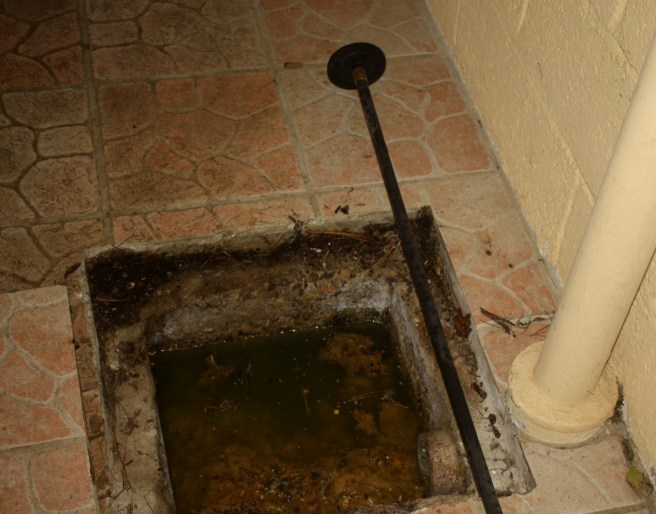
Today I have been cleaning out the sewerage drains to the cess pit. They have been problematic since we arrived. They are designed for old-school high cistern tsunami-flush systems not modern eco-cistern flushes. I tend to have to clean about twice a year and my plumber’s rods have paid for themselves in saved money many times over.

We could call it “Zen and the Art of Cleaning out the Shitter”.

The idea being that it is a job that needs done before my bionic hip.

Because my motion is increasingly spastic I could not perform one of the fiddly tasks to  get a rod around a partial U-bend. I tried and had to ask the wife to help. There was a choice to do a partial clean and maintenance or do a thorough job. She was able to do the fiddly bit and I was able to finish a thorough job. The rods, now washed, are drying on the drive.

I was less Zen today because of the awkwardness of my body and the pain in my hips.

Similarly the ceiling in the lounge could use another coat of paint at one end. We could leave it or I could do it tomorrow. The temptation to let standards drop is stronger because of my incapacity. We have already made a few compromises. They are realistic.  Time is running out a little.

I would like to have all the “heavy” tasks out of the way before they slice me up. I don’t know how incapacitated I will be nor for how long. There are some things that only I can do.

People can mistake being slapdash as being clever or cunning. Cleverness is not the same as wisdom which prefers a more thorough approach.

Wisdom can appear to take more time in the short term, but in the integral over all events, thoroughness is often a saver of time.

Slapdash people never get to see the experimental data which backs us this postulate {above}. They are hasty and prejudiced. They KNOW they are right.

My Five Buddhist Incarnations – Dreaming

In around 2003 whilst living in London and working as a lecturer in Physical Chemistry at Imperial College in London I started having waking visions of myself dressed as a Buddhist monk / priest. These visions overlaid normal day to day reality and I was able to lecture to a theatre full of ~one hundred students on chemical reaction kinetics or in smaller groups, chemical applications of group theory, whilst these visions were resident. They persisted on the crowded Victoria Line tube trains. I had repeat visions of om mane padme hum tattooed in Sanskrit on my inner forearms. Accompanying these images was/is the sensation of tattoo. These visions lasted on and on for over a year.

I did not mention this to anyone because I thought it would not go down well in the Chemistry department. I thought human resources might not appreciate this and occupational health might be consulted.

I however was pretty sure that this was past life recall.

Obviously, it is impossible to prove scientifically, that any past life recall is real. At best there can be what the courts call, circumstantial evidence. Dreaming comprises some of this kind of evidence.

In 2009 I had a series of visionary telepathic conversations, early in the morning, walking in the woods near Tring with the master Djwhal Kuhl. He told me of five of my previous lives, two of which were Buddhist. He said that I had been a very close disciple of Siddartha.

The dream yesterday has added Nāgārjuna to the list of possible life-candidates.

Irrespective of accuracy or otherwise the theme of scholasticism and scholar runs through all the/my putative incarnations as does the theme of entrepreneurship. I am “on” the second ray, of the Elephant dreaming class and conditioned by love-wisdom, the teaching ray.

One dream suggests that I was Bakula a close disciple of Siddartha who came late to the path after a scholarly life.

Yesterday’s dream suggests some six hundred years later Nāgārjuna. Who was a “founder” of Mahayana and may have taught at Nalanda university.

Another dream has pointed at a saffron trousered Muay Thai trained Burmese / Thai incarnation, a monk/priest/protector.

Then there is dreaming evidence of a Japanese Vajrayana monk incarnation, with poetry.

{The feeling for me is that I also had a Japanese Zen life but no dreams as yet}.

The next two lives were not substantially Buddhist.

Of late there has been increasing “evidence” for a 20th century incarnation as a Tibetan Buddhist. So far there is no evidence of a named individual. If it was a sequential birth then they need to have died before or in early 1964. If it is a shared emanation then there is no strict constraint of time frame.

It is not for me beyond the realms of possibility that I have had five {six} incarnations with a dominant Buddhist flavour and of a non lay orientation.

It is not going to detrimentally affect my career prospects to write about this here and now.

I can just be some crazy eccentric old git living like a quasi-hermit.

“Look at the twp boy over by there…”

.

Entrepreneur – Consciousness Studies – Dream 16-04-2025

Here is this morning’s dream had between 3 and 6 AM.

The dream starts in a non-chain coffee shop similar to one I once went to in San Jose. It has a Berkley – San Francisco feel. There is wooden panelling and stools up to an island style table. They are the same height as lab stools but out of wood with an inbuilt orange-red “cushion”. I am with a young man {~40} who is very excited and energised. He is dressed smartly and known to me though I cannot see who he is. We are to meet an acquaintance of his who is some relatively big shot tech entrepreneur. He is wealthy and now investing.

A man comes in with a small entourage. He is wearing a dark suit with unruly black hair. His shirt is unbuttoned. He spies my companion across the room and motions for his entourage to be seated. He comes over. My companion gets up and they great each other profusely as “bros” in a transatlantic accent. The entrepreneur is also in his 40s. He sits on a stool opposite me and has the air of someone in a rush used to not wasting time.

My companion introduces me as the ex-academic mystic he has been talking about. The entrepreneur is setting up some kind of endeavour looking into consciousness studies. He asks me how I got involved. I explain that my first formal introduction into meditation was during Kyokushin Karate training and the zen meditation therein. I demonstrate a brief series of karate style chudan-ski punches. I explain that I looked into shamanism. And that later I did some very pioneering meditation.

The man decides that he wants me “on board”. I know in the dream beyond any doubt that he has not the faintest idea what he is letting himself in for nor what I am capable of. He has no clue what I am. He is completely unaware of his ignorance and full of bluster.

The scene changes and I am now in a red brick UK mansion in an upper floor large room. The entrepreneur is sat there with some of the people he has gathered. I am there too, near a large sash window. I am standing. A part of the motivation of the entrepreneur is to understand his father, his meditation and what has happened to him after death.

I look out onto the lawn and sat there cross legged is a large white man with a complelety bald head and a massive ZZ top beard. He is meditating in the light rain, his hands in mudras in his lap. The sun is behind him and I can see at the far end of the lawn a faint rainbow lit up in the rain. The man on the lawn and I know each other well. We go way back, lifetimes.

The dream ends.

Buddha Pronounces the Sūtra of the Total Annihilation of the Dharma

This prompted by my dream see previous post.


Translated from Sanskrit into Chinese

by

An Unknown Person

Thus I have heard:

    At one time the Buddha, together with bhikṣus and Bodhisattvas, was staying in the city kingdom of Kuśinagara, where He would enter parinirvāṇa in three months. Countless multitudes came to the Buddha and bowed their heads down to the ground. Surrounded by His devotees longing to hear the Dharma, the World-Honored One remained silent, and His radiance did not manifest.

    The venerable Ānanda made obeisance to the Buddha and asked Him, “When the World-Honored One pronounces the Dharma, His awesome radiance is always displayed before and after. Now in this huge assembly, His radiance does not appear. Why is this so? There must be a reason. I pray to hear its implication.”

    The Buddha remained silent, not responding. After Ānanda asked this question for the third time, the Buddha told Ānanda, “After my parinirvāṇa, as the Dharma comes to an end, the way of the māras will thrive in this world of the five turbidities. Māras will appear as śramaṇas so as to undermine and destroy my Way. They will wear lay clothes and delight in the monk’s robe dyed with a mixture of five colors. To gratify ravenous appetites, they will drink alcohol, eat flesh, and kill sentient beings. Devoid of lovingkindness, they will hate and envy others.

    “At that time, there will be Bodhisattvas, Pratyekabuddhas, and Arhats, who energetically cultivate virtue and treat all with respect. Esteemed by all, they will teach and transform others impartially. They will pity the poor and old, and help the needy and unfortunate. They will teach others to revere and uphold the sūtras and the holy images. Kind and benevolent in nature, they will do meritorious karmas. Never harming others, they will disregard any harm to themselves in order to help others. Kind and friendly, they will endure abuse, not protecting themselves.

    “Although there will be such good people, all māra bhikṣus will be jealous of them. They will slander, malign, and banish them. Afterward, individually and as a group, the māra bhikṣus will not cultivate virtue. Temples will be deserted, falling into disrepair then into ruins. Greedy for material wealth, they will accumulate things, not using them to acquire merit. They will sell slaves to work in the fields. Devoid of lovingkindness, they will burn mountain forests, harming sentient beings. Male slaves will become bhikṣus, and female slaves will become bhikṣuṇīs. Devoid of morality, they will engage in sexual debauchery and perversion, whether with men or women. Such people will cause my Way to fade away.

    “Some of them will seek sanctuary in my Order to escape prosecution by the law. They will become śramaṇas but will not observe the precepts or regulations. Although they will, in appearance, recite the precepts on new-moon and full-moon days, they will be reluctant and indolent, not wanting to hear the recitation. They will omit some precepts, not wanting to recite all of them. They will not recite or study the sūtras. If there are readers who do not know the words [in the sūtras], they will claim that they know them. They will not consult the learned ones, but will instead seek fame for self-elevation. They will glorify themselves with fake elegant ways, expecting offerings from others. For committing any of the five rebellious sins, after death, these māra bhikṣus will fall into the hell of uninterrupted suffering. They will then be reborn as animals or hungry ghosts for as many kalpas as the sands of the Ganges. After their sins have been purged, they will be reborn [as humans] in a fringe country where the Three Jewels will not be accessible.

    “When the Dharma is ending, women will diligently do meritorious karmas while men will be indolent and arrogant. Men, having no faith, will not use the words in the Dharma, but will regard śramaṇas as feces and dirt. When the Dharma is ending, gods will shed tears. Flood and drought will ravage, and five kinds of grain will not ripen. Epidemics will be prevalent and many will die. People will endure a hard life, and government officials will exploit them. People will not follow good principles, thinking only of pleasure and strife. The evil ones will become as numerous as the sands in the sea. The good ones will decrease to one or two. As a kalpa is ending, the sun and the moon will be unstable and human lifespan will shorten. At the age of 40, one’s hair will turn white. Men indulging in sexual acts may die prematurely from depletion of their semen, or may live to only 60. While men will live short lives, women will live long to 70, 80, 90, or even 100 years. Faithless people will say that the situation can be permanent.

    “A massive flood will suddenly rise, lasting endlessly. Various species of sentient beings, lofty or lowly, will drown or drift in the waters, and they will be eaten by fish and other sea creatures. Bodhisattvas, Pratyekabuddhas, and Arhats, driven away by the māras, will not convene. [These holy beings of] the Three Vehicles will enter the meritorious grounds in the mountains. There they will live a long life, tranquilly biding their time. They will meet with one another when the god-kings escort Moonlight Bodhisattva to appear in the world. Together they will revitalize my Dharma for fifty-two years.

    “Then the Śūraṅgama Sūtra and the Pratyutpanna Buddha Sammukhāvasthita Samādhi Sūtra will be destroyed, to be followed by all other sūtras in the twelve categories. Their words will not be seen again. The monk’s robe will naturally turn white. When my Dharma perishes, it will be like [the flame of] an oil lamp. When it is dying, its light becomes brighter for a while then dies out. When my Dharma perishes, it will be like the extinction of a lamp. What will happen afterward is hard to describe. Eventually, after tens of millions of years, Maitreya Bodhisattva will descend to this world to become a Buddha. All toxic gases will then be eliminated, and the world will be safe and peaceful. The rains will be harmonious and the five grains will thrive. The trees will be tall, and humans will each be eighty feet tall, with a lifespan of 84,000 years. Innumerable sentient beings will be delivered.”

    The venerable Ānanda made obeisance to the Buddha and asked Him, “What should we call this sūtra? How should we uphold it?”

    The Buddha replied, “Ānanda, this sūtra is called Total Annihilation of the Dharma. Pronounce it to all and let them know its significance. Your merit will be immeasurable, beyond reckoning.”

    The four groups of disciples, having heard this sūtra, were distressed and downcast, but they all activated their resolve to attain the unsurpassed bodhi. Then they made obeisance to the Buddha and departed.

Losing Your Mind – Zen

Some people might think that I am/was a complete nut job for getting out of a contract which would have paid 8000 euros a month tax free, over a decade ago. I must have been out of my mind. Others might think me whacko for a number of my beliefs and that I have lost my mind. Why would a trained scientist not strive for recognition and research funding. Why renounce his job at a world “top ten” university? He must be barking mad and batshit crazy to boot.

I have lost my mind but not in the way people might think.

In general, my mind / head is a very quiet place. There is no continuous chatter of internal dialog. I am not busy with should and ought, nor is comparison mind resident there. My mental default is silence. I can observe, I can experience and absorb. I can hear and see, but there is no mind making endless qualitative thinking. If I want to think I have to actively engage my mind. It does not run off like a horse when the stable door is opened.

I could say that my “mind” differs from most. I know that it has changed markedly over the last two decades. But there is no way that I can explain or illustrate in a meaningful way what my “mind” is like to anyone suffering from internal dialogue or very attached to the common socio-political assimilation of world and society. I once experienced that world first hand as an active participant. I no longer do/am.

I still look much the way I used to but the animating contents of the meaty body are now changed. People might struggle to understand that I am not as I was and interpret me in terms of an old look up table of behaviour and manner. I’ll speculate that many would not get it or me. My assimilation of world is different, I cannot prove this to you or anyone really. It would take sharing a considerable amount of time and circumstance to appreciate and I would have to extrovert my thoughts and thinking in order for people to see just how different. I can still interpret events from a “normal” perspective but I do not share the emotions many are beholden to. I can appear to fit in and comply with the common world views.

In the Zen literature there is a lot of mention of Buddha nature. If I understand Zen at all it is to live fully in the present and at the point before mind knowing that as observer you are also participant and not separate from the arising phenomena. Zen does not like definitions because that is a feature of comparison mind and a definition by definition invites comparison to said definition which is “mind”. People stress over definition and argue the toss. Buddha nature is offered as a way of being, a nebulous ideal which exists when mind is fully quiescent. Most of the Zen koans are devised to show just how much mind trips one up and self-entangles. They point at not using mind the way which it is customary so to do.

In order to be “Zen”, one has to lose one’s mind and yet remain sane.

However, what is considered sane in the common socio-political assimilation of world, is all “mind” and therefore insane. If people like their possessions and acquisitional materialism, to detach from these would be considered lunacy by many. A wide empty path is the road of the lunatic who disavows possession, grabbing and the socio-political accumulation of kudos and social power.

Kudos is illusion in Zen and Buddhism as a whole. Yet many seek it with a passion.

Although people use Zen as an adjective for calm, they are not interested in attaining it because it requires that they forego the common world view. As we all know you cannot have your cake and eat it.

How is my logic?

Do we live in a sane world?

Is there an increasing problem with mental health as measured to the normative socio-political construct?

I have lost my “mind” does that make more or less sane than you?

Are you saner than I?

Discuss….