Venture Capital – UCL – Dream 20-07-2025.

Here is last night’s dream, unusually had early in the night ~1 AM. It seems contextually out of the blue.

The dream starts outside a swish urban building similar in style to The Ritz or Berner Kantonalbank, with a partially covered walk way. The feel is European, Germanic or British not French. There is a sense of commerce and business. The building is like a TARDIS much more spacious on the inside than the outsides suggest. It is high rent, posh and opulent.

In the atrium on a meeting area to one side I am sat in an alcove with Mark. There are antique like chairs with coffee tables  arranged facing each other in a semi-circle. Mark is there with his team from the Venture Fund. They are all suited and well dressed. Mark is a bit younger than he would be now. We are discussing the funding opportunities for my project. He is quite enthusiastic. The event we are at is some kind of inventor-investor meet-up.

He stands up and ushers me to follow him. I note that I do not have a suit on simply a white collarless granddad shirt which is immaculately pressed. I cannot see my lower half. I can see the fine grain of the cloth.

He leads me up a grand staircase to the event dining room. In a wall-mirrored room sat around large round “Louis XIV” gilded tables are diners in groups of around a dozen. Mark ushers me to a table where Debbie and Sue are sat. Sue is the far end of the table next to the wall and Debbie is nearer the walkway. She stands up to greet me  and we hug. Sue is more reticent as if she is embarrassed to see me for some reason. Debbie is at the event to promote technology transfer from her university. She is keen to hear what I have been up to. She says that I can stay in her room overnight if I would like. There is a very faint sexual overtone. She is roughly as she was thirty years ago when I last saw her. She addresses me using the nickname “George” which was in use then. She says that if I stay with her, I can get one of the most excellent breakfasts put on by the event. The wanting to feed motif is much stronger than any faint sexual overtone.

I ask her if she recognises the dress I am wearing. In the dream I show her the material of an exquisitely patterned grey floral female dress which I am wearing on my top half. It is very expensive and high quality with petite floral designs interspersed with doves. I say that it used to be her dress. She does not recognise it. She hands me her technology transfer / business development card. I make my excuses and leave the posh event.

As I am leaving the lobby of the building, I see a news broadcast about a man who is promoting cross channel intellectual and business collaborations between France and England. His ‘phone number and email flash up on screen, which I write down on the back of the business card.

I continue out of the building and into a suburban train station car park. It is very dark and raining slightly. I walk over a partially covered bridge over the rails to the station on the other side of the tracks.

The dream ends and seems incongruous.

——————————————————

  • Mark, Debbie and Sue were in my Chemistry degree class at UCL in the early eighties. I have spoken to Mark on Teams in the last year, before that not for forty years. I have not spoken in person to Debbie for thirty years and Sue for probably forty years.

Future Plans – Pre-op Chore List

Assuming that the frequency of hospital appointments remains reduced we can start planning for the future. So far there is no “show stopper” for the pencilled in total hip replacement surgery in late autumn. There are two major appointments for which we do not yet have dates: a pre-op anaesthesia assessment and a CT cardio-angiogram. The latter is due.

The cardiologist suggested that this would probably be ok, but nobody has imaged me thus, yet. Given they operate on frail old nannas I should be good to go. But it may advise on my increased risk. I also need a full dental 360 degree check.

It seems a long way off but when you have a big garden, scale can eat time. I have to think about doing the heavy donkey work before the operation because I will be very incapacitated for 6 weeks or so, through Christmas. No driving for me…We live alone and have to hope that the wife’s health holds. If that starts to fail we are in deep shit.

I am not a fan of last minute dot com.

Chores:

  1. Sewerage check – lift the inspection covers and use plumber’s rods to clear the 30 metres to the cess pit. Should last 3-6 months.
  2. Wood – we need to order some oven dried wood. There is probably about 1 tonne of wood left over to be sorted and sized. I may need to split the pine left over from Tempest Ciaran. Perhaps another tonne or so. I will need to break and clear two wooden pallets. These can be sized for kindling. Two palettes is about 3 months. They may need to be cut to fire-stick ready size. Perhaps I need a new splitting axe.
  3. I need to move some more earth to shore up the side of the pond which has a slow leak. A couple of loads of 250kg of dirt should help it cope with the full pond. The pond always fills to overflow with the autumn rain.
  4. Need to clean and power wash the external hallway. The swallows who nested there will head off for Africa and leave the guano behind.
  5. We need to secure someone to help out in the gardening. The maintenance pruning needs to be put on hold
  6. The pink rambler rose at 2 metres  high needs dead heading.
  7. I have strimming and mole trapping to be done. There will be one or two full property boundary strims to do at 8000 metres squared that is a bit of strimming frenzy.

————-

  • Indoors we need to sugar soap wash the room near the wood oven. This will provoke painting of much of the downstairs. That is a big job.
  • The downstairs floor needs to be solvent cleaned with acetone to remove dirt accumulation from excess glue. I will need to use my favourite product Mr Propre floor cleaner with a mop.
  • The upstairs kitchen needs to be floored. It is the only remaining room which we have not done already. We have floored in excess of 200 square metres.
  • It may need a lick of paint too.
  • The repaired volet boxes need cleaned and filled, painted to bring back up to standard.
  • There is one room with loose wallpaper which needs removed and new paper perhaps glued in place.

We need to figure out if I need a downstairs hospital bed. The spiral staircase looks to be a bit tricky. The loo and shower are already disabled enabled downstairs.

Do we need a bigger freezer and for me to prepare spicey foods?

Knowing the way things work here I will need a yellow bio-hazard sharps box for the used anti-coagulant syringes, which I will be self-darting.

This seems to be what the next few months looks like heading into year end.

That is probably the scope of it…

I can already use a Zimmer frame and peg about on crutches.

Where can I get a black eye patch and a parrot?

Circle Game – Merry-go-round

————————————————————————————–

There’ll be new dreams, maybe better dreams and plenty
Before the last revolving year is through
And the seasons they go round and round
And the painted ponies go up and down
We’re captive on the carousel of time
We can’t return, we can only look behind
From where we came
And go round and round and round
In the circle game

And go round and round and round
In the circle game

Joni Mitchell

————————————————————————————-

This morning I had yet another scan, a CT scan to test MY diagnosis of diffuse idiopathic skeletal hyperostosis (DISH). This based on my interpretation of a lung CT scan which included data on the spinal column.

“Diffuse idiopathic skeletal hyperostosis (DISH) is a type of arthritis that affects tendons and ligaments, mainly around your spine. These bands of tissue can become hardened (calcified) and form growths called bone spurs where they connect to your bones. DISH can also cause bone spurs in your hips, knees, shoulders, feet and hands and harden bones throughout your body. 

DISH, sometimes called Forestier disease, often doesn’t cause symptoms and is usually found when you have an imaging test for another problem. Some people have pain and stiffness in their  back that may get worse over time.” 

The GP has asked the radiologist specifically so we should get a specific answer. It will then be on record and “official” if indeed the formal diagnosis is made.

This brings to the end a flurry of medical appointments and scans. Perhaps there will be a hiatus. I have a GP appointment late next week to pull threads together. Then I have a urologist “finger” appointment to discuss my elevated prostate specific antigen (PSA) level in early August. They may order a biopsy {yippee}, but perhaps we are not there yet.  

I am due a CT cardio angiogram at some stage before the hip operation.

A number of the threads will probably go nowhere, be left with no actions.

Of late I have been wondering, “does modern medicine with its endless testing and so-called preventative measures {like statins} actually make you ill? Is it some weird self-fulfilling prophecy?”

There certainly is tendency to obsess about health engendered thereby. What are my cholesterol levels like today? Have I had too many units of alcohol?  Will I die of health related anxiety or a stress induced hypertensive episode? Is the world getting a tad obsessed by medical metrics?

Buggered if I know…

What it looks like is maybe an autumnal new hip, perhaps followed by a second in early spring assuming I can hack it. Which means in summer ’26 I might have a little less pain and a little more flexibility. I am not expecting much.

Off-compound interaction is likely to remain low and we will have to sell the house to get something smaller and more suitable. The blighty or Brittany question will raise its head. Aside from that I do not see any great shakes. I have emailed a couple of people about dreaming.

In general people are vey busy, they have lots on their plates and I am functionally irrelevant to the wider world. I am an anomaly to the mainstream. No biggie…

A recent dream has pointed at some kind of engagement with mental health. Implicit in this has to be anglophone. I am not sounding a trumpet call of excitement. The world out there is a minefield. If someone can get sacked from their high profile job for a single racist jibe whilst half pissed, it is a strange and disproportionate place. Best to say fuck all then. That is the take home message.

I know that I am largely out of touch with the younger people. I do not have any personal data on how people younger than 40 think, because I have not interacted with any. It looks such a  dangerous minefield out there and it makes me so glad that I am not in my erstwhile role in “pastoral care”.

The dreaming has not dreamed in, any vision of the future. I note that in the year 2015 when I had my colon cancer operation there were precious few dreams. Maybe as I approach surgery later, they will cease in a similar manner.

Maybe the painted ponies have stopped going up and down for a while, a brief respite, while other merry-go-round users climb aboard. Soon the garish music will start anew and the ride will begin again….

The Cubic Centimetre of Chance

———————————————————————

“All of us, whether or not we are warriors, have a cubic centimeter of chance that pops out in front of our eyes from time to time. The difference between an average man and a warrior is that the warrior is aware of this, and one of his tasks is to be alert, deliberately waiting, so that when his cubic centimeter pops out he has the necessary speed, the prowess, to pick it up.”

― Carlos Castaneda

——————————————————————–

With this quote who has the chance / opportunity can be down to perspective. Some feel that they may be holding and offering the chance to others unaware that it is they who are in fact missing out. The perception as to who has power may have more than one interpretation. It is not always obvious.

I have noted elsewhere in this blog that in general I observe that people feel the need to “teach” me. They tend to extrovert and I do not often argue because my assessment is that there is little or no point. Rarely, very rarely, do people inquire.

When we have the chance to profess or the chance to learn, many choose to profess, often from their soap boxes. People like to be heard and sometimes admired. They like to be seen as knowing, expert even. There is kudos therein.

In the common view of the world opportunity is seen for advancement and material success. Applying for and getting a job at a top university, although difficult to achieve, could be seen as seizing the cubic centimetre of chance. Quitting the highfalutin could be seen as the opposite, though it could be the chance to get off the endless hamster wheel of the slippery pole rat race.

It terms of perspective chance differs. What is on offer, what is the opportunity, what is in it for me? Is philosophically opposite to emptiness and not striving. In the respective frameworks one offers material success and social kudos, the other a kind of pared back freedom. Many would struggle to seize such a gap to freedom were it to materialize. They would not like a life so lacking in accoutrement.

Inherent in the cubic centimetre of chance is the 99% rule. The rule states that 99% of people think only of themselves 99% of the time. People caught under the umbrella of this rule are nearly always unaware of the cubic centimetre of chance when it appears fleetingly before them.

Castaneda stresses the need for speed, for quick and decisive action, carpe diem on steroids. Afraid of looking foolish and worried by risk, many throw away cubic centimetre after cubic centimetre. In trying to control every aspect of life they fail to grasp that which might be of most  benefit to them in the long run. The problem is that effort and hard work are often unattractive though nearly always the most fruitful at harvest. Short termism wins out frequently. The gift horse is examined and found dentally wanting, it is wastefully jettisoned. Convenience is often detrimental to evolution. That which is familiar and convenient cannot bring change. This 7/11 choice is the most commonly made, stay the same.

The blinkers of expectation and desired outcome can often hide these cubic centimetres. They do not look like they should or ought according to rigid preconceived ideas. They may not have the fancy clothes of institutional affiliation; their track record or CV may be non-standard. That is why exactly they may be the cubic centimetre of chance. The wrapping is however unacceptable. The potential gift remains unopened.

People are often not very alert and as the saying goes, “Britain needs lerts”.

——————————————————-

Have you ever failed to seize a cubic centimetre of chance offered kindly to you by the universe?

Did you only notice in hindsight?

——————————————————–

Castaneda and Neuroscience

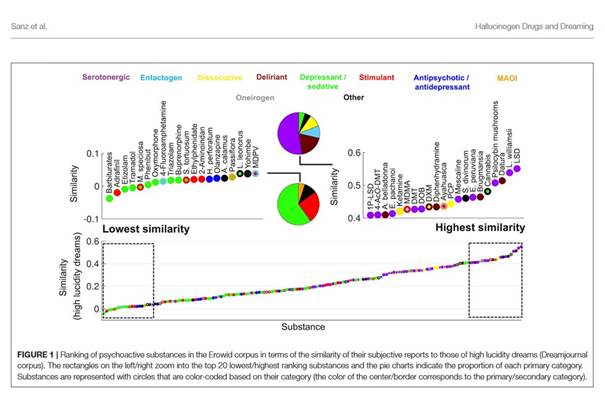
Prompted by the dream the other day I have been having a little look into neuroscience. It seems that there is much interest in using hallucinogens to {perhaps} help with mental health. There is interest in the crossover between dreams and hallucinogenic activity. This from “Frontiers in Neuroscience”.

In the books of Castaneda, don Juan introduces him to peyote (lophophora williamsii), jimson weed (datura) and magic mushrooms (psylocibin). Castaneda describes some of his outlandish experiences whilst off his trolly. Castaneda wrote a book on “The Art of Dreaming” which perhaps tacitly lies aback much of the Lucid Dreaming genre. One could suggest that Castaneda had an effect on neuroscience and the psychology of dreams. If you look at the graph below from the above article the similarity of psychoactive experience and dream lucidity is correlated with the don Juan substances of choice. Only LSD outperforms the “natural” substances. Cannabis comes close. {Man}

When I was ill, I was prescribed the MAOI phenelzine which had no psychoactive effects, as far as I could tell. I had one hypertensive crisis at a business dinner in Japan, something iffy with tryamine in the seaweed. Those Nitrogen atoms look receptor ready…hydrogen bonding to the fore.

“Phenelzine, sold under the brand name Nardil among others, is a non-selective and irreversible monoamine oxidase inhibitor (MAOI) of the hydrazine family which is primarily used as an antidepressant and anxiolytic to treat depression and anxiety. Along with tranylcypromine and isocarboxazid, phenelzine is one of the few non-selective and irreversible MAOIs still in widespread clinical use.”

I used this for probably one year. It is a MAOI to the right of the graph.

I have had limited exposure to magic mushrooms and LSD, over thirty years ago and I stopped smoking week in 1999.

Obviously if one is doing research, it must seem pukka and thoroughly scientific. I doubt anyone acknowledges Castaneda though some may have read him…

The Dreamers IN Time

In his series of books on the Toltec Teachings Théun Mares suggests a model for understanding human nature in which people have various preferences or predilections. These can offer interpretations on behavioural traits, strengths and weaknesses. They could be seen as similar to MBTI types, at a push. At the risk of sounding like the last air-bender, these traits might have the description of earth, air, water and fire. Which are pragmatic grounded, cerebral thoughtful, nurturing watering and passionate fiery.  These are the directions North, East, South and West. We might say that people have a penchant for verbal inquiry {talking} or dream like reflection. We have extrovert (s)talker and introverted dreamer. It is difficult to dream whilst you are busy talking. It is difficult to converse when you are away with the fairies.

There are five types “assigned” to each direction with one “wild card”.

In this schema there are various techniques one of these is dreaming. Logic suggest that dreaming does not pertain to the known as it resists ordering, it flows like water. You dream in something unknown. Fire is ephemeral and not as well understood, so this too is of the unknown, it is unpredictable. Earth and wind are more predictable; these are the relatively well understood or known. We might further assign matter to the North, time to the East, energy to the South and space to the West.

Please note this does not correlate with the physics understanding in common use. Feel the qualities inherent.

Time then is observing the process of life, what happens. Space is understanding the purpose of life, why stuff happens.

In this arrangement the people assigned to the West are called “the dreamers in space”, because purpose is a feeling not a reason. Those in the East are called “the stalkers in time” because reason comes with words and chronology, a time line, a sequence of events, it is more cerebral.

My primary predilection, some would say obsession, is with dreams. I am also introverted. So I would be assigned to the South {dreams, water} an introverted dreamer in the “place” of dreaming.

My secondary predilection is cerebral, logical, thinking, cause & effect reasoning. I am keen on timing and a bit anal about being on time. I have a predilection for the East and eastern philosophy

One could say that I am a dreamer IN time.

I am picking up what may be a shift in that the dreamers of mankind are becoming dreamers in time and less in space. This suggests that dreams are acquiring a more time-oriented manifestation. They are timed to events. There is a shift to the East.

There are more dreamers IN time…

Dreaming during anaesthesia – selected abstracts

—————————————————————-

Dreaming during anaesthesia is defined as any recalled experience (excluding awareness) that occurred between induction of anaesthesia and the first moment of consciousness upon emergence. Dreaming is a commonly-reported side-effect of anaesthesia. The incidence is higher in patients who are interviewed immediately after anaesthesia (≈22%) than in those who are interviewed later (≈6%). A minority of dreams, which include sensory perceptions obtained during anaesthesia, provide evidence of near-miss awareness. These patients may have risk factors for awareness and this type of dreaming may be prevented by depth of anaesthesia monitoring. Most dreaming however, occurs in younger, fitter patients, who have high home dream recall, who receive propofol-based anaesthesia and who emerge rapidly from anaesthesia. Their dreams are usually short and pleasant, are related to work, family and recreation, are not related to inadequate anaesthesia and probably occur during recovery. Dreaming is a common, fascinating, usually pleasant and harmless phenomenon.

Leslie et al.  “Dreaming during anaesthesia in adult patients”

Best Practice & Research Clinical Anaesthesiology

Volume 21, Issue 3, September 2007, Pages 403-414

——————————————————————————-

BMC Anesthesiol. 2016 Aug 2;16:53. doi: 10.1186/s12871-016-0214-1

“Dreaming under anesthesia: is it a real possiblity? Investigation of the effect of preoperative imagination on the quality of postoperative dream recalls”

Judit Gyulaházi et al.

——————————————————————————————-

“The relationship between different bispectral index and the occurrence of dreams in elective surgery under general anesthesia: protocol for a randomized controlled clinical trial”

Yufei Zhang, Bijia Song & Junchao Zhu

Trials, volume 24, Article number: 205 (2023)

Abstract

Introduction

Dreaming reported after anesthesia remains a poorly understood phenomenon. At present, there is a hypothesis that dreaming occurs intraoperatively and is related to light or inadequate anesthesia; thus, in order to further verify the hypothesis, we choose elective surgery under general anesthesia to observe whether the generation of dreams is related to the dose of general anesthetics maintenance.

Introduction

Dreaming is a familiar and mysterious mode of cognitive function, and we involuntarily return to this mode every night. Dreaming during sleep is defined as “any type of cognitive activity that occurs during sleep” and is “a subjective experience that can only be obtained through the dreamer’s memories after waking up.” Despite more than a century of scientific exploration, dreams continue to arouse the interest of sleep scientists, but they are still not fully understood [1, 2]. Moreover, its rigorous scientific exploration is a recent development, dating back to the discovery of rapid eye movement (REM) sleep in the 1950s. When this stage of sleep was first described in humans, researchers quickly noticed that people who awakened from REM sleep often reported dreaming (in 74% of cases, only 17% of non-REM [NREM] sleep). Therefore, dreaming is equivalent to rapid eye movement sleep, and this concept seems to be consistent with the electrophysiological characteristics of this sleep stage: closing the eyeballs under the eyelids, as if the sleeper is watching an animated scene [3, 4]. General anesthesia causes a drug-induced state of unconsciousness and is a non-physiological process that is similar to natural sleep. Its purpose is to create a state of sensory deprivation wherein patients are unresponsive to stimuli and thus leads to explicit amnesia [5]. Dreaming is also a common, long-lasting, and fascinating part of the anesthesia experience, but its cause and timing are still elusive. Patients usually report that they dreamed during anesthesia, but the actual time of dreaming during anesthesia is unknown. Dreaming during anesthesia can be defined as “any experience (excluding awareness) that a patient is able to recall and which he or she thinks occurred between induction of anaesthesia and the first moment of consciousness after anaesthesia” [6]. Patients receiving propofol for general anesthesia often report a higher incidence of dreaming compared with patients maintained with volatile anesthetics [7]. One explanation is that propofol and volatile anesthetics have different pharmacological effects in the central nervous system [8, 9]. Another explanation is that propofol can wake up from anesthesia faster than the volatile anesthetics, allowing patients to report their dreams before they are forgotten [10]. Why is the investigation of dreams during anesthesia important? Dreaming is one of the most common side effects of anesthesia, but it is still puzzling and requires explanation [7, 11]. Dreaming can sometimes make patients feel distressed and may reduce satisfaction with care [12]. Some patients who report dreaming worry that their anesthetic is insufficient; their experience is actually consciousness. At present, there is a hypothesis that dreaming occurs intraoperatively and is related to light or inadequate anesthesia; thus, in order to further verify the hypothesis, we choose elective surgery under general anesthesia to observe whether the generation of dreams is related to the dose of general anesthetics maintenance.

—————————————————————————-

“Dreaming during gastrointestinal endoscopy under propofol, ciprofol, or remimazolam anesthesia: study protocol for a parallel-design double-blind, single-center trial”

    Le-Qiang Xia et al

Trials, volume 25, Article number: 2 (2024)

Abstract

Background

Dreaming sometimes occurs during sedation. It has been reported that factors such as different anesthetics, depth of anesthesia, age, sex, and preoperative psychological state may affect dreams. Ciprofol and remimazolam are novel choices for painless endoscopy. Herein, we aimed to investigate dreaming during gastrointestinal endoscopy under propofol, ciprofol, and remimazolam anesthesia respectively.

Methods

This is a prospective, parallel-design double-blind, single-center clinical trial. Three hundred and sixty subjects undergoing elective painless gastroscopy, colonoscopy, or gastroenteroscopy will be enrolled. Eligible subjects will undergo propofol-, ciprofol-, or remimazolam-induced anesthesia to finish the examination. Interviews about the modified Brice questionnaire will be conducted in the recovery room. Incidence of dreaming is set as the primary outcome. Secondary outcomes include type of dreams, improvement of sleep quality, evaluation of patients, incidence of insufficient anesthesia, and intraoperative awareness. Safety outcomes are the incidences of hypotension and hypoxia during examination and adverse events during recovery.

Discussion

This study may observe different incidences of dreaming and diverse types of dreams, which might lead to different evaluations to the anesthesia procedure. Based on the coming results, anesthesiologists can make a better medication plan for patients who are going to undergo painless diagnosis and treatment.

————————

Discussion

In recent years, the amount of painless gastrointestinal endoscopy has been increasing. It was reported that approximately one-fifth to one-quarter of them experienced dreams during painless gastrointestinal endoscopy [5, 19, 20]. Xu et al. [20] observed that among the dreamers, approximately one-third reported pleasant dreams. Studies have demonstrated that the main factors influencing dreams during anesthesia include the kind and dosage of anesthetics, depth of anesthesia, sex, and preoperative psychological pretreatment [4, 5, 20,21,22,23]. Furthermore, Yoshida et al. [24] found that a less than 11 depression score of the HADS was highly correlated with positive dreams.

In the present study, we intended to investigate dreaming during painless gastrointestinal endoscopy under propofol, ciprofol, and remimazolam anesthesia respectively. The primary aim of this study is to analyze the incidence of dreaming in the three groups. Since the duration of examination and recovery is short, we did not choose complicated scales. Instead, we selected the modified Brice questionnaire which has been widely applied by researchers to determine whether there is a dream or intraoperative awareness [3, 25, 26]. For those who have a dream, patients simply need to tell pleasant, unpleasant, or indifferent to evaluate the quality of the dreams.

To minimize the mentioned confounding factors, we plan to take some measures. First, we will test the HADS for the patients. In this way, some patients with severe undiagnosed anxiety and depression can be excluded. Second, the Narcotrend index will be monitored for its good consistency between sedation depth and propofol or benzodiazepines [27, 28]. Considering that the stimulus intensity of gastrointestinal endoscopy is relatively mild, sufficient anesthesia is defined as grade C of the Narcotrend index. This is similar to a previous study in which no intraoperative awareness was observed even though quite a few Narcotrand values were above 70 [29].

There are some limitations in the study. On the one hand, we do not prescribe a limit to the category of endoscopy. Gastroenteroscopy is more likely to take more time and drugs than gastroscopy. However, these two factors are not the outcome parameters. On the other hand, we do not administer the anesthetics in a continuous way, which may cause fluctuations in sedation. Since it is difficult for us to predict the duration of endoscopy, continuous administration may lead to explosive suppression of the brain. In addition, this is a single-center trial, and multicenter studies are still needed.

——————————————————————————————————

Anaesthesia Dream Therapy

Link Here

Inside the emerging world of anesthesia “dream therapy”

“The amount of interest is enormous,” says anesthesiologist Boris Heifets. “People are dropping in and coming out of the woodwork, trying to understand how to do this.”

Key Takeaways

  • Anesthesia-induced dreams, once considered random side effects, are being studied for their therapeutic potential.
  • Stanford researchers Harrison Chow and Boris Heifets are exploring how these dreams, which often feature hyper-vivid and structured narratives uncharacteristic of “normal” dreaming, may help ease anxiety and trauma.
  • Big Think contributor Saga Briggs recently visited the Stanford team to explore the origins and future of this emerging field — and the curious parallels between anesthesia dreams and psychedelic experiences.

——————————————————————————-

American Journal of Psychiatry Volume 181, Issue 6 ,June 01, 2024

Pages 461-564

ARTICLE

“Reduction in Trauma-Related Symptoms After Anesthetic-Induced Intra-Operative Dreaming”

Laura M. Hack, Pilleriin Sikka, Kelly Zhou, Makoto Kawai, Harrison S. Chow and Boris Heifets

To the Editor: While dreaming during anesthesia is common (1), it is not known whether this phenomenon differs from normal dreaming or has post-surgical benefits. We present two cases of female patients who experienced rapid and sustained reduction of posttraumatic stress disorder (PTSD) symptoms immediately following anesthetic-based EEG-guided intraoperative dream induction. Both patients underwent surgeries and received propofol/opioid-based anesthetics. Upon finishing the surgery but before emergence, we maintained a pre-emergent anesthetic state characterized by specific frontal cortical activity for several minutes: reduced alpha power and enhanced beta power (2). Based on previous findings showing that dreaming during anesthesia is associated with more high-frequency frontal power before emergence (3) or as compared to connected consciousness (1), we believe this cortical activity reflects dreaming while being sedated. Patients were interviewed immediately upon emergence, and both reported having had vivid dreams.

Both patients were identified as part of a quality-improvement program to enhance recovery after surgery, which includes informing patients of the possibility of dreaming without priming content, minimizing likelihood of emergence agitation through use of intravenous rather than inhalational anesthesia, minimal sensory input during gradual anesthetic emergence (4), and assessment for intraoperative awareness and dreaming immediately on emergence using a modified Brice Questionnaire (5). After identification, both patients provided informed consent for retrospective psychiatric diagnostic interviews. Patients were not identified preoperatively. Anesthetic adjustments, assessment, and diagnostic interviews adhere to established standards of care, received approval from the IRB, or fall under IRB exemption (IRB exempt protocols #54043, #59783, #65538, #67245; informed consent provided on IRB protocol #67399).

——————————————————————

Anaesthesia – Antwerp Dream 15-07-2025

This afternoon I had a colonoscopy under general anaesthetic. In recovery I told the woman in charge that this was the first dream I have had and recalled under anaesthetic.

The dream is set in Antwerp something like two hundred years ago. I am as “pony-tail” man though now of a middle age. I am with a young man who is wearing a knitted sweater / jersey he has very light ginger curly hair and a sunny disposition. He is one of my relatives, a nephew perhaps, a younger generation. We are waiting on his friend who has a horse-donkey driven cart. It is very rudimentary. When he arrives, we all set of for the port.

A ship, galleon like in appearance, has just docked from its voyages down the West coast of Africa. On board someone has something for me by way of jewels in a pouch. At the port there is chaos as sailors get off and cargo is unloaded. There are hawkers and prostitutes. We park the cart. My “nephew” is ultra-excited as he knows the man onboard who works with me. My friend descends the gang plank he looks emaciated and very dirty. He sees us. My “nephew” runs towards him and hugs him. I get closer. It is summer so I have only my white blouson shirt on the top half. He has a coat because he now feels the cold of the North. We embrace and I can smell the stench of him. He reaches into his jacket pocket and pulls out a velvet like purse drawn together with a red ribbon. In it I know are jewels, rubies and emeralds. He knows that I will knows who will buy these. He quickly puts the purse back into his jacket so that it is not seen.

I awake as I am being wheeled out of theatre into recovery and am surprised at the contrast to the Antwerp port and cool high technology hospital. The air is odourless. I do a double take.

Mental Health Drop-in Centre Dream 15-07-2025

Here is last night’s dream had during a restless night thanks to the pre-colonoscopy preparation.

The dream starts in a town or city with a West country feel. Maybe Bristol or Bath. There are rolling hills. As I walk amongst the sand stone buildings I see first Simon and then Rob. They are both wearing light coloured “journalist” lightweight “Africa” suits and ties. I meet them each in turn, in passing, and wave to them. They wave back. Each of them is younger than they are now yet older than when I last would have met them. The scene is very “English”. I carry on down a side street and see a small building with white wooden slats. I know this to be a medical office of some kind. Their names with dr are on brass plaques by the door. There are letter boxes and doorbells. I know that this is their practice.

{On writing this I think that it must be Bath because of my association with them there}.

I continue my stroll around the backstreets and come upon a centre, a kind of hippie drop in centre. I know this centre to be for wellbeing, alternative health and mental health. It has a café and meet area. It is held up partially on stilts into the hillside and overlooks the river below. There is a steep path off the road to the main door. I take this path and enter the building.

In the atrium someone is holding a  dance / stretching session. She ushers me to join in with the others. Soon it is clear that I cannot do the moves and say so to her. The class finishes and she beckons me to follow her. I go with her into a room where sat at a table “interview” style are a few other young people, in their twenties and thirties. They are trendy and fashionable with dyed hair and some with piercings. She takes up her position as “chair”. They look me up and own. They are therapists, psychotherapists of some school or other. They are on some kind of mission to heal. They smell of trendy group therapy.

The young woman asks me if I am happy. I ask her what she means by happy. She is smiley and profusive and she says, “you know, just very happy.”

I say to her that I do not recognise the term “happy” as it is an intemperate state, an emotional state which is transitory and illusional. At a push I could describe myself as content. I am no longer striving and, generally at equilibrium, is the best description.

She persists, “but are you happy?”

I look at her and ask, “why would anyone want to be happy, to seek out and strive for happiness?”

A young woman comes in from the front desk and whispers to the chair, “he is here again.”

The chair get up and follows her to the atrium when there is a tall young man dressed in black who is very clearly agitated. The chair motions for him to follow her and they head off to a side room. She is agitated and concerned her happy bubble has burst. She ushers him to sit down, she sits opposite.

I ask him if he is ok for me to be there too. Yes. He is.

I too sit down, near him. He is agitated and fidgeting, looking down at the floor. I can see from her file on the table that he has a red flag for suicide attempts.

I catch his attention. I say that my name is Alan and ask him what his is. He says Mark.

I say, “Mark, can you please roll up your sleeves so that I can see your forearms.”

This he does to reveal a patchwork of self-harm scars, some of which are severe, deep  and blueish.

The woman who has not seen these before lets out an involuntary gasp. I am completely unfazed.

I ask Mark, “when did you last cut?”

He says, “it was last Tuesday but only a little scratch, cos I was angry.”

I ask if he would like me to clean and dress the wound. He relaxes and lets me physically guide him by the shoulder to a kitchen area. He is pleased that he has found me, someone who can listen to him without agenda. He trusts me.

The dream ends…

Anaesthesia Consent and DNR

We do  have some lovely conversations in this house…

I will, early this evening, light the metaphorical blue touch paper for tomorrows procedure. It will be ten years since I had my pT3N0M0 adenocarcinoma removed. 39 lymph nodes were extracted and pathologically examined. Since then I have had numerous colonoscopies. Tomorrow I will have general anaesthetic. I will have another endoscopy. I will be shitting my arse off, tonight and tomorrow morning.

There will be Bastille Day “fireworks” chez nous.

I have to give consent in French and nowhere am I asked if I fully understand. The assumption of comprehension is one of the clinically flawed approaches here, in my opinion. Nobody checks if you understand. It is the kind of detail which bugs me. There are a lot of assumptions in France…the process is trusted. Given the quality of healthcare it might be a good tweak to make it better.

A simple question….Do you {really} understand what I am saying?

In the unlikely event of an emergency I have said that I do not want to be resuscitated if there is a danger of paraplegia or brain death. I now have an anomaly in my ECG…

Karmically if it is time, it is time. DNR, do not resuscitate.

I am anticipating that they will find some polyps which will be excised and biopsied. If the polyps are benign my next day of joy will be scheduled five years hence. If there is a need for a follow up, I will see the chimney sweep again sooner.

This kind of thing reminds you of impermanence…

The best thing is that even with a buzz cut hair cut they make you wear a groovy hair net. I will be 24 hours with no food…having been on a white-bland no-residue diet for three days…

The diet recommendations in France speak of not eating escargot, not a problem for me. The UK ones say that you can have plain naan and chapatti…

I have manged to do a “white” curry without onion or garlic, which was passable…

Pizza is on the menu for tomorrow evening with crisps….to follow…