Tibetan Phrase Dream Follow up

“I start out on my route and part the way along in or near Mongolia I am given two white plaques of an irregular shape. Phonetically these plates speak in the dream. They say, “Mon yet {yat} Dzong” and “Sprul yet Tsaay” I can see the associated Tibetan script but cannot associate it directly with the phonetics.”

ཡེ (ye, “primordial”)

Ye{t} could have been je or jay

DEFINING THE TERM MON

According  to  Neeru  Nanda  in  her  article,  “Monpas  in  their  borderland-A  historical  review”  she  stated  that  the  Monpas have a local saying that; “We are neither of Gyasar(Tibet) nor of Gyagar(India),we are the Mon”. The Monpa tribe of Arunachal Pradesh represents the dominant ethnic group of the region. The term Monpa meaning someone from Mon, is used either for people living in the region of Mon or for someone who is of Mon, irrespective of region. The term Monpa or Mon are hence used as a blanket terms by Tibetan to designate certain neighbouring region or people situated to the south. In many Tibetan writings, Mon, Monyul, Lho Mon or Shar Mon refers to a region, specifying a location mostly to the south of Central Tibet. According to early Tibetan sources, Monyul is situated in South Tibet, it was also known as Lho Mon, the southern belt of Tibet before the emergence of Kingdom in Bhutan and Sikkim Lho Mon was reffered to the people who lived in south Tibet. According to the historical sources of Bhutan, Sikkim and Tibet Lho-Mon is referred to as the inhabitant of south Tibet  which  includes  Bhutanese  and  Monpa.  Lho means south in Tibetan and Mon means people inhabiting in the region. Old Mon is largely connected to an area, which includes the whole of Sikkim state, Bhutan and the Mon region i.e. the Tawang and West kameng district in the westernmost tribe of Arunachal Pradesh.

Old Mon even included the southernmost counties of Lhoka and Shigatse Prefectures, such as Mon Tsho sna and Mon Gro mo in the TAR, which are adjoining border areas to Sikkim, Bhutan and Tawang district . Besides the description of the Monpa people of the Mon region as a “Scheduled tribes” in the state of Arunachal Pradesh, the term Mon is also widely used in other parts of the Himalayan region. Presently from the eastern Himalaya to the western Himalayas, Mon or Monpa is used as an unspecific meaning of an ethnic group. In the case of the eastern Himalayas, it is used in Bhutan, Sikkim and adjoining district of the west Bengal state. The trend of differentiating these regions as being not referred to Mon prior to the eighteenth century is strong in contemporary writings from the region.

Presently in Bhutan, Mon refers to an ethnic group living in the south-central districts and to a cluster of villages in Monmola  Trashithangyed,  Chiwog  of  Serthi  Gewog  region  in  the  Samdrup  Jongkhar  district.  In Sikkim and  n  the  adjoining district, Mon is referred to the region as well as to the Lepcha tribe and other ethnic group in the region.In the western Himalayas, the region of Ladakh and Kargil of Jammu and Kashmir as well as Lahaul, spiti and Kinnaur areas of Himachal  Pradesh,  Mon  and  sometimes  Mon pa  represent  group  of  sedentary  musicians  who  are  situated  low  in  the  social hierarchy. This lower social status of Mon is further recorded in Baltistan of Pakistan. The usage of term mon is also found in Central Himalayas region, where the upland hill people called or named their southern valley neighbours Mon.

The historical understanding of the different key term Mon, in its ancient and orginal term Man, is applied by the Chinese to several ‘barbarian’  groups  related  to  the  ch’iang  including  the  people  of  rGyal  rong.  The term is found in Tibetan text of the eighth and ninth centuries in the forms of Mon and Mong, and thereafter it is applied to all kinds of groups throughout the Himalaya with whom the Tibetan come in contact. The term lost any specificity it might once have had and came to mean little more than ‘southern or western mountain-dwelling non-Indian non-Tibetan barbarian’. The present range of term must have had its first impetus in a movement from the east to the south-east, and the affinities noted above incline one to look for the main point of secondary diffusion in the centre and east of ‘proto-bhutan’; not only the language but also some of social institution peculiar to the area may have served to link it in Tibetan eyes to the true Mon of rGyal rong.  The old towers  and  fortresses  in  the  Sino-Tibetan  marches,  the  mong-dzong  of  the  Nam  text,  are  parralled by many such building which have disappeared or lie in ruins in central and eastern Bhutan and in Kameng .

Sangey Phurpa, Rajiv Gandhi University

Journal of Visual and Performing Arts June 2024 5(6), 1889–1893

————————

“Sprul yet Tsaay”

At a push yet {yat} tsay could be yantse

—— Sprul {emanation} from (g)yantse

About Gyantse Dzong

Gyantse Dzong is a historic fortress perched majestically on a hill overlooking the charming town of Gyantse in Tibet. Gyantse Dzong, also known as Gyantse Fortress, is a symbol of Tibet’s rich cultural heritage and a testament to its strategic importance in the region’s history. You can trek to the top of Gyantse Dzong and overlook Pelkor Chode Monastery.

Dating back to the 14th century, Gyantse Dzong served as a military stronghold, administrative center, and royal palace, playing a crucial role in the defense of the town and surrounding areas. The fortress’s imposing walls, watchtowers, and strategic location offer a glimpse into Tibet’s past as a land of ancient kingdoms, epic battles, and enduring traditions.

Gyantse is often called the “Hero City” by local people, because of the determined resistance of the Tibetans against far superior forces during the British invasion of Tibet in 1903 and 1904. It was a slow and bloody massacre of hundreds of Tibetan people, who were only equipped with antiquated matchlock guns, swords spears, and slingshots at that time. What they faced were Maxim machine guns and 10-pound cannons.

As you wander through the corridors and chambers of Gyantse Dzong, you will encounter relics of the past, including ancient murals, prayer halls, and artifacts that speak to the fortress’s role as a center of governance and spirituality. The peaceful ambiance of the fortress, coupled with its commanding presence against the backdrop of the Himalayas, creates a sense of awe and reverence for the history and heritage it embodies.

Whether you are a history enthusiast, a cultural explorer, or simply a traveler seeking to immerse yourself in the beauty and legacy of Tibet, a visit to Gyantse Dzong promises a memorable experience filled with insights into the region’s past and the enduring spirit of its people. Join us on a journey to Gyantse Dzong and discover the stories, legends, and architectural marvels that make this fortress a cherished landmark in the heart of Tibet.

—————————–

Gyantse, officially Gyangzê Town (also spelled Gyangtse; Tibetan: རྒྱལ་རྩེ, Wylie: rgyal rtse, ZYPY: Gyangzê; simplified Chinese: 江孜镇; traditional Chinese: 江孜鎮; pinyin: Jiāngzī Zhèn), is a town located in Gyantse County, Shigatse Prefecture, Tibet Autonomous Region, China. It was historically considered the third largest and most prominent town in Tibet (after Lhasa and Shigatse), but there are now at least ten larger Tibetan cities.

Wikipedia

—————-

“Sprul yet Tsaay”

Ye-tsaay

Wisdom of the emanation?

Or emanation of wisdom?

—————–

ɕ is a sshh sound

ཡེ་ཤེས

Tibetan Etymology

From ཡེ (ye, “primordial”) +‎ ཤེས (shes, “to know, understand, realise, cognise”).

Pronunciation

    Old Tibetan: /*je.ɕes/

    Lhasa: /ji˩˨.ɕi˥˨/

Noun

ཡེ་ཤེས • (ye shes)

  • wisdom, awareness, knowledge
  •   (Buddhism) jnana

Proper noun

ཡེ་ཤེས • (ye shes)

    a unisex given name, Yeshe

From Wiktionary
Hokkaido – Golden Pins – Tibetan Phrases – Road Trip – Dream 07-02-2025

Here is this morning’s dream had between 4 and 8 AM.

The dream opens in Japan specifically Hokkaido. I am indoors in a hectic setting, a kind of big event hall. I am competing in a game which is part physical plane sprint racing and part abstract computer intelligence game. Each round is set off by a buzzer and the contestants have to make their way to the finish line within the context of the duality. In the booth next to me is a tall slim Japanese man. The buzzer sounds and the race begins. In both scenarios he just beats me. I come second in the race.

We both go over the left of the finish line in the computer world and in the thing which holds up the finish flag are the positional pins. We each select a tiny golden micro-pin which has the positional letter. My pin ends in a golden 2, his a golden 1. I place the pin in my shirt pocket on the left hand side of my chest. The race repeats several times and each time the result is the same. I soon have quite a collection of golden two pins in my shirt pocket. The “competition” finishes.

I am then walking through a busy brightly lit mall. I am in a food court in which various Japanese food outlets are selling street food. The atmosphere is pungent and very lively. The food on offer is highly coloured and from around the globe. I cannot decide. I walk over to a burger joint and a Japanese woman asks me what I would like. It is her job to serve me and be of assistance. She is very friendly, lively and with excellent English {UK}. I say that I would like a small burger and fries and for her to surprise me. She brings my food over together with a large bottle of top-end Japanese spring water. She sits next to me and helps me to eat.

I go back to my rooms; they are executive and above parr. I am unsure as to what to do next. I have no return flight. So, I start to look up flights from Sapporo to Queensland Australia. The Idea being that I land in Townsville or Brisbane and buy a second hand car to drive to the Isa {Mt Isa}.

I pause and take a stroll. Outside in the car park is my ex-wife. She is in a beat up camper van and I can hear her snoring. The van is a mess. I go back inside. She knocks on the door. I open it. She asks how I am coping with the water. Just fine. She says that she had problems getting served at the food court and did not like the tap water. I say that she probably had problems communicating. With the Japanese it is very important to listen. If you don’t listen carefully to what they say they consider you rude and vulgar. I say that listening was never one of her skills. I point to the bottle of top-end spring water on the side and say that she can take it back to her camper van, her brumby. This she does…

I hear the song from Men at Work, I come from the land down under, “travelling in a beat up brumby”.

I decide against going to Queensland.

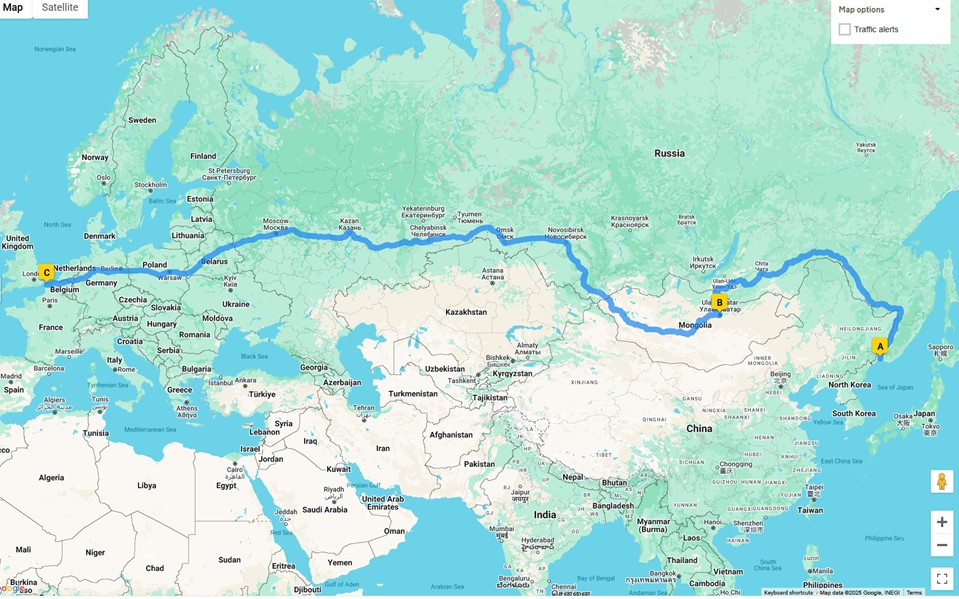
Instead, I must take a road trip. I see in my minds eye a map showing Hokkaido and Sapporo with mainland Asia and Vladivostok. I know that I can easily get a boat to Vladivostok and that I could drive from there to Wiltshire. I resolve in the dream to look up a route on AA route planner when I get up. I know that I must go via Mongolia and that it will be a long trip.


Here is AA Router planner route Vladivostok to Calais. Distance ~ 8000 miles.


I start out on my route and part the way along in or near Mongolia I am given two white plaques of an irregular shape. Phonetically these plates speak in the dream. They say, “Mon yet {yat} Dzong” and “Sprul yet Tsaay” I can see the associated Tibetan script but cannot associate it directly with the phonetics.

The dream ends

————————————–

Sprul

The concept of tulpas has origins in the Buddhist nirmāṇakāya, translated in Tibetan as sprul-pa (སྤྲུལ་པ་): the earthly bodies that a buddha manifests in order to teach those who have not attained nirvana. The western understanding of tulpas was developed by twentieth-century European mystical explorers, who interpreted the idea independently of Buddhahood

——-

1) Trulku (in Tibetan: sprul sku) — Literally the “emanation body” of a buddha. In a Tibetan context, a trulku (often given the epithet rinpoché, “precious one”) denotes the chosen reincarnation of a lama of high spiritual stature. A trulku usually inherits his (or her) predecessor’s prestige, wealth, and institutional seat. Important trulku lineages include the Dalai and Panchen Lamas and the Karmapas, who originated the tradition in the thirteenth century

2) sprul sku (སྤྲུལ་སྐུ) (Tibetan; in Sanskrit: nirmāṇakāya) — (lit. “Emanation body”) — Within the compass of the formbody, the aspect of a buddha that appears for the sake of ordinary sentient beings. A single buddha may manifest multiple emanation bodies, which may be in human, animal, or inanimate form. The “historical Buddha” Śākyamuni is generally regarded as an emanation body. The Tibetan term for emanation body, trulku, is used to designate a deliberately reincarnated lama

Sprul

སྤྲུལ་ send forth an emanation; emanate; emanation

————————–

Mon

མོན་

Bhutan; Mon, a district in Tibet

Mön

Mon. Name for lands to the south and southwest of Tibet

Dzong

Dzong (Tib. རྫོང་, Wyl. rdzong) — literally a ‘fortress’, the equivalent of a monastery in Bhutan.

—————————————————————-

Le dzong du Bhoutan est un monastère-forteresse bouddhiste caractéristique du Bhoutan.

Les premiers dzongs furent construits dans le pays dès le XIIe siècle, mais leur âge d’or fut la première moitié du XVIIe siècle qui vit le renforcement défensif du pays par le shabdrung ou grand lama Ngawang Namgyal (1594-1651), l’unificateur du Bhoutan moderne.

The Slippery Slope to Totalitarianism

Postulate:

Humanity has a short memory and fails to learn from the past.

————

————-

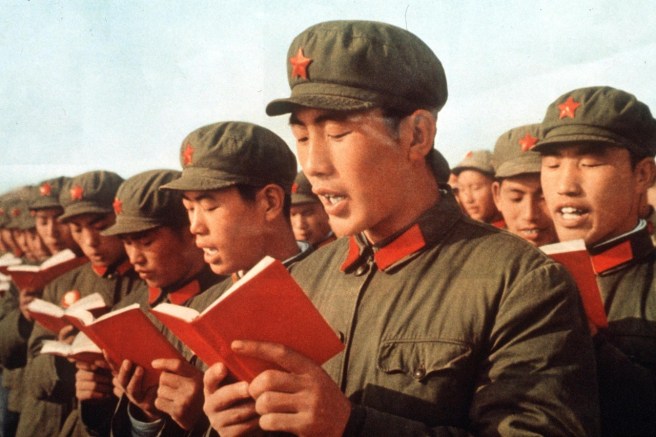
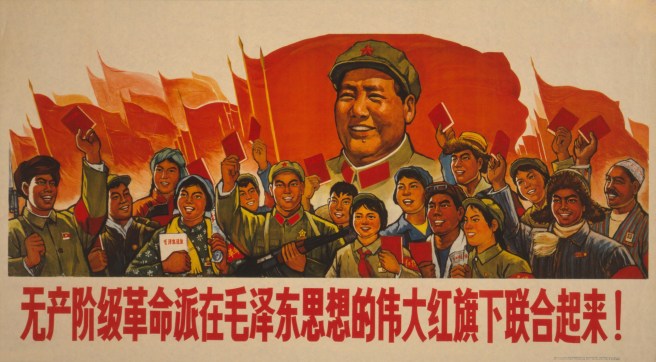
The Cultural Revolution, formally known as the Great Proletarian Cultural Revolution, was a sociopolitical movement in the People’s Republic of China (PRC). It was launched by Mao Zedong in 1966 and lasted until 1976. Its publicly stated goal was to preserve Chinese socialism by purging remnants of capitalist and traditional elements from Chinese society.

In May 1966, with the help of the Cultural Revolution Group, Mao launched the Revolution and said that bourgeois elements had infiltrated the government and society with the aim of restoring capitalism. Mao called on young people to bombard the headquarters and proclaimed that “to rebel is justified”. Mass upheaval began in Beijing with Red August in 1966. Many young people, mainly students, responded by forming cadres of Red Guards throughout the country. Quotations from Chairman Mao Tse-tung became revered within his cult of personality. In 1967, emboldened radicals began seizing power from local governments and party branches, establishing new revolutionary committees in their place while smashing public security, procuratorate and judicial systems. These committees often split into rival factions, precipitating armed clashes among the radicals. After the fall of Lin Biao in 1971, the Gang of Four became influential in 1972, and the Revolution continued until Mao’s death in 1976, soon followed by the arrest of the Gang of Four.

From Wikipedia

———–

The first step towards totalitarianism is to purge those who are against you and promote loyal brown nosers and supporters. Sycophantic yes-men are preferred over anyone who queries even if said queries are wise.

The intelligentsia must be crippled and undermined, democracy called into question and belittled. Propaganda is more important than fact. Short adamant statements hook and are preferred over detail.

Any voice to the contrary must be silenced, preferably in public and painfully so.

———-

———-

Postulate:

The cult of the personality is on the rise in humanity at large.

Substance and ethics are demoted and no longer important. Mini-me types are cloning themselves. We are sleep walking into very retrograde times.

People are easily drawn into group mind which prevents true thinking. Grievance can be exploited to garner support. Give someone an enemy and they will fall in behind you against them. Enemies unite rabbles and crowds.

—–

—-

Postulate:

Humanity has an anathema for inconvenient truths.

Humanity prefers any story or “plan” which means that they do not have to change their ways. If someone says that anthropogenic climate change is exaggerated that is easier to believe, because they want to. There is confirmation bias. People prefer to stick their heads in the sand rather than change. The bringer of messages which go against the inconvenient truths is a hero, a friend, “I told you so!”

Goebbels comments here on the power of mantra, the repetition of which can be black magic.

Postulate:

There is no such thing as a sustainable quick fix, this is an inconvenient truth.

Immediacy does not solve anything, knee jerks are never considered they are at best reactive.

Focused blame cultures and look-at-me attempts to fix “single-issue” problems are misguided if popular. It is easier to blame external factors than to accept responsibility and work hard at root cause.

Postulate:

China and Russia were never communist despite finger pointing to the contrary. They were / are totalitarian or authoritarian at best.

The bogey man of communism is an American invention, it has never been realised. Western quasi-socialism of the last century is the closest humanity has come to that ideal.

Postulate:

The cult of the personality is a very dangerous and a slippery slope. This too is an inconvenient truth.

There are numerous examples of this cult currently active and perhaps growing in the so-called democratic West. People can get easily caught up in the faux-euphoria of group mind and its sense of belonging.

Narcissists however have absolutely zero notion of loyalty and are fickle, motivated only by their own desires. Supporters are not shown the loyalty expected and demanded of them.

Postulate:

Humanity is again on the slippery slope to widespread totalitarianism pretending to be democracy.

Coypu and the Lotus Wars

It is very important that the lotus grows out of the mud, the mire, and strecthes its radiant head above water to soak in the solar bounty.

Here is the Heron recorded after dawn. In the pond you can see the proto-lotuses starting to form. They are to the top middle of the video.

Turn the sound up to hear the birdsong….

We finished reinforcing the wire fence yesterday. But, here is Moma Coypu coming from the left up from the river. She disturbs the witness sticks…

She is joined by junior coypu, who heads off in the direction of the lotuses for supper…

After dining junior comes back to Moma and she grooms the little bastard.

About and hour or so before dawn Moma heads back in the general direction of the river.

If you listen carefully you can hear an owl.

Somehow they are getting though the electric fence. I’ll put the camera out to observe and will probbaly make a five strander. The toad migration has started and unfortunatley we electrocuted a female toad the other night. I need to make sure there is good clearence at the bottom…

Kabwe – Tuskers – Dream Follow Up

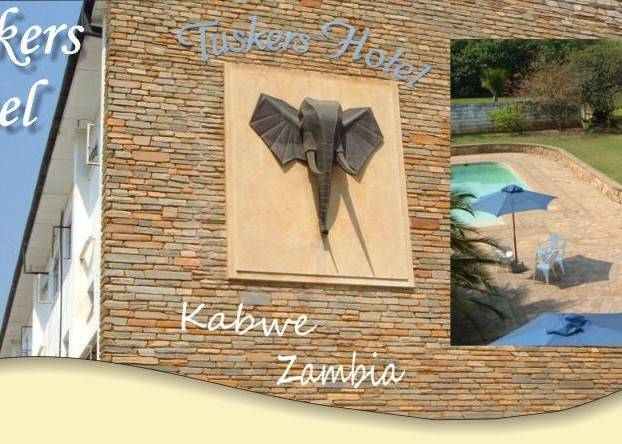
I have not long watched a shaky video on YouTube of someone going into the Tuskers Hotel in Kabwe Zambia. It was weird given that I have not seen the place since well before 1978. But I recognised the restaurant immediately. We went there with a buddy of my father from Mount Isa. A woman moistend her nipple and stuck it in the sugar bowl thence to feed her child. My father’s friend was {apparently} a closetted homosexual and very shocked.

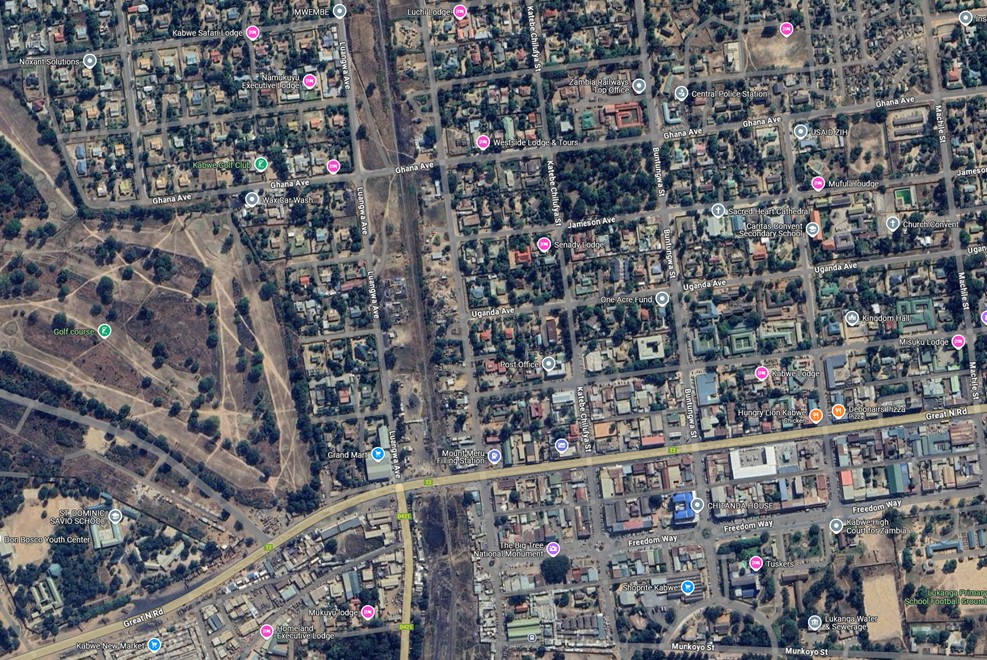
Here is a satellite image of a part of my old world from Google maps. You can open the image in another tab.

To the top left you can see a pink flag, Kabwe Safari Lodge. We lived two houses to the left on the opposite side of the street. You can still the vegetable garden which Tembo, the gardener made. Tembo is swahili for elephant.

Bottom left is the golf course where during the school holidays back from school in the UK I played golf most mornings.

It was there that I had Rock Shandies. I have had a few of late. I have just ordered some Angostura Bitters on line.

To the upper mid right you can see a grey flag with a cross in, Sacred Heart cathedral. To the right of that is the convent scool I attended for a few months in mid 1974.

Bottom right is a pink flag Tuskers which was, I think, the Hotel Intercontinental once.

In the middle right is a violet flag, the big tree national monument. A baobab under which people met and held markets. They used to do haircuts there too. I had my hair cut there prior to the photo on the quantum dreamer picture taken at the Lusaka high commission just before my tenth birthday.

Tuskers is only a few blocks from my old house about one kilometre away.

Zambia – Father – Royal Family – Golden Orb – Dreams – Dream 05-02-2025

This dream came as a series of sleep-wake cycles.

The dream opens in Kabwe Zambia. I have come to reclaim the body of my father who is lying in the “mines” medical facility. He is on a morgue trolley under a blanket. I have to sign a chit for his release so that he can be repatriated. Once I have done this, I can take him away in a wheelchair. I do this and wheel him around town for a last look, during this he appears to be conscious and interacting with the environment. Kabwe is much more metropolitan and modern than I remember. I take him back to the facility so that he can be shipped.

I have a sudden realization that I must get to Lusaka, so I go to the now modern train station. The train leaves at 40 minutes past the hour. I have just missed one. I go into a coffee shop / bar to try to arrange a hotel for when I arrive in Lusaka. Unusually for me I get out a smartphone and look for hotels. I find one. I ask the owner of the bar if she has heard of it. She a white woman with a slight Afrikaans, Cape Town, accent says yes. It is her sister who runs “Tuskers” an elephant themed hotel / restaurant near the train station in Lusaka. It is a sister hotel. I say that I like elephants.  She arranges a booking and offers me curry from the buffet in her bar.

I awake.

A Google search reveals that there is a Tuskers Hotel at Butungwa Street PO Box 80942, Kabwe 60100 Zambia. It is near the Big Tree Monument, and I have been in that hotel as a child when it had another name.

I drift off.

I catch the train to Lusaka. It is modern and there are loads of young people on their devices. I arrive at my hotel and get installed. Prince William the Prince of Wales is there, and he wants me to accompany him on his tour of schools in the area and then to go with him to the Okavango Delta. He has very fond memories of his time in Africa before he had too much responsibility and it all got so complex. William is hyper enthusiastic and gets a great reception at the schools. He asks my opinion on each establishment after we have visited. He brings excitement into their lives. It is uplifting.

I wake up

I drift back off.

I am now in the UK if feels west country maybe Gloucestershire. We are walking along a private path / road on an estate. It is tree lined, and autumnal. William is introducing me to Catherine and George. George is a little intense and kicking leaves. I say that I used to have the nickname George when I was a teenager. He then relaxes slightly. William explains that George has many questions which he would like to ask me. I say that I am happy to try to answer. Back in a drawing room of sorts George goes off and comes back with something in his hands.

He shows me an aspherical golden orb. It is about the size of a large potato and it is like an elongated, squashed sphere. There is an inlay in a darker coloured gold wrapping it in a cross bottom and top and all around the long “circumference”. It is clearly hollow and there is something inside. He asks me to take a look at it and hands it to me to inspect. I know that there are other artefacts in the series and that he is not telling me any background information.

I say that we need to think carefully about how we approach this. He nods.

I awake

I drift off

William, Catherine and I are now once again outside on the path. William tells me that Catherine is still fragile after her ordeal and that her mood fluctuates.  He says that she would like to talk with me about her dreams which have been plentiful. They are linked to George, and she senses they are of the same puzzle. I say to them that I would be very happy to talk about dreaming and dreams, subjects close to my heart. Catherine smiles and sighs in relief. William says that he is very happy for me to do this, in private, but I must undertake to keep him updated on a regular and thorough basis. This is because there are many things pertaining to royalty about which I am unaware. He is more concerned about Catherine than George, because of the blood, implied royal in George.

The dream ends and I think WTF.

Impossible Conversations – No Context

One might say that I am an initiate of a certain degree in the church of physical sciences. I have a bachelor’s degree and a doctorate from a kosher university, I was at one time a member of two professional learned societies and they even let me teach for a decade or so. I have an albeit rusty context of how UK academia works. I was able to write and secure a quantum optics patent whilst “retired” and well away from the hurly burly. There is no chance that I could teach at undergraduate level these days, I might still be able to do some fancy-schmancy laser experiments. Were I to encounter someone from that world I could at least have a go at conversation, even though I no longer share the ambition or goals. There would be at least a partial context in common.

That background was held in suspicion on various courses such as foundation shamanic and I Ching. When I stayed up all night and kept the camp fire going in the middle of a wood, the would be shamans accepted me more freely. I was perhaps more rigorous and less angel-reiki-fairy. Perhaps more American Indian than they from the home counties. If you have never been in a drumming circle you have no idea what goes on there.

As a thought experiment imagine me sitting down with a university professor who had a reputation for top end molecular spectroscopy and the use of ab initio quantum calculations to elucidate intermolecular interactions and bonding. This was something that we once shared.

“Well, it has been a long while. From time to time, I see your articles. Since we last met at lot has happened to me. I have learned of a number of my previous incarnations and all the evidence points at me being a three pronged dreaming nagal of the elephant dreaming class, I am a dreamer by prediction and have been doubly severed.”

I suspect that I would have lost the professor in and around the previous incarnations bit. He was a Christian and fairly devout. It would be impossible to convey to this intelligent man what the last sentence means. I remember him as being philosophical and open minded. He could take it at face value being polite.

But where would you begin? If you read these books about Toltecs, I can visit you again in a couple of years and try to explain.

The chances are that there would be not much purpose in trying to explain. That sentence is of a different world and next to impossible to verbally contextualize. His eyes might glaze over.

So, I might change the subject and say I really enjoyed his paper on mass resolved rotational coherence stimulated Raman ion dip spectroscopy for large molecules without an absorption transition dipole moment. I would be back in context and even though I am rusty we could have an intelligent conversation which would be above the heads of many people who have never even heard of these things. I would be talking arcane chemical physics with a world expert. I still have residual arcane spectroscopy knowledge.

There are some conversations which are impossible if there is no shared context. Two ships might pass in the night oblivious of each other. Sure in their world, convinced of their reality and unaware that there are more than one reality.

Ghost Residues – The Unexplainable

Scanning back through the collection of dreams I have quiet a few with big “cheeses” in, people of historical and cultural import. To my knowledge I have never met any of them on the physical plane. The trajectory of my life turned away from any which might have led me to even come close to contacting them.

My claim to fame is that I once worked in a pub now owned by Rita Ora’s dad. I have met en passant a number of science Nobel laureates and I knew two people who were presidents of learned societies. But that is about as far as it goes. My uncle got an MBE from miliary intelligence during the Malay insurgency, a fact which impressed my housemaster at prep school. He told me Colonel Rees was coming to see me; I had no idea that this was my dad’s half-brother. I did not recognise the surname. I got quizzed by army wives at his funeral, only now do I sense that they may have had intelligence roles too.

There is no readily explainable reason for why I get these “famous” geezers in my dreams when examined from my life circumstance here in the compound. Stretching things past the elastic limit there is a near vanishing possibility that I am under surveillance, given dream content. For some reason that is connected.

There was once, perhaps, a very small possibility that my life could have had wider physical plane significance. So, there may be tiny faint residues of that trajectory left in the web of life. A path not taken leaving an ethereal track in the fabric of maybe. That track, those tracks, somehow leaks into the dreaming.

I am not mithering about these things. Of a night we watch some telly and maybe do a quiz. At the moment we are doing university challenge re-runs. Dependent upon the questions bias I can get anything between two and a dozen questions right. Each morning, I empty the coffee grounds, check what the coypu have been up to and feed the birds. Every afternoon we feed the stray cats and top up the birds.

It is so far removed from famous geezer land and hamster wheel dizziness.

Why then do I have dreams with prime ministers, presidents and high lamas?

I can’t explain it.

Who might crop up tonight, we shall see…

Alexander Boris de Pfeffel Johnson Dreams 03-02-2025

Here is last night’s sequence of dreams. I made no attempt to rejoin the dreams on waking but this is kind of what happened. I awoke multiple times and can think of no obvious reason, this side of the channel, why BoJo should pop up.

The first part starts on a beach which has sand dunes behind it. There are a number of people on the beach and the weather is clement though not hot and sunny. I hear some vehicles pull up and some shouting. Men darkly clothed and armed with Kalashnikov assault rifles are charging the beach firing. I shout to everyone to get into the sea and swim as far out as they can. Bullets are ripping into the water as we get further out to sea. I can see dead on the beach and blood in the sea.

There is a strong tide forcing us up the length of the beach. I encounter Boris who has been swimming there. We are being forced towards a rocky part at the end of the beach. There is no way around the headland, and we are forced to land one the beach. I say to Boris that he must resist the temptation to say who he is and to try not to give the terrorists a piece of his mind. There is an off chance that they won’t recognise him, and we should save that for later should we need it.

I wake up

The next section starts in an underground cave. We are clearly in a hostage situation. The cave is equipped with computers, cameras and much media kit. The terrorists are partially masked and clearly highly organised. The hostages me included are now dressed. Boris and I are at the back of one cave with two young boys. I have suggested to Boris that he keeps a low profile and minimise the risk of being recognised. The terrorists have installed a huge TV, and we can see that there is a media circus on the dunes. There are multiple religious groups amongst the hostages, and we are international.

Boris starts to chat with the young boys. One of them says that he can see daylight coming into the tunnel. Boris suggests that he quietly investigates. Which he does. There is a gap. Something kicks off in the main terrorist room. Sending the boys first we attempt to leave the tunnel. Boris manages to bash his head and although a little dazed we make it out into the sunlight.

I awake.

I am now walking with Boris towards a semi-ruined church. I know that inside there are Buddhists keeping vigil for those held in the hostage taking. Unusually these Buddhists are wearing grey robes and are mostly Western. I knock on the church door and am welcomed in by a Buddhist “priest”. I explain what has happened and who Boris is. The man sits Boris down and tends to a slight wound on his head with some cotton wool and water. The atmosphere in the church is calm and tranquil.

The priest asks Boris for a number to call for people to come and get him. Boris takes the ‘phone and calls for help.

I awake.

I am now sitting in a room with Boris and Carrie. I explain to Boris that, he is like me, a Wood Dragon by birth and that we are contemporaries. I say that if he really wanted to be world king, he should have stuck with Alexander which is more regal than Boris. I ask him if there are any umlauts in the spelling of his name because I may do his numerology.

I say that he is a lot fitter than me. He says that downstairs in a bottle is some fat which he has had sucked out of his body and that accounts for it. I know he is joking. I explain that although we both can see bigger pictures, he as an ENTP is very different from me as an INFJ.

I awake again and wonder what the bloody hell has Johnson been doing to be in and out of my dreams all night.

The Glamour of Secret Knowledge

In the film “Bullet Proof Monk” a bunch of Nazis go to what looks like Tibet in order to gain a magical scroll which will grant them secret knowledge and near super-powers. The ageing guardian of the scroll is shot in the raid and the burden of keeping it safe and secret passes to a younger monk. There is a magical transference of sorts.

In real life an SS sponsored mission did go to Tibet in 1938-9 and the lead, a Dr Schaefer, was interrogated at the end of the war by USFET Military Intelligence

———————————-

Tibet Explorer & Scientist With SS-Sponsored Scientific Institutes
(Including Answers to USFET Special Interrogation Brief No. 104)

United States Forces – European Theater
Military Intelligence Service Center
APO 757 Final Interrogation Report (OI-FIR) No. 32 Feb. 12, 1946
.

Schaefer was a member of Das Ahnenerbe, the organization founded by Himmler in 1935 to investigate a variety of scientific and pseudo-scientific problems raised in Germany following the Nazi ascension to power. He belonged also to the Freundeskreis, which included many high SS leaders and German industrialists. Through the success of his last Tibetan expedition of 1938-1939, which was sponsored mainly by Nazi organizations, Schaefer became an outstanding representative of National Socialist science and of considerable propaganda value for the SS. After his return to Germany from this expedition, he was welcomed personally by Himmler. Subsequently he headed the following three scientific organizations: the Sven Hedin Institute, the Instruction and Research Foundation for Horse-Breeding, and the Instruction and Research Institute for Plant Genetics, all of which were connected with Ahnenerbe.

Now he claims that he used the SS solely to obtain the means for his scientific work. He is very helpful in all matters which do not involve himself, and his statements seem to be reliable. The information contained in this report has been confirmed by Miss Friedlieb of Homburg and Mrs. Lehmann of Frankfurt Ginbach, Schaefer’s former secretaries, who were interrogated at their homes.

———————-

Schaefer was able to correspond with Reting Rinpoche the regent of Tibet and the Nechung Oracle who was relatively new to the post Ta Lama Lobsang Namgyal. The oracle had been involved with the finding the 14th Dalai Lama in ~1937.

All of whom are characters in the film Kundun.

The photo of the oracle on Wikipedia is Schaefer’s. So, he must have been very welcome if he was allowed to get close enough to photograph. See the text caption.

It is reported that he took back to Germany a copy of all 108 volumes of the Tibetan canon, the Kangyur.

———————————

Out of a fact often comes extrapolation.

There are many stories about Hitler and his interest in the occult and esotericism. In my experience Germanic efficiency is efficient and organised. It is likely that Hitler and his nasty pals, if they were interested, would have kept records, archives.

People who lust after power also lust after short cuts. It is pretty obvious that Hitler did not bat on the same team as Jesus. It is not a stretch to deem him evil, a nasty piece of work.

So, what happened to Hitler’s occult archives, did they find their way to Moscow, were they shipped to Argentina or Brazil, or did they go to US or UK intelligence services?

The problem is that a scroll or a document cannot grant its owner, whether rightful or not, powers. The guide book, the grimoire needs practice and skill. To wield “magic shit” the person needs discipline, training and practise. There is probably no “ta-dah” moment when some talisman or other grants powers. Life is not like that. Even dark power must be earned. There is no fairy god mother.

The idea of secret knowledge, the holy grail, is salacious to humans. This is because people are lazy. It is very glamorous and makes for entertaining movies. The more secret something is the more exciting it is, for some. Knowledge from the past unearthed by Harrison Ford or Angelina Jolie is unlikely to change the balance of power geo-politically. Magic from the days of Atlantis is best kept buried beneath the waves which it called forth.

It stands to reason that there will be some surveillance of things like the occult. The USA even had a programme looking into “Remote Viewing”. On the off chance that telepathy, telekinesis and things like remote viewing work it would make sense to keep an eye on them. Even if that eye is sceptical.

What are the crazy mystical Russians doing?

Why did China invade Tibet the home of the so-called Masters of Wisdom?

China has a long occult history.

What exactly are in the vast Tibetan libraries?

It is said that knowledge is neutral. It can be used for good or evil dependent upon the user.

If people were not interested in “secret knowledge” Harry Potter would have been a flop.

Secrecy is exciting for some; it hints at power over others. But secrecy leads to darkness and in the darkness strange things grow…

Humans struggle to resist temptation…